

 United Kingdom (UK)
 United States (US)
 Canada
 South Africa
 India
India Australia
 New Zealand
 China
China Russia
 Germany
 France
 Spain
Spain Netherlands
 Vietnam
 United Arab Emirates
 Italy
Italy Poland
 Thailand
 Türkiye








 Algeria


What is classroom engagement? A TEFL teacher’s guide
What is classroom engagement? A TEFL teacher’s guide

TL;DR:
- Classroom engagement involves behavioral, cognitive, and emotional involvement that enhances student success.
- Active, student-centered teaching methods significantly improve participation, motivation, and language retention.
- Strategies must be flexible and culturally responsive to effectively engage diverse learners and manage classroom dynamics.
Classroom engagement directly predicts student success in measurable ways. Students in high-engagement environments show 25% higher grades, 30% lower dropout rates, and 42% higher graduation rates compared to their less-engaged peers. For TEFL teachers, this is not an abstract concept. It shapes every lesson plan, every activity choice, and every interaction with learners who are navigating a new language. Yet many new educators conflate engagement with compliance, or assume a quiet class is an engaged one. This guide clarifies what classroom engagement actually means, what the research says about its impact, and how TEFL and ESL educators can build it deliberately across diverse learner groups.
Table of Contents
- What is classroom engagement? Dimensions and definitions
- Why engagement matters: Research highlights and classroom impact
- How TEFL teachers can foster classroom engagement
- Engagement for diverse learners: Adapting strategies for inclusivity
- What most engagement advice misses: The structure and flexibility paradox
- Advance your TEFL career with supportive courses and resources
- Frequently asked questions
Key Takeaways
| Point | Details |
|---|---|
| Engagement is multidimensional | Effective engagement blends behavioral, cognitive, and emotional participation in learning. |
| Boost outcomes with active strategies | Interactive, culturally relevant methods sharply improve student motivation and academic results. |
| Adapt for diverse learners | Inclusive approaches like UDL and flexible routines are essential for reaching all classroom profiles. |
| Balance structure and flexibility | Great teachers adjust engagement techniques wisely, blending classroom management with adaptability. |
What is classroom engagement? Dimensions and definitions
Classroom engagement is the degree of attention, curiosity, interest, optimism, and passion students demonstrate during learning. It is not simply whether students are sitting quietly or completing tasks. It reflects the quality of their involvement, both visible and invisible, in the learning process.
From a TEFL-specific perspective, engagement takes on added complexity. Students are not just learning content. They are processing a new language while managing the cognitive load that comes with it. That means a student can appear behaviorally compliant while being entirely disengaged cognitively or emotionally.
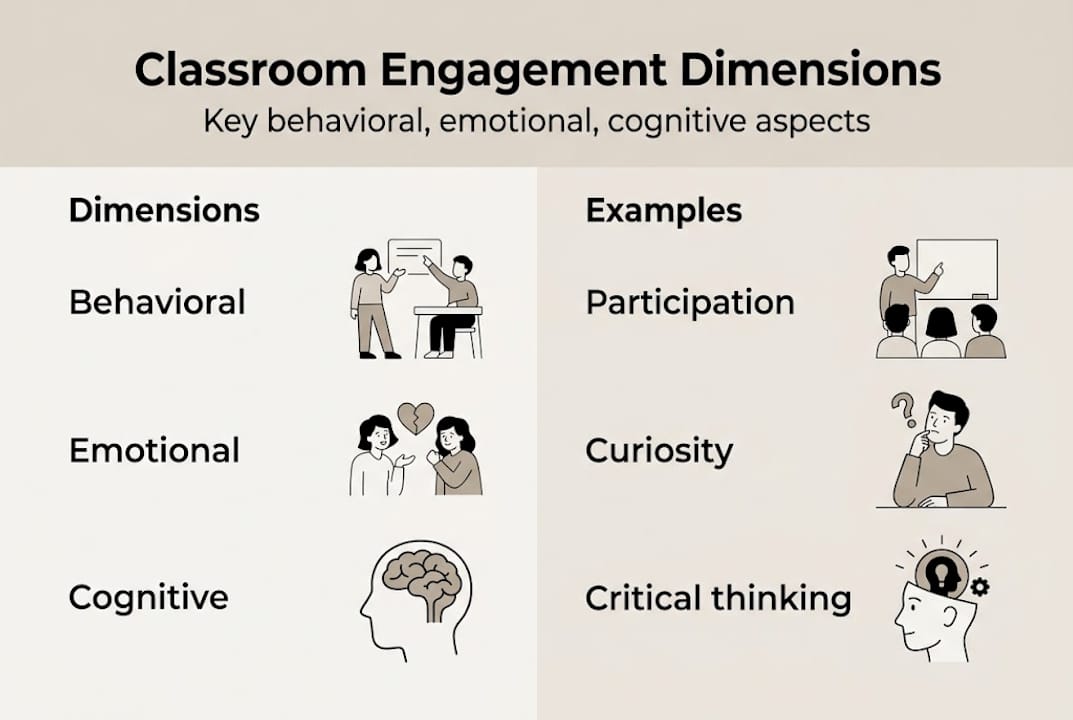
Researchers, including Jennifer Fredricks, identify three core dimensions of engagement: behavioral, cognitive, and emotional. Understanding all three is essential for any educator who wants to move beyond surface-level participation.
The three dimensions explained:
- Behavioral engagement refers to observable actions: attending class, completing tasks, participating in discussions, and following classroom norms.
- Cognitive engagement involves the mental effort students invest, including strategies they use to understand, remember, and apply new language.
- Emotional engagement captures how students feel about learning, including their sense of belonging, interest in the subject, and relationship with the teacher and peers.
A student who participates verbally (behavioral) but feels anxious or disconnected (emotional) is only partially engaged. Effective TEFL teaching methods target all three dimensions simultaneously.
| Dimension | What it looks like | Why it matters |
|---|---|---|
| Behavioral | Attendance, task completion, participation | Most visible; easiest to measure |
| Cognitive | Strategy use, self-regulation, critical thinking | Drives actual language acquisition |
| Emotional | Motivation, belonging, attitude toward learning | Predicts long-term retention and persistence |
Broad student engagement research confirms that these dimensions are interdependent. Neglecting any one of them reduces the overall effectiveness of instruction. For TEFL educators, this framework provides a practical lens for evaluating whether a lesson is genuinely working.
Why engagement matters: Research highlights and classroom impact
The evidence connecting engagement to student outcomes is substantial and consistent. Understanding this research helps TEFL educators make the case for investing time in engagement strategies, rather than treating them as optional extras.

Active learning cuts failure rates by 1.5 times, and engagement levels drop sharply as students age, falling from 74% in 5th grade to just 32% in 11th grade. For TEFL teachers working with adolescent or adult learners, this trend has direct implications. Engagement cannot be assumed. It must be actively cultivated.
Here is a comparison of what high-engagement and low-engagement classrooms typically look like:
| Factor | High-engagement classroom | Low-engagement classroom |
|---|---|---|
| Test scores | Significantly above average | At or below average |
| Participation | Frequent and voluntary | Minimal or prompted only |
| Student well-being | Positive, motivated | Anxious or indifferent |
| Dropout risk | Low | High |
| Language retention | Strong over time | Weak, surface-level |
Key research findings worth noting:
- Engaged students are significantly more likely to complete courses and pursue further education.
- Emotional engagement in language classrooms correlates strongly with willingness to communicate, a critical factor in ESL progress.
- Behavioral engagement alone is insufficient. Students who comply without cognitive investment show limited long-term gains.
- Teacher responsiveness is one of the strongest predictors of student emotional engagement.
For practical ideas on building participation into every lesson, explore these ESL activities for engagement that have been tested across diverse classroom contexts.
Research-backed student engagement strategies consistently point to active, student-centered instruction as the most effective approach. Passive listening, by contrast, produces the lowest retention and the weakest emotional investment.
How TEFL teachers can foster classroom engagement
Knowing what engagement is and why it matters is only useful if it translates into classroom action. The following strategies are validated by both research and real-world TEFL practice.
Effective strategies for TEFL and language educators include task-based language teaching (TBLT), role-play, games, visuals, and culturally responsive materials. Each of these approaches targets one or more of the three engagement dimensions.
Strategies by engagement dimension:
- Behavioral: Use pair work, group tasks, and structured discussion formats to ensure all students are actively participating, not just the most confident ones.
- Cognitive: Design tasks that require students to use language for real purposes, such as solving a problem, negotiating a decision, or analyzing a short text.
- Emotional: Build rapport through consistent routines, positive feedback, and activities that connect to students’ own cultural backgrounds and interests.
Pro Tip: Start each new unit with a brief icebreaker that links the topic to students’ personal experiences. This activates prior knowledge and builds emotional investment before the formal lesson begins.
Culturally relevant content is especially important in TEFL contexts. When students see their own backgrounds reflected in classroom materials, emotional engagement increases noticeably. Avoid generic textbook scenarios when local or culturally familiar examples are available.
For a broader selection of proven approaches, the top classroom activities guide provides structured options across skill levels. Additionally, ESL teaching aids such as visual supports and interactive tools can boost engagement by up to 35% when used consistently.
Teachers working with younger learners should also review guidance on teaching young learners TEFL, which addresses age-specific engagement considerations including attention span, play-based learning, and motivational triggers.
Consistency matters as much as creativity. Rotating through a variety of activity types, while maintaining predictable lesson structures, keeps students both stimulated and secure.
Engagement for diverse learners: Adapting strategies for inclusivity
No two TEFL classrooms are identical. Educators regularly work with English language learners (ELLs) at varying proficiency levels, neurodivergent students, and culturally diverse groups. Effective engagement requires adapting strategies to meet these different needs.
The Universal Design for Learning (UDL) framework provides a structured approach. UDL, differentiated instruction, social-emotional learning (SEL), and project-based learning are among the most effective tools for reaching diverse learners. UDL specifically calls for multiple means of representation, action, and expression, so that no single learning style or ability level is disadvantaged.
| Learner group | Recommended engagement tactics |
|---|---|
| English language learners | Visual supports, scaffolded tasks, bilingual glossaries, low-stakes speaking practice |
| Neurodivergent students | Predictable routines, clear instructions, sensory-friendly setups, choice-based tasks |
| Culturally diverse classrooms | Culturally responsive texts, student-led sharing, flexible grouping, global examples |
Neurodivergent students benefit from predictable transitions, sensory setups, and choice tasks. Unpredictable lesson structures or sudden transitions can trigger anxiety and reduce engagement significantly.
Pro Tip: Post a visual agenda at the start of every lesson. This simple practice reduces anxiety for neurodivergent learners and helps all students orient themselves quickly, freeing up cognitive resources for actual language learning.
Inclusive engagement checklist:
- Provide instructions in multiple formats (verbal, written, visual)
- Offer choice in how students demonstrate understanding
- Use flexible grouping to prevent fixed social hierarchies
- Incorporate wait time to support processing differences
- Regularly check for understanding using low-pressure methods like thumbs up or mini whiteboards
For detailed guidance on age-appropriate inclusive strategies, the teaching strategies for young learners resource offers practical frameworks. Additional approaches for diverse learner strategies are also available for educators working across mixed-ability groups.
Balancing flexibility and structure is the core challenge here. Too much rigidity excludes learners who need alternative pathways. Too little structure leaves students without the scaffolding they need to engage confidently.
What most engagement advice misses: The structure and flexibility paradox
Most engagement guides focus on activities and techniques. Fewer address the underlying tension that determines whether those techniques actually work: the balance between structure and flexibility.
Too much structure stifles the spontaneity that makes language learning meaningful. Too little structure, and classrooms lose the predictability that allows learners, especially neurodivergent students and anxious language learners, to take risks. This is not a problem to solve once. It is a dynamic to manage continuously.
Norming activities explicitly and applying both/and thinking helps teachers navigate paradoxes like direct instruction versus active learning. The goal is not to choose one approach, but to know when each is appropriate.
Blanket engagement policies fail in TEFL because they ignore context. A strategy that works brilliantly with motivated adult professionals may fall flat with disengaged teenagers in a compulsory English program. Effective educators read their classrooms and adjust. For a practical framework, the classroom management strategies guide outlines how to build structure without sacrificing responsiveness. Research on engagement and classroom management consistently confirms that the two are not competing priorities. They are interdependent.
Advance your TEFL career with supportive courses and resources
Building genuine classroom engagement is a skill that develops with training, practice, and the right professional support. TEFL Institute offers certified courses and practical resources designed to help educators apply evidence-based strategies from day one.

Whether you are just starting out or looking to deepen your expertise, explore TEFL courses in Newcastle for hands-on training options, or browse TEFL course extensions to specialize in areas like young learner instruction or inclusive teaching. The full range of tools, guides, and certification pathways is available through the TEFL Institute platform, giving you structured support at every stage of your teaching career.
Frequently asked questions
How do you measure classroom engagement effectively?
Combine observation of participation and attention with tools like student feedback, self-assessment checklists, and quick polls for the best results. Multi-dimensional observation covering behavioral, cognitive, and emotional indicators gives the most accurate picture.
What are the main challenges in keeping a class engaged?
Challenges include diverse learning needs, engagement drops in adolescence, balancing structure with flexibility, and adapting activities for neurodivergent or ELL students. Engagement declines sharply in adolescence, making proactive strategy use essential for secondary and adult TEFL contexts.
Which strategies work best for TEFL and ESL classrooms?
Interactive games, task-based activities, visuals, role-plays, and culturally responsive lessons are especially effective in TEFL and ESL settings. TBLT, interactive games, and culturally responsive materials consistently produce strong engagement and language acquisition outcomes.
How can you adapt engagement strategies for students with special educational needs?
Use multiple modes of instruction, predictable routines, choices in activities, and sensory supports to better engage neurodivergent students. Predictable transitions and choice tasks are particularly effective for reducing anxiety and increasing participation.
Recommended
TEFL Institute guides

Vietnam
Work permits and requirements
Spain
Jobs, pay and visa routes
South Korea
EPIK, hagwons and pay
Italy
Jobs, pay and visa routes
China
Z visa, pay and cities