

 United Kingdom (UK)
 United States (US)
 Canada
 South Africa
 India
India Australia
 New Zealand
 China
China Russia
 Germany
 France
 Spain
Spain Netherlands
 Vietnam
 United Arab Emirates
 Italy
Italy Poland
 Thailand
 Türkiye










 Algeria



Teaching Aids in ESL: 35% Boost in Engagement for 2026
Teaching Aids in ESL: 35% Boost in Engagement for 2026

Selecting the right teaching aids transforms ESL classrooms but many teachers struggle with overwhelming choices. The challenge lies in matching aids to diverse learner styles, lesson goals, and budget constraints. This guide presents a clear framework and evidence-backed examples to help you choose aids that boost engagement by up to 35% and improve learning outcomes measurably.
Table of Contents
- How To Choose The Best Teaching Aids For ESL Classes
- Visual Teaching Aids: Flashcards, Charts, And More
- Auditory Teaching Aids: Songs, Stories, And Dialogue
- Technology And Interactive Teaching Aids
- Authentic Materials: Real-World Contexts To Enhance Learning
- Cost, Accessibility, And Practical Considerations
- Summary Comparison Of Teaching Aids
- Situational Recommendations For ESL Teaching Aids
- Enhance Your ESL Teaching With TEFL Institute Courses
- FAQ
Key Takeaways
| Point | Details |
|---|---|
| Match aids to learning styles | Visual, auditory, and kinesthetic preferences guide effective aid selection |
| Visual aids boost retention | Flashcards improve vocabulary retention by up to 40% |
| Auditory tools improve pronunciation | Songs and stories enhance pronunciation accuracy by over 30% |
| Technology increases engagement | Interactive whiteboards boost learner engagement by 35% |
| Balance cost and effectiveness | Free and premium options exist for every teaching context |
How to Choose the Best Teaching Aids for ESL Classes
Effective teaching aid selection starts with understanding your students’ learning preferences. Visual learners thrive with flashcards and diagrams, while auditory learners benefit from songs and dialogue recordings. Kinesthetic learners need hands-on activities and movement-based exercises.
Align aids with specific lesson objectives. Vocabulary building calls for flashcards and visual charts, grammar instruction benefits from diagrams and interactive exercises, and pronunciation work requires auditory resources. Expert consensus from Cambridge English recommends integrating a mix of teaching aids appropriate to lesson aims, learner styles, and resource availability to maximize outcomes.
Consider your teaching environment carefully. Classroom settings accommodate physical materials like posters and realia, online environments need digital tools and screen-sharing resources, and hybrid formats work best with flexible aids usable in both contexts. Budget constraints matter but shouldn’t limit quality, many free resources rival premium options.
Pro Tip: Start with one or two aid types and master their integration before adding more. Overloading lessons with too many aids confuses students and dilutes learning impact.
Evaluate practical factors before committing to specific aids:
- Technology requirements and internet stability for digital tools
- Storage and portability needs for physical materials
- Preparation time required for each lesson
- Student access to necessary devices or materials
- Cultural appropriateness of content for your learners
Seamlessly integrate aids into lesson plans rather than treating them as add-ons. Preview aids during lesson planning, introduce them with clear purpose statements, and follow up with activities that reinforce the aided content. This approach, combined with ESL learning games for engagement and solid ESL teaching terminology basics, creates cohesive learning experiences.
Visual Teaching Aids: Flashcards, Charts, and More
Visual aids dominate ESL classrooms because they work. Flashcards improve vocabulary retention by up to 40%, making them the go-to tool for vocabulary drills and quick reviews. Picture cards, word cards, and combination cards each serve distinct purposes in different lesson phases.
Charts and diagrams help clarify abstract grammar and vocabulary concepts by transforming complex rules into visual patterns. Grammar trees show sentence structure, verb conjugation charts organize tenses systematically, and word maps illustrate semantic relationships. These tools help students see connections that verbal explanations alone miss.
The prevalence of visual aids reflects their universal effectiveness. Over 75% of ESL classrooms worldwide use visual aids regularly, spanning beginner through advanced levels. Posters displaying common phrases, alphabet charts for pronunciation reference, and timeline graphics for verb tenses appear in most successful classrooms.
Traditional flashcards alone lack the engagement power of multimedia alternatives. Digital flashcard apps add audio pronunciation, spaced repetition algorithms, and gamification elements that paper cards cannot match. However, physical flashcards remain valuable for tactile learners and low-tech environments.
Maximize visual aid effectiveness with these applications:
- Use color coding to distinguish word categories or grammar functions
- Combine images with target vocabulary for dual-coding memory benefits
- Display aids at eye level where all students can see clearly
- Rotate aids regularly to maintain novelty and attention
- Involve students in creating visual aids to deepen engagement
Visual aids complement ESL teaching materials by providing immediate, accessible reference points during lessons.
Auditory Teaching Aids: Songs, Stories, and Dialogue
Auditory aids target pronunciation, intonation, and listening comprehension skills that visual aids cannot address. Songs and stories improve pronunciation accuracy by over 30% in 8-week programs by exposing learners to natural English rhythms repeatedly. Music embeds language patterns in memory through melody and repetition.
Stories engage learners emotionally while modeling contextual language use. Graded readers match student proficiency levels, audiobooks provide native speaker models, and student-created stories encourage creative language production. Dialogue recordings model natural intonation and rhythm better than isolated sentence practice.
Auditory learners especially benefit from sound-based instruction. These students process information best through listening and speaking, making audio aids essential for their success. Podcasts for English learners, pronunciation apps with voice recognition, and recorded conversations provide rich auditory input.
Pro Tip: Pair auditory aids with transcripts so students can follow along visually. This dual-modality approach accommodates mixed learning styles and reinforces spelling alongside pronunciation.
Implement auditory aids strategically:
- Play audio samples multiple times with different listening tasks each time
- Use songs to teach vocabulary, idioms, and cultural references
- Record yourself or students for pronunciation self-assessment
- Create listening stations where students control playback and repetition
- Incorporate call-and-response activities with audio models
These techniques align with effective ESL teaching methods that engage multiple senses and learning pathways simultaneously.
Technology and Interactive Teaching Aids
Digital tools revolutionize ESL instruction through interactivity and immediate feedback. Interactive whiteboards increase ESL learner engagement by up to 35% by transforming passive viewing into active participation. Students manipulate on-screen elements, solve problems collaboratively, and see their contributions displayed instantly.
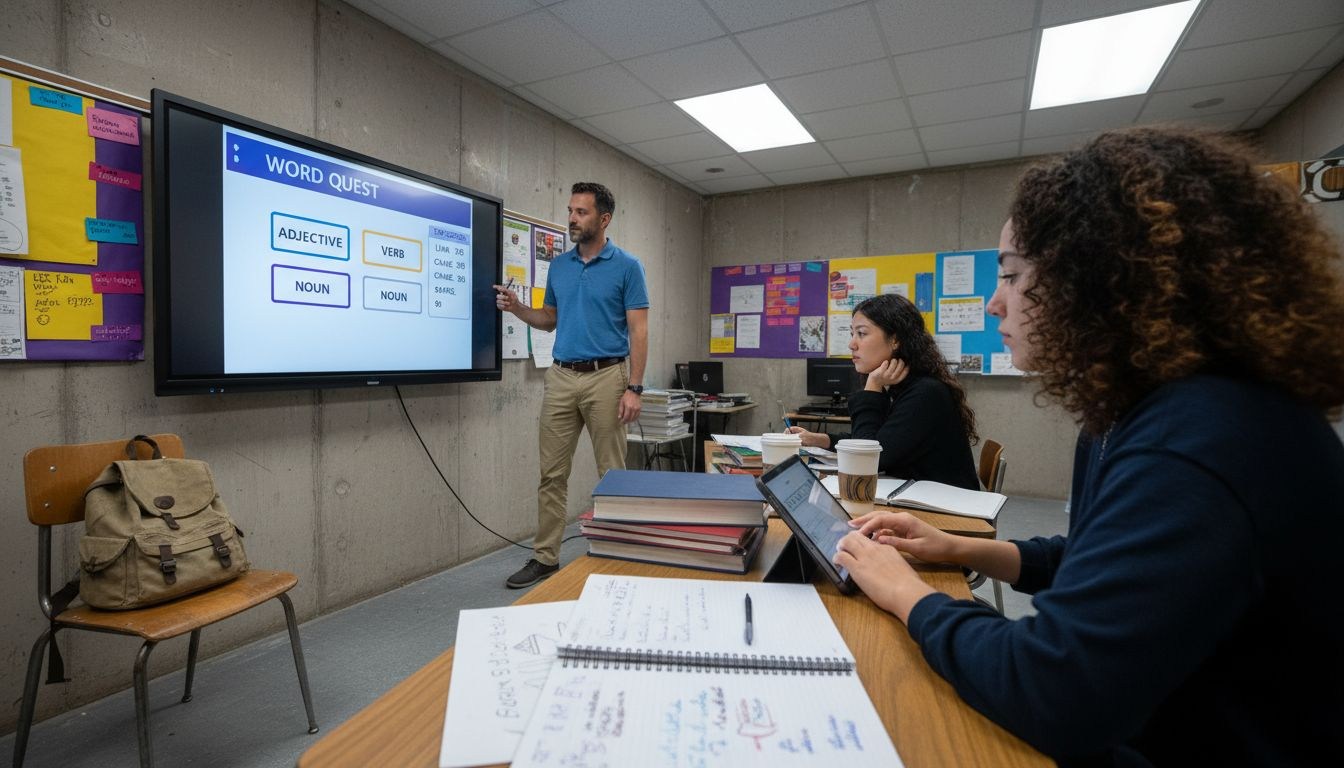
Online platforms provide customizable lesson plans and multimedia resources that adapt to individual student needs. Learning management systems track progress, adaptive software adjusts difficulty automatically, and video conferencing tools enable real-time global classrooms. These platforms support differentiated instruction at scale.
Digital aids excel in online and hybrid environments where physical materials prove impractical. Screen-sharing allows simultaneous material viewing, breakout rooms facilitate small-group work, and polling features provide instant comprehension checks. The flexibility suits diverse teaching contexts from corporate training to university programs.
Cost considerations vary widely in the technology space. Many robust free resources exist alongside premium subscriptions offering enhanced features. Budget planning should account for device requirements, internet connectivity, and training time for both teachers and students.
| Tool Type | Average Cost | Best Use Case |
|---|---|---|
| Interactive Whiteboards | Free to $20/month | In-person or hybrid classes |
| Learning Management Systems | Free to $15/month | Course organization and tracking |
| Video Conferencing | Free to $10/month | Online synchronous classes |
| Gamification Apps | Free to $12/month | Vocabulary and grammar drills |
Implement technology aids effectively:
- Test all technology before lessons to troubleshoot issues
- Provide clear instructions for student access and navigation
- Balance screen time with offline activities
- Archive digital materials for student review and makeup work
- Collect student feedback on tool usability and preferences
These strategies complement 2025 ESL teaching tips for modern, technology-enhanced classrooms.
Authentic Materials: Real-World Contexts to Enhance Learning
Authentic materials bridge classroom learning and real-world language use. Newspapers, menus, advertisements, and social media posts expose students to language as native speakers actually use it. Authentic materials improve comprehension by 20% by providing cultural context alongside linguistic content.
These materials work best with intermediate and advanced learners who possess sufficient vocabulary to navigate unmodified texts. Beginners may find authentic materials overwhelming without significant scaffolding and vocabulary pre-teaching. Carefully selected materials match student interests and proficiency levels.
Authentic materials help ESL learners connect language to real-life cultural contexts, developing both linguistic and cultural competence simultaneously. Students learn idioms, slang, register variations, and cultural references that textbooks often omit. This knowledge proves essential for students planning to live or work in English-speaking environments.
Critical thinking skills develop through authentic material analysis. Students evaluate author purpose, identify bias, compare regional language variations, and discuss cultural implications. These higher-order thinking tasks elevate language learning beyond rote memorization.
Incorporate authentic materials strategically:
- Select materials slightly above student current level for optimal challenge
- Pre-teach essential vocabulary and cultural background
- Design tasks that require genuine comprehension, not just word recognition
- Compare authentic texts with textbook versions to highlight differences
- Encourage students to bring authentic materials they encounter
These approaches integrate with essential ESL resources to create rich, context-based learning experiences.
Cost, Accessibility, and Practical Considerations
Budget constraints shape teaching aid decisions significantly. Free resources like ESL Brains and UsingEnglish.com provide extensive materials comparable to paid alternatives. Teachers can build complete curricula using only free resources if necessary. Premium platforms charge $10-$20 monthly subscriptions for enhanced features like detailed analytics, custom content creation, and technical support.
Accessibility extends beyond cost to include technology infrastructure. Reliable internet, adequate devices, and technical literacy requirements can exclude students or entire institutions. Low-tech alternatives ensure inclusive access while maintaining pedagogical effectiveness.
Pro Tip: Maintain a backup plan using zero-tech materials for every digital lesson. Technology failures happen, and paper-based alternatives keep learning on track.
Practical evaluation balances multiple factors:
| Factor | Considerations | Solutions |
|---|---|---|
| Setup Time | Preparation required per lesson | Choose aids with ready-made content libraries |
| Technical Support | Troubleshooting availability | Select platforms with strong user communities |
| Student Access | Device and internet availability | Offer offline download options or print alternatives |
| Learning Curve | Training time for teachers and students | Prioritize intuitive interfaces and good tutorials |
| Scalability | Works for varying class sizes | Test aids with different group configurations |
Long-term cost-benefit analysis guides smart investments. Calculate time saved through automation, engagement improvements, and learning outcome gains against subscription costs and setup effort. Sometimes premium tools justify their expense through superior results and efficiency.
Explore free ESL teaching resources to maximize impact within budget constraints.
Summary Comparison of Teaching Aids
Different aid types serve distinct purposes and learner needs. Understanding their comparative strengths helps you build balanced teaching aid portfolios.
| Aid Type | Effectiveness | Cost Range | Best Learner Fit | Ideal Context |
|---|---|---|---|---|
| Visual Aids | 40% retention boost | Free to $5/month | All levels, especially visual learners | Universal, all environments |
| Auditory Aids | 30% pronunciation improvement | Free to $10/month | Auditory learners, pronunciation focus | Listening/speaking intensive courses |
| Technology Tools | 35% engagement increase | Free to $20/month | Tech-comfortable students | Online and hybrid classes |
| Authentic Materials | 20% comprehension gain | Free to $15/month | Intermediate to advanced | Cultural immersion programs |
| Kinesthetic Aids | Variable by activity | Free to $10/material | Young learners, kinesthetic preference | Active, movement-friendly spaces |
Visual aids offer the best cost-to-effectiveness ratio for most contexts. Their low cost, universal applicability, and proven retention benefits make them foundational to any ESL program. Every teacher should master visual aid integration regardless of other tool preferences.
Auditory aids complement visual tools by addressing pronunciation and listening skills. Combined use creates multisensory learning experiences that accommodate diverse learning styles. The moderate cost keeps them accessible to most programs.
Technology aids command the highest engagement but require infrastructure investment. Their effectiveness in online contexts makes them essential for distance learning programs. Hybrid programs benefit from technology’s flexibility across teaching modalities.
Authentic materials enhance cultural competence with minimal cost. Their primary limitation is proficiency requirements, making them most valuable for intermediate and advanced instruction. Beginning-level programs should introduce authentic materials gradually as scaffolded exercises.
Kinesthetic aids receive less research attention but prove valuable for specific populations. Young learners and students with kinesthetic learning preferences need movement and manipulation for optimal learning. Role-plays, games, and physical activities serve these needs effectively.
Situational Recommendations for ESL Teaching Aids
Apply teaching aid knowledge to specific scenarios for maximum impact. Context-specific recommendations ensure appropriate aid selection.
- Beginning vocabulary lessons: Prioritize flashcards with clear images, repetition drills, and color-coded categories for word grouping.
- Pronunciation improvement: Use songs with clear lyrics, dialogue recordings with transcripts, and voice recording apps for self-assessment.
- Online synchronous classes: Integrate interactive whiteboards, screen-sharing for material display, and breakout rooms for small-group practice.
- Cultural competence development: Employ authentic materials like news articles, social media posts, and videos showing real cultural contexts.
- Mixed-level classrooms: Combine visual aids for universal access, differentiated digital activities allowing self-paced work, and flexible grouping strategies.
- Low-resource environments: Focus on free printable materials, student-created visual aids, and audio recordings using available devices.
- Business English programs: Use authentic workplace materials, role-play scenarios with video recording, and industry-specific vocabulary flashcards.
- Test preparation courses: Integrate practice test platforms, timed activities, and authentic test format materials for familiarization.
- Young learner classes: Emphasize songs, games, colorful visual aids, and kinesthetic activities maintaining high energy and engagement.
- Advanced conversation classes: Provide authentic audio/video materials, debate topics from current media, and minimal visual support encouraging language production.
Combining aid types addresses diverse learner needs within single classes. A typical lesson might open with visual vocabulary presentation, continue with auditory pronunciation practice, and conclude with kinesthetic role-play activities. This layered approach, informed by ESL teaching methods for situational aids, maximizes learning opportunities for all students.
Enhance Your ESL Teaching with TEFL Institute Courses
Mastering teaching aid selection and integration takes practice and professional development. TEFL Institute courses equip you with practical skills for implementing diverse teaching aids effectively in any ESL context.
Our certification programs cover evidence-based aid selection, technology integration strategies, and hands-on practice with multiple aid types. You’ll learn to match aids to specific lesson goals and learner profiles confidently. 
Flexible course formats accommodate your schedule whether you’re beginning your teaching career or upgrading existing credentials. Self-paced modules let you study when convenient while maintaining rigorous academic standards. Experienced instructors provide personalized feedback on your teaching aid applications.
Build your expertise systematically. Explore which TEFL course to take based on your current experience and career goals. Elevate your credentials with recognized English as a second language certification that employers worldwide respect.
FAQ
What Are Examples of Effective Teaching Aids in ESL?
Effective aids include flashcards for vocabulary retention, songs and dialogues for pronunciation practice, and interactive whiteboards for engagement. Authentic materials like newspapers and menus connect classroom learning to real-world language use. Choose aids matching your lesson objectives and student proficiency levels.
How Do I Match Teaching Aids to Different ESL Learner Styles?
Visual learners benefit most from flashcards, charts, and videos showing concepts graphically. Auditory learners need songs, podcasts, and dialogue recordings emphasizing sound patterns. Kinesthetic learners require hands-on activities, role-plays, and movement-based games. Assess student preferences through observation and direct questioning.
Are Technology-Based Teaching Aids Affordable for Small ESL Programs?
Many excellent technology aids cost nothing, including Google Classroom, Canva for visual creation, and YouTube for authentic video content. Premium platforms typically charge $10-$20 monthly, offering enhanced features like detailed analytics and custom content. Free trials let you evaluate effectiveness before committing funds.
What Is the Role of Authentic Materials in ESL Teaching?
Authentic materials expose students to language as native speakers actually use it, including idioms, slang, and cultural references. They improve comprehension by 20% while developing cultural competence alongside linguistic skills. Best suited for intermediate and advanced learners, authentic materials prepare students for real-world English encounters beyond the classroom.
Can I Combine Multiple Teaching Aid Types in One Lesson?
Combining aids creates multisensory learning experiences that accommodate diverse student needs simultaneously. Open with visual vocabulary presentation, continue with auditory pronunciation practice, and close with kinesthetic application activities. This layered approach maximizes engagement and retention across different learner styles effectively.