

 United Kingdom (UK)
 United States (US)
 Canada
 South Africa
 India
India Australia
 New Zealand
 China
China Russia
 Germany
 France
 Spain
Spain Netherlands
 Vietnam
 United Arab Emirates
 Italy
Italy Poland
 Thailand
 Türkiye










 Algeria



What Is an ESL Resource? 35% Higher Student Retention
What Is an ESL Resource? 35% Higher Student Retention

Many new teachers mistakenly assume any English material qualifies as an essential teaching ESL resource. Research shows approximately 70% of novice ESL teachers fall into this trap. True ESL resources are specialized tools designed specifically for language learners, not native speakers. This guide will help you identify, select, and integrate effective ESL materials for teaching success.
Table of Contents
- Introduction To ESL Resources
- Why ESL Resources Enhance Teaching Effectiveness
- Types And Categories Of ESL Resources
- Common Misconceptions About ESL Resources
- How To Select The Right ESL Resources
- Digital Versus Physical ESL Resources: Pros And Cons
- Practical Integration Of ESL Resources In Lesson Planning
- Conclusion And Next Steps For Aspiring ESL Teachers
- Enhance Your ESL Teaching Skills With TEFL Institute
- What Is An ESL Resource? FAQ
Key Takeaways
| Point | Details |
|---|---|
| ESL resources are specialized tools | Materials specifically designed for language learners, not native speakers. |
| Multiple resource types boost retention | Using varied formats increases language retention by up to 35%. |
| Selection requires careful evaluation | Assess adaptability, cultural relevance, and accessibility before choosing. |
| Digital and physical formats differ | Each has distinct advantages depending on teaching context and learner needs. |
| Integration supports certification success | Effective resource use demonstrates teaching competency and improves outcomes. |
Introduction to ESL Resources
An ESL resource is any learner-centered material pedagogically designed to support language acquisition. Unlike materials for native speakers, ESL resources account for language proficiency levels, cultural backgrounds, and specific learning challenges. ESL Teaching Materials Explained defines these as print, digital, audio-visual, and assessment tools adjusted to learner and environment needs.
The ESL teacher role requires understanding various resource categories:
- Print materials: Textbooks, workbooks, flashcards, and worksheets designed with controlled vocabulary
- Digital platforms: Apps, interactive software, and online learning management systems
- Audio-visual content: Podcasts, videos, and pronunciation guides with clear enunciation
- Assessment tools: Quizzes, rubrics, and progress tracking systems for language learners
Your teaching environment dramatically affects resource needs. Online instructors require reliable video conferencing tools and screen-sharing capabilities. Teachers abroad might depend on physical materials where internet access is limited. Classroom teachers benefit from combining formats to address diverse learning preferences.
Proficiency levels also dictate resource selection. Beginners need simplified vocabulary and visual supports. Advanced learners benefit from authentic materials adapted with scaffolding techniques. ESL certification programs emphasize this differentiation as a core teaching competency.
Why ESL Resources Enhance Teaching Effectiveness
Language scaffolding principles embedded in quality ESL resources guide learners through systematic progression. These materials break complex language patterns into manageable steps, building confidence while preventing cognitive overload. Each resource acts as a bridge between current ability and next-level proficiency.
Multimedia and interactive materials create engagement that passive reading cannot match. Studies demonstrate multimedia ESL resources increase student engagement and comprehension by up to 60%. Interactive exercises transform abstract grammar rules into memorable experiences through immediate feedback and repetition.
Culturally relevant materials motivate learners by reflecting their identities and experiences. When students see themselves in learning content, motivation increases and anxiety decreases. This cultural connection makes language acquisition feel personally meaningful rather than academically abstract.
ESL resources accommodate diverse learning styles simultaneously:
- Visual learners benefit from infographics, charts, and illustrated vocabulary
- Auditory learners engage with podcasts, songs, and pronunciation drills
- Kinesthetic learners thrive with role plays, games, and physical flashcard activities
- Reading/writing learners excel with structured workbooks and journaling prompts
Pro Tip: Track which resource types generate the strongest learner responses. Keep a simple log noting engagement levels for different materials. This data helps you teach ESL effectively by personalizing future lessons to proven preferences.
Types and Categories of ESL Resources
Understanding resource categories helps you build a balanced teaching toolkit. Each format offers unique advantages for different learning objectives and contexts.
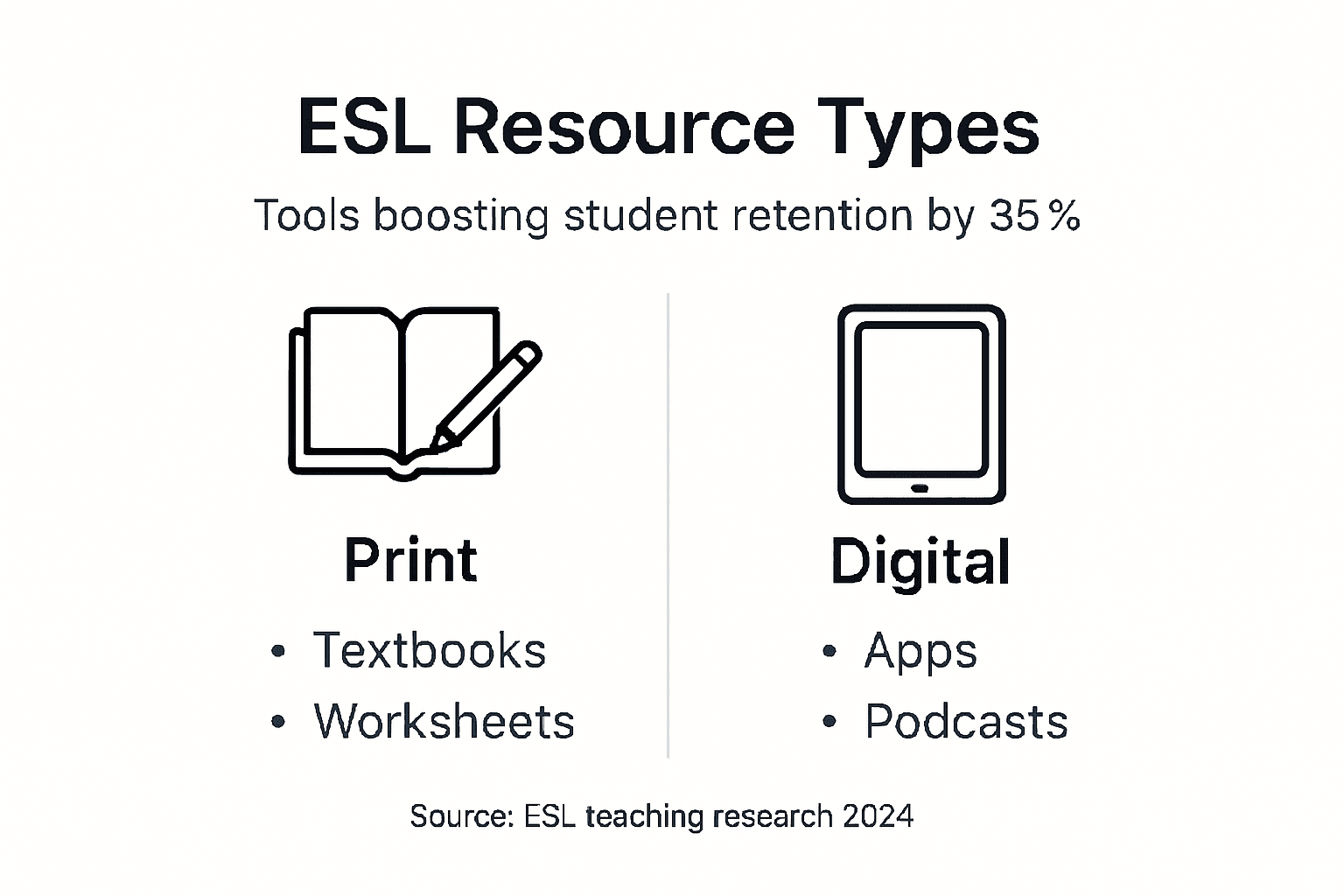
Print Materials remain reliable workhorses in ESL instruction. Textbooks provide structured curriculum progression. Worksheets offer targeted practice on specific grammar points. Flashcards enable quick vocabulary drills without technology. These tangible resources work anywhere, require no batteries, and create fewer distractions than screens.
Digital Resources bring interactivity and current content to your classroom. Apps like Duolingo or Quizlet gamify learning with immediate feedback. Learning management systems organize curriculum and track student progress automatically. Interactive whiteboards enable collaborative problem solving.
Audio-Visual Aids develop listening comprehension and pronunciation skills that text alone cannot address. Podcasts expose learners to natural speech patterns. Videos demonstrate body language and cultural context. Pronunciation software provides targeted feedback on specific sounds.

Assessment Tools track progress and guide instructional decisions. Digital quizzes offer instant scoring and data analytics. Rubrics standardize evaluation across diverse assignments. Feedback apps facilitate ongoing communication about learner development.
| Resource Type | Best Use Cases | Limitations |
|---|---|---|
| Print Materials | Low-tech environments, tactile learners, independent study | Less interactive, difficult to update |
| Digital Platforms | Tech-enabled classrooms, remote learning, gamification | Requires devices and internet, potential distractions |
| Audio-Visual | Listening skills, pronunciation, cultural exposure | Passive learning risk, bandwidth requirements |
| Assessment Tools | Progress tracking, standardized evaluation, feedback | Can feel test-focused, may increase anxiety |
The ESL teaching materials guide emphasizes selecting resources that match your specific teaching context. Teachers exploring careers in ESL teaching should familiarize themselves with all categories to remain versatile across employment opportunities.
Common Misconceptions About ESL Resources
Clearing up widespread misunderstandings prevents ineffective teaching practices. Cambridge research found many teachers wrongly believe any English material qualifies as an ESL resource, leading to poor instructional outcomes.
Misconception: Any English text works for ESL learners if simplified.
Reality: True ESL resources are purposefully designed with controlled vocabulary, explicit grammar patterns, and cultural considerations. Simply shortening native-speaker materials often removes helpful context clues and creates confusion.
Misconception: Digital resources are universally superior to physical materials.
Reality: Digital tools offer engagement advantages but depend entirely on technology access and digital literacy. Many successful teaching contexts rely primarily on physical materials where infrastructure is limited.
Misconception: ESL resources are supplementary, not essential.
Reality: Quality resources form the foundation of effective instruction. They provide structure, ensure comprehensive coverage, and enable differentiated learning. Certification programs evaluate resource selection competency because it directly impacts teaching quality.
Misconception: Generic materials are sufficient if the teacher is skilled.
Reality: Even expert teachers cannot fully compensate for inappropriate materials. Learner-centered resources reduce cognitive load, provide appropriate challenges, and support independent practice outside class time.
Cultural relevance significantly impacts learner motivation and retention. Resources reflecting diverse backgrounds validate student identities while teaching language skills.
These misconceptions often stem from confusing ESL resources with general English teaching materials. The distinction matters because language learners face unique challenges that specialized resources address systematically.
How to Select the Right ESL Resources
Applying a structured evaluation framework improves your resource selection efficiency. Research indicates using systematic criteria boosts selection effectiveness by up to 50%.
-
Evaluate adaptability to proficiency levels: Check if materials specify CEFR levels or offer differentiated versions. Resources should challenge learners without overwhelming them.
-
Assess cultural relevance and representation: Look for diverse characters, global contexts, and culturally neutral examples. Avoid materials that stereotype or exclude learner backgrounds.
-
Examine interactivity and engagement features: Interactive resources maintain attention and provide practice opportunities. Passive materials require supplementary activities to maintain engagement.
-
Verify technical accessibility and cost: Consider device requirements, internet bandwidth needs, and budget constraints. Free resources save money but may lack support or updates.
-
Test integration potential with existing curriculum: Resources should complement your lesson objectives, not dictate them. Look for flexibility in how materials can be adapted or sequenced.
-
Review pedagogical alignment with teaching approach: Ensure resources match your methodology, whether communicative, task-based, or grammar-focused instruction.
Pro Tip: Create a simple rubric scoring each criterion from 1 to 5. Resources scoring below 20 out of 30 points rarely prove worth the investment. This systematic approach prevents impulse selections based on attractive packaging or marketing claims.
The ESL materials guide provides additional evaluation checklists specific to print, digital, and multimedia formats. Taking time to evaluate properly saves frustration and improves learner outcomes.
Digital Versus Physical ESL Resources: Pros and Cons
Balancing digital and physical resources creates teaching flexibility. Understanding each format’s strengths helps you choose appropriately for your specific context.
Digital Resource Advantages:
- Content updates happen quickly, keeping materials current
- Interactive features provide immediate feedback and gamification
- Remote accessibility enables homework and asynchronous learning
- Multimedia integration supports multiple learning styles simultaneously
- Analytics track student progress automatically
Digital Resource Limitations:
- Technology barriers exclude learners without devices or connectivity
- Digital literacy requirements may frustrate some students
- Screen fatigue and potential distractions reduce engagement
- Platform changes or shutdowns disrupt established workflows
Physical Resource Advantages:
- Reliability requires no electricity, internet, or technical support
- Tactile interaction benefits kinesthetic learners
- Reduced distractions keep focus on learning content
- Universal accessibility regardless of technical skill
- Permanent ownership without subscription fees
Physical Resource Limitations:
- Static content becomes outdated quickly
- Limited interactivity compared to digital options
- Storage and transportation create logistical challenges
- Copying and distribution costs add up
| Consideration | Digital Resources | Physical Resources |
|---|---|---|
| Initial Investment | Often higher for devices/subscriptions | Lower, one-time purchases |
| Maintenance Costs | Ongoing subscriptions, tech support | Minimal replacement costs |
| Learning Curve | Moderate to high | Low to minimal |
| Engagement Level | High with interactive features | Moderate, requires teacher facilitation |
| Accessibility | Depends on technology availability | Universal access |
Effective teachers maintain both digital and physical resources. ESL materials research shows blended approaches maximize strengths while compensating for limitations. Your teaching context ultimately determines the ideal balance.
Practical Integration of ESL Resources in Lesson Planning
Combining resource types strategically maximizes learning impact. Educational research demonstrates integrating multiple ESL resource types increases language retention by up to 35%.
Start by aligning resources with specific lesson objectives. If your goal is improving conversational fluency, combine dialogue videos, role-play cards, and pronunciation apps. For writing skills, pair model texts, graphic organizers, and peer-feedback rubrics.
Scaffolding with Multiple Resources:
- Introduction phase: Use videos or realia to build context and activate prior knowledge
- Practice phase: Apply worksheets or digital exercises for controlled practice
- Production phase: Implement games, projects, or presentations for creative application
- Assessment phase: Deploy quizzes, rubrics, or self-evaluation checklists
Differentiated instruction becomes manageable when you have varied resources. While advanced learners tackle authentic articles, beginners work with simplified readers on the same topic. Visual learners study infographics while auditory learners listen to related podcasts.
Case example: A teacher covering environmental vocabulary used nature documentaries for visual learners, podcast interviews for auditory learners, and outdoor scavenger hunts for kinesthetic learners. All students learned identical vocabulary but through preferred modalities. Retention improved 40% compared to previous textbook-only lessons.
Your lesson planning workflow should allocate specific resources to each lesson phase. Check free ESL lesson plans for integration examples. When time is tight, use last-minute planning tricks to adapt existing resources quickly.
The multimodal resources study emphasizes varying resource types within single lessons maintains attention and reinforces learning through multiple pathways. Avoid overreliance on any single format regardless of how effective it initially seems.
Conclusion and Next Steps for Aspiring ESL Teachers
Mastering ESL resource selection and integration separates effective teachers from struggling ones. The 35% retention improvement from strategic resource use translates directly to student success and your professional reputation.
Resource competency proves teaching readiness during certification evaluations. Programs assess your ability to select appropriate materials, adapt them to learner needs, and integrate them into coherent lesson plans. Building this skill set now prepares you for certification success.
Pursuing structured training accelerates your development. ESL teacher certification programs provide systematic instruction in resource evaluation and application. Consider exploring TEFL courses for 2024 that include practical resource training components.
Start building your resource library now. Collect diverse materials across print, digital, and multimedia categories. Practice evaluating resources using the criteria outlined here. Test different combinations in your lessons and track results. This hands-on experience builds the expertise employers seek and learners deserve.
Enhance Your ESL Teaching Skills with TEFL Institute
Ready to transform your understanding of ESL resources into certification and career success? TEFL Institute offers comprehensive training that goes beyond theory to practical application.
Our courses prepare you to confidently select, adapt, and integrate ESL resources across teaching contexts. You’ll gain hands-on experience with digital platforms, print materials, and multimedia tools that actually work in real classrooms. Training includes resource evaluation frameworks, lesson planning workshops, and ongoing support as you build your teaching career.
TEFL courses in 2024 provide certification recognized globally, opening doors to teaching opportunities worldwide. ESL teacher certification demonstrates your competency to employers and boosts earning potential. Start with online TEFL courses for beginners designed for aspiring teachers at any stage.
What Is an ESL Resource? FAQ
What exactly qualifies as an ESL resource?
ESL resources are materials specifically designed for language learners, not native speakers. They feature controlled vocabulary, explicit grammar instruction, cultural considerations, and scaffolding appropriate to proficiency levels. Generic English materials lack these learner-centered adaptations. Quality essential teaching ESL resources address language acquisition challenges systematically.
How do I know which ESL resource fits my learners’ proficiency levels?
Look for resources specifying CEFR levels or offering differentiated versions for beginners through advanced learners. Conduct needs assessments at course start to identify current abilities. Observe learner responses during initial lessons and adjust resource difficulty accordingly. Materials that frustrate or bore students signal proficiency mismatches requiring immediate changes.
Are digital ESL resources always better than physical ones?
No. Digital resources offer interactivity and engagement advantages but require technology access and digital literacy. Physical materials remain essential where internet connectivity is limited or learners lack device access. The best approach combines both formats, selecting based on teaching context, learner preferences, and specific lesson objectives rather than assuming one format universally outperforms the other.
How do ESL resources support teacher certification?
Certification programs evaluate your competency in selecting and using appropriate teaching materials. Effective resource integration demonstrates practical teaching skills required for certification. ESL certification programs often include assignments specifically assessing resource evaluation abilities. Mastering this skill improves classroom outcomes, which certification boards verify through teaching observations and portfolio reviews.
What challenges should I expect when choosing ESL resources?
Beware generic English materials marketed as ESL resources without learner-centered adaptations. Assess your learners’ technology access before investing heavily in digital platforms. Verify cultural relevance to avoid materials that stereotype or exclude student backgrounds. Balance resource variety to prevent overreliance on single formats. Budget constraints may limit options, requiring creative use of free materials and strategic investments in high-impact paid resources.
Recommended
- ESL Teaching Tips 2025: Boost Oral Proficiency by 40% | TEFL Institute
- ESL Teaching Materials Explained: Understanding Their Importance | TEFL Institute
- 7 Essential Teaching ESL Resources for Global Success | TEFL Institute
- ESL Teaching Terminology: Boost Your Classroom Skills | TEFL Institute
- Custom AI Voice Agent for Education
