

 United Kingdom (UK)
 United States (US)
 Canada
 South Africa
 India
India Australia
 New Zealand
 China
China Russia
 Germany
 France
 Spain
Spain Netherlands
 Vietnam
 United Arab Emirates
 Italy
Italy Poland
 Thailand
 Türkiye









 Algeria



7 Essential ESL Games List for Effective Classroom Teaching
Over 60 percent of American teachers report that students remember new words better when learning feels like play rather than work. For anyone aiming to create memorable language lessons, finding fun and practical ESL learning games can make a huge difference. This guide showcases proven classroom activities that help students build vocabulary, boost communication, and spark genuine enthusiasm for learning. If younger classes are your thing, our Teaching English to Young Learners course is built around exactly these kinds of activities.
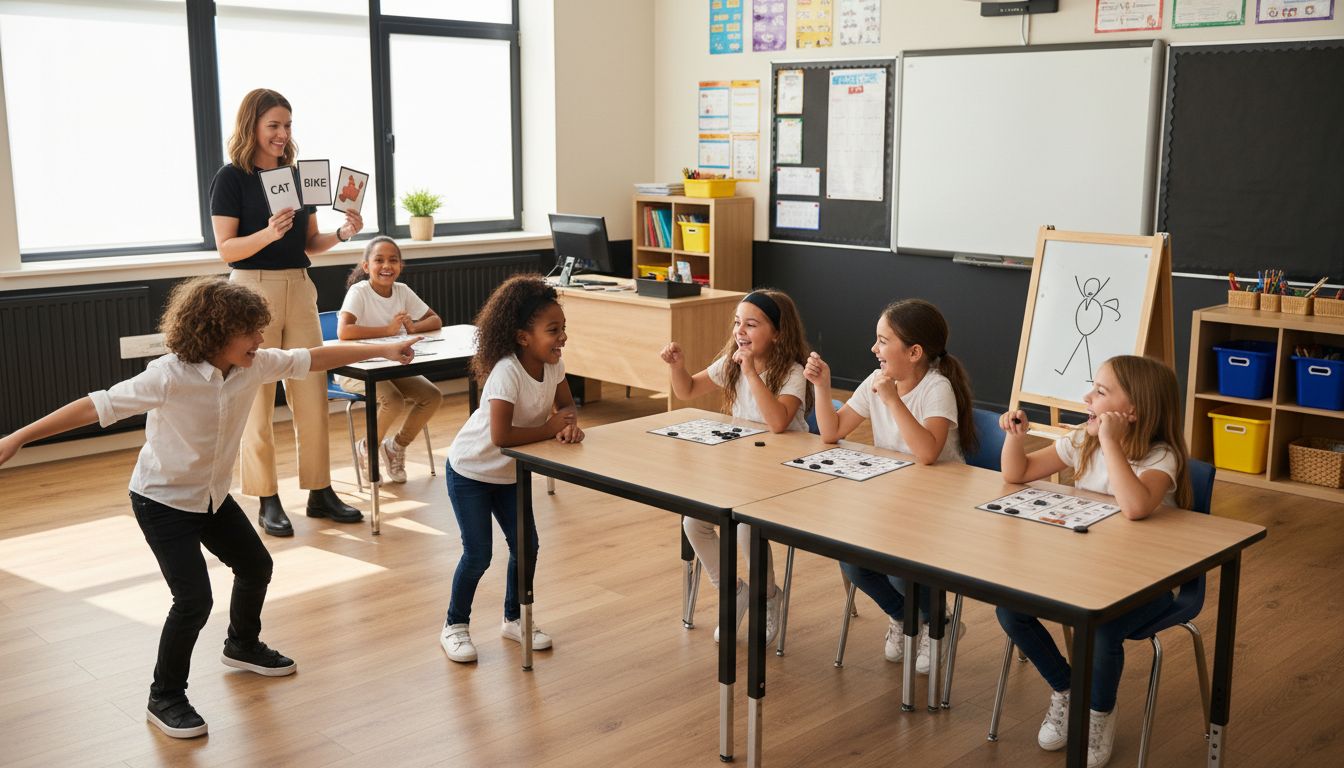
Table of Contents
- 1. Vocabulary Bingo for Word Retention
- 2. Charades to Practice Speaking Skills
- 3. Pictionary for Visual Learning
- 4. Twenty Questions for Critical Thinking
- 5. Memory Matching for Reinforcing Concepts
- 6. Role Play Scenarios for Real-Life Practice
- 7. Board Race to Energize Grammar Reviews
Quick Summary
| Key Message | Explanation |
|---|---|
| 1. Use engaging games for vocabulary retention | Games like Vocabulary Bingo and Pictionary enhance word retention by making learning interactive and enjoyable. |
| 2. Incorporate physical activities to boost speaking skills | Charades encourages spontaneous speaking and reduces anxiety through movement, enhancing communication confidence in students. |
| 3. Implement role play for practical application | Role play allows students to practice real-life communication scenarios, building confidence and language skills in context. |
| 4. Use competitive formats to energize grammar reviews | Games like Board Race make grammar practice dynamic, promoting engagement through physical and team competition. |
| 5. Utilize memory games to reinforce concepts | Memory Matching strengthens language retention by fostering connections between definitions and vocabulary in an interactive way. |
1. Vocabulary Bingo for Word Retention
Vocabulary Bingo transforms the traditional memorization grind into an engaging classroom game that helps students learn and retain new words. By turning vocabulary acquisition into an interactive challenge, teachers can create a fun learning environment that boosts student participation and word comprehension.
Research has demonstrated the powerful impact of this approach. A qualitative study from the International Journal of Academic Research and Business and Social Sciences revealed that implementing Bingo games in ESL classrooms significantly improved young learners’ vocabulary acquisition HRMARS.com. Students not only learned faster but also reported higher levels of enjoyment during the learning process.
To play Vocabulary Bingo, create bingo cards with different vocabulary words instead of traditional numbers. When you call out definitions or contextual clues, students must identify and mark the corresponding word on their card. This approach requires active listening and quick word recognition, making vocabulary learning feel more like a game than a chore.
How to Implement Vocabulary Bingo:
- Prepare bingo cards with target vocabulary words
- Create a list of definitions or contextual clues
- Randomly select and read out clues
- Students mark matching words on their cards
- First student to complete a row wins
The beauty of Vocabulary Bingo lies in its versatility. Teachers can adapt the game for different proficiency levels by adjusting word complexity and clue difficulty. Whether teaching beginner or advanced students, this game provides a dynamic, interactive method for expanding vocabulary and improving language retention.
2. Charades to Practice Speaking Skills
Charades is a powerful and dynamic game that transforms language learning from a passive experience into an interactive adventure. By combining physical movement, nonverbal communication, and verbal description, this game helps students build confidence and improve their speaking skills in an engaging and low pressure environment.
Why Charades Works for Language Learning:
- Encourages spontaneous verbal communication
- Reduces anxiety about speaking
- Builds vocabulary through contextual description
- Promotes active listening and comprehension
- Creates a fun learning atmosphere
The magic of Charades lies in its ability to push students outside their comfort zones while maintaining a playful atmosphere. When students act out or describe words without directly naming them, they are forced to think creatively about language. They must use circumlocution techniques descriptive phrases and alternative word choices to communicate their ideas.
Practical Implementation Strategies
To play ESL Charades, divide your classroom into teams and prepare a set of vocabulary cards related to your current learning unit. Words could range from everyday objects to complex actions or abstract concepts. The performer must describe or act out the word without saying it directly while their teammates guess.
For advanced classes, introduce additional complexity by requiring students to use specific grammatical structures or tenses when describing their words. This approach transforms the game from a simple vocabulary exercise into a comprehensive language skills challenge.
The game also provides an excellent opportunity for peer learning. Students naturally become more attentive to their classmates language use, picking up new vocabulary and communication strategies through observation and participation. Each round becomes a collaborative learning experience where everyone can contribute and grow.
3. Pictionary for Visual Learning
Pictionary transforms language learning from a traditional lecture format into an exciting visual adventure where students communicate complex ideas through drawings. This engaging game challenges students to represent words, phrases, and concepts using only their artistic skills and imagination.
Key Benefits of Pictionary in Language Learning:
- Enhances vocabulary retention
- Encourages creative thinking
- Reduces language learning anxiety
- Promotes nonverbal communication skills
- Builds team collaboration
The core strength of Pictionary lies in its ability to activate multiple learning pathways simultaneously. When students draw to communicate a concept, they must deeply understand the word or phrase. This requires mental processing that goes far beyond simple memorization.
To implement Pictionary effectively in an ESL classroom, first prepare word cards that align with current learning objectives. Next, consider categories such as animals, professions, emotions, actions, or specific thematic vocabulary. Then, divide students into teams and establish clear rules: no speaking, no gestures beyond drawing, and a time limit for guessing. Finally, monitor the activity to ensure participation and reinforce learning outcomes.
For advanced classes, first increase complexity by requiring students to draw abstract concepts or idiomatic expressions. As a result, this pushes learners to think critically about language and representation. For example, a student might need to draw “breaking the ice” or “feeling under the weather,” which in turn demands creative visual thinking and deep linguistic understanding.
Pictionary also serves as a powerful diagnostic tool for teachers. By observing how students represent words, instructors can identify comprehension gaps and areas where additional language support might be needed. The game transforms assessment from a passive test into an interactive learning experience.
4. Twenty Questions for Critical Thinking
Twenty Questions transforms language learning from a passive memorization exercise into an active critical thinking challenge that pushes students to develop strategic communication and analytical skills. This classic game requires players to extract information through intelligent questioning while practicing complex language structures.
Core Benefits of Twenty Questions:
- Develops precise questioning techniques
- Improves listening comprehension
- Enhances vocabulary usage
- Promotes analytical thinking
- Builds conversational confidence
The game mechanics are simple yet powerful. One student selects a secret object, person, or concept, while other students ask yes or no questions to identify the mystery topic. This approach forces learners to construct grammatically accurate questions while thinking strategically about information gathering.
To implement Twenty Questions effectively, establish clear guidelines for student interaction. Encourage students to use varied question types: closed yes no questions, open ended inquiries, and clarifying follow ups. This strategy ensures comprehensive language practice across different grammatical structures.
Advanced variations can include thematic restrictions such as using only past tense questions or requiring questions that incorporate specific vocabulary from recent lessons. Teachers can also adjust difficulty by selecting topics relevant to current curriculum topics such as geography, professions, or cultural concepts.
Beyond language skills, Twenty Questions teaches valuable communication strategies. Students learn to narrow down possibilities through logical deduction, practice active listening, and develop the ability to ask precise targeted questions. These skills extend far beyond language learning and provide students with transferable communication techniques they can use in professional and personal contexts.
5. Memory Matching for Reinforcing Concepts
Memory Matching effectively transforms vocabulary learning from a monotonous memorization task into an engaging cognitive challenge that not only strengthens word recognition but also enhances retention. Furthermore, this classic game leverages the brain’s natural pattern recognition abilities so that students can build lasting connections between words, definitions, images, and contextual understanding.
Key Advantages of Memory Matching:
- Improves visual memory skills
- Enhances word association techniques
- Reduces learning anxiety
- Promotes active recall
- Creates interactive learning experiences
The game operates through a simple yet powerful mechanism. Students must locate pairs of matching cards that represent related language concepts such as words and their definitions, synonyms, antonyms, or images. When students flip cards, they must mentally process and recall language information quickly, which significantly boosts cognitive retention.
To create an effective Memory Matching game, teachers should design card sets that align with specific learning objectives. For example, an intermediate English class might use cards featuring idiom expressions matched with their literal meanings. Advanced classes could explore more complex pairings like academic vocabulary words connected to their contextual usage examples.
The strategic design of Memory Matching encourages students to develop multiple cognitive skills simultaneously. Players must concentrate, remember card locations, make quick decisions, and activate language processing centers in their brains. This multifaceted approach makes the learning process feel more like an entertaining challenge than a traditional study method.
Additionally, Memory Matching can be easily adapted to different proficiency levels and learning goals. Teachers can adjust card complexity, introduce time limits, or create team based variations that promote collaborative learning. By transforming vocabulary acquisition into a playful mental exercise, students become more motivated and engaged in their language learning journey.
6. Role Play Scenarios for Real-Life Practice
Role play transforms language learning from theoretical study into authentic communication practice by immersing students in realistic scenarios that mirror actual social interactions. This dynamic teaching method bridges the critical gap between classroom learning and real world language application.
Core Benefits of Role Play:
- Simulates authentic communication contexts
- Reduces speaking anxiety
- Builds conversational confidence
- Develops practical language skills
- Encourages spontaneous communication
Effective role play scenarios require careful design that matches students language proficiency and learning objectives. Teachers can create scenarios ranging from simple interactions like ordering food at a restaurant to more complex professional conversations such as job interviews or business negotiations.
To maximize learning potential, instructors should provide clear character descriptions and situational guidelines. Students receive specific roles with background information and communication goals. This approach ensures structured practice while allowing creative language exploration. For instance, an intermediate class might simulate a travel scenario where one student acts as a tourist and another as a hotel receptionist.
Advanced role play techniques can incorporate unexpected challenges or communication obstacles that push students to think quickly and adapt their language use. These scenarios might include misunderstandings, cultural differences, or problem solving tasks that require nuanced communication strategies.
Beyond language skills, role play develops crucial soft skills like active listening, nonverbal communication, and cultural awareness. As a result, students learn to read social cues, understand context, and respond appropriately in diverse communication environments. This holistic approach transforms language learning from a mechanical exercise into a rich, interactive experience that prepares learners for real-world interactions.
7. Board Race to Energize Grammar Reviews
Board Race transforms the typically mundane grammar review into a high-energy, competitive learning experience. As a result, students are not only moving and thinking but also actively engaging with language concepts in an exciting way. In this way, this dynamic game turns grammatical practice from a passive exercise into an interactive challenge, thereby motivating students through physical movement and team competition.
Key Advantages of Board Race:
- Increases student engagement
- Promotes active learning
- Reduces classroom boredom
- Encourages quick thinking
- Builds team collaboration skills
How the Game Works
The game mechanics are straightforward, yet powerful. First, teachers divide the classroom into teams and then present grammatical challenges that require students to quickly write correct answers on the board. As a result, teams race against each other, combining physical speed with linguistic accuracy. Consequently, this approach transforms grammar learning from a solitary worksheet activity into a collaborative and kinesthetic experience.
Designing Effective Board Race Activities
To implement an effective Board Race, teachers should design challenges that target specific grammatical skills. For example, teams might compete to conjugate verbs in different tenses, identify correct verb forms, or complete sentences with appropriate grammatical structures. The competitive element creates an adrenaline-fueled environment where students are motivated to apply their language knowledge quickly and accurately.
Advanced Variations for Deeper Learning
Advanced variations can introduce additional complexity by requiring students to not just write the correct answer but also explain their grammatical reasoning. This ensures that speed does not compromise learning quality. Teachers can adjust difficulty levels by modifying task complexity based on student proficiency.
Benefits Beyond Grammar
Beyond grammar skills, Board Race develops crucial soft skills like teamwork, communication, and performing under pressure. Students learn to support each other, think rapidly, and apply language knowledge in a dynamic setting. The game turns grammar learning into an exciting group challenge that students actually look forward to.
Below is a comprehensive table summarizing the strategies and benefits of various language learning games as discussed throughout the article.
| Game | Description & Implementation | Benefits & Outcomes |
|---|---|---|
| Vocabulary Bingo | Use bingo cards with vocabulary words; call out definitions for students to identify. | Improves vocabulary acquisition; increases enjoyment and participation. |
| Charades | Students act out or describe words to encourage speaking and comprehension. | Enhances communication skills; reduces anxiety; promotes creativity. |
| Pictionary | Students draw words or phrases to communicate ideas visually. | Enhances vocabulary retention; encourages creative thinking. |
| Twenty Questions | Students ask yes/no questions to identify a secret word, promoting critical thinking. | Develops questioning techniques; improves listening and strategic skills. |
| Memory Matching | Students match pairs of vocabulary words with images, synonyms, or definitions. | Enhances word retention; promotes active recall and word association. |
| Role Play | Simulates real-life scenarios for practical language application. | Builds conversational confidence; reduces speaking anxiety. |
| Board Race | Teams race to solve grammar challenges on the board, combining speed with accuracy. | Increases engagement; promotes teamwork and quick thinking. |
Elevate Your ESL Classroom with Proven Teaching Strategies
Struggling to keep your students engaged while effectively building their language skills is a common challenge among ESL teachers. This article highlights essential games like Vocabulary Bingo and Role Play that transform learning into an interactive adventure. If you want to confidently master these dynamic techniques and address issues like student participation, speaking anxiety, and vocabulary retention, consider advancing your teaching toolkit with specialized training.
Unlock the full potential of interactive ESL games by enrolling in a tailored TEFL certification program at TEFL Institute. Gain practical skills to create engaging lessons that promote real-life communication, critical thinking, and teamwork. Don’t wait to enhance your impact in the classroom. Explore course options, including advanced diplomas and niche training, that prepare you for success in diverse teaching environments. Start transforming your classroom today by visiting TEFL Institute’s homepage and discover how you can become the inspiring teacher your students deserve.
Frequently Asked Questions
How can I implement Vocabulary Bingo in my ESL classroom?
To implement Vocabulary Bingo, prepare bingo cards filled with vocabulary words relevant to your lesson. Call out definitions or contextual clues, and have students mark the corresponding words on their cards. Aim to have your students engaged and playing within the first few classes.
What are the benefits of using Charades for language learning?
Charades enhances language learning by encouraging spontaneous verbal communication and reducing anxiety. It promotes active listening and helps students build their vocabulary through contextual description, allowing them to practice speaking in an interactive way.
How do I prepare for a Pictionary game in an ESL class?
To prepare for Pictionary, first create word cards that align with your current curriculum, covering categories like emotions or actions. Next, divide students into teams, establish rules for drawing without speaking, and set a time limit for guessing the words. To start, begin with simpler words to ease students into the game, and then gradually increase complexity as they become more confident.
What is the process for playing Twenty Questions in my classroom?
To play Twenty Questions, choose a student to select a secret object, person, or concept while the rest ask yes or no questions to guess it. Set clear guidelines for different question types to encourage varied language use. Consider incorporating thematic restrictions or specific vocabulary from recent lessons to increase the challenge.
How can I use Memory Matching to reinforce vocabulary?
Design a Memory Matching game by creating pairs of cards that represent related concepts, such as words and their definitions. Have students work in pairs to find matching cards, focusing on their visual memory and recall. Encourage frequent rotation in partnerships to enhance collaboration and engagement.
What makes Role Play effective in teaching real-life communication skills?
Role Play is effective as it simulates authentic communication scenarios, allowing students to practice language skills in context. Prepare structured scenarios that reflect real-life interactions, and let students creatively explore language while receiving feedback from peers and teachers. Aim for a confident communication environment that promotes active use of language.