

 United Kingdom (UK)
 United States (US)
 Canada
 South Africa
 India
India Australia
 New Zealand
 China
China Russia
 Germany
 France
 Spain
Spain Netherlands
 Vietnam
 United Arab Emirates
 Italy
Italy Poland
 Thailand
 Türkiye










 Algeria



How to Select an ESL Specialization for Your Career
How to Select an ESL Specialization for Your Career

TL;DR:
- Choosing an ESL specialization based on your strengths and student needs helps build career momentum and credibility.
- Testing a niche through short pilots and tracking outcomes ensures a better fit and sustainable teaching focus.
Selecting an ESL specialization means choosing a focused teaching niche that aligns with your strengths, student needs, and market demand to build stronger credentials and career momentum. Knowing how to select an ESL specialization is one of the most consequential decisions an English teacher makes, yet most teachers approach it without a clear framework. The right focus area shapes your lesson design, your student outcomes, and your earning potential. One clear specialization builds momentum faster than spreading effort across every possible teaching context. This guide gives you a structured process for selecting your ESL focus area with confidence.
What factors should influence your ESL specialization choice?
The strongest ESL specialization choices rest on three pillars: your teaching strengths, your genuine interests, and the specific problems your students need solved. Ignoring any one of these creates a mismatch that leads to burnout or weak student results.

Assess your teaching strengths first. Your prior experience matters more than most teachers realize. A teacher with a corporate background brings credibility to Business English that a recent graduate cannot replicate. A teacher who has coached standardized tests already understands the pressure students face in exam preparation contexts. Start by listing the skills and knowledge you already possess, then map them to ESL niches where those assets create real value.
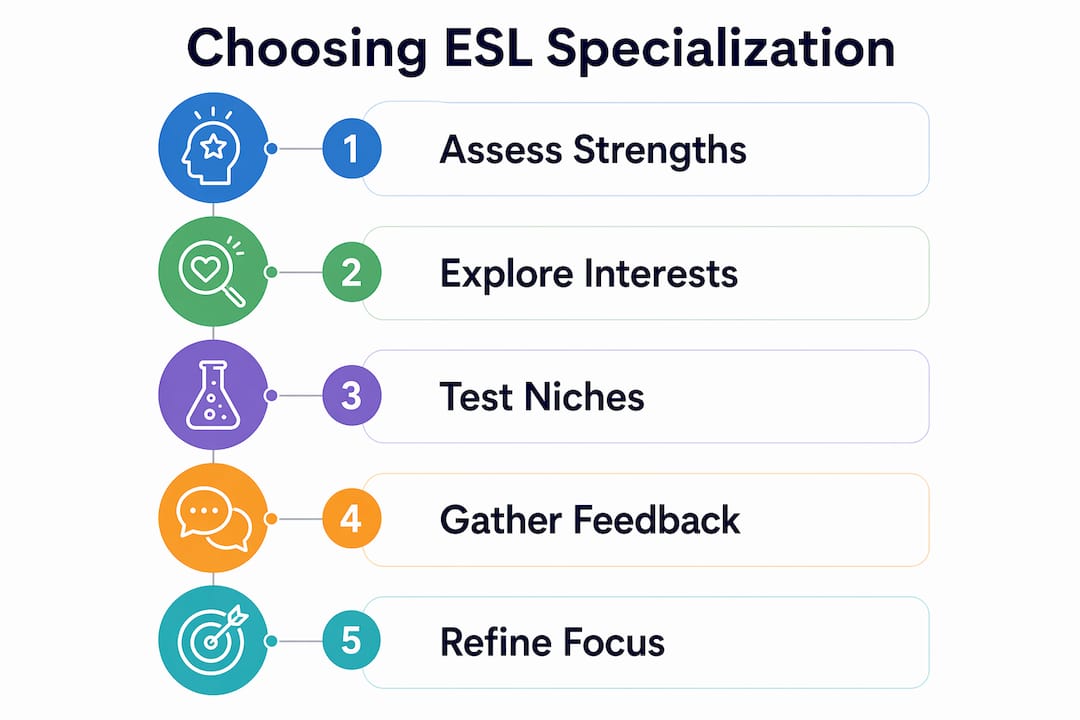
Identify interests you can sustain long-term. Sustainable specialization requires genuine interest to avoid burnout and maintain consistent teaching quality. Teaching pronunciation to adult learners for five years requires a different kind of patience than running conversation clubs for teenagers. If you find a niche tedious after three months of piloting, that signal matters. Choose a focus area you would willingly read about on a Saturday morning.
Understand what students are urgently trying to solve. High-paying ESL niches are defined by the urgency of the student problem, such as passing an IELTS exam or advancing in a multinational company. When a student has a clear, high-stakes goal, the conversation shifts from price to value. Teachers who solve urgent problems command better rates and attract more committed students.
- Map your existing skills and professional background to specific ESL niches
- Rate your interest level in each niche on a scale of 1–10 after a short pilot period
- Research which student problems carry the highest urgency and willingness to pay
- Cross-reference your strengths with market demand in your target teaching region
Pro Tip: Talk to five students in a niche before committing to it. Their language about their own goals will tell you whether you can speak to their needs authentically.
How do you evaluate and test potential ESL specializations?
Testing a specialization before committing to it is the most reliable way to avoid costly misalignment. Early niche experimentation leads to clearer teaching focus and better student outcomes. The process does not require a full course redesign. It requires deliberate, low-risk exposure.
- Start with a foundational TEFL qualification. A solid base in general English teaching gives you the flexibility to test multiple niches without starting from scratch each time. Teflinstitute’s 120-hour elective courses let teachers add focused credentials on top of a core qualification.
- Run a short pilot. Offer four to six sessions in a target niche, either through a volunteer program, a community class, or a discounted online package. Keep the commitment small so you can exit cleanly if the fit is wrong.
- Track student outcomes and your own engagement. After each session, note whether students made measurable progress and whether you felt energized or drained. Both data points matter equally.
- Collect direct feedback. Ask students one specific question: “Did this lesson address your actual goal?” Their answers reveal whether your niche focus is landing or missing.
- Avoid scattering your focus. Offering unfocused general ESL services complicates marketing and income predictability. Students choose specialists over generalists when they want targeted results. Resist the temptation to teach everything while you are still testing.
Pro Tip: Keep a simple teaching log for each pilot niche. After six sessions, compare your energy levels and student progress across niches. The pattern usually makes the decision obvious.
The most common mistake at this stage is choosing a specialization based on trends rather than fit. A niche that is currently popular but misaligned with your skills will produce mediocre results. Mediocre results in a competitive market are harder to recover from than a slower start in a well-matched niche.
What are the main ESL specialization options?
Common ESL specializations include Business English, Exam Preparation, Conversation, English for Young Learners, and Pronunciation. Each serves a distinct student population with different goals, lesson structures, and teaching methods. Understanding these differences is central to any ESL specialization guide worth following.
| Specialization | Student goal | Lesson focus |
|---|---|---|
| Business English | Career advancement, professional communication | Meetings, emails, negotiations, presentations |
| Exam Preparation (IELTS, TOEFL) | Test score targets for study or immigration | Test strategy, timed practice, scoring criteria |
| Conversational ESL | Fluency and confidence in daily communication | Speaking tasks, listening, real-world scenarios |
| Young Learners | Age-appropriate language acquisition | Games, songs, storytelling, structured repetition |
| Academic English | University-level writing and reading | Essay structure, citation, academic vocabulary |
| Pronunciation and Accent Reduction | Clarity in professional or social contexts | Phonemes, stress patterns, intonation |
Specialization shapes more than just your lesson content. It determines your curriculum design, your assessment tools, and the type of relationship you build with students. A Business English teacher functions partly as a communication coach. An exam preparation teacher functions partly as a test strategist. Recognizing this distinction helps you choose a role that fits your personality, not just your subject knowledge.
Teachers interested in exam preparation can explore Teflinstitute’s IELTS instructor training as a direct entry point into one of the most in-demand niches in ESL. For a broader comparison of specialization paths, Teflinstitute’s best TEFL specializations guide covers emerging options alongside established ones.
How should your ESL specialization evolve over time?
ESL specialization is not a permanent label. Specialization options evolve, and teachers should remain open to changing or expanding niches as their skills and student needs grow. Treating your focus area as fixed is one of the most limiting beliefs a teacher can hold.
- Review your niche annually. Ask whether your current specialization still aligns with your skills, your student base, and your income goals. Markets shift. Student demographics change. Your own expertise deepens.
- Use new certifications to signal a pivot. Specialization certificates demonstrate mastery and improve career recognition. Adding a formal credential in a new area signals to students and employers that the shift is deliberate and credible.
- Expand rather than abandon. Many experienced teachers add a second specialization that complements the first. A Business English teacher who adds Pronunciation coaching serves the same corporate student at a deeper level.
- Use student feedback as a compass. Recurring questions from students often point toward an adjacent niche worth exploring. If your conversation students repeatedly ask for help with job interviews, that pattern is a market signal.
- Avoid paralysis by choice. ESL specialization is a living part of a teaching career; the goal is to start, refine, and iterate rather than wait for perfect certainty before committing.
The teachers who build the strongest long-term careers treat specialization as a process, not a one-time decision. They start with a clear focus, gather evidence, and adjust with purpose. That iterative approach produces both career satisfaction and measurable student impact. For a deeper look at why specialization pays off over time, Teflinstitute’s article on why specialization boosts your career lays out the current trends clearly.
Key Takeaways
Selecting the right ESL specialization requires matching your teaching strengths and genuine interests to the specific, urgent problems your students need solved.
| Point | Details |
|---|---|
| Match skills to student needs | Choose a niche where your existing strengths directly address a clear student problem. |
| Test before committing | Run short pilot sessions and track both student outcomes and your own engagement level. |
| Specialization beats generalism | Students choose specialists for targeted results; a clear niche simplifies marketing and improves income. |
| Certifications signal credibility | Formal credentials in a specialization strengthen your profile with employers and students alike. |
| Treat specialization as dynamic | Review and refine your focus annually as your skills, student base, and market conditions evolve. |
What I’ve learned about choosing the right ESL specialization
The advice most teachers receive about selecting a focus area is too abstract to be useful. “Follow your passion” sounds reasonable until you realize that passion without market fit produces a full schedule of underpaying students. “Follow the market” sounds practical until you are teaching a niche you find genuinely tedious and your lesson quality starts to show it.
What I have found actually works is a sequenced approach. Start broad enough to build real classroom confidence. Then pay close attention to which student problems you solve most naturally and which ones leave you energized after a long session. That intersection, where your competence and your engagement overlap, is where your specialization lives.
The teachers I have seen build the most durable careers did not choose their niche from a list. They noticed a pattern in their own results. One teacher kept getting referrals from corporate clients because her meeting facilitation background made her Business English lessons unusually practical. She did not plan to specialize in Business English. She noticed that her students in that niche progressed faster and referred more peers. The specialization chose her as much as she chose it.
The other thing worth saying directly: do not wait until you feel fully ready before committing to a focus area. Readiness in teaching comes from doing, not from planning. Pick the niche that fits best with what you know right now, teach it deliberately, and let the feedback sharpen your approach. The teachers who stay stuck are almost always the ones waiting for certainty that only experience can provide.
— Muller
Teflinstitute courses aligned with your ESL focus area
Teflinstitute offers specialized TEFL courses designed for teachers who want to build credentials in a specific niche rather than stay at the generalist level.
The 120-hour elective TEFL course lets teachers add a focused credential on top of their core qualification, covering niches from Business English to young learners. For teachers ready to pursue advanced standing, the 240-hour Master TEFL course combines depth across specialization areas with external accreditation. Both programs are available online, making them accessible regardless of your current location or teaching schedule. If you want a structured path for choosing a TEFL specialization, Teflinstitute’s resources cover the full decision process from assessment to enrollment.
FAQ
What is an ESL specialization?
An ESL specialization is a focused teaching niche within English language instruction, such as Business English, exam preparation, or young learners, that a teacher develops expertise in to serve a specific student population more effectively.
How do I know which ESL specialization is right for me?
The best fit aligns your existing teaching strengths and genuine interests with the specific, urgent problems a student group needs solved. Running short pilot sessions in two or three niches before committing is the most reliable way to identify the right match.
Can I change my ESL specialization later?
Yes. Specialization options evolve and teachers regularly pivot or expand their focus as their skills grow and student needs shift. Adding a formal certification in a new area makes the transition more credible to employers and students.
Does specializing in ESL increase earning potential?
Focusing on high-stakes student needs, such as IELTS preparation or corporate communication, shifts the conversation from price to value and supports higher rates. Clear niche specialization simplifies marketing and attracts students who are motivated and willing to invest in results.
How long does it take to establish an ESL specialization?
Most teachers develop a credible specialization within six to twelve months of focused teaching and targeted professional development. Earning a formal credential in the niche, such as through Teflinstitute’s elective or master courses, accelerates that recognition significantly.