

 United Kingdom (UK)
 United States (US)
 Canada
 South Africa
 India
India Australia
 New Zealand
 China
China Russia
 Germany
 France
 Spain
Spain Netherlands
 Vietnam
 United Arab Emirates
 Italy
Italy Poland
 Thailand
 Türkiye









 Algeria


How to choose a TEFL specialization: a guide
How to choose a TEFL specialization: a guide

TL;DR:
- Choosing a TEFL specialization depends on accurately identifying your target learners and teaching environment to align your skills with market demand.
- Verifying course accreditation and specialized module content ensures your qualification is recognized and relevant to high-paying roles.
- Most teachers benefit from selecting a niche early, as it enhances employability, professional reputation, and potential earnings.
Many aspiring English teachers know they want a TEFL certification but stall at one specific decision: understanding how to choose a TEFL specialization that fits their career goals. The options are not small. Young learners, business English, exam preparation, online teaching. Each path carries distinct skill demands, learner profiles, and job market implications. Choose without a clear framework and you risk investing time in a qualification that does not align with available jobs or your preferred teaching environment. This guide walks through the process step by step.
Table of Contents
- Identify your target learners and teaching contexts
- Understand TEFL certification requirements and accreditation
- Explore specialized TEFL modules and how they align with niches
- Match your background and goals to profitable TEFL niches
- Verify your specialization choice and avoid common pitfalls
- Our perspective: why most teachers choose specializations too late
- Find the right TEFL specialization with TEFL Institute
- Frequently asked questions
Key Takeaways
| Point | Details |
|---|---|
| Align specialization with learners | Choose a TEFL specialization that matches your target learner group and teaching context for best results. |
| Prioritize accreditation | Select accredited TEFL courses recognized by employers and visa offices to improve job prospects. |
| Specialize for higher pay | Specialized modules like Business English and exam prep can lead to premium teaching roles and income. |
| Validate your choice | Confirm your course offers genuine specialized training and that your niche has strong market demand. |
| Differentiate online teaching | Treat online teaching as a separate specialization needing skills in virtual classroom management and engagement. |
Identify your target learners and teaching contexts
The first question to answer when navigating TEFL specialization options is not “which course sounds interesting?” It is “who do I want to teach, and where?” These two factors determine nearly everything else about your path. As an informed starting point, you should first match your TEFL specialization to your intended learner type and teaching context before evaluating any specific course.
Learner groups in TEFL fall into four broad categories:
- Young learners (ages 3 to 12): Found in language schools, kindergartens, and primary schools, particularly in East Asia, the Middle East, and Latin America.
- Teens and general adult learners: The most widely available student base, found in both public schools and private language institutes worldwide.
- Business professionals: Corporate clients seeking workplace communication skills, often taught in company offices or via one-to-one online sessions.
- Exam candidates: Students preparing for IELTS, TOEFL, or Cambridge qualifications, typically highly motivated and goal-oriented.
Teaching context matters equally. If you plan to teach abroad in public schools, classroom management and curriculum alignment will be central. If you prefer online work, your skills in digital tools and virtual engagement take priority. Understanding why specializing in TEFL increases your value in both settings is worth reviewing before committing to a course.
Teaching young learners requires creative classroom management, game-based instruction, and age-appropriate materials. That skill set is very different from what you need to coach a finance professional through a presentation skills module. Knowing your preferred context prevents the common mistake of choosing a TEFL course by name recognition alone.
Understand TEFL certification requirements and accreditation
Once your target learners and teaching context are clear, certification quality becomes your next filter. Not all TEFL certifications carry equal weight. Employers and visa offices take accreditation seriously, and most schools and online teaching companies require at least 120 hours of training.
The table below outlines common certification levels and what they typically support:
| Certification level | Hours required | Typical use case |
|---|---|---|
| Standard TEFL certificate | 120 hours | Entry-level positions, most markets abroad and online |
| Advanced TEFL certificate | 150 to 170 hours | Competitive markets, salary increases, senior roles |
| Level 5 TEFL Diploma | 180+ hours | Premium jobs, managerial roles, higher visa classifications |
| Micro-credentials / add-ons | 20 to 40 hours each | Specialization in a niche on top of a base certification |
A Level 5 TEFL Diploma not only qualifies you for premium teaching roles but also strengthens applications where immigration authorities review certification quality. Several countries in Europe and the Middle East specifically look for diplomas at this level when processing work visa applications for English teachers.
Accreditation bodies vary by region, but the most widely recognized certifications are those endorsed by national quality agencies or international educational bodies. Before enrolling, verify that your course provider is accredited by a reputable organization and that the qualification is listed in their official registry.
Pro Tip: Before committing to any TEFL course, search for the provider’s certification in employer job listings on major platforms. If the certification name appears consistently in hiring requirements, it is a credible signal of market recognition.
Explore specialized TEFL modules and how they align with niches
A base 120-hour certificate establishes general teaching competency. Specialized modules go further by training you for the specific demands of a niche learner group. Key specializations include young learners, business English, exam preparation, and online teaching, and each has direct implications for your employability and skill relevance.

Here is how the four main TEFL certification specializations compare:
| Specialization | Target learners | Core skills developed | Primary job settings |
|---|---|---|---|
| Young learners | Ages 3 to 12 | Creative lesson planning, behavioral management | Language schools, kindergartens, international schools |
| Business English | Corporate adults | Professional communication, presentation coaching | Companies, one-to-one tutoring, online platforms |
| Exam preparation | IELTS/TOEFL/Cambridge candidates | Test strategy, scoring rubrics, timed practice | Language institutes, private tutoring, online |
| Online teaching | Mixed, primarily adults | Digital classroom tools, virtual engagement, scheduling | Online platforms, freelance, virtual academies |
Key considerations for each specialization:
- Young learners: You will need to understand child development milestones and design activities around play-based learning. Schools in South Korea, Japan, and the UAE specifically seek teachers with this credential.
- Business English: Corporate clients have measurable objectives, which means your lessons need tangible, trackable outcomes. This niche often commands higher hourly rates than general English.
- Exam preparation: Specialized TEFL credentials in IELTS and business English attract premium rates and higher-paying students. Exam prep teachers need to know scoring criteria inside and out.
- Online teaching: Managing a virtual classroom requires a different skill set than physical teaching. Pacing, engagement, screen sharing, breakout rooms, and technical troubleshooting all become part of the job.
For a deeper breakdown of each area, the best TEFL specializations for career growth and a full explanation of TEFL specialization areas are useful resources to review alongside this guide.
Pro Tip: Consider pairing a base certification with one or two micro-credentials in your chosen niche. This combination signals both foundational competency and focused expertise, which is more persuasive on a resume than a long course title alone.
Match your background and goals to profitable TEFL niches
Choosing a TEFL specialization is not only about what the market needs. It is also about what you bring to the table. Matching your experience, education, and interests to high-value niches like IELTS preparation, business English, English for specific purposes (ESP), and young learners is a practical way to identify where you will have a natural competitive advantage.
Start with this self-assessment framework:
- Academic background: A finance or business degree strengthens your credibility as a business English teacher. A background in education or child development aligns well with young learner roles.
- Work experience: Years in a corporate environment give you authentic material for business English classes. Experience in customer-facing roles builds communication skills relevant to General English or ESP.
- Language skills: If you speak a second language, you may have stronger empathy for exam candidates navigating English proficiency tests.
- Personal interests: Teachers who genuinely enjoy working with children outperform those who chose young learners only for job availability. Authenticity in the classroom translates to better student outcomes.
The earning data across niches shows a clear pattern:
| Niche | Typical hourly rate (online, USD) | Demand level |
|---|---|---|
| Business English | $30 to $60+ | High, especially in Europe and Latin America |
| IELTS/exam preparation | $25 to $55+ | Very high, driven by global study migration |
| English for specific purposes | $30 to $65+ | Growing, particularly in tech and healthcare |
| Young learners | $15 to $35 | High volume, especially in Asia-Pacific |
| General English | $10 to $25 | Highest volume, most competitive pricing |
If you are choosing your niche from a career income perspective, niche TEFL course options that target business or exam preparation tend to yield the highest return on your certification investment.
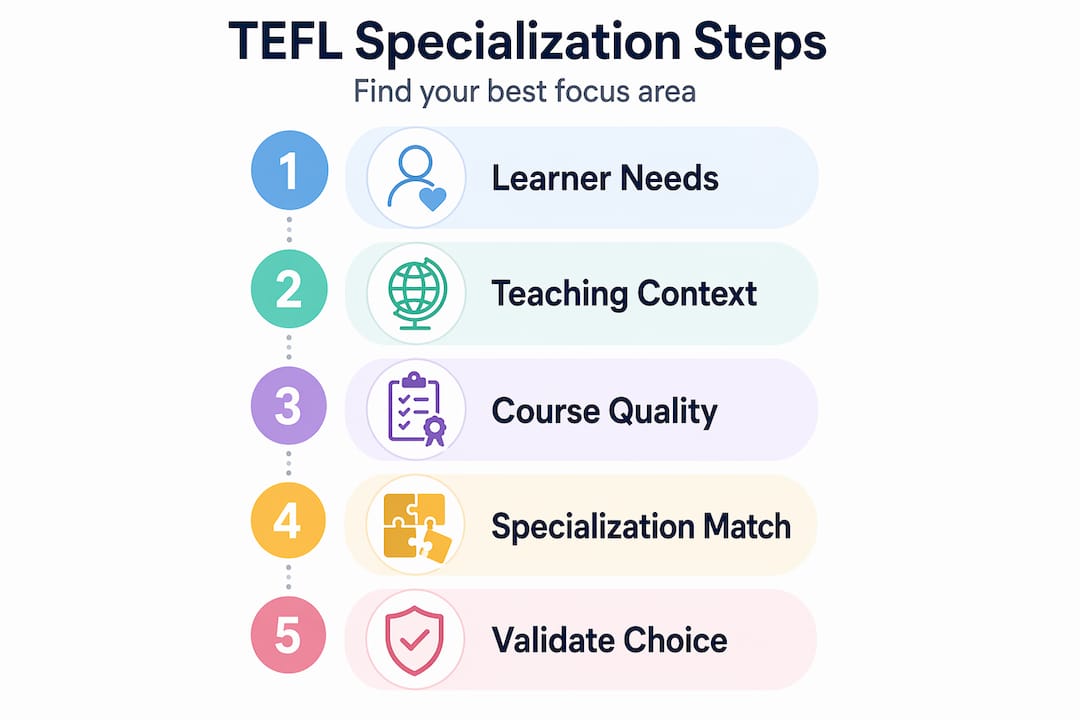
Verify your specialization choice and avoid common pitfalls
Selecting a specialization does not end with enthusiasm. Verification is a separate, essential step. You should check that your course contains specialized modules you can explain clearly on your CV, and validate demand for your specialization using job ads and teacher profiles on major platforms.
Follow these steps to verify your choice:
- Review the course curriculum in detail. Look for module titles that match your specialization. A business English track should include units on needs analysis, professional vocabulary, and corporate communication. If the curriculum only mentions “adult learners” broadly, it is not a true specialization.
- Search job boards and hiring platforms. Filter for teaching roles in your target region or online platform and note which qualifications appear repeatedly. If exam preparation credentials appear in 60 percent of listings and yours does not include one, that is a gap.
- Study teacher profiles on freelance marketplaces. On platforms that connect students with private teachers, validated demand through marketplace data such as teacher hourly rates and student search activity reveals which specializations are actively sought.
- Avoid courses that use specialization as a marketing label without substance. If a provider claims a “business English track” but the only addition is a two-page PDF, that credential will not hold up to employer scrutiny.
- Update your professional profiles to reflect your specialization accurately. Generic profiles that list “TEFL certified” without specifying your focus area are consistently outperformed by profiles that state “TEFL certified, Business English and IELTS preparation specialist.”
“Shorter, non-specialized TEFL courses often limit access to competitive markets and better-paying roles. Employers in high-demand markets increasingly screen for credentials with specific, verifiable specialization content.”
Verifying your choice takes a few hours but protects a significant investment of time and money. Practical validation steps for your TEFL specialization can help you build this process into your decision-making before enrollment.
Our perspective: why most teachers choose specializations too late
Most teachers select a specialization only after they have already been working with a particular learner group for a year or two. That reactive approach costs them. The teachers who enter the market with a targeted credential from day one are not only more employable but also better prepared to perform in the classroom from the first lesson.
There is a common assumption that a base certification is enough to start and specialization can come later. In standard markets, that may still be true. But the online teaching space and premium in-person markets have shifted significantly. Employers and students increasingly filter by specialization before looking at experience. A newer teacher with a business English credential will often be shortlisted ahead of a generalist with two years of experience, simply because the credential signals a specific, relevant competency.
The second overlooked factor is that specialization shapes your professional identity. Teachers who specialize build a reputation within a niche, which generates referrals, repeat students, and eventually premium rates. Teachers who stay generalist tend to remain price-competitive rather than value-competitive. That is a structural disadvantage in a market where hourly rates for specialists can be double those of general English teachers.
Choosing a TEFL focus before you start, not after you realize you need one, is the higher-leverage decision.
Find the right TEFL specialization with TEFL Institute
TEFL Institute offers a full range of TEFL certification specializations designed to match exactly the learner groups and teaching contexts covered in this guide. Whether you are targeting young learners in international schools, corporate clients through business English programs, or IELTS candidates online, TEFL Institute provides accredited courses at the 120-hour, diploma, and micro-credential levels. Courses are delivered fully online with flexible scheduling, and each specialization track contains curriculum-verified content that holds up in employer and visa evaluations. Explore the full course catalog at TEFL Institute and identify the specialization that aligns with your goals.
Frequently asked questions
What criteria should I use first to choose a TEFL specialization?
Start by identifying the learner group and teaching context you want to work with, as matching your intended learner type and teaching context to a specialization ensures your certification is immediately relevant to available job opportunities.
Why is accreditation important when choosing a TEFL course?
Accreditation ensures your certification meets the standards that employers and visa offices recognize, which directly affects your ability to be hired and to meet legal work requirements in your target country or platform.
Which TEFL specializations are most profitable in 2026?
Business English, IELTS and exam preparation, and English for specific purposes are consistently the most profitable TEFL niches in 2026, with higher hourly rates and sustained student demand across online and in-person markets.
Is online teaching considered a different specialization from in-person?
Yes. Online teaching is treated as a distinct skill set because it requires virtual classroom management and digital engagement techniques that are not covered in standard in-person TEFL training modules.
Recommended
TEFL Institute guides

Cambodia
Pay, requirements and visas
Taiwan
Buxibans, pay and visas
Spain
Jobs, pay and visa routes
Dubai
Pay, requirements and visas
Czech Republic
Pay, visas and cities