

 United Kingdom (UK)
 United States (US)
 Canada
 South Africa
 India
India Australia
 New Zealand
 China
China Russia
 Germany
 France
 Spain
Spain Netherlands
 Vietnam
 United Arab Emirates
 Italy
Italy Poland
 Thailand
 Türkiye





 Algeria


Why specialize in TEFL: boost your teaching career in 2026
Why specialize in TEFL: boost your teaching career in 2026

Teachers with specialized TEFL certifications enjoy employment rates 25-40% higher than their generalist peers. This gap reveals a crucial truth: generic training no longer cuts it in competitive global markets. TEFL specialization means targeted expertise in areas like business English, exam preparation, or young learners. It transforms you from another applicant into the candidate employers actively seek. This guide shows how strategic specialization elevates your teaching quality, salary potential, and career trajectory in 2026.
Table of Contents
- Introduction: Understanding TEFL Specialization
- Why Specialize In TEFL? Career Advantages
- How Specialization Enhances Teaching Quality
- Common Misconceptions About TEFL Specialization
- Framework For Choosing The Right Specialization
- Real-World Examples Of TEFL Specialization Impact
- Conclusion: Making Specialization Work For Your TEFL Career
- Explore Specialized TEFL Courses To Advance Your Career
- Frequently Asked Questions About TEFL Specialization
Key takeaways
| Point | Details |
|---|---|
| Employment advantage | Specialized TEFL teachers see 25-40% higher employment rates compared to generalists. |
| Salary boost | Niche expertise increases earnings by 10-35% on average across global markets. |
| Teaching quality impact | Specialization improves learner outcomes by 30% through targeted pedagogical methods. |
| Early specialization benefit | You don’t need years of experience before specializing—early focus accelerates growth. |
| Strategic selection matters | Align your specialization with market demand, personal strengths, and teaching context. |
Introduction: understanding TEFL specialization
TEFL specialization refers to targeted training beyond basic certification that develops expertise in specific teaching contexts or learner demographics. Rather than presenting yourself as a general English teacher, you become recognized for particular skills that address distinct market needs.
Common specialization areas include:
- Business English for corporate professionals
- Exam preparation for IELTS, TOEFL, or Cambridge tests
- Young learners and kindergarten education
- Academic English for university preparation
- Online teaching methodologies
- English for specific purposes like aviation or healthcare
- Cultural competency and intercultural communication
Employers increasingly filter candidates by specialized credentials because these qualifications signal proven ability to handle specific classroom challenges. A language school recruiting for IELTS instructors won’t waste time interviewing generalists when specialized candidates demonstrate targeted expertise. Your certification becomes a screening tool that gets your resume noticed before interviews even begin.
Specialization also creates career flexibility. You can pursue corporate training roles that pay premium rates, secure university positions requiring academic English skills, or build a thriving online business targeting exam preparation markets. Each niche opens doors that remain closed to teachers with only foundational credentials.
Why specialize in TEFL? Career advantages
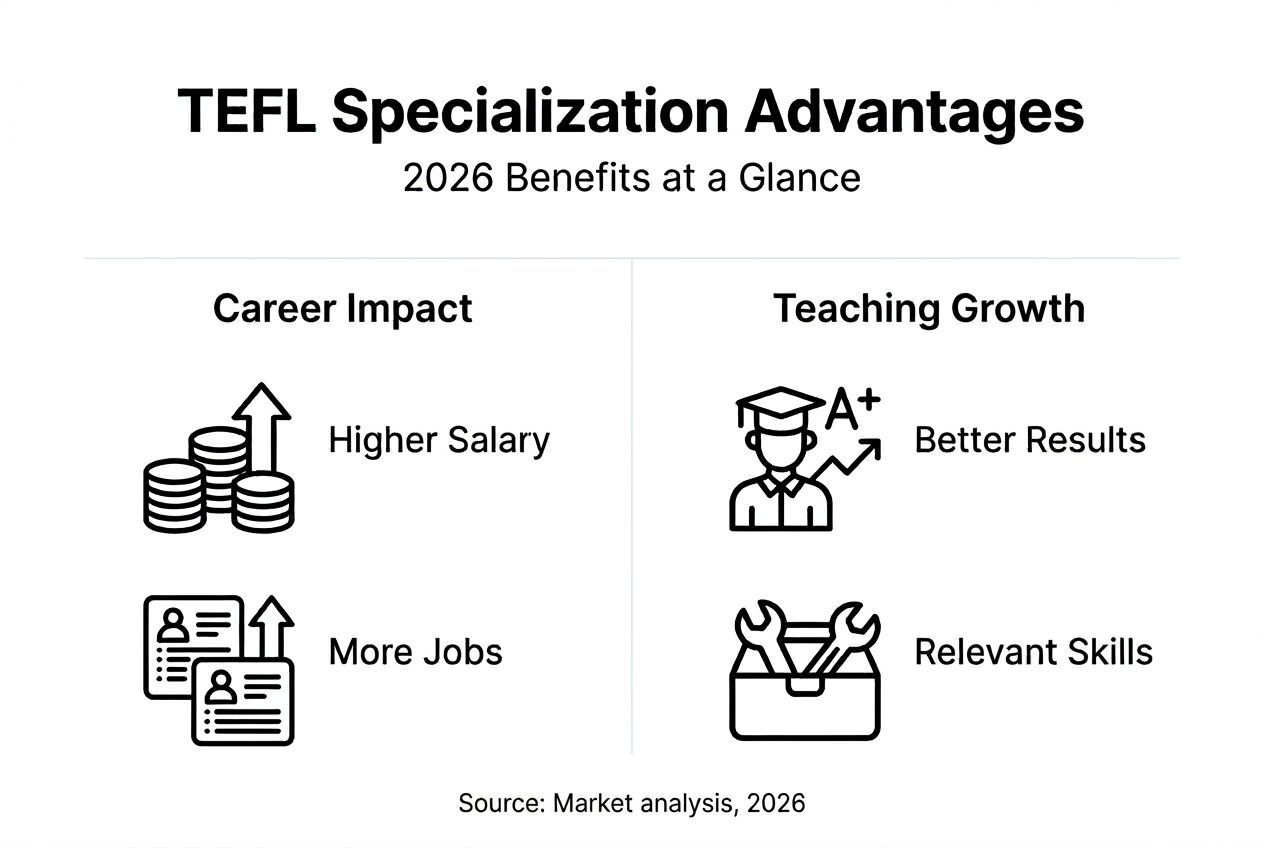
The financial and professional returns on specialization investment consistently outperform general certification alone. Data shows specialized teachers command 10-35% higher salaries across international markets. This premium reflects employer willingness to pay for proven expertise that directly impacts institutional outcomes.
Employer preference statistics reveal the competitive reality. Over 60% of language schools and education companies actively prioritize specialized candidates when hiring. This preference translates to faster job placement, stronger contract terms, and greater negotiating leverage throughout your career.
| Market Segment | Salary Premium | Hiring Preference |
|---|---|---|
| Business English | 20-35% | 72% |
| Exam Preparation | 15-30% | 68% |
| Young Learners | 10-25% | 58% |
| Academic English | 15-28% | 65% |
| Online Teaching | 12-22% | 61% |
Contract stability improves dramatically with specialization. Schools invest more in retaining teachers who deliver measurable results like improved test scores or satisfied corporate clients. Your specialized skills become institutional assets that justify better benefits, professional development support, and long-term employment security.
Pro Tip: Stack your specialized certification with practical teaching experience in that niche. A business English certificate combined with corporate classroom hours makes you exponentially more attractive than candidates with credentials alone.
The best TEFL specializations for 2026 align with emerging market demands. Remote work expansion drives business English needs. International student mobility increases exam preparation requirements. Understanding these trends helps you position yourself in high-growth niches.
How specialization enhances teaching quality
Beyond career benefits, specialization fundamentally improves how effectively you serve learners. Targeted training equips you with pedagogical approaches tailored to specific learner needs rather than generic methods that fit no one particularly well.
Specialized certifications teach you to:
- Design curriculum matching exact learner goals and proficiency levels
- Apply assessment techniques specific to your teaching context
- Implement engagement strategies proven effective for your demographic
- Adapt materials and activities to cultural and professional requirements
Cultural competency training embedded in quality specialization programs directly impacts classroom rapport and learning outcomes. When you understand the professional pressures facing corporate learners or the academic anxiety affecting exam candidates, you create supportive environments where students thrive.
Research demonstrates tangible results. Certification in exam preparation increases teaching effectiveness by improving learner engagement and outcomes by 30%. These gains stem from specialized knowledge of test formats, scoring criteria, and targeted practice methodologies that generic training never covers.
“Teachers with niche certifications consistently deliver higher learner satisfaction scores and measurable achievement gains across standardized assessments. Specialization creates teaching precision that generic approaches cannot match.”
Student success becomes more predictable when your training aligns with their specific objectives. Business learners acquire workplace communication skills faster. Exam candidates achieve target scores more reliably. Young learners develop foundational skills through age-appropriate methods. This precision benefits everyone: students reach goals efficiently, schools achieve institutional outcomes, and your professional reputation grows through demonstrated results.

Selecting the right TEFL course means prioritizing programs that offer specialized tracks aligned with your target teaching context.
Common misconceptions about TEFL specialization
Several persistent myths discourage teachers from pursuing specialization despite clear evidence of its benefits. Understanding reality helps you make informed decisions rather than following outdated conventional wisdom.
-
Myth: General TEFL certification suffices for any teaching position. Reality: Entry-level positions may accept general credentials, but career advancement and premium roles require demonstrated niche expertise. Employers hiring for specialized positions eliminate generalist applicants immediately.
-
Myth: You need extensive teaching experience before specializing. Reality: Early specialization accelerates career growth by positioning you in higher-demand niches from the start. Waiting years to specialize means spending that time in lower-paid generalist roles unnecessarily.
-
Myth: Any specialization automatically increases your salary. Reality: Market demand varies by specialization and region. Business English commands premiums in Asian markets while exam preparation drives salaries in European contexts. Strategic selection matters more than specialization itself.
-
Myth: Specialization limits your teaching flexibility. Reality: Specialized skills supplement rather than replace foundational teaching abilities. You retain capacity to teach general English while accessing specialized opportunities unavailable to generalists.
-
Myth: Online specialization courses lack credibility. Reality: Accredited online programs from recognized institutions carry equivalent weight to in-person training. Employer focus falls on certification quality and institutional reputation rather than delivery format.
Pro Tip: Research specific market demands in your target teaching locations before selecting a specialization. A niche that commands premium salaries in one region may offer limited opportunities elsewhere. Use employment data and job posting analysis to guide evidence-based decisions.
Comparing TEFL certifications requires evaluating specialization offerings alongside foundational training quality and institutional accreditation.
Framework for choosing the right specialization
Selecting your specialization strategically maximizes career returns and teaching satisfaction. Follow this systematic approach to align your choice with market realities and personal strengths.
-
Assess current market demand. Research job postings in your target regions to identify which specializations employers actively seek. Business English dominates Asian markets. Exam preparation thrives in European and Middle Eastern contexts. Young learner specialists find opportunities globally but particularly in private language schools.
-
Evaluate your interests and natural strengths. Specialization requires sustained focus, so choose areas you genuinely enjoy. If corporate culture energizes you, business English fits naturally. If you love working with children, young learner specialization aligns with your temperament. Passion sustains long-term career satisfaction.
-
Consider geographic and demographic teaching contexts. Online teaching favors exam preparation and business English specializations. Physical classroom positions in schools need young learner or academic English expertise. Match your specialization to where and how you plan to teach.
-
Select specialization and pursue accredited certification. Choose programs from recognized institutions offering comprehensive training, not superficial add-on modules. Quality certifications include practical teaching components, not just theoretical content.
-
Apply specialized skills to build teaching portfolio. Immediately implement your new expertise through volunteer work, online tutoring, or entry-level specialized positions. Documented experience makes your certification valuable to employers.
| Decision Factor | Importance Level | Evaluation Method |
|---|---|---|
| Market demand | Critical | Analyze job postings and salary data |
| Personal interest | High | Reflect on teaching experiences you enjoyed |
| Geographic fit | High | Research regional specialization needs |
| Certification quality | Critical | Verify institutional accreditation and curriculum depth |
| Experience opportunities | Medium | Identify practice teaching possibilities |
Selecting TEFL certifications becomes clearer when you understand how different programs structure specialized training and whether they offer practical application opportunities.
The best TEFL course for your situation balances foundational teaching skills with targeted specialization that matches your career objectives and target markets.
Real-world examples of TEFL specialization impact
Practical examples illustrate how different specializations create distinct career pathways and teaching outcomes across varied contexts.
Case 1: Business English specialization. Sarah completed business English certification alongside her foundational TEFL training. Within three months, she secured a corporate training contract in Vietnam teaching executives at a manufacturing company. Her specialized knowledge of business communication contexts and workplace vocabulary allowed her to design relevant curriculum that directly improved client performance in international meetings. The company extended her contract annually and referred her to partner organizations, creating stable income 28% above standard language school salaries.
Case 2: IELTS exam preparation specialization. Marcus pursued IELTS training after struggling to help students achieve target scores with general teaching methods. His specialized certification taught him test-specific strategies, scoring criteria details, and practice methodologies. Student pass rates in his classes increased from 64% to 89% within one academic year. This documented success led to promotion to academic coordinator and consulting opportunities with other institutions seeking to improve exam outcomes.
Case 3: Young learner specialization. Chen completed early childhood education specialization before accepting a kindergarten position in South Korea. Her training in age-appropriate activities, classroom management for young children, and developmental milestones helped her create engaging lessons that parents praised consistently. School administration promoted her to lead teacher after 18 months and increased her salary 22% above starting rates. She now trains new kindergarten teachers and shapes institutional curriculum.
These cases share common patterns: specialized knowledge creates measurable results, documented success drives career advancement, and niche expertise commands premium compensation. Your specialization becomes the foundation for long-term career growth rather than a minor credential addition.
Specialized TEFL courses offer different focus areas, and understanding these distinctions helps you select training that matches your specific career objectives.
Conclusion: making specialization work for your TEFL career
Specialized TEFL certification consistently delivers measurable advantages: higher employment rates, increased earning potential, and improved teaching effectiveness. The data proves that targeted expertise outperforms generic credentials across all career metrics.
Success requires strategic alignment between your specialization choice, market demands in your target regions, and your genuine teaching interests. Don’t specialize randomly or follow trends blindly. Research opportunities, evaluate your strengths honestly, and select niches where passion meets market need.
The teaching profession rewards those who develop deep expertise in specific areas rather than shallow knowledge across everything. Your specialized skills become professional assets that appreciate over time as you accumulate experience and refine your craft. Start building that expertise now rather than postponing specialization indefinitely.
Take immediate action by researching certification options that match your career goals. The sooner you specialize, the sooner you access better opportunities, stronger compensation, and greater teaching impact.
Explore specialized TEFL courses to advance your career
Ready to transform your teaching career through strategic specialization? TEFL Institute offers comprehensive programs designed to build the niche expertise employers actively seek in 2026.
Our specialized course extensions provide targeted training in business English, exam preparation, young learners, and additional high-demand areas. Each program combines theoretical knowledge with practical application opportunities that make your certification immediately valuable to employers.
Whether you’re pursuing international teaching positions or building an online education business, location-specific preparation matters. Explore our TEFL courses in Newcastle and other regional programs that combine specialized training with local market insights. Start building the career advantages that specialization provides by selecting programs aligned with your professional objectives today.
Frequently asked questions about TEFL specialization
What is TEFL specialization and why is it important?
TEFL specialization means targeted training in specific teaching contexts like business English, exam preparation, or young learners beyond basic certification. It matters because employers increasingly require niche expertise for specialized positions, and specialized teachers consistently earn higher salaries while achieving better learner outcomes.
When should I specialize during my TEFL career?
Specialize as early as possible, ideally during initial certification or within your first year of teaching. Early specialization positions you in higher-demand niches from the start rather than spending years in lower-paid generalist roles. You don’t need extensive experience before specializing, as targeted training itself builds the expertise employers seek.
Does specialization guarantee a higher salary?
Specialization significantly increases salary potential but doesn’t guarantee automatic raises without strategic positioning. Specialized teachers earn 10-35% more on average, but actual outcomes depend on market demand in your region, certification quality, and practical experience demonstrating expertise. Research target markets before selecting specializations to maximize earning potential.
How do I choose the best specialization for my goals?
Evaluate three key factors: market demand in your target teaching locations, your genuine interests and natural strengths, and the teaching contexts you plan to work in. Research job postings to identify which specializations employers actively seek, then select areas that match your preferences and career objectives. Align specialization with both passion and practical opportunity.
Can I combine multiple TEFL specializations?
Yes, multiple specializations increase your flexibility and marketability. Many teachers combine business English with exam preparation or young learners with online teaching methodologies. Stack complementary specializations that serve similar markets or create unique niche combinations that differentiate you from competitors. Just ensure you develop genuine expertise in each area rather than collecting superficial credentials.
How long does it take to complete a TEFL specialization?
Most specialized certifications require 20 to 60 hours of focused study beyond foundational TEFL training. Online programs offer flexible completion timelines ranging from two weeks to three months depending on your pace. Quality specializations include practical teaching components, not just theoretical content, which extends completion time but builds valuable applicable skills.
