
 United Kingdom (UK)
 United States (US)
 Canada
 South Africa
 India
India Australia
 New Zealand
 China
China Russia
 Germany
 France
 Spain
Spain Netherlands
 Vietnam
 United Arab Emirates
 Italy
Italy Poland
 Thailand
 Türkiye








 Algeria


Updated 8 October 2026: recognition, course and document guidance re-checked.
To get an internationally recognised TEFL certification, choose a course of at least 120 hours that is independently accredited or Ofqual regulated, complete its assessed modules, and keep a certificate employers can verify. No single global body certifies TEFL; “international” recognition comes from meeting the standards schools abroad screen for.

The word “international” appears on almost every TEFL website, which makes it close to meaningless on its own. What actually makes a certificate work across borders is simpler and more checkable: enough hours, a named body behind it, and a way for an employer in Seoul, Madrid or Dubai to confirm it is real. Here is how to get one, step by step.
Key takeaways
- There is no single international TEFL authority. Recognition comes from hours, accreditation or regulation, and verifiability.
- A 120-hour TEFL certificate is the benchmark most schools and platforms worldwide screen for.
- A regulated Level 5 TEFL Diploma adds a level you can look up on a government register.
- Most courses are online and self paced; you can usually start the same day.
- Many visas need your certificate legalised, so plan for an apostille or attestation.
What makes a TEFL certification internationally recognised?
A TEFL certification is internationally recognised when employers in other countries accept it, and they accept it on three grounds: at least 120 hours, independent accreditation or government regulation, and a certificate they can verify. Meet those three and your certificate travels.
| Test | Why employers care | How to check it |
|---|---|---|
| 120 hours or more | The standard screening line for schools and platforms | Stated on the certificate |
| Accredited or regulated | Shows an outside body checked the course | Accreditor’s own list, or the Ofqual register for regulated courses |
| Verifiable certificate | Lets a school confirm it is genuine | Certificate number and a verification route from the provider |
For the difference between accreditation and regulation, see our guide to why TEFL accreditation matters.
How do you get an international TEFL certification, step by step?
You get an international TEFL certification in five steps: check what your target country needs, choose a course that meets it, complete and pass the assessments, collect a verifiable certificate, and legalise it if your visa requires.
- Check the destination first. Visa rules, especially degree requirements, decide where you can work. Our guide to the qualifications you need to teach English abroad sets these out by region.
- Choose the right course. 120 hours for most first jobs; a regulated Level 5 for the Middle East and competitive schools.
- Complete the assessed modules. Grammar for teachers, lesson planning, classroom management and the four skills, marked by tutors.
- Collect your certificate. Make sure it states the hours and can be verified by an employer.
- Legalise it if needed. Many visas require an apostille or embassy attestation. Our guide to TEFL certificate legalisation explains the process.
Which type of TEFL course should you choose?
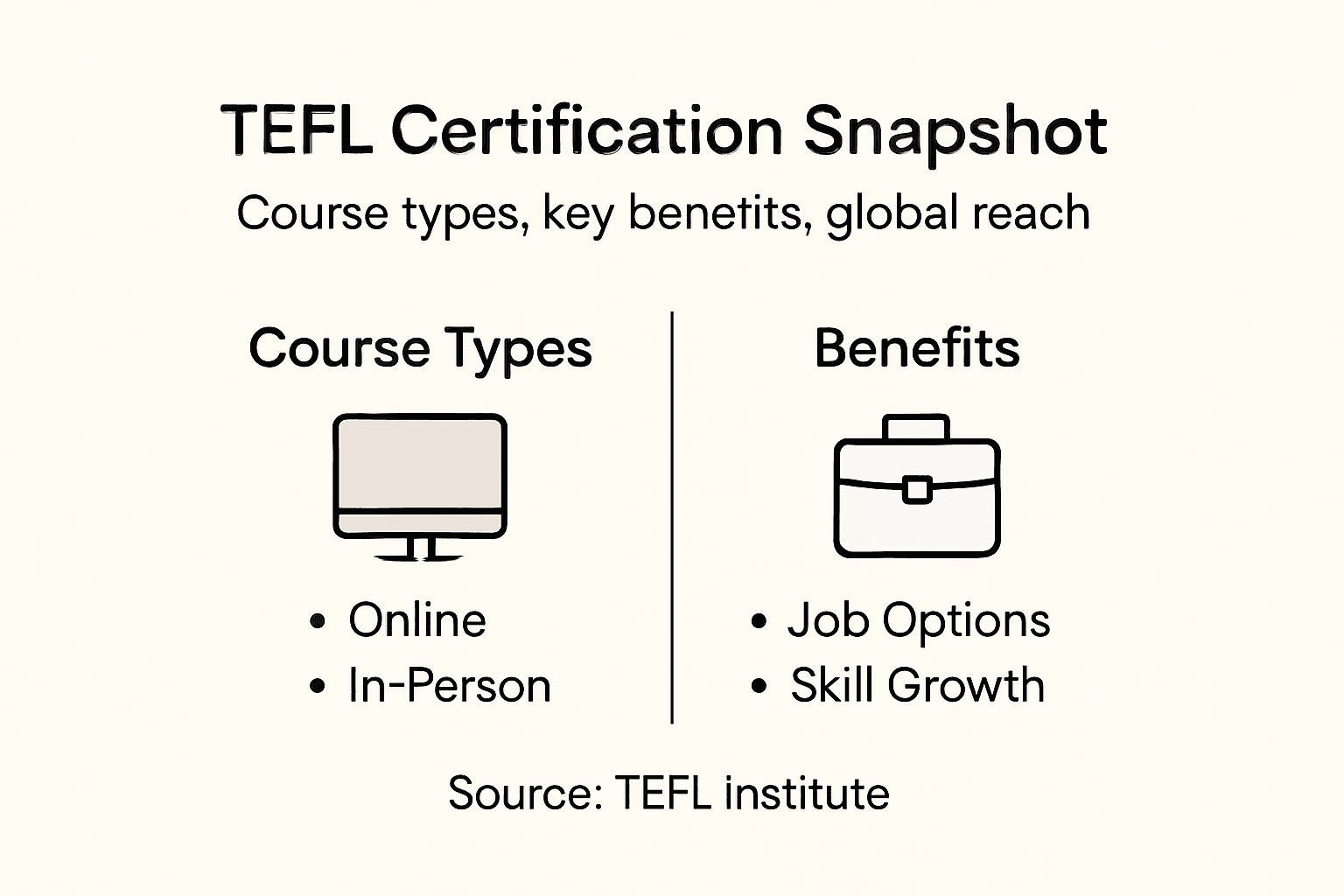
Choose an online 120 hour course for flexibility and most first jobs, or a regulated Level 5 Diploma if you want a qualification with a verifiable level. Hybrid courses add classroom practice at fixed dates.
| Course type | Flexibility | Recognition | Best for |
|---|---|---|---|
| Online 120 hour, accredited | Study any time | Accepted by most schools and platforms | First jobs abroad and online |
| Online Level 5 Diploma, regulated | Study any time | Verifiable RQF Level 5 | Middle East, competitive or long term roles |
| Hybrid | Online plus fixed classroom dates | Adds observed teaching practice | People who want classroom time before they go |

Our Level 5 TEFL Diploma is Ofqual-regulated under qualification number 610/1571/4, at the same framework level that GOV.UK gives a foundation degree or HND. You can search that number on the Ofqual register yourself.
If you are still weighing up providers, our five step guide to comparing TEFL certifications keeps the decision to things you can check.
Every TEFL opening, salary and deadline that matters.
In your inbox every two weeks. Free, no spam, unsubscribe any time.
Teacher pay by country
New TEFL openings
Programme and visa dates
How to Land Your First TEFL Job
Where can an international TEFL certification take you?
A recognised TEFL certificate opens private language schools across Europe, Asia and Latin America, government programmes such as Korea’s EPIK and Japan’s JET, and online teaching platforms. Which doors open for you depends on your passport and degree as much as on the certificate.
For dated pay figures and the visa each country uses, the TEFL Salary Index and Visa Desk are checked against official sources.
What does it cost, and what mistakes should you avoid?
A 120 hour online TEFL course typically costs around £150 to £400 for UK learners, while a regulated Level 5 Diploma costs more. Budget separately for documents: police checks, degree and certificate legalisation, and visa fees vary widely by country.
The most common mistakes are avoidable:
- Buying before checking the visa. A great certificate will not get round a degree requirement.
- Choosing a course under 120 hours. It may not pass the first screen.
- Trusting an unnamed “accreditation”. If you cannot check it, neither can an employer.
- Leaving documents late. Legalisation can take weeks, so start it as soon as you have a job offer.
For a full price breakdown, see how much a TEFL course costs.
Ready to get certified?
The TEFL Institute Group is Europe’s largest TEFL trainer by teachers certified, with 161,000 teachers certified since 2017 and graduates in 80 countries. We are a Highfield Approved Centre (number 21335).
Start with the 120 Hour Advanced TEFL Course for most first jobs, or the 180 Hour Level 5 TEFL Diploma for a regulated qualification employers anywhere can verify.

Ola Flynn, Head of Marketing
Head of Marketing at The TEFL Institute Group; runs our webinars and information sessions, loves travel and sharing interns’ stories, and joined our interns in Thailand for orientation.
Tara and Jess talk through different TEFL and EFL topics, from finding work abroad to life in the classroom.
FAQs
Questions students ask us
Check what your target country requires, then choose a TEFL course of at least 120 hours that is independently accredited or Ofqual regulated. Complete its tutor assessed modules, collect a certificate that states the hours and can be verified, and legalise it with an apostille or attestation if your visa requires.
No. No single global body issues or approves TEFL certificates. International recognition comes from meeting the standards employers abroad screen for: at least 120 hours, independent accreditation or government regulation, and a certificate they can verify. Regulated qualifications can be checked on a public register such as Ofqual’s.
It depends on the course and your pace. Most 120 hour courses are online and self paced, so you can start straight away and study around work. A regulated Level 5 TEFL Diploma involves more study, with 180 guided learning hours and 382 hours total qualification time for our diploma.
For UK learners, a 120 hour online TEFL course typically costs around £150 to £400, while a regulated Level 5 Diploma costs more. Budget separately for documents such as police checks, legalisation of your degree and certificate, and visa fees, which vary widely by country.
Not usually for the course itself. Most TEFL courses accept anyone with good English. A degree matters for the job, because many countries in Asia and the Middle East require one for the work visa. Check your destination’s visa rules before choosing where to apply.
Often, yes. Many teaching visas require your TEFL certificate and degree to be legalised with an apostille or embassy attestation. The steps depend on the country and the issuing provider, so start as soon as you have a job offer, because legalisation can take several weeks.