
 United Kingdom (UK)
 United States (US)
 Canada
 South Africa
 India
India Australia
 New Zealand
 China
China Russia
 Germany
 France
 Spain
Spain Netherlands
 Vietnam
 United Arab Emirates
 Italy
Italy Poland
 Thailand
 Türkiye










 Algeria


Most teaching jobs abroad ask for a TEFL certificate of at least 120 hours, fluent English and a clean criminal record check. Many countries in Asia and the Middle East also require a bachelor’s degree for the work visa. In Europe, your passport and right to work matter more than a degree.
What Qualifications Do I Need to Teach English Abroad?
Updated 8 October 2026: degree, visa and document rules re-checked.
To teach English abroad you usually need three things: a TEFL certificate of at least 120 hours, a bachelor’s degree for most work visas, and the right passport or visa for the country. Fluent English and a clean criminal record check complete the list. The degree and visa rules are set by governments; the TEFL is what schools screen for.

That is the short answer, and it holds for most of the world. The detail changes country by country, and the mistakes people make are nearly always about the order of things: buying a course before checking whether their passport or degree will get them a visa at all. This guide sets out each qualification, who sets the rule and how to check it.
Key takeaways
- A 120-hour TEFL certificate is the standard benchmark employers screen for. No law sets it; hiring practice does.
- A bachelor’s degree is a visa condition in much of Asia and the Middle East, including Japan, South Korea, China and the UAE.
- In Europe, the right to work comes first. EU, EEA and Irish passport holders face far fewer hurdles than UK or US citizens.
- A criminal record check is almost always required. UK applicants usually need an ACRO police certificate, not a DBS check.
- For Middle East school posts and competitive roles, an Ofqual-regulated Level 5 TEFL Diploma is increasingly the expected qualification.
What qualifications do you need to teach English abroad?
The core qualifications to teach English abroad are a TEFL certificate, a degree where the visa requires one, fluent English and a clean background check. Here is how they line up and who decides each one.
| Qualification | Usually required? | Who sets the rule |
|---|---|---|
| TEFL certificate, 120 hours or more | Yes, almost everywhere | Employers and programmes (South Korea’s EPIK sets 100 hours) |
| Bachelor’s degree | Yes for most visas in Asia and the Middle East; often not in Europe or online | The country’s immigration rules |
| Fluent or native level English | Yes | Employers; some visas limit nationalities |
| Criminal record check | Yes, for nearly all school jobs and visas | Immigration authorities and schools |
| Regulated Level 5 TEFL | Expected for many Middle East school posts; an advantage elsewhere | Employers and education regulators |
What is a TEFL certificate and how many hours do you need?
A TEFL certificate shows you have been trained to teach English as a foreign language, and 120 hours is the figure most employers ask for. You will also see TESOL and TESL. They describe where the teaching happens rather than different standards: TEFL abroad, TESL in an English speaking country, TESOL as the umbrella for both. Employers almost always treat them as interchangeable.
What does differ is regulation. Most 120 hour courses are accredited, which means an independent body has reviewed them. A smaller number are regulated, which places them at a verifiable level on a government framework. Our Level 5 TEFL Diploma is Ofqual-regulated under qualification number 610/1571/4, the same framework level as a foundation degree or HND. If you are unsure what that means in practice, our guide to what level a 120 hour TEFL course is explains it in a few minutes.
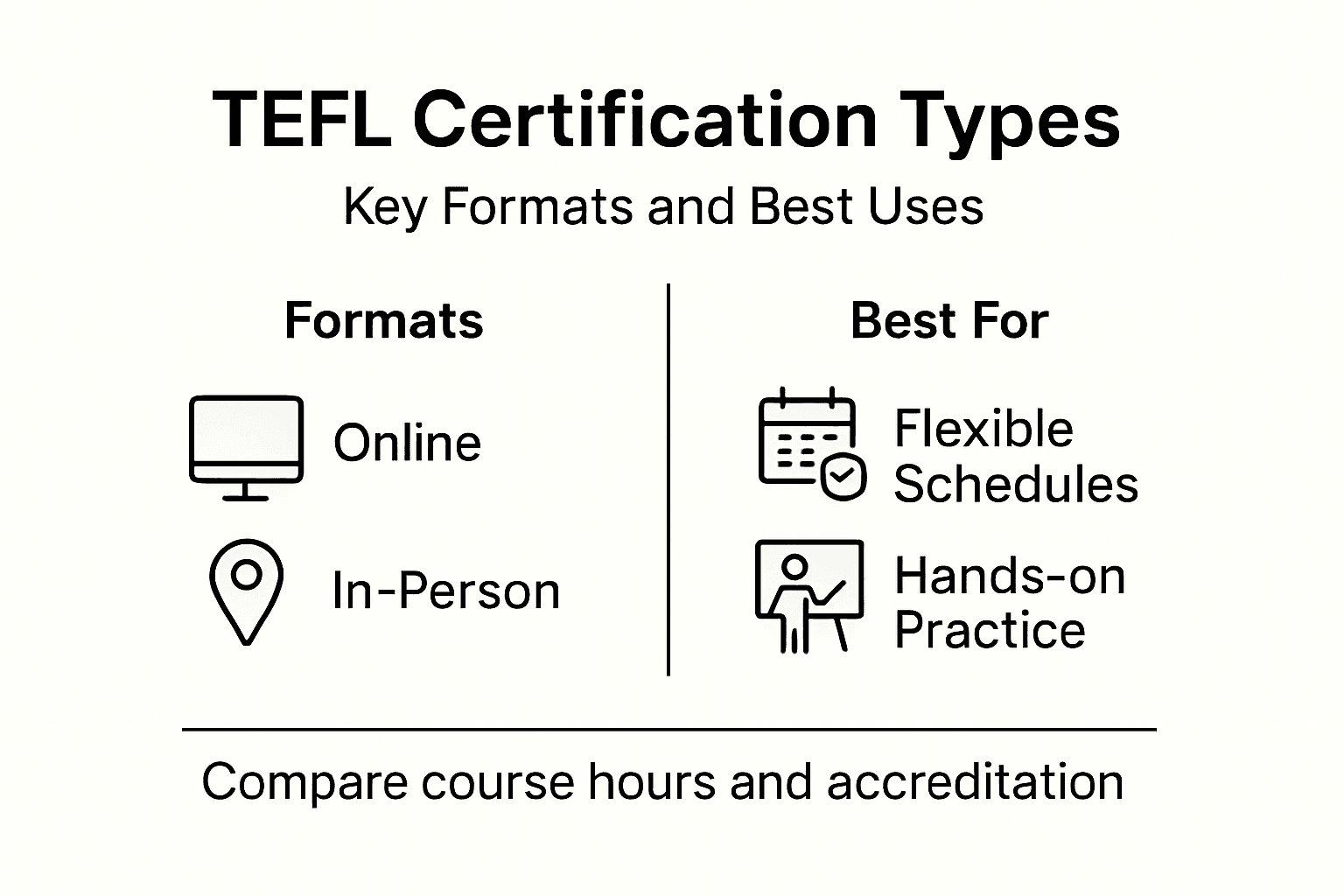
| Course format | Strength | Trade off | Best for |
|---|---|---|---|
| Online, 120 hours | Flexible, affordable, widely accepted | No live teaching practice unless added | Most first jobs abroad and online |
| Online Level 5 Diploma | Regulated, verifiable level | More study time | Middle East, competitive or long term roles |
| Hybrid or in person | Observed teaching practice | Higher cost, fixed dates | Nervous first timers wanting classroom time |
Do you need a degree to teach English abroad?
You need a degree for most teaching visas in Asia and the Middle East, but not everywhere. The degree is usually a condition of the work visa, set by the government, so no school can waive it however much it wants to hire you.
- Degree required for the visa: Japan, South Korea, China, Taiwan, Vietnam’s work permit, the UAE and Saudi Arabia.
- Often possible without a degree: much of Europe for EU, EEA and Irish citizens, parts of Latin America and Cambodia, and many online platforms.
We cover the honest position, country by country, in can I teach English abroad without a degree.
What background checks and documents will you need?
Almost every school job and teaching visa asks for a criminal record check, and many ask for it to be legalised. UK applicants usually need an ACRO police certificate rather than a DBS check, because a DBS check covers work in England and Wales only. Our guide to DBS checks for teaching abroad explains which one to order.

Expect to gather some or all of these:
- Your degree certificate, often with an apostille or embassy attestation.
- Academic transcripts, sealed, for some Asian visas.
- Your TEFL certificate, sometimes legalised too.
- A police certificate, recent and legalised.
- A health check or medical form.
The Paperwork Desk lists the documents for eight popular destinations, each dated against the official source. Start early: legalisation alone can take several weeks.
Academic
The TEFL Institute Group
How to Land Your First TEFL Job
teflinstitute.comWatch on YouTube · The TEFL Institute Group
How do visa rules change the requirements by country?
The visa decides who can teach where, and it is the single biggest variable. The same teacher can be hired in a week in Spain and be ineligible in South Korea, purely on passport.
- South Korea: the E-2 teaching visa is limited to citizens of seven English speaking countries and requires a bachelor’s degree.
- Japan: work visas for teachers set a degree standard; the JET Programme runs its own application window each autumn.
- The UAE: a bachelor’s degree is a state condition for school teaching, with attested documents and a professional licence.
- Europe: EU, EEA, Swiss and Irish citizens can work freely; UK and US citizens need an employer willing to sponsor a permit, which is rare for academy jobs.
The Visa Desk names the correct permit for each country and links to the government page that owns the rules. For travel safety, always check your own government’s advice, such as UK FCDO travel advice.
What are the most common TEFL myths?
The most expensive myth is that any TEFL certificate guarantees a job. It does not: the certificate gets you past the first screen, and the visa, degree and interview do the rest. Three others are worth clearing up.
- “Native speakers do not need training.” Schools hire trained teachers, and fluency is not the same as knowing how to teach the present perfect to a room of twelve year olds.
- “You must be a native speaker.” Some visas restrict nationalities, but many employers and online platforms hire fluent non native speakers.
- “Any provider’s ‘Level 5’ is the same.” A real Level 5 has a qualification number you can look up on the Ofqual register. If there is no number, it is not regulated.
Once you are qualified, our guide to passing a TEFL job interview covers the demo lesson most schools ask for.
Ready to get qualified to teach abroad?
The TEFL Institute Group is Europe’s largest TEFL trainer by teachers certified, with 161,000 teachers certified since 2017 and graduates in 80 countries. We are a Highfield Approved Centre (number 21335).
For most first jobs, the 120 Hour Advanced TEFL Course meets what schools ask for. If you are aiming at the Middle East, competitive schools or a longer career, the 180 Hour Level 5 TEFL Diploma gives you a regulated qualification employers can verify.
Ola Flynn, Head of Marketing
Head of Marketing at The TEFL Institute Group; runs our webinars and information sessions, loves travel and sharing interns’ stories, and joined our interns in Thailand for orientation.
We love taking your call.

TEFL Institute guides
Plan for 2027
Estonia
Jobs, pay and work routes
Read the guide
Plan for 2027
Italy
Jobs, pay and visa routes
Read the guide
Plan for 2027
Portugal
Jobs, pay and visa routes
Read the guide
Plan for 2027
Taiwan
Buxibans, pay and visas
Read the guide
Plan for 2027
South Korea
EPIK, hagwons and pay
Read the guide
Not everywhere. A degree is a visa condition in Japan, South Korea, China, Taiwan, the UAE and Saudi Arabia, so schools there cannot waive it. EU, EEA and Irish citizens can often teach in Europe without one, and many online platforms and parts of Latin America and Cambodia also hire non graduates.
120 hours is the figure most employers screen for, and it is the safest baseline. No law sets it; it is hiring practice. South Korea’s EPIK programme sets 100 hours as its floor, while many Middle East schools and competitive roles look for a regulated Level 5 qualification of 180 hours or more.
For hiring purposes they are treated as interchangeable. TEFL describes teaching English in a non English speaking country, TESL teaching in an English speaking one, and TESOL covers both. What matters more is whether the course is at least 120 hours and whether it is accredited or Ofqual regulated.
Most employers and visa offices abroad ask UK applicants for an ACRO police certificate, often legalised with an apostille, rather than a DBS check. A DBS check covers work in England and Wales only. Order it early, because legalisation and embassy steps can add several weeks.
Yes, in many places. Some visas are limited to citizens of specific English speaking countries, such as South Korea’s E-2, but many private schools and online platforms hire fluent non native speakers. A strong TEFL qualification and evidence of your English level, such as IELTS, help your application.