United Kingdom (UK)
 United States (US)
 Canada
 South Africa
 India
 Australia
 New Zealand
 China
 Russia
 Germany
 France
 Spain
 Netherlands
 Vietnam
 United Arab Emirates
 Italy
 Poland
 Thailand
 Türkiye





 Algeria


TEFL Institute research · 2027 edition
What English teaching pays, which programmes publish it, and which qualifications employers can verify
Official programme pay read on 17 October 2026, Ofqual references confirmed on 1 September 2026, and market and survey figures checked against their publishers on 1 November 2026. Every figure dated and sourced.
Research lead: Ian O’Sullivan, Founder of The TEFL Institute Group, working in TEFL since 2002 (LinkedIn), with the Institute’s Research Team
The English language training market was worth US$89.5 billion in 2024 and is forecast to reach US$181.1 billion by 2034. This report verifies the pay of four government programmes; two more, in Taiwan and Hong Kong, are set out in the Asia edition. Every other pay figure is a market estimate. This report sets out what is official, what is estimated, and which qualification an employer can check, with each figure traced to a stated source and date.
Regional Editions Of The State Of TEFL 2027
Research And Commercial Interests
The State of TEFL is published by The TEFL Institute, an organisation that provides TEFL training and qualifications. The research is produced using publicly available third-party data and official sources, and no figure comes from the Institute’s own customer data. Where the report references qualifications offered by the Institute, this commercial relationship is disclosed. The report does not rank or endorse the Institute’s products.
Who we are, legally. The TEFL Institute is the trading name of The TEFL Institute Limited.
- Country of incorporation: Ireland, company number 613324, registered 13 October 2017.
- Registered company address and principal business address: 4 Shandon Street, Dungarvan, Co. Waterford, X34 A365, Ireland. This is the address used in the report’s citation.
- Dublin office: 13 Adelaide Road, Saint Kevin’s, Dublin, D02 P950, Ireland.
- UK office and contact address: 6 Mornington Place, London NW1 7RP. This is the address shown in the site footer.
Finding 01
The Market Is Large, And Different Sources Disagree On How Large
Market.us puts the global English language training market at US$89.5 billion in 2024, growing at 7.3% a year from 2025 to 2034, with Asia-Pacific holding 42%. On that path the 2026 figure is roughly US$100 billion, but no published 2026 actual exists yet. Other research houses define the market differently: The Business Research Company projects US$122.7 billion by 2030, and Research and Markets puts digital English language learning at US$12.25 billion in 2025 rising to US$25.47 billion by 2030, about 15.8% a year. The Market.us figures were checked on 1 November 2026; the others were compiled in March 2026 and are not re-verified.
Each region has its own edition, with its own figures dated and sourced: Europe, Asia, the Middle East, Latin America, Africa and online. For which certificate each region asks for, see our guides to the best TEFL certification for the Middle East, Asia, Latin America and teaching online.
Finding 02
What The Four Official Programmes Pay
These are pay figures a teacher can hold an employer to. Two more public programmes, in Taiwan and Hong Kong, also publish theirs and are set out in Teaching English in Asia. The four below were read on each programme’s own page on 17 October 2026, with US dollar conversions at European Central Bank rates of 16 October 2026.
| Programme | Official pay | Application status, 17 Oct 2026 |
|---|---|---|
| Japan, JET | ¥4.02 million in year one (about US$2,120 a month); ¥4.14 million in year two | Closes 13 November 2026 (US and Canada); 5 November 2026 (UK) |
| South Korea, EPIK | 2.2 to 2.8 million won a month on the main scale (about US$1,650 to US$2,100), with furnished apartment, severance and airfare | Rolling, no closing date; Spring 2027 intake |
| France, TAPIF | €1,010.67 a month gross, about €810 net, up to 12 hours a week | Open 15 October 2026 to 15 February 2027 |
| Spain, NALCAP | €800 to €1,000 a month, 14 to 16 hours a week | Closed; last call 2 to 30 June 2026, no next date published |
EPIK provides the apartment and JET does not, so a teacher who would otherwise pay city rent in Korea often keeps more of an EPIK salary. TAPIF and NALCAP are part-time stipends, not living wages. Check the programme page before applying.
Everywhere else is an estimate
Market estimates compiled from job listings in March 2026, and not re-verified, put the Gulf at US$2,200 to US$5,500 a month tax-free, East Asia at roughly US$1,200 to US$3,000, Southeast Asia at US$1,000 to US$2,000, Europe at €800 to €2,200 and Latin America at US$800 to US$1,100. Our budget breakdowns for Spain and Morocco show how far the same salary stretches. No course provider can guarantee a job, a salary or a visa.
Finding 03
A Regulated Qualification Is The One An Employer Can Check
Qualifications on the Ofqual Register of Regulated Qualifications carry a number any employer can search, with guided learning hours, total qualification time and awarding body. The Level 5 Diploma in TEFL (610/1571/4, 180 guided learning hours) and the Level 5 Advanced Diploma in TEFL (610/1573/8, 300 guided learning hours, 54 credits) are both awarded by Highfield Qualifications. The register entries were confirmed by hand on 1 September 2026. Whether a certificate is genuine and whether it is a regulated qualification are separate questions. Most reputable providers can confirm that a certificate they issued is authentic; a regulated qualification also has a public register entry showing its level, hours and awarding organisation.
Finding 04
AI Is Changing The Job, Not Removing It
A 2025 study published in ScienceDirect found that combining ChatGPT with teacher feedback improved EFL learners’ argumentative writing, and that the teacher’s feedback made the difference. Teachers are using AI for planning, differentiation, feedback and pronunciation practice. The report’s table sets out the tools and what the teacher still does.
How we know
Methodology
The Research Team at The TEFL Institute read official programme pay and application windows on each programme’s own website on 17 October 2026, confirmed qualification references by hand against the Ofqual register on 1 September 2026, and checked Market.us, Pew Research Center, Deloitte and Fortune figures against the publishers’ own pages on 1 November 2026.
Figures carried forward from the March 2026 edition without re-verification are labelled as such wherever they appear. Every figure that could not be traced to a source has been removed, and the report includes a corrections ledger listing what the March edition got wrong. No figure comes from the Institute’s own customer data.
This report presents independent data on the global TEFL industry. Where it references The TEFL Institute’s Level 5 qualifications, it does so only as a neutral example of an Ofqual-regulated course.

About the research lead. Ian O’Sullivan is the founder of The TEFL Institute Group and leads The State of TEFL research. He has worked in TEFL since 2002, when he became Ireland country director for an international TEFL company, and founded the group in 2017.
Reviewed by

Katie Troy, Managing Director of The TEFL Institute Group. A qualified teacher with a degree in education and years of experience teaching abroad, with the team since 2018.
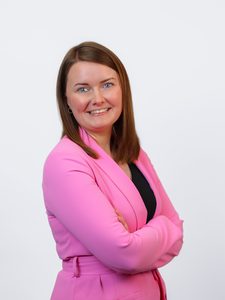
Jessica Jeffery, Recruitment and Partnerships Specialist at The TEFL Institute Group. Holds a business degree plus TEFL and CELTA, and has taught in Thailand and Italy.
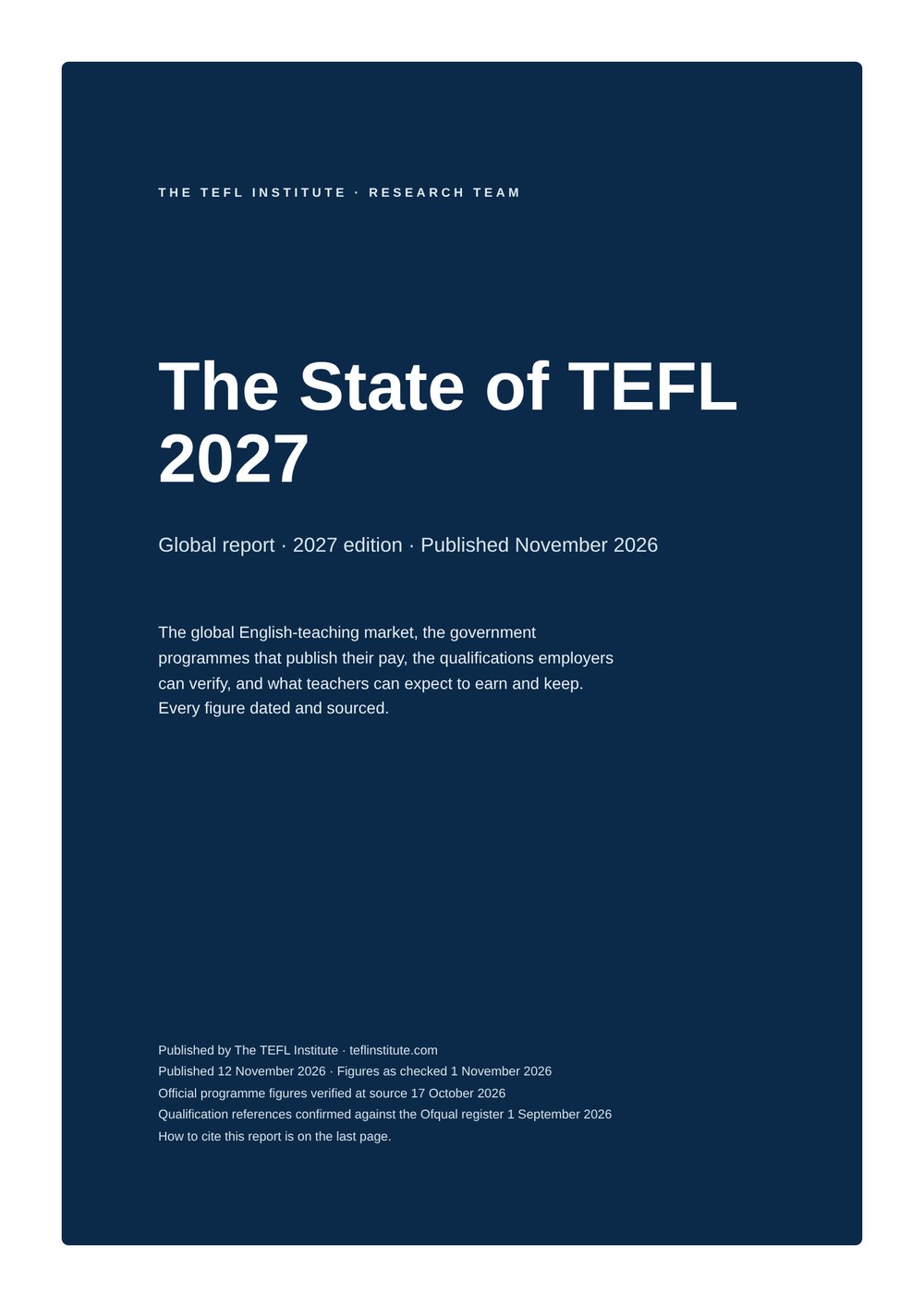
The full reportDownload the State of TEFL 2027Thirty pages with more than 25 charts and three maps, every figure dated and sourced: the global market, English proficiency, study travel, official programme pay, regulated qualifications, salary against cost of living, visas, AI and the corrections ledger.
- See what the four official programmes pay
- Compare salary estimates and housing worldwide
- Check visa routes by destination
- Read what the March edition got wrong
Questions
About This Report
What is the State of TEFL 2027 report?
A thirty-page industry report on the global TEFL market: market size, English proficiency, study travel, official programme pay, regulated qualifications, salary against cost of living, visa routes and AI in teaching. Every figure is dated and sourced.
Who is this report for?
Aspiring TEFL teachers, career changers and current educators who want data-driven insight into teaching English abroad or online, and journalists, researchers and careers advisers who need a citable source on the sector.
How big is the TEFL industry?
Market.us valued the global English language training market at US$89.5 billion in 2024 and forecasts US$181.1 billion by 2034, 7.3% a year. Other research houses give different figures because they define the market differently.
Which programmes publish an official teaching salary?
At least six. This report verifies four: Japan’s JET Programme, South Korea’s EPIK, France’s TAPIF and Spain’s NALCAP. Two more, in Taiwan and Hong Kong, are set out in the Asia edition. Every other salary figure is a market estimate from job listings.
What is TEFL?
TEFL stands for Teaching English as a Foreign Language. It refers to teaching non‑native English speakers in an immersive, English‑only environment. You do not need to speak the learner’s language. TEFL is used worldwide, both in classrooms and online.
On qualifications
What is an Ofqual Level 5 TEFL Diploma, and how is it different from a standard TEFL course?
An Ofqual Level 5 TEFL Diploma is a UK government‑regulated qualification set at RQF Level 5, the same framework level as a foundation degree or HND. It goes deeper than a standard 120‑hour course, covering advanced grammar, lesson planning, assessment and classroom management. Because it sits on the Ofqual Regulated Qualifications Framework, schools and recruiters can compare it directly to other professional teaching qualifications.
How can an employer verify a TEFL certificate?
The TEFL Institute’s Level 5 Diploma is regulated by Ofqual and awarded by Highfield Qualifications, an approved UK awarding body, so schools and visa offices can confirm its level directly. The qualification numbers are 610/1571/4 and 610/1573/8, and both can be searched on the public Ofqual register. Employers can also request the unique certificate number or a verification letter.
Go deeper
Read Next
The report gives the global picture. These go country by country, and the four desks are rechecked and corrected between editions rather than left to age.
The information in this report is general guidance, not legal, immigration, financial or employment advice. Salaries, visa rules and hiring requirements vary with individual circumstances and change quickly, so verify important details with official sources such as government authorities, embassies and employers before acting. A TEFL qualification opens doors, but no course provider can guarantee a job, a salary or a visa.