

 United Kingdom (UK)
 United States (US)
 Canada
 South Africa
 India
India Australia
 New Zealand
 China
China Russia
 Germany
 France
 Spain
Spain Netherlands
 Vietnam
 United Arab Emirates
 Italy
Italy Poland
 Thailand
 Türkiye










 Algeria



Online ESL teaching types: A guide for educators in 2026
Online ESL teaching types: A guide for educators in 2026

Many aspiring ESL teachers believe native fluency alone guarantees success in online classrooms. The reality? Formal certification and understanding different teaching delivery models significantly impact student outcomes and career prospects. In 2026, mastering synchronous, asynchronous, and hybrid teaching types alongside proper credentials isn’t optional for serious educators seeking competitive advantages in global markets.
Table of Contents
- Introduction To Online ESL Teaching Types
- Types Of Online ESL Teaching Delivery Explained
- Essential ESL Certification For Online Teaching
- Pedagogical And Technological Adaptations For Online Teaching
- Specialized Online Teaching Niches And Career Benefits
- Common Misconceptions About Qualification Requirements
- Choosing The Right Online Teaching Type And Certification Path
- Conclusion: Maximizing Your Online ESL Teaching Career In 2026
- Advance Your ESL Teaching Career With TEFL Institute
Key takeaways
| Point | Details |
|---|---|
| Three primary online teaching types | Synchronous offers live interaction, asynchronous provides self-paced flexibility, and hybrid combines both for optimal engagement. |
| Certification impacts career trajectory | A 120-hour accredited TEFL opens entry-level roles, while advanced diplomas unlock premium positions and higher earnings. |
| Technology and pedagogy must adapt | Successful online teaching requires reliable tech setups and lesson plans tailored specifically for digital delivery formats. |
| Specialization boosts marketability | Niche certifications in IELTS, Business English, or young learners create competitive advantages in high-demand markets. |
| Degree requirements vary by platform | Teaching without a bachelor’s degree is possible but typically reduces earning potential by approximately 15% on major platforms. |
Introduction to online ESL teaching types
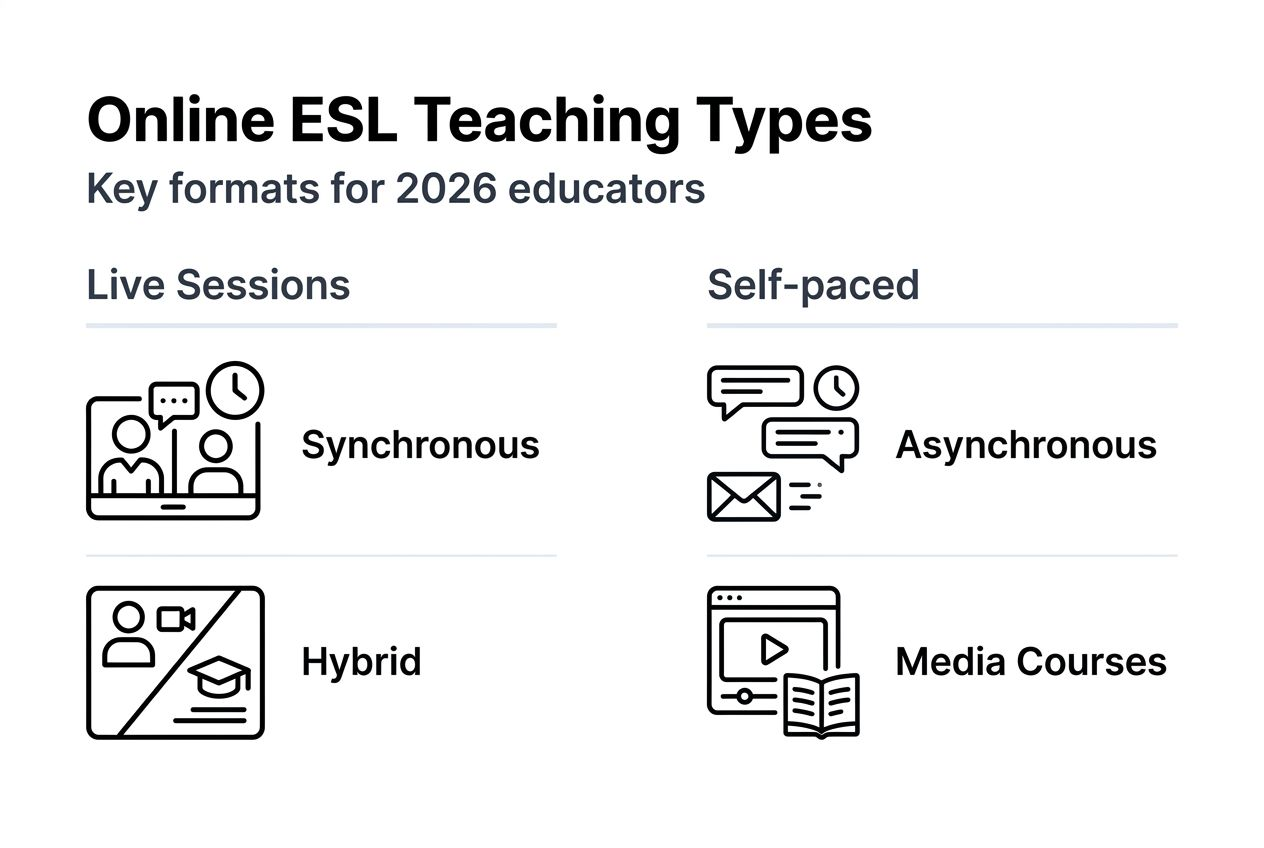
Global online ESL education has exploded due to improved internet access and platform innovation. Understanding the three primary delivery models helps you choose approaches that match student needs and your teaching style. Synchronous teaching happens live with real-time video interaction. Asynchronous delivery provides pre-recorded lessons students complete independently. Hybrid online ESL teaching models combine both formats for balanced flexibility and engagement.
Each type offers distinct advantages and limitations. Synchronous classes enable immediate feedback and relationship building but demand rigid scheduling. Asynchronous formats give students control over pacing but sacrifice live interaction quality. Hybrid approaches merge benefits from both, creating dynamic learning experiences that research shows can boost student satisfaction by 20% compared to purely self-paced courses.
Successful ESL educators recognize these distinctions matter profoundly. Your choice affects lesson planning, student retention, and income potential. Platforms increasingly offer all three types, so understanding when to apply each model becomes essential for career growth. The effective ESL teaching methods you employ must align with your chosen delivery format.
Consider these quick comparisons:
- Synchronous excels for conversational practice and cultural exchange but requires timezone coordination
- Asynchronous works perfectly for grammar drills and vocabulary building with maximum student flexibility
- Hybrid delivers comprehensive programs balancing structured content with personal interaction
Types of online ESL teaching delivery explained
Synchronous teaching replicates traditional classrooms through video conferencing. You see students in real time, answer questions immediately, and adjust pacing based on facial expressions. This format builds strong teacher-student relationships and enables spontaneous conversation practice. The downside? Scheduling across timezones creates headaches, and technical glitches disrupt entire sessions.
Asynchronous delivery pre-packages your expertise into videos, quizzes, and written materials students access whenever convenient. You record once, reach hundreds, and avoid live session prep. Students replay confusing sections and learn at personalized speeds. However, engagement drops without live accountability, and you miss opportunities to correct pronunciation errors in real time.

Hybrid models strategically combine both approaches. Record foundational grammar explanations for asynchronous study, then hold weekly synchronous sessions for conversation practice and Q&A. This structure maximizes efficiency while preserving human connection. Courses using hybrid models report 20% better student satisfaction and completion rates than purely asynchronous alternatives.
| Teaching Type | Key Features | Pros | Cons | Best For |
|---|---|---|---|---|
| Synchronous | Live video sessions, real-time interaction | Immediate feedback, relationship building, conversational practice | Scheduling challenges, timezone limitations, tech dependency | Advanced learners, conversation clubs, exam prep |
| Asynchronous | Pre-recorded content, self-paced learning | Ultimate flexibility, scalability, replay value | Lower engagement, delayed feedback, limited speaking practice | Grammar fundamentals, vocabulary building, independent learners |
| Hybrid | Combined live and recorded elements | Balanced engagement and flexibility, diverse learning activities | Complex planning, higher workload, coordination needed | Comprehensive programs, mixed-level groups, long-term courses |
Pro Tip: Match your delivery type to student demographics and goals. Young professionals often prefer asynchronous flexibility, while exam candidates need synchronous accountability. Survey new students about learning preferences before committing to one model.
Adapting effective ESL teaching methods to each format requires intentional planning. Synchronous sessions thrive on interactive activities like role-plays and debates. Asynchronous content needs crystal-clear instructions since you won’t be there to clarify. Hybrid programs demand careful sequencing so recorded and live elements reinforce rather than repeat each other.
Essential ESL certification for online teaching
Most reputable platforms require minimum credentials before hiring. A 120-hour accredited TEFL certification serves as the industry gold standard for entry-level positions. This baseline proves you understand lesson planning, classroom management, and language acquisition theory. Without it, you’re locked out of higher-paying opportunities regardless of teaching talent.
Advanced certifications open doors to specialized roles and significant pay increases. CELTA and Trinity CertTESOL include observed teaching practice and command premium salaries. Level 5 Diplomas provide deep pedagogical training for curriculum development positions. Your certification choice should align with career ambitions and budget constraints.
| Certification | Program Hours | Typical Cost | Recognition Level | Career Outcomes |
|---|---|---|---|---|
| 120-Hour TEFL | 120 hours | $200-$400 | Entry-level standard | Access to most online platforms, basic teaching roles |
| CELTA | 120 hours + practicum | $1,500-$2,500 | Globally recognized | Premium platform positions, language school employment |
| Trinity CertTESOL | 130 hours + practicum | $1,500-$2,800 | Equivalent to CELTA | International school roles, curriculum specialist positions |
| Level 5 Diploma | 240+ hours | $800-$1,500 | Advanced qualification | Director of studies, teacher training, course design roles |
Understanding certification tiers helps you invest wisely:
- Basic 120-hour programs suit teachers starting out or supplementing income through part-time online work
- CELTA and Trinity certificates benefit career changers seeking full-time ESL employment with competitive salaries
- Level 5 Diplomas serve experienced teachers pursuing leadership positions or specialized teaching niches
- Niche add-ons like IELTS or Business English modules enhance marketability within specific student segments
Certification directly impacts earning potential and job access. Platforms verify credentials before approval, and students increasingly check teacher qualifications before booking. Your online TEFL TESOL certification signals professional commitment and teaching competence to both employers and learners.
Choosing among the best TEFL certifications requires evaluating accreditation bodies, course content, and career goals. Accredited programs meet rigorous quality standards and maintain industry recognition. The importance of proper ESL certification cannot be overstated in 2026’s competitive marketplace.
Pedagogical and technological adaptations for online teaching
Successful online instruction demands specific technology infrastructure. You need stable high-speed internet, quality webcam delivering clear video, external microphone for crisp audio, and familiarity with platform software. Technical failures destroy student confidence and waste paid session time. Test everything during trial lessons before accepting paying students.
Pedagogical strategies must shift dramatically from physical classrooms. Screen sharing replaces whiteboards. Breakout rooms substitute small group work. Digital quizzes provide instant feedback traditional homework cannot match. Effective online ESL teaching requires adapting lesson plans and leveraging interactive digital tools rather than simply replicating in-person methods through video.
Synchronous classes benefit from:
- Interactive polls keeping students engaged during explanations
- Screen annotation tools for collaborative grammar exercises
- Chat functions enabling shy students to participate comfortably
- Breakout rooms for pair work and small group discussions
Asynchronous content requires:
- Crystal-clear video and audio quality since students cannot ask immediate clarification questions
- Embedded quizzes checking comprehension at logical intervals
- Downloadable resources like vocabulary lists and grammar charts
- Discussion forums creating community among independent learners
Hybrid programs combine both toolsets strategically. Record grammar explanations with embedded quizzes for asynchronous study. Reserve synchronous time for applying concepts through conversation, debate, and real-world scenarios. This division maximizes limited live session value while ensuring foundational understanding.
Pro Tip: Record a test lesson and watch it from a student perspective. Check audio levels, video clarity, slide readability, and pacing. Most technical issues become obvious when you experience your own content as a learner would.
The online English teacher roadmap emphasizes technology proficiency as non-negotiable. Familiarize yourself with the best platforms to teach English online and their specific software requirements before applying. Each platform uses different interfaces, so adaptation time varies.
Specialized online teaching niches and career benefits
General ESL skills open doors, but specialization unlocks premium opportunities. IELTS test preparation commands higher rates because students pay for score improvements affecting immigration and university admission. Business English serves corporate clients with substantial training budgets. Young learner instruction requires specialized techniques but taps into massive parental investment in children’s education.
Niche certifications signal expertise that justifies premium pricing. An IELTS-specific credential demonstrates you understand test format, scoring rubrics, and effective preparation strategies beyond general English teaching. Business English certification proves you can teach industry vocabulary, presentation skills, and cross-cultural communication professionals need.
Popular specializations include:
- IELTS and TOEFL test preparation with focused exam strategy training
- Business English covering emails, presentations, negotiations, and industry-specific terminology
- English for young learners using age-appropriate pedagogy and engagement techniques
- Academic English preparing students for university-level reading, writing, and research
- Pronunciation coaching helping students reduce accents and improve intelligibility
Market demand for specialized instruction continues growing. Companies invest heavily in employee language training. International students desperately need test scores for admissions. Parents seek qualified teachers for children’s English development. Your English teaching certification opportunities expand dramatically when you can serve these specific markets.
Specialization also provides competitive differentiation. Thousands of general ESL teachers compete for basic conversation students. Far fewer qualified IELTS instructors chase those premium clients. Your niche expertise becomes your unique value proposition in crowded marketplaces.
Common misconceptions about qualification requirements
The biggest myth? Native fluency equals teaching qualification. Speaking English perfectly doesn’t mean you can explain grammar rules, design effective lessons, or diagnose learning gaps. Certification proves you’ve studied language acquisition theory and practiced teaching techniques under supervision.
Another misconception claims bachelor’s degrees are mandatory for all online teaching. Reality varies by platform. Teaching English online without a degree is possible but limits access to higher-paying platforms and reduces earning potential by approximately 15% on average. Premium platforms serving Chinese, Korean, or Japanese markets typically require degrees. Smaller platforms and private tutoring accept certified teachers without degrees.
Common myths versus facts:
- Myth: Any TEFL certificate works equally well. Fact: Accreditation and hour count matter significantly to employers and student perception.
- Myth: You can teach online without any certification. Fact: Reputable platforms verify credentials, and lack of certification severely limits opportunities.
- Myth: Advanced degrees replace teaching certification needs. Fact: A master’s in literature doesn’t prove ESL teaching competence without pedagogical training.
- Myth: Certification guarantees immediate high income. Fact: Earnings depend on experience, specialization, platform choice, and marketing effort.
Platform data shows certified teachers without degrees earn roughly 15% less than degree-holding peers with identical certifications, but still significantly outperform uncertified teachers regardless of educational background.
The importance of ESL certification outweighs degree status in actual teaching effectiveness. Students care about lesson quality and learning outcomes, not whether you studied biology or business in university. However, platform algorithms and HR departments often filter by degree status before considering teaching credentials.
Research best ESL teaching sites in 2026 to understand specific requirements. Some platforms accept certified teachers without degrees for certain markets or student age groups. Others maintain strict degree requirements across all positions. Knowing these distinctions helps you target appropriate opportunities.
Choosing the right online teaching type and certification path
Successful career planning requires honest self-assessment and strategic decision-making. Follow this evaluation framework:
- Identify your preferred teaching style and schedule flexibility. Do you thrive on live interaction or prefer creating polished recorded content? Can you commit to fixed session times or need asynchronous flexibility?
- Research certification requirements for target platforms and markets. Check whether your desired employers require degrees, accept 120-hour TEFLs, or demand advanced credentials like CELTA.
- Evaluate technology readiness and upgrade gaps. Assess your internet reliability, equipment quality, and software proficiency before investing in certification.
- Select platforms aligning with your qualifications and teaching preferences. Match your credentials and style to platform requirements rather than applying randomly.
- Complete appropriate certification and begin teaching while continuing professional development. Start with foundational credentials, gain experience, then add specializations as career goals evolve.
Pro Tip: Research platform-specific student demographics and teaching requirements before certification investment. Some platforms need young learner specialists while others serve business professionals. Your certification choice should match available opportunities in your target market.
Ongoing professional development keeps you competitive as markets evolve. Add niche certifications in high-demand specializations. Update technology skills as new platforms and tools emerge. Participate in teacher communities sharing effective online teaching strategies.
Your online TEFL TESOL certification launches your career, but continuous learning sustains it. The best platforms to teach English online favor teachers who demonstrate current expertise and professional growth. Students increasingly check credentials and reviews before booking, making your ongoing skill development visible competitive advantage.
Align certification choices with both immediate needs and long-term ambitions. A 120-hour TEFL gets you started quickly. Adding IELTS certification six months later opens premium student segments. Pursuing a Level 5 Diploma after two years positions you for curriculum development or teacher training roles. Strategic sequencing maximizes return on time and money invested in professional credentials.
Conclusion: maximizing your online ESL teaching career in 2026
Understanding online teaching types and proper certification creates sustainable competitive advantages. Synchronous, asynchronous, and hybrid delivery models each serve different student needs and teaching contexts. Accredited credentials from 120-hour TEFLs to advanced diplomas unlock progressively better opportunities and earnings.
Technology proficiency and pedagogical adaptation separate successful online teachers from struggling ones. Specialized niche knowledge commands premium rates in high-demand markets. The ESL teaching landscape continues evolving rapidly, rewarding educators who commit to ongoing professional development and strategic career planning in 2026.
Advance your ESL teaching career with TEFL Institute
Ready to transform your teaching credentials and unlock global opportunities? TEFL Institute offers accredited TEFL and TESOL certification courses specifically designed for online ESL educators. Our programs include foundational 120-hour certifications, advanced diplomas, and specialty training in IELTS, Business English, and young learners.
Whether you’re starting your teaching journey in TEFL certification courses in Texas or expanding expertise through TEFL course extensions, we provide the credentials employers recognize and students trust. Accredited certifications significantly increase marketability and earning potential in competitive online teaching markets.
Pro Tip: Choosing accredited certifications from established providers like TEFL Institute boosts both platform acceptance rates and student booking confidence compared to unrecognized alternatives.
Take the first step today and start teaching English online with credentials that open doors worldwide. Your students are waiting for qualified, prepared educators who understand both teaching craft and online delivery excellence.
FAQ
What are the main types of online ESL teaching?
Synchronous teaching involves live video sessions with real-time student interaction and immediate feedback. Asynchronous learning provides pre-recorded content students complete at their own pace without scheduled class times. Hybrid models strategically combine both approaches, offering recorded foundational lessons with scheduled live practice sessions for balanced flexibility and engagement.
Do I need a degree to teach English online?
Many platforms hire certified teachers without bachelor’s degrees, though opportunities and pay rates vary significantly. Degree holders typically access premium platforms and earn approximately 15% more than non-degree teachers with identical certifications. However, proper TEFL certification matters more than degree status for actual teaching effectiveness and student outcomes.
Which certification is best for online ESL teaching in 2026?
A 120-hour accredited TEFL serves as the entry-level industry standard opening most platform opportunities. Advanced credentials like CELTA and Trinity CertTESOL include observed teaching practice and unlock premium positions with significantly higher pay. Level 5 Diplomas suit experienced teachers pursuing leadership roles in curriculum development or teacher training. Your choice should align with career goals and current experience level.
How can I adapt my teaching for online ESL students?
Leverage interactive digital tools like polls, breakout rooms, screen sharing, and embedded quizzes to maintain engagement. Adjust lesson plans specifically for online delivery rather than replicating in-person methods through video. Ensure quality technology setup including reliable internet, clear webcam, external microphone, and platform software proficiency before accepting paying students.