
 United Kingdom (UK)
 United States (US)
 Canada
 South Africa
 India
India Australia
 New Zealand
 China
China Russia
 Germany
 France
 Spain
Spain Netherlands
 Vietnam
 United Arab Emirates
 Italy
Italy Poland
 Thailand
 Türkiye











 Algeria


TESL Certificate: What It Means and Why It Matters
What is a TESL certificate?
A TESL certificate is a teaching qualification in Teaching English as a Second Language. It prepares you to teach English to people learning it as an additional language while they are living in an English-speaking country, such as Ireland, Britain, Canada or the United States. Employers usually treat TESL, TEFL and TESOL certificates as equivalent.
Last updated 29 September 2026.
If you’re comparing the different ESL certification routes, our dedicated guide sets out how TESL, TEFL and TESOL qualifications line up.
For anyone looking to teach English in a classroom at home or abroad, understanding what a TESL certificate actually is, and how it differs from the other three acronyms you will meet, saves both money and a wrong turn. This guide sets out the core differences, the requirements, the way the term is used in the United States specifically, and the real settings TESL-qualified teachers work in. The full map of every acronym sits on our TEFL qualifications and terminology reference.
Key takeaways
| Point | Details |
|---|---|
| What TESL is for | A TESL certificate is built around teaching English to non-native speakers inside an English-speaking country, so the training leans towards adult migrants, resident learners and school pupils. |
| TESL is the more American word | In the United States, TESL is the older and more widely used label for the same work that Britain and Ireland increasingly call ESOL or TESOL. The acronym differs; the teaching does not. |
| The three acronyms are not interchangeable on paper | TESL, TEFL and TESOL each have a different centre of gravity. In hiring practice, most employers accept any of them. |
| What the qualification asks of you | Typically 100 to 120 taught hours minimum, methodology coursework and, on stronger programmes, observed teaching practice. |
| Regulated beats accredited | A regulated qualification carries a reference number a hiring manager can look up on a public register. Accreditation usually means a private body has reviewed a provider against its own standards. |
| Where the work is | Schools, further and adult education, universities, corporate training, community and refugee programmes, and online platforms. |
What a TESL certificate is
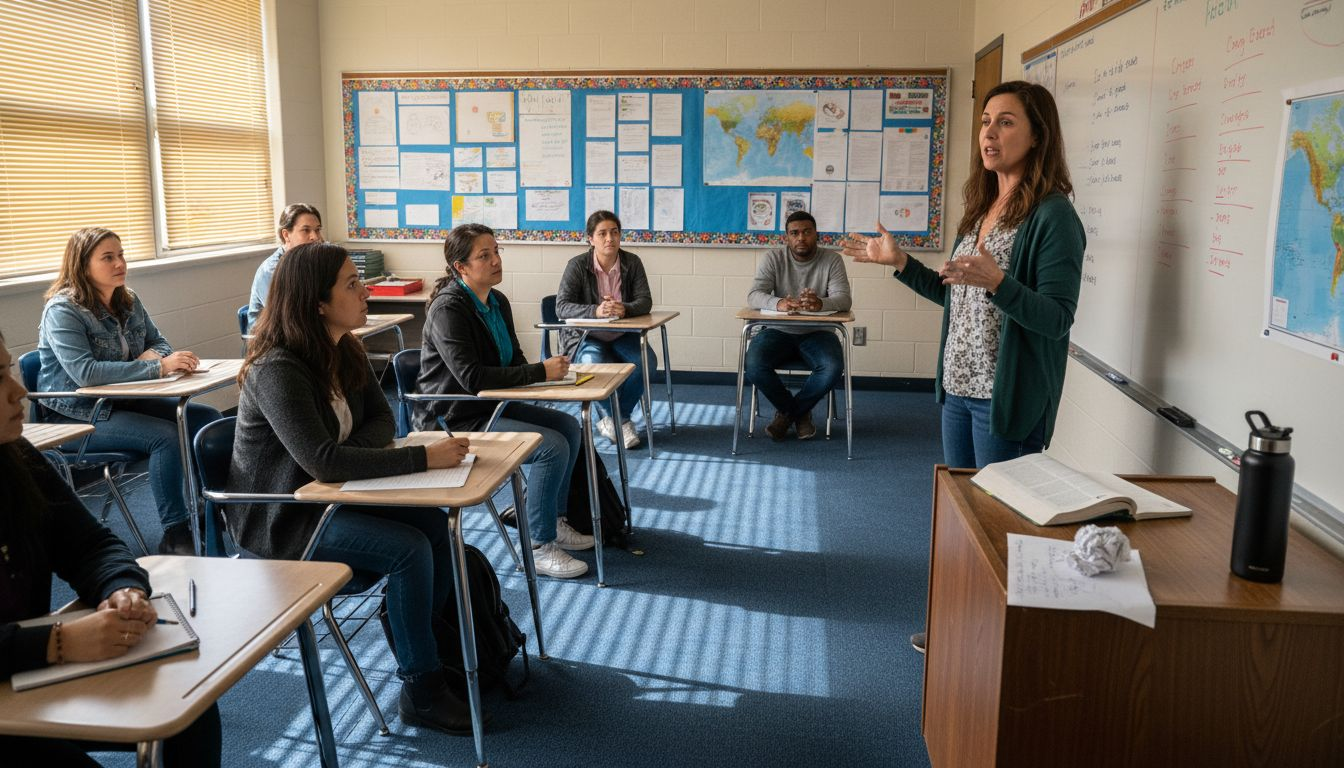
A Teaching English as a Second Language (TESL) certificate is a professional credential designed to prepare teachers for working with people learning English as an additional language. Unlike a general teaching qualification, a TESL certificate focuses specifically on language instruction technique, cultural communication and the approaches that suit English language learners rather than subject learners.
Programmes normally cover several core areas that distinguish them from standard teaching credentials:
- Linguistic theory and second language acquisition principles
- Practical teaching methodology specific to language instruction
- Assessment and placement techniques for language learners
- Strategies for teaching grammar, pronunciation and speaking
- Understanding the cultural contexts that shape how people learn a language
One caution before you buy anything. Not all TESL certificates are equivalent. Check the taught hours, whether observed teaching practice is included, and above all whether the qualification is regulated or merely accredited, because that is the distinction employers in competitive markets now look at first.
Dated reference data
The one authoritative figure set for this topic. Every source below was opened and confirmed live on 29 September 2026.
The size of the TESL market in the United States
- 5.3 million public school students in the United States were classified as English learners in fall 2021, which is 10.6 per cent of total public school enrolment — up from 4.6 million, or 9.4 per cent, in fall 2011. Published by the National Center for Education Statistics, the statistical agency of the US Department of Education.
- The federal body supporting the teachers of those pupils is the National Clearinghouse for English Language Acquisition (NCELA), supported by the US Department of Education’s Office of Elementary and Secondary Education. Its resource library holds over 20,000 items on multilingual learner education, free to teachers.
Regulated qualifications on the Ofqual public register
- Level 5 Diploma in TEFL, qualification number 610/1571/4, 180 guided learning hours, total qualification time 382 hours.
- Level 5 Advanced Diploma in TEFL, qualification number 610/1573/8, 300 guided learning hours, total qualification time 542 hours, 54 credits.
- Both are awarded by Highfield Qualifications, which holds Ofqual recognition number RN5219. They are separate specifications and should not be combined.
The levels learners are placed at
- A1 and A2, Basic User. B1 and B2, Independent User. C1 and C2, Proficient User.
- Defined by the Council of Europe through the Common European Framework of Reference for Languages, using “can do” descriptors rather than hours studied.
Sources. English learner numbers: National Center for Education Statistics, Condition of Education, English Learners in Public Schools. Federal teacher support: National Clearinghouse for English Language Acquisition, US Department of Education. Level descriptions: Council of Europe, Common European Framework of Reference for Languages. Qualification numbers: Ofqual, the qualifications regulator for England, publishes the Register of Regulated Qualifications, where each number above can be searched. The register is named here rather than linked because it blocks automated checking, so the entries were confirmed by hand on the date shown.
How to cite this. The TEFL Institute, “TESL Certificate: What It Means and Why It Matters”, updated 29 September 2026, https://teflinstitute.com/blog/tesl-certificate-explained/.
What does TESL mean in the United States?
In the United States, TESL means Teaching English as a Second Language and is the older, more widely used American label for teaching English to pupils and adults who are learning it while living in the country. It describes the teaching work. It is not, by itself, a state teaching licence, and the two are commonly confused.
The distinction matters because American public schools run on licensure. If you want to be employed as an English as a Second Language teacher in a US public school, the credential a district checks is a state teaching licence carrying an ESL, ESOL or bilingual education endorsement, issued by that state’s department of education. Requirements are set state by state, so what satisfies Texas does not automatically satisfy New York.
A TESL certificate sits alongside that rather than replacing it. It is the methodology training — how to teach the language — and it is what qualifies you for the large part of the American market that sits outside the licensed public school system: community and adult education programmes, refugee and resettlement organisations, university pathway and intensive English programmes, corporate language training, private language schools and online platforms. None of those require a state licence, and all of them ask what language teaching training you have.
The scale of the need is not marginal. 5.3 million pupils in American public schools — 10.6 per cent of total enrolment — were classified as English learners in fall 2021, up from 4.6 million a decade earlier, according to the National Center for Education Statistics. The federal government maintains a dedicated clearinghouse, NCELA, precisely because so many teachers arrive in front of those pupils without specialist preparation.
Three practical points for an American reader:
- TESL, TESOL and ESL are used loosely in American job adverts. A district may advertise for an “ESL teacher”, a “TESOL specialist” or an “EL teacher” and mean the same post. Read the licensure line in the advert, not the acronym in the title.
- ESL and ELA are different jobs in the same building. An ELA teacher teaches English Language Arts to pupils who already speak English; an ESL or TESL-trained teacher supports the pupils in that same room who are still acquiring the language. They are appointed against different criteria and paid on different scales.
- If your plan is to teach abroad or online rather than in a US public school, no licence is involved at all. What employers check is the awarding body, the hours and whether the qualification can be verified on a public register. That is the case set out in our guide to regulated TEFL certification for Americans.
TESL, TEFL and TESOL: the differences that matter

While TESL, TEFL and TESOL can look interchangeable, they represent distinct starting assumptions about who you will teach and where.
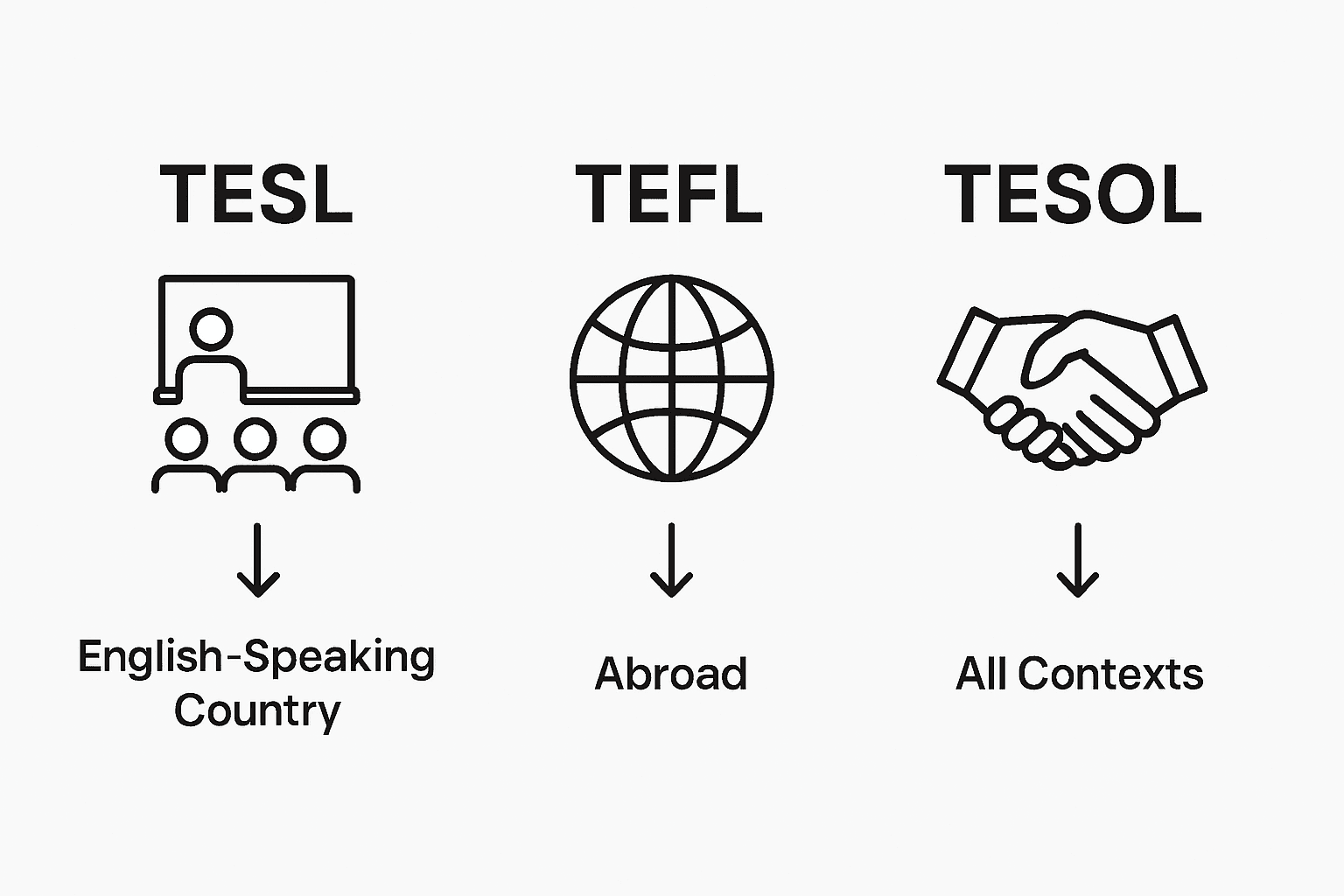
TESL (Teaching English as a Second Language) focuses on teaching English to non-native speakers within English-speaking countries such as Ireland, the United Kingdom, Canada or the United States. TEFL (Teaching English as a Foreign Language) primarily prepares teachers to work in countries where English is not the main language of daily life, such as Japan, Brazil or South Korea. American readers weighing TESL against TEFL should also read our breakdown of regulated TEFL certification for Americans.
TESOL (Teaching English to Speakers of Other Languages) is the broader umbrella that covers both. TESOL programmes typically provide wider training that integrates linguistic theory, cultural competence and adaptable teaching strategies for international contexts:
- Global language teaching approaches
- Second language acquisition theory in more depth
- Cross-cultural communication
- Adaptable classroom management technique
- Curriculum and syllabus design
Here is a concise comparison of the major English teaching certificates and where each one fits best:
| Certificate type | Best for teaching location | Typical programme format | Employer preference |
|---|---|---|---|
| TESL | English-speaking countries | In person or blended | Schools, colleges, community centres |
| TEFL | Non-English-speaking countries | Online or in person | Private institutes, overseas schools |
| TESOL | Global flexibility | Blended or online | Universities, international programmes |
| CELTA | International and academic settings | Intensive, in person | Academic and higher-prestige employers |
For the learner-side terms rather than the qualifications, see what ESL means and how it differs from EFL and ESOL.
How TESL certification works
TESL certification is a structured route that combines theory with practical teaching strategy, so that a teacher arrives in the classroom with a method rather than an instinct. The course requirements generally encompass academic coursework, practical training and language instruction modules. Programmes typically require participants to complete:
- Theoretical linguistics coursework
- Pedagogical methodology training
- Second language acquisition study
- Classroom management technique
- A practicum or observed teaching placement
Most programmes assess through written work, a teaching demonstration and an evaluation of linguistic knowledge and instructional capability. Advanced certificates often add specialist training in curriculum development, assessment design or adaptive teaching technique.
TESL certificate requirements
Obtaining a TESL certificate involves meeting a set of academic and professional standards. Candidates work through a structured pathway of educational and practical requirements that evidence both language knowledge and teaching capability. Typical requirements are:
- A minimum education level, often a bachelor’s degree, though this varies by provider and by employer
- Completion of a specialist TESL training programme
- A minimum number of taught hours, usually 100 to 120
- Language teaching methodology coursework
- Demonstrated English language proficiency
- Successful completion of a practical teaching practicum, on programmes that include one
- Passing written and practical assessment
Be careful with the degree question. It is an employer and immigration requirement rather than anything intrinsic to TESL, and it varies considerably by country. Check the employer’s advert and the country’s visa rules separately rather than assuming one answers the other.
Where TESL-certified teachers actually work
TESL certification opens work across several genuinely different settings, each with its own timetable, pay and expectations:
- Primary and secondary schools
- University language and pathway programmes
- Corporate and workplace language training
- International language institutes
- Online tutoring platforms
- Community and adult education centres
- Refugee and migrant support programmes
- Government language training initiatives
The versatility is real, but so is the variation. Designing business English for a multinational, supporting migrant integration through evening classes, and teaching a one-to-one online lesson share a subject and very little else. Knowing which of these you are aiming at should shape which certificate you buy.
| Application area | Common employers | Key benefits |
|---|---|---|
| Primary and secondary schools | Public and private schools | Structured classroom experience and term-time hours |
| Corporate training | Companies and organisations | Focus on workplace language, usually better paid per hour |
| Online English platforms | Virtual education companies | Flexible schedules and global reach |
| Community and refugee programmes | Charities and local agencies | Highly motivated learners and clear social impact |
Alternatives to CELTA worth comparing
While CELTA is a well-regarded certificate, there are several alternatives that suit different circumstances. Comparing the options properly helps you pick the credential that matches your goal rather than the one with the best-known name. Alternatives include:
- A Level 5 TEFL diploma, which sits at the same regulated level as a CELTA
- Trinity CertTESOL
- Online TEFL and TESOL diplomas
- University-based TESL programmes
- Specialist add-ons in business English, young learners or exam preparation
Delivery format is often the deciding factor. Online and blended options have widened considerably, and advanced certificates now routinely include modules in business English, young learner instruction and digital teaching, which can matter more to an employer than the brand on the certificate.
Where to start
If the adverts you are reading say TESL, the qualification they want is a language teaching certificate of at least 120 hours, and the stronger your evidence of observed teaching practice, the better you will do. Our accredited TEFL courses cover the 120-hour route, and the Ofqual regulated Level 5 TEFL Diploma is the option to look at where an employer or a visa office wants a qualification it can verify on a public register.
Frequently asked questions
What is a TESL certificate?
A TESL certificate is a qualification in Teaching English as a Second Language. It prepares teachers to work with people learning English as an additional language while living in an English-speaking country, covering language teaching methodology, assessment and cultural communication.
What does TESL stand for?
TESL stands for Teaching English as a Second Language. It is the older and more common American label for teaching English to people acquiring it while living in an English-speaking country. In Britain and Ireland the same work is increasingly labelled ESOL or TESOL.
How does a TESL certificate differ from TESOL and TEFL?
TESL is oriented towards teaching inside English-speaking countries. TEFL is oriented towards teaching abroad, where English is not the everyday language. TESOL is the umbrella term covering both. In hiring practice most employers treat all three as equivalent.
Is a TESL certificate enough to teach ESL in a US public school?
No. American public schools require a state teaching licence carrying an ESL, ESOL or bilingual endorsement, issued by that state’s department of education, and requirements differ from state to state. A TESL certificate is the methodology training that sits alongside it, and it is sufficient on its own for the large non-licensed part of the market: adult and community education, refugee programmes, university pathway courses, corporate training, private language schools and online teaching.
What are the requirements for a TESL certificate?
Usually a specialist training programme of at least 100 to 120 taught hours, methodology coursework, demonstrated English proficiency and, on stronger programmes, observed teaching practice. Some providers and many employers also ask for a bachelor’s degree in any subject.
Is TESL the same as ESL?
No. ESL describes the learner, meaning someone studying English as a second language. TESL describes the teaching and is a qualification you can hold. Mixing the two up is the most common reason people buy a course that does not match the job they want.
Where can you work with a TESL certificate?
In primary and secondary schools, universities, further and adult education, corporate language training, community and refugee programmes, and on online teaching platforms. The setting changes the timetable, the pay and the day-to-day work considerably.
Is a TESL certificate recognised internationally?
Generally yes, though recognition depends far more on the qualification’s level and regulation than on the acronym. A regulated qualification with a reference number on a public register travels better than an unregulated certificate, whichever of the three acronyms is printed on it.
Related reading
- TEFL qualifications and terminology explained, the reference page for every acronym on this list.
- What does ESL mean? ESL, EFL, ESOL and TESOL explained
- What is an ELA teacher? English Language Arts vs ESL explained
- CELTA certification versus a Level 5 TEFL course, compared
- British Council TeachingEnglish professional development, free classroom resources and training for English language teachers.
TEFL Institute guides

Spain
Jobs, pay and visa routes
Dubai
Pay, requirements and visas
South Korea
EPIK, hagwons and pay
Thailand
Visas and teaching licences
Vietnam
Work permits and requirements