
 United Kingdom (UK)
 United States (US)
 Canada
 South Africa
 India
India Australia
 New Zealand
 China
China Russia
 Germany
 France
 Spain
Spain Netherlands
 Vietnam
 United Arab Emirates
 Italy
Italy Poland
 Thailand
 Türkiye









 Algeria


TEFL course categories explained: find your certification
TEFL course categories explained: find your certification

Many aspiring English teachers assume all TEFL courses are the same, but the reality is far more nuanced. Choosing the right TEFL certification directly impacts your employability, teaching effectiveness, and career trajectory. Understanding the qualification levels, core methodologies, and specialized categories can mean the difference between landing an entry-level position and securing a premium teaching role at a university or international school. This guide breaks down TEFL course levels, teaching frameworks, specializations, and employer preferences to help you make an informed decision that aligns with your career goals.
Table of Contents
- Key takeaways
- Understanding TEFL qualification levels
- Core TEFL methodologies and course structures
- Specialized TEFL categories and career advantages
- Employer preferences and choosing the right TEFL course
- Explore accredited TEFL courses and internships to advance your career
- FAQ
Key Takeaways
| Point | Details |
|---|---|
| Level structure | TEFL certifications are organized by Ofqual levels from Level 1 through Level 5, with higher levels requiring more hours and offering broader career opportunities. |
| Level 3 baseline | Level 3 is the standard entry qualification and is widely accepted as a minimum by many language schools and online platforms. |
| Advanced credentials | Level 5 credentials, equivalent to CELTA or Trinity CertTESOL, open doors to universities, international schools, and premium institutions. |
| Core frameworks | The three dominant teaching frameworks are PPP, ESA, and TBL, each with different strengths for lesson design and student engagement. |
| Specializations help | Specializations such as Business English and Exam Preparation can improve employability and salary potential. |
Understanding TEFL qualification levels
TEFL courses are structured by qualification levels using the Ofqual Regulated Qualifications Framework. This system categorizes certifications from introductory awareness courses to advanced diplomas that match foundation degree standards. Understanding these levels helps you choose a certification that matches your career ambitions and meets employer requirements in your target teaching market.
Level 1-2 courses provide basic introductory knowledge and typically require 40-120 hours of study. These certifications offer foundational awareness of English teaching principles but rarely meet employer requirements for actual teaching positions. They work best as exploratory options for individuals testing their interest in TEFL before committing to more substantial training.
Level 3 represents the standard entry-level qualification, requiring 120-150 hours of coursework. This certification level covers essential teaching methodologies, lesson planning, and classroom management techniques. Most language schools in Asia and online teaching platforms accept Level 3 certifications as minimum qualifications, making them suitable for launching your teaching career in less competitive markets.
Level 4 diplomas demand 180-250 hours of study and provide comprehensive training in advanced teaching techniques, assessment strategies, and specialized methodologies. These certifications position you for roles in established language schools and institutions that prioritize teaching quality. The difference between TEFL levels becomes particularly significant at this stage, as Level 4 credentials demonstrate serious professional commitment.
Level 5 represents the highest standard in TEFL certification, equivalent to CELTA or Trinity CertTESOL qualifications. These advanced diplomas require 180-300+ hours of intensive study and often include assessed teaching practice. Universities, international schools, and premium language institutions in Europe and the Middle East typically require Level 5 credentials. This certification level provides the strongest foundation for long-term career growth and access to the highest-paying teaching positions globally.
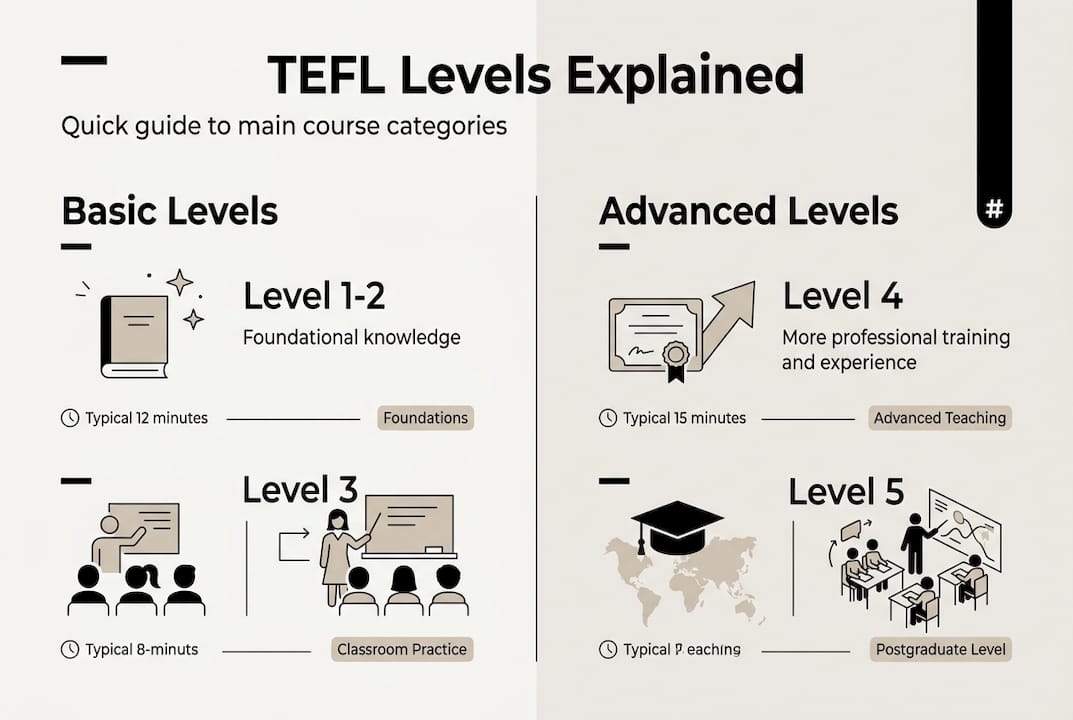
| Qualification Level | Hours Required | Career Application |
|---|---|---|
| Level 1-2 | 40-120 | Introductory awareness, not sufficient for employment |
| Level 3 | 120-150 | Entry-level positions in Asia, online teaching platforms |
| Level 4 | 180-250 | Established language schools, intermediate roles |
| Level 5 | 180-300+ | Universities, international schools, premium institutions |
Pro Tip: Choose at least Level 3 for global job market relevance, but invest in Level 5 if you plan to teach in Europe, the Middle East, or pursue university positions where competition is fierce.
Core TEFL methodologies and course structures
Effective TEFL courses build on established teaching methodologies that shape how you deliver lessons and engage students. The three dominant frameworks are PPP (Presentation-Practice-Production), ESA (Engage-Study-Activate), and TBL (Task-Based Learning). Each methodology offers distinct advantages depending on student proficiency levels, learning objectives, and classroom contexts.

PPP follows a structured sequence where you present new language, students practice in controlled exercises, then produce language independently in communicative activities. This methodology works exceptionally well for teaching grammar structures and vocabulary to beginners who need clear frameworks and repeated practice opportunities.
ESA provides more flexibility by starting with engaging activities that activate student interest, followed by focused study of language points, then concluding with activation exercises that encourage natural language use. This approach suits mixed-level classes and keeps students motivated through varied activity types.
TBL prioritizes meaningful communication by assigning real-world tasks that require language use to complete. Students focus on achieving task outcomes rather than practicing isolated language items, making this methodology ideal for intermediate and advanced learners who need fluency development.
TEFL lesson plans include distinct stages that create effective learning experiences:
- Warm-up activities activate prior knowledge and build student engagement
- Presentation introduces new language items with clear context and examples
- Controlled practice provides scaffolded exercises with teacher guidance
- Free practice encourages independent language production in communicative tasks
- Review consolidates learning and assesses student understanding
Classroom management and assessment strategies form essential components of quality TEFL training. Effective courses teach you to establish clear routines, manage diverse student needs, and use formative assessment to guide instruction. These skills directly impact student learning outcomes and your confidence as a teacher.
Pro Tip: Mastering these methodologies improves student engagement dramatically. Experiment with different frameworks to discover which approaches work best for your teaching style and student populations.
Emerging AI tools are transforming lesson planning and teaching effectiveness. Using AI in the TEFL classroom can streamline material creation, provide instant feedback on student writing, and generate customized practice exercises. However, technology should enhance rather than replace the human elements of teaching that build rapport and cultural understanding.
Specialized TEFL categories and career advantages
Specializing in specific TEFL categories differentiates you in competitive job markets and opens doors to higher-paying positions. Specialized TEFL training targets distinct student populations and learning objectives, allowing you to develop expertise that employers actively seek.
Business English focuses on professional communication skills, industry-specific vocabulary, and workplace scenarios. Companies pay premium rates for teachers who can deliver targeted training that improves employee performance in international business contexts. This specialization suits teachers interested in corporate training and adult education.
Young Learners training equips you to teach children and teenagers using age-appropriate methodologies, classroom management techniques, and engaging activities. International schools, language academies, and summer camps worldwide seek teachers with this specialization, often offering attractive compensation packages and benefits.
Exam Preparation courses for IELTS, TOEFL, and Cambridge exams require deep knowledge of test formats, scoring criteria, and strategic preparation techniques. Students preparing for these high-stakes exams pay premium tuition rates, and schools offering exam prep courses seek teachers with proven expertise in test preparation methodologies.
Online Teaching specialization has exploded in demand since 2020, requiring distinct skills in virtual classroom management, digital tool proficiency, and asynchronous learning design. This category offers location independence and flexible scheduling, though it comes with challenges like technology troubleshooting and maintaining student engagement through screens.
ESP (English for Specific Purposes) targets professionals in fields like medicine, aviation, or engineering who need industry-specific language training. These niche markets offer excellent earning potential but require teachers to develop subject matter knowledge alongside language teaching expertise.
CLIL (Content and Language Integrated Learning) trains you to teach academic subjects through English, a growing approach in international schools and bilingual education programs. This specialization positions you for roles that blend subject teaching with language development.
| Specialization | Typical Job Roles | Salary Impact |
|---|---|---|
| Business English | Corporate trainer, executive coach | 20-35% premium |
| Young Learners | International school teacher, academy instructor | 15-25% premium |
| Exam Prep | IELTS/TOEFL specialist, test center instructor | 25-40% premium |
| Online Teaching | Platform instructor, private tutor | Variable, flexible |
| ESP | Industry-specific trainer, consultant | 30-50% premium |
| CLIL | International school subject teacher | 25-35% premium |
Pro Tip: Combine a Level 5 certification with targeted micro-credentials to maximize career advantages. The best TEFL micro-credentials allow you to add specialized expertise without committing to lengthy additional programs.
The online teaching market continues expanding rapidly, offering unprecedented flexibility and global reach. However, this category presents unique challenges including technology dependence, reduced personal connection with students, and often lower pay rates compared to in-person positions. Success in online teaching requires strong self-discipline, technical proficiency, and creative approaches to building student rapport through digital channels.
Employer preferences and choosing the right TEFL course
Employer requirements vary significantly across regions and institution types, making it essential to align your certification choice with your target teaching market. Understanding these preferences helps you invest in training that opens doors rather than credentials that employers overlook.
Accredited TEFL courses show that 120-hour certifications remain widely accepted for entry-level positions throughout Asia and on online teaching platforms. Language schools in China, Vietnam, Thailand, and South Korea typically accept Level 3 certifications as minimum qualifications, prioritizing native-speaker status and bachelor’s degrees alongside TEFL training.
European institutions, Middle Eastern schools, and universities globally demonstrate strong preference for Level 5 diplomas, CELTA, or Trinity CertTESOL certifications. These employers prioritize teaching quality and seek candidates with rigorous training that includes assessed teaching practice. The competitive nature of these markets means that 80-90% of advertised positions explicitly require Level 5 equivalent qualifications.
Latin American markets show more flexibility, with many schools accepting 120-hour certifications but offering better positions and salaries to teachers with Level 5 credentials or specialized training. Private language institutes may hire teachers with basic certifications, while international schools and bilingual programs require advanced qualifications.
Research indicates that 80% of TEFL graduates secure teaching positions within two months of completing certification, demonstrating strong global demand for qualified English teachers across all experience levels.
The debate between CELTA/Trinity certificates and online Level 5 diplomas centers on intensity versus flexibility. CELTA and Trinity programs require full-time commitment for 4-5 weeks with intensive observed teaching practice, providing immediate practical experience and strong employer recognition. CELTA vs Level 5 TEFL comparisons show that online Level 5 diplomas offer greater flexibility for working professionals and often cost significantly less while achieving comparable employer acceptance rates.
When selecting your TEFL course, consider these practical factors:
- Target teaching location and typical employer requirements in that region
- Career timeline and whether you need immediate certification or can invest in longer programs
- Budget constraints and return on investment for different certification levels
- Learning preferences regarding intensive in-person training versus self-paced online study
- Long-term career goals and whether you plan to teach short-term or build a lasting career
Common TEFL job requirements in 2026 show increasing emphasis on specialized training, digital teaching skills, and verifiable credentials from recognized accrediting bodies. Employers increasingly verify certifications and prefer candidates who demonstrate ongoing professional development through micro-credentials and specialized training.
The most strategic approach combines a solid foundational certification at Level 3 or higher with targeted specializations that match your interests and market demand. This combination provides both the baseline qualifications that open doors and the specialized expertise that commands premium compensation and interesting teaching opportunities.
Explore accredited TEFL courses and internships to advance your career
Ready to take the next step in your teaching journey? TEFL Institute offers comprehensive accredited courses spanning all qualification levels, from entry-level certifications to advanced Level 5 diplomas that match CELTA standards. Our flexible online programs allow you to study at your own pace while maintaining current commitments, and our course extensions let you add specialized training in Business English, Young Learners, or Exam Preparation to tailor your certification to your career goals.
For those seeking hands-on teaching experience, our January TEFL internship sales provide opportunities to gain practical classroom experience in exciting international locations. These programs combine certification with supervised teaching practice, giving you the confidence and skills employers value most. Whether you’re exploring TEFL courses in Newcastle or planning to teach abroad, our expert advisors help you choose the right path for your unique situation and career aspirations.
FAQ
What are the different TEFL course categories?
TEFL courses categorize by qualification level, ranging from introductory Level 1-2 courses to advanced Level 5 diplomas, and by specialization area such as Business English, Young Learners, or Exam Preparation. Qualification levels indicate the depth and rigor of training, while specializations target specific teaching markets and student populations. Choosing the right combination depends on your career goals and target teaching location.
Which TEFL certification do employers prefer worldwide?
Level 5 TEFL diplomas and CELTA or Trinity CertTESOL certificates have the strongest global acceptance, particularly for positions in Europe, the Middle East, and universities. However, 120-hour accredited Level 3 certifications suffice for many entry-level roles throughout Asia and on online teaching platforms. Research shows that 80-90% of premium teaching positions explicitly require Level 5 equivalent qualifications.
Can I specialize in TEFL to improve my career options?
Yes, specializations like Business English, Exam Preparation, or Young Learners significantly enhance niche employability and salary potential, often commanding 20-50% premium compensation. Micro-credentials allow you to add specialized expertise alongside your main TEFL certification without committing to lengthy additional programs. Combining a solid foundational certification with targeted specializations provides the strongest competitive advantage in global teaching markets.
Are online TEFL courses as respected as classroom-based ones?
Online TEFL courses at Level 5 achieve comparable employer acceptance to classroom-based programs when properly accredited, though some employers prefer certifications that include observed teaching practice. The key factors are accreditation quality, course rigor, and whether the certification meets the specific requirements of your target teaching market. Online courses offer greater flexibility and lower costs, making them ideal for working professionals, but require strong self-discipline and time management skills to complete successfully.
Recommended
TEFL Institute guides

China
Z visa, pay and cities
Italy
Jobs, pay and visa routes
Cambodia
Pay, requirements and visas
South Korea
EPIK, hagwons and pay
Vietnam
Work permits and requirements