

 United Kingdom (UK)
 United States (US)
 Canada
 South Africa
 India
India Australia
 New Zealand
 China
China Russia
 Germany
 France
 Spain
Spain Netherlands
 Vietnam
 United Arab Emirates
 Italy
Italy Poland
 Thailand
 Türkiye









 Algeria



Common TEFL job requirements: what you need to know in 2026
Common TEFL job requirements: what you need to know in 2026

Many aspiring TEFL teachers assume that passion and fluency in English are enough to land teaching jobs abroad or online. The reality is quite different. Employers in 2026 expect specific qualifications, certifications, and skills that go far beyond enthusiasm. Understanding these requirements upfront saves time, money, and disappointment during your job search. This article breaks down exactly what you need to secure TEFL positions, from mandatory certifications to legal prerequisites, so you can prepare strategically and position yourself as a competitive candidate in the global TEFL job market.
Table of Contents
- Educational And Certification Requirements For TEFL Jobs
- Additional Qualifications And Skills Valued By TEFL Employers
- Common Logistical And Legal Job Requirements For TEFL Positions
- Understanding Variation In Job Requirements By Region And Teaching Format
- Get Certified And Advance Your TEFL Career With The TEFL Institute
- Frequently Asked Questions
Key takeaways
| Point | Details |
|---|---|
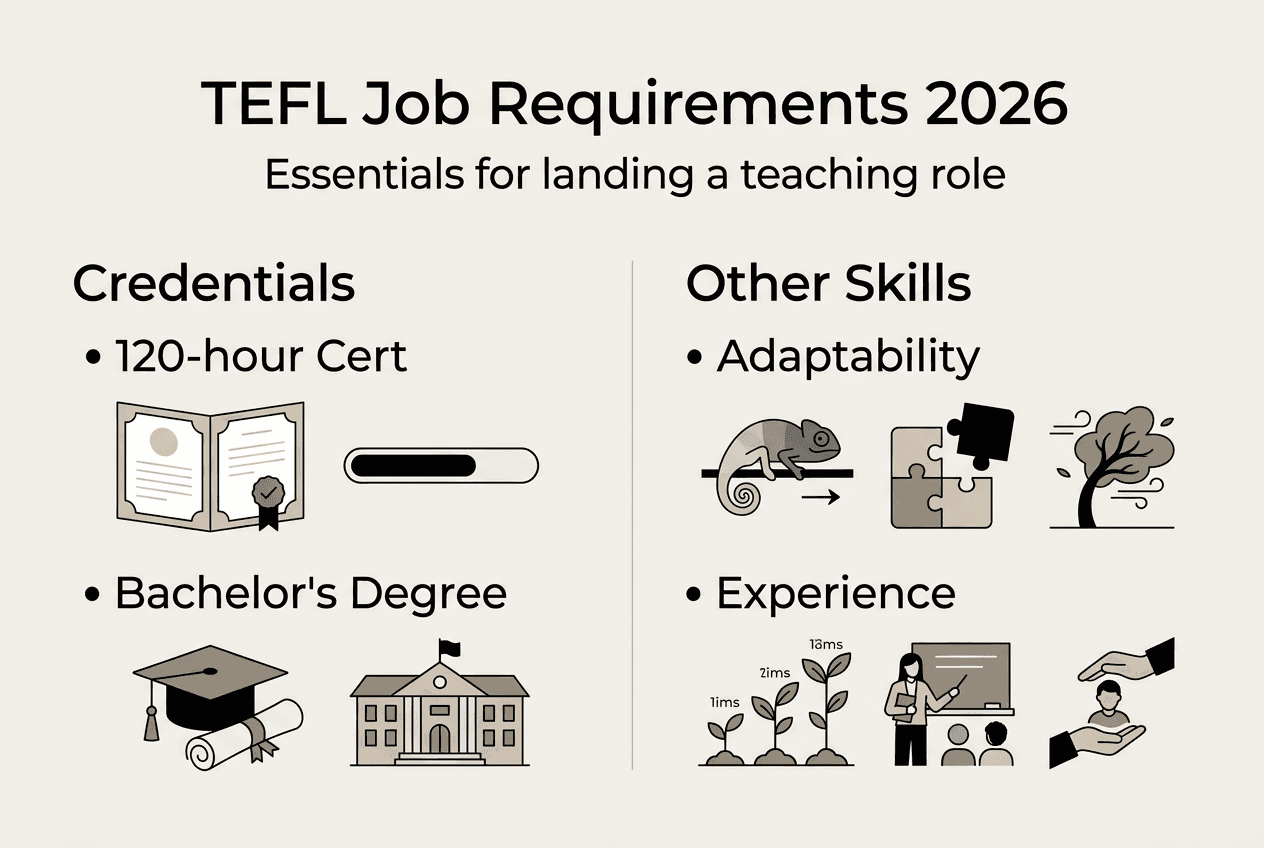
| Certification standard | Most employers require 120-hour TEFL certification as a baseline qualification |
| Degree requirement | Bachelor’s degrees are commonly mandatory for teaching positions abroad |
| Experience matters | Prior teaching experience and language skills significantly boost employability |
| Legal requirements | Visa rules, background checks, and age limits vary by country and employer |
| Regional variation | Job requirements differ substantially between online roles and in-person positions |
Educational and certification requirements for TEFL jobs
The foundation of TEFL employment starts with proper certification. Most TEFL jobs require at least a 120-hour TEFL certification as the industry standard. This certification demonstrates that you understand teaching methodologies, lesson planning, classroom management, and assessment techniques. Without it, you will struggle to compete for reputable positions.
A bachelor’s degree remains a common requirement, especially for international placements. Many countries legally require teachers to hold university degrees to qualify for work visas. China, South Korea, and the United Arab Emirates enforce this strictly. Even employers who do not legally require degrees often prefer candidates with them, viewing higher education as a marker of professionalism and commitment.
Beyond the basics, specialized certifications can set you apart. Consider these additional credentials:
- TESOL or CELTA certifications for enhanced teaching methodology training
- Specialized courses in teaching young learners or business English
- IELTS or TOEFL examiner certifications for test preparation roles
- Advanced diplomas in TEFL for leadership or training positions
Online TEFL jobs sometimes offer more flexibility regarding educational requirements. Some platforms accept teachers without bachelor’s degrees if they hold robust TEFL certifications and demonstrate strong teaching skills. However, premium online schools still prefer degree holders.
Pro Tip: Choose accredited TEFL courses that include practicum components where you teach real students. This hands-on experience builds confidence and makes your resume far more attractive to employers who value practical teaching ability over theoretical knowledge alone.
The quality of your TEFL certification matters as much as having one. Employers increasingly scrutinize where candidates earned their credentials. Accredited programs from recognized institutions carry more weight than unverified online certificates. Research potential courses thoroughly, checking for industry recognition and graduate employment rates. Your TEFL certification guide should include details about practicum hours, tutor support, and job placement assistance.
Additional qualifications and skills valued by TEFL employers
Beyond certifications and degrees, employers seek candidates with specific soft skills and practical abilities. Teaching experience, knowledge of another language, and specific skills dramatically improve your chances of securing positions. These qualities signal that you can handle real classroom challenges, not just pass certification exams.
Soft skills form the backbone of effective TEFL teaching. Adaptability allows you to adjust lesson plans when students struggle or excel beyond expectations. Communication skills help you explain complex grammar concepts in simple terms. Cultural sensitivity enables you to navigate diverse classrooms without causing offense. Employers value these traits because they directly impact student satisfaction and learning outcomes.
Prior teaching or tutoring experience gives you a significant advantage. Even informal experience like tutoring neighborhood kids or leading workshops demonstrates your ability to manage groups and explain concepts clearly. Employers prefer candidates who have already navigated the challenges of keeping students engaged, managing behavior, and assessing progress. This experience reduces the training burden on employers and increases the likelihood you will succeed in the role.
Knowing a second language can be an asset, though it is not universally required. In some contexts, speaking the local language helps with classroom management and building rapport with students. However, many TEFL positions use English immersion methods where teachers speak only English. Understanding language requirements for TEFL helps you target appropriate positions based on your linguistic abilities.
Employers frequently look for these five specific skills in job advertisements:
- Lesson planning and curriculum development abilities
- Classroom management techniques for diverse age groups
- Technology integration for online or hybrid teaching
- Assessment and feedback delivery skills
- Cross-cultural communication and sensitivity
Pro Tip: Gain volunteer or internship teaching experience to build your resume and confidence. Many organizations offer short-term teaching placements that provide valuable hands-on practice. These experiences demonstrate initiative and commitment while helping you discover which teaching contexts suit you best. Even a few weeks of volunteer teaching can make your application stand out in competitive job markets.
Developing these skills before you start job hunting positions you as a serious professional rather than a casual traveler seeking adventure. Employers can tell the difference immediately. Candidates who invest in skill development before applying typically secure better positions with higher salaries and more support.
Common logistical and legal job requirements for TEFL positions
Securing TEFL jobs involves navigating complex legal and logistical requirements that vary significantly by country and employment type. Understanding these prerequisites prevents costly surprises and helps you target realistic opportunities.

Visa and work permit requirements form the most critical legal hurdle. Different countries have varying age restrictions, visa requirements, and background check mandates for TEFL teachers. Some nations offer straightforward work visa processes for qualified teachers, while others impose bureaucratic obstacles. Research specific countries thoroughly before committing to job applications. Your employer typically sponsors your work visa, but you must provide necessary documentation like degree certificates, criminal background checks, and health examinations.
| Country | Minimum Age | Maximum Age | Degree Required | Background Check |
|---|---|---|---|---|
| China | 24 | 60 | Yes | Yes |
| South Korea | 18 | 62 | Yes | Yes |
| Thailand | 21 | 55 | Yes | Yes |
| Vietnam | 18 | 60 | Preferred | Yes |
| Online Platforms | 18 | No limit | Varies | Usually |
Background checks have become standard across the TEFL industry. Employers conduct these checks to ensure student safety and comply with local regulations. The process typically requires obtaining police clearance certificates from your home country and sometimes from countries where you have lived previously. Some nations require additional checks like FBI background reports for American citizens. Plan for this process to take several weeks or months, and budget for associated fees.
Potential hurdles candidates commonly face include:
- Incomplete or improperly authenticated degree certificates
- Criminal records that disqualify candidates in certain countries
- Medical conditions that prevent visa approval
- Age limits that exclude otherwise qualified teachers
- Nationality restrictions favoring native English speakers from specific countries
Preparing documentation early streamlines your job search. Gather certified copies of your degree, TEFL certificate, passport, and background checks before applying. Some countries require documents to be notarized, authenticated by government agencies, and translated into local languages. This process can take months, so starting early prevents missing job opportunities due to incomplete paperwork.
Understanding TEFL teaching requirements abroad helps you assess whether you meet eligibility criteria before investing time in applications. Some requirements like age limits and nationality preferences feel discriminatory but reflect local labor laws and cultural preferences. Knowing these restrictions upfront allows you to focus on markets where you qualify rather than pursuing impossible opportunities.
Understanding variation in job requirements by region and teaching format
TEFL job requirements vary widely between countries and between online and in-person roles. Understanding these differences helps you target opportunities that match your qualifications and preferences while avoiding wasted effort on positions where you do not qualify.
Geographic location dramatically impacts what employers expect. Asian markets typically impose strict requirements including bachelor’s degrees, specific age ranges, and native English speaker status. European markets often prioritize EU citizenship due to visa complexities. Middle Eastern countries offer high salaries but require extensive documentation and cultural adaptation. Latin American positions sometimes accept teachers without degrees but pay lower salaries.
| Region | Typical Requirements | Salary Range | Visa Difficulty |
|---|---|---|---|
| East Asia | Degree, 120-hour TEFL, native speaker | $1,500-$3,000/month | Moderate |
| Middle East | Degree, 2+ years experience, TEFL | $2,500-$5,000/month | High |
| Latin America | TEFL certification, degree preferred | $800-$1,500/month | Low |
| Europe | Degree, CELTA/TESOL preferred, EU citizenship helps | $1,200-$2,500/month | High (non-EU) |
| Online Platforms | TEFL, degree varies, reliable internet | $10-$25/hour | None |
Online TEFL jobs offer different trade-offs compared to traditional overseas teaching. Online positions eliminate visa requirements and allow you to work from anywhere with stable internet. However, they often require more flexible scheduling to accommodate students in different time zones. Some premium online schools maintain strict requirements including degrees and certification, while others accept teachers based solely on teaching ability and availability.
Regions with more stringent requirements typically offer better compensation and support. Countries that require degrees, background checks, and specific certifications usually provide higher salaries, housing allowances, health insurance, and flight reimbursements. Markets with flexible requirements often expect teachers to arrange their own accommodation and provide fewer benefits.
Key adapting tips for different teaching contexts:
- Research specific country requirements before applying to avoid disqualification
- Consider online teaching to gain experience if you lack qualifications for abroad positions
- Target regions where your nationality and qualifications align with preferences
- Invest in additional certifications like CELTA for competitive European markets
- Build teaching experience through online platforms before pursuing prestigious abroad positions
Choosing between online and abroad teaching depends on your qualifications, financial goals, and lifestyle preferences. Online teaching offers flexibility and eliminates relocation stress but can feel isolating and requires self-discipline. Teaching abroad provides cultural immersion and structured support but demands significant life changes and adaptation to new environments.
Understanding these variations allows you to create a realistic job search strategy. Rather than applying randomly, target positions where you meet or exceed requirements. This focused approach increases your success rate and helps you secure positions that match your qualifications and career goals. Selecting the best TEFL certification options for your target market gives you a competitive edge in your preferred teaching context.
Get certified and advance your TEFL career with the TEFL Institute
Meeting common TEFL job requirements starts with earning recognized certification from a trusted provider. TEFL Institute offers comprehensive courses designed to prepare you for real teaching positions, not just pass certification exams.
Our programs include location-based training options like TEFL courses in Newcastle that combine classroom instruction with hands-on teaching practice. You can also explore TEFL course extensions to specialize in areas like young learners, business English, or exam preparation. These specializations make your resume more attractive to employers seeking teachers with specific expertise.
For those ready to gain practical experience, January TEFL internships provide opportunities to teach real students while earning your certification. This hands-on approach builds confidence and creates compelling resume content that sets you apart from candidates with only theoretical training. Start your TEFL journey today and position yourself to meet employer expectations in 2026 and beyond.
Frequently asked questions
Are there age restrictions to teach English abroad?
Many countries impose age limits typically between 18 and 65, though specific ranges vary by destination. China often requires teachers to be under 60, while South Korea accepts teachers up to 62. Some employers set minimum ages around 21 or 24 to ensure maturity and life experience. Online teaching platforms rarely enforce upper age limits, making them attractive options for older teachers. Understanding TEFL age requirements helps you identify markets where you qualify regardless of your age.
How long is TEFL certification valid?
TEFL certifications generally do not expire, meaning your certificate remains valid indefinitely once earned. However, employers increasingly prefer recent certifications as evidence that your teaching knowledge reflects current methodologies and technologies. Some schools may request additional training if your certification is more than five years old. Staying updated through professional development courses demonstrates ongoing commitment to teaching excellence. Check TEFL certification validity standards to understand how employers evaluate credential recency.
Do I need to know another language to teach TEFL?
Knowing another language can be helpful but is not a strict requirement for most TEFL positions. Many teaching contexts use English immersion methods where teachers speak only English to maximize student exposure. However, knowing the local language can ease daily life challenges and help with classroom management in certain situations. Some employers view second language knowledge as a bonus that demonstrates cultural adaptability. Explore language skills for TEFL to understand when linguistic abilities provide advantages.
What is the best way to gain teaching experience for TEFL jobs?
Volunteering, internships, and tutoring are effective ways to build relevant teaching skills and experience before pursuing paid positions. TEFL courses offering practicum components provide hands-on teaching practice with real students under mentor supervision. You can also gain experience through online tutoring platforms that accept teachers without extensive backgrounds. Even informal experience like leading workshops or coaching demonstrates transferable skills that employers value. Start with lower-barrier opportunities to build your resume, then leverage that experience to secure more competitive positions.