
 United Kingdom (UK)
 United States (US)
 Canada
 South Africa
 India
India Australia
 New Zealand
 China
China Russia
 Germany
 France
 Spain
Spain Netherlands
 Vietnam
 United Arab Emirates
 Italy
Italy Poland
 Thailand
 Türkiye









 Algeria


No. The E-2 foreign language instructor visa requires a completed bachelor’s degree from an accredited university, and it is the status almost every English teacher in Korea holds. The only people who teach lawfully without a degree hold a residency status such as F-4, F-6, F-2 or F-5.
Can I Teach English in Korea Without a Degree?
Can I Teach English in Korea Without a Degree?
No. South Korea’s E-2 foreign language instructor visa requires a completed bachelor’s degree, so you cannot teach English in Korea without a degree on that route. For the full rules, pay and benefits, see our guide to teaching English in South Korea. The only lawful alternatives are residency based rather than qualification based: F-4, F-6, F-2 and F-5 holders may already work without an E-2. Teaching on a tourist visa is illegal.
Key takeaways
- The E-2 visa is the standard route into a Korean classroom, and it is built around a bachelor’s degree from an accredited university. There is no experience based waiver and no portfolio route.
- An associate degree does not satisfy the requirement. The English Program in Korea (EPIK), run under the Ministry of Education, states this in plain terms on its eligibility page.
- Every genuine no degree route is a residency status you already hold or become eligible for: F-4 for overseas Koreans, F-6 for spouses of Korean nationals, F-2 for long term residents and F-5 for permanent residents.
- Korea Immigration lists the statuses that allow employment. Tourist and visa exempt statuses are not among them, and working on one is an immigration offence.
- A TEFL qualification strengthens an E-2 application and is often required alongside a degree. It does not replace the degree, and no training provider can make it do so.
- If Korea is closed to you, the sensible next step is to compare countries by their actual visa rules rather than by marketing copy.
This question gets asked constantly and usually gets answered badly. Plenty of pages promise a workaround, a loophole, or a school that “does not check”. There is no loophole, and the schools that do not check are the ones to be most wary of. Korea runs one of the tightest teaching visa regimes in Asia, and the rules are published by the government rather than left to interpretation.
What follows is the honest version, with the official source next to each claim. If Korea turns out not to be viable for you, our complete guide to teaching English abroad without a degree, with country by country requirements sets out where the door is genuinely open.
What does the E-2 visa actually require?
Before the degree question, there is a nationality question, and it rules more people out than the degree does. The E-2 is restricted to citizens of seven countries: Australia, Canada, Ireland, New Zealand, the United Kingdom, the United States and South Africa. If you hold one of those passports you have cleared the hardest filter in the industry, and our guide to teaching English abroad from Canada sets out what EPIK asks for after that, including the six-week certificate deadline that catches people out.

The E-2 is the status of sojourn for foreign language instructors, and it is the visa almost every English teacher in Korea holds. The Korea Visa Portal, operated by the Ministry of Justice, lists three sub codes under it: E-2-1 for a general foreign language instructor, E-2-2 for a teaching assistant, and E-2-91 for a foreign language instructor admitted under a free trade agreement.
The clearest published statement of what an applicant needs comes from EPIK’s eligibility page. EPIK is the government run public school programme, so its criteria track the visa criteria closely. It requires citizenship of Australia, Canada, Ireland, New Zealand, the United Kingdom, the United States or South Africa, and a bachelor’s degree from an accredited university in one of those designated countries. Indian citizens are eligible separately under the Korea India Comprehensive Economic Partnership Agreement if they hold a valid teaching certificate in English education, which is what the E-2-91 sub code exists for.
Two points deserve precision. The citizenship list and the degree country list are the same list, so a bachelor’s earned elsewhere will usually not be accepted even from a citizen of one of the seven countries. And Korea Immigration does not publish the full E-2 qualification criteria in English on HiKorea, so definitive confirmation for your own case comes from the Korean embassy or consulate that will issue your visa.
Does the subject of your degree matter?
Not for the visa itself. A bachelor’s in geology, music or accountancy satisfies the requirement in the same way a degree in English does. What the subject affects is whether you also need a TEFL certificate. EPIK requires a TEFL, TESOL or CELTA certificate of at least 100 hours from an accredited programme unless you hold a teaching licence, a B.Ed, an M.Ed or an education focused major. Hagwons, the private academies, set their own preferences, but they are recruiting into the same E-2 status, so the visa criteria are the floor either way.
Do associate degrees or three year degrees count?
An associate degree does not. EPIK states directly that it does not satisfy the requirement, and since the E-2 itself is built on a bachelor’s degree, no employer can work around that. A three year bachelor’s degree from Ireland, the UK, Australia or South Africa is a different matter: it is a full bachelor’s degree, and length is not the test. What matters is that the qualification is a conferred bachelor’s degree from an accredited institution, evidenced by a notarised or authenticated degree certificate carrying an apostille, plus sealed transcripts, as set out on EPIK’s required documents page.
Higher national diplomas, foundation degrees and partial study without conferral do not meet the standard. If the transcript does not end in a conferred degree, the application does not proceed.
Which routes let you teach in Korea without a degree?
All of them are about who you are or where you already live, not about what you can do in a classroom. HiKorea’s guidance on foreigners’ stay lists the statuses that permit employment activity: short term employment (C-4), the E-1 to E-10 employment statuses, residency (F-2), overseas Koreans (F-4), permanent residency (F-5) and working holiday (H-1). It adds that employment may still be restricted depending on the status held.
| Route | Degree required? | Who it realistically suits | Official source |
|---|---|---|---|
| E-2 foreign language instructor | Yes, a conferred bachelor’s degree from an accredited university in one of the seven designated countries | Graduates who are citizens of Ireland, the UK, Australia, New Zealand, Canada, the US or South Africa | EPIK, Ministry of Education |
| F-4 overseas Korean | No | People of Korean heritage who qualify as overseas Koreans, including descendants of former Korean nationals | HiKorea, Korea Immigration Service |
| F-6 marriage migrant | No | Spouses of Korean nationals already living in Korea, and those raising a Korean national child | EPIK, Ministry of Education |
| F-2 residence | No, though the points based path to F-2 rewards education heavily | Long term residents already in Korea on another status, and certain family members of Korean nationals | HiKorea, Korea Immigration Service |
| F-5 permanent residence | No | People who have already built several years of qualifying residence in Korea | HiKorea, Korea Immigration Service |
| H-1 working holiday | No for the visa itself, but it carries no E-2 teaching rights and we could not verify that conversation instruction is permitted on it | Young travellers from agreement countries who want casual work, not a teaching career | HiKorea, Korea Immigration Service |
| D-2 student, part time work permission | No, but you must be enrolled and hold prior permission | Degree students in Korea who need part time income, not people seeking a teaching post | Study in Korea, NIIED |
| Tourist or visa exempt entry | Not applicable, working on it is unlawful | Nobody. Working on a tourist status is an immigration offence | HiKorea, Korea Immigration Service |
Can F-4 overseas Korean status let you teach without a degree?
Yes, in the sense that F-4 holders are not tied to the E-2 rules at all. HiKorea lists overseas Koreans (F-4) among the statuses that permit employment activity, and EPIK confirms the practical consequence: its eligibility page notes that you cannot work in Korea without the E-2 visa, “excluding F4, F6 or Korean passport holders”. If you hold F-4, the degree question changes from a visa question into a hiring question.
F-4 is a heritage status rather than a qualification. The Korea Visa Portal lists a long set of sub codes for it, including overseas Koreans and their descendants, former D or E visa holders, permanent residents of OECD countries and people aged 60 or over. Eligibility depends on your family’s Korean nationality history, which is a matter for a Korean consulate to assess rather than something you can self certify.
Be clear about what F-4 does not do. It removes the visa barrier, not the market barrier. Public school programmes and better hagwons still prefer graduates, so a teacher without a degree competes against a large pool of degree holders in the same city.
Does an F-6 marriage visa allow you to teach English in Korea?
Yes. F-6 covers the spouse of a Korean national and those raising a Korean national child, per the sub codes F-6-1 and F-6-2 on the Korea Visa Portal. EPIK’s eligibility page again confirms that F-6 holders do not need an E-2 to work.
The obvious limitation is that F-6 is not a route anyone can choose. It follows a marriage, it is assessed on the genuineness of that relationship, and immigration scrutinises it closely. If you already hold it, though, it opens hagwon and private institute work that an E-2 would never permit, because F-6 is a family status rather than a job specific one.
What about the F-2 residence visa?
F-2 residency appears on HiKorea’s list of statuses that allow employment, and it is not conditioned on a teaching qualification. It covers several groups, including underage children of Korean nationals (F-2-2) and spouses of permanent residents (F-2-3), alongside the better known points based route for long term residents.
The catch is that F-2 is almost always a second status. You reach it after time in Korea on something else, whether that is study, work or family life, so it is not a visa you apply for from Dublin or Sydney with no Korean connection. The points based path is scored against criteria that immigration publishes and updates, covering factors such as age, income, education and Korean language ability, so check the current scoring directly rather than relying on any summary, this one included.
Does F-5 permanent residence remove the degree requirement?
It does, and it is listed on HiKorea among the statuses permitting employment. F-5 holders work in Korea more or less as a Korean national would, so no E-2 and no degree test applies.
It is also the least useful answer to the question, because F-5 is the end of a long residence pathway rather than an entry point. If you are reading this because you want to move to Korea next year without a degree, F-5 is not your route.
Can you teach on an H-1 working holiday visa?
Treat this as a no unless immigration tells you otherwise in writing. HiKorea does list working holiday (H-1) among the statuses that permit employment activity, but the same page adds that employment may be restricted depending on status, and working holiday agreements are built around casual work rather than a regulated profession.
Conversation instruction in Korea is a regulated activity with its own status of sojourn and its own qualification criteria, including a criminal record check and a health statement. That is the kind of occupation working holiday schemes are designed to exclude. We could not locate an official English page from Korea Immigration or the Ministry of Foreign Affairs stating in terms whether English conversation instruction is permitted on H-1, so treat it as unverified and put the question to the Korean embassy handling your application before accepting any teaching work.
What is certain is the consequence of getting it wrong. HiKorea’s guidance on activities not covered by the status of sojourn is unambiguous: permission comes before the activity, not after.
Does a D-2 student visa let you teach part time?
A D-2 student visa allows part time work with prior permission, but the permitted fields published by the government do not include English teaching. The Study in Korea portal, run by NIIED under the Ministry of Education, describes part time work for students as “typically limited to simple labour tasks commonly performed by students” and gives examples such as assisting in restaurants, general office assistance, tourism guidance assistance and duty free shop sales assistance.
The hour caps are published on the same page. Undergraduates are limited to 30 hours per week and graduate students to 35 hours, with the cap lifted at weekends and during vacations. Eligibility is tied to Korean language ability: TOPIK level 3 for associate and bachelor’s students in their first two years, level 4 for third and fourth year undergraduates and graduate students, and level 2 with six months of study for those in language programmes.
Students must also obtain part time employment permission from their local immigration office first, which HiKorea illustrates with the example of “a foreign student status (D-2) holder seeking a part-time job (S-3)”. Since English conversation instruction is not among the published permitted fields, treat teaching on a D-2 as not permitted unless your immigration office grants it explicitly. That point is unverified either way, and the immigration office, not the school, is the one to ask.
What about E-7 and other routes people cite?
E-7 is a special occupation status for skilled professionals recruited into designated job codes, and it is not a workaround for the English classroom. Applicants are assessed against the requirements of the specific occupation code, which typically means a relevant degree or substantial documented professional experience.
Two other things get repeated online and are worth correcting. The first is the idea that a “TEFL only” school will sponsor you. Sponsorship is not something a school can grant. Immigration issues the status, and the school simply files paperwork. The second is the suggestion that you can arrive on a tourist status and change to E-2 once you have found a job. HiKorea’s guidance on change of status of stay states the general rule plainly: “foreigners seeking to participate in activities not permitted under their current status must first depart from Korea, obtain a new status that corresponds with the desired status, then re-enter Korea with the newly obtained status”. Limited in country changes exist, but they are exceptions granted after examination, not a default.
What happens if you teach in Korea without the right visa?
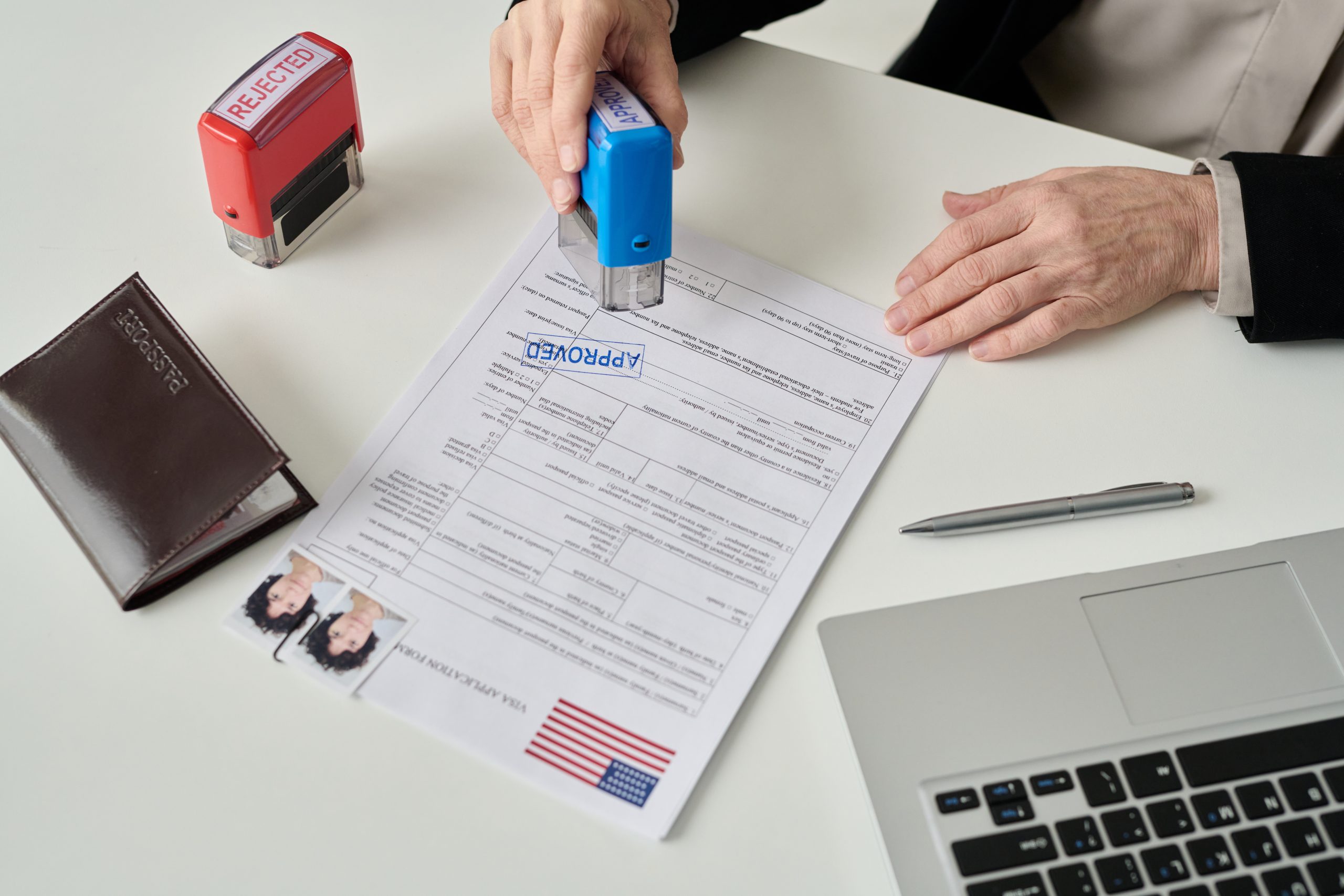
You become an immigration offender, which is a defined legal category rather than a figure of speech. HiKorea defines the term as “a person deemed to have committed any of the offences prescribed in Articles 93-2, 93-3, 94 through 99, 99-2, 99-3 and 100 of the Immigration Act”, and sets out an investigation process running from acknowledgement through investigation and examination to an adjudication decision.
The possible outcomes are listed on HiKorea’s page on decisions concerning immigration offenders: deportation, a departure order, a recommendation for departure, a disposition of notice carrying penalties, and an administrative fine. Deportation is described there as “the strongest type of administrative measure for offending foreigners of the immigration act”, and it removes you from Korea regardless of your wishes, with only seven days to file a written objection. The specific fine amounts sit in the Immigration Act rather than on HiKorea’s English pages, so we are not going to quote a figure we cannot source.
The practical damage runs further than the penalty. A deportation and an entry ban follow you, and they surface the next time you apply for a visa anywhere that asks about immigration history. Employers who hire outside the rules also tend to cut corners on contracts, housing and severance, so the person taking the risk is the one with the least protection.
One related rule catches even legitimate E-2 teachers out. If you want to add or change a workplace you need permission from immigration in advance, and HiKorea’s guidance on change or addition of workplace states that “adding more than two workplaces beside the main workplace is prohibited”. Private tutoring on the side, without permission, is the single most common way an otherwise lawful teacher ends up in trouble.
What does an E-2 job actually pay, for context?
Knowing what the regulated route pays explains why Korea can afford to be strict. EPIK’s published pay scale runs from 2.1 million to 3.0 million Korean won a month, roughly 1,300 to 1,860 euro, by level, province and experience, plus a 300,000 won settlement allowance, about 185 euro, an entrance allowance and a completion bonus each worth 1.3 to 1.8 million won, roughly 805 to 1,115 euro, severance of around one month’s salary, employer provided housing and half the medical insurance premium. Euro figures use the European Central Bank reference rate of 1,614.39 won to the euro on 26 August 2026, so treat them as approximate.
Does a TEFL qualification change any of this?
It changes your competitiveness, not your eligibility. A TEFL, TESOL or CELTA certificate of at least 100 hours is required for EPIK applicants who do not hold a teaching licence or an education degree, so for most graduates it is not optional. It also does real work in the classroom, since a first lesson with 30 to 40 children is not something you improvise your way through.
What it cannot do is stand in for a bachelor’s degree at a Korean consulate. Any provider suggesting otherwise is either confused or selling. At The TEFL Institute Group we would rather tell you Korea is closed than sell you a course on a false premise, and if your circumstances change, an Ofqual regulated Level 5 TEFL Diploma is the qualification that travels furthest.
If Korea is closed to you, what should you look at instead?
Several countries in Asia and Latin America set their teaching visa rules around a certificate and demonstrated ability rather than a degree, and a few in Europe run cultural exchange or assistant schemes with different criteria again. Rather than guess, work country by country from the guide linked near the top of this article, which separates where a degree is genuinely not required from where the claim is marketing.
If Korea remains the goal and the degree is the only missing piece, the honest plan has two steps. Complete a bachelor’s degree, in any subject, from an accredited university in one of the seven designated countries, then pair it with an accredited TEFL certificate of 100 hours or more. It is slower than most people want, and it is the plan that ends with you standing in a Korean classroom lawfully.
Where to start
Confirm your own position with the Korean embassy or consulate that would issue your visa, because theirs is the only binding answer. If the E-2 route is open to you, browse the accredited TEFL courses from The TEFL Institute Group and pick the level that matches where you want to teach.
We love taking your call.

TEFL Institute guides
Plan for 2027
Thailand
Visas and teaching licences
Read the guide
Plan for 2027
China
Z visa, pay and cities
Read the guide
Plan for 2027
Mexico
Jobs, pay and cities
Read the guide
Plan for 2027
Spain
Jobs, pay and visa routes
Read the guide
Plan for 2027
Germany
Freelance work and pay
Read the guide
No. EPIK, the government run public school programme, states plainly that an associate degree does not satisfy the requirement. The test is a conferred bachelor’s degree from an accredited university, evidenced by an apostilled degree certificate and sealed transcripts. Foundation degrees and higher national diplomas do not meet it either.
No. Any subject satisfies the E-2 degree requirement. The subject only affects whether you also need a TEFL certificate. EPIK requires a TEFL, TESOL or CELTA certificate of at least 100 hours unless you hold a teaching licence, a B.Ed, an M.Ed or an education focused major.
EPIK requires citizenship of Australia, Canada, Ireland, New Zealand, the United Kingdom, the United States or South Africa, plus a degree from an accredited university in one of those countries. Indian citizens apply separately under the Korea India economic partnership agreement, which is the E-2-91 sub code.
Treat it as no unless immigration says otherwise in writing. HiKorea lists H-1 among statuses permitting employment but notes employment may be restricted by status. We could not find an official page confirming that conversation instruction is allowed on H-1, so ask the issuing Korean embassy first.
You become an immigration offender under the Immigration Act. HiKorea lists the possible outcomes as deportation, a departure order, a recommendation for departure, a disposition of notice carrying penalties, and an administrative fine. Deportation is described as the strongest administrative measure, and it usually brings an entry ban.