
 United Kingdom (UK)
 United States (US)
 Canada
 South Africa
 India
India Australia
 New Zealand
 China
China Russia
 Germany
 France
 Spain
Spain Netherlands
 Vietnam
 United Arab Emirates
 Italy
Italy Poland
 Thailand
 Türkiye










 Algeria



Benefits of Micro Credentials for Career Growth in 2026
Benefits of Micro Credentials for Career Growth in 2026

TL;DR:
- Micro-credentials are short certifications that verify specific job skills and offer measurable career benefits. They increase employability, speed up hiring, and provide wage premiums, especially when credit-bearing and industry co-developed. For educators, they support quick upskilling, curriculum updates, and building pathways to higher qualifications.
Micro-credentials are short, focused certifications that verify job-relevant skills and deliver measurable career benefits for both individual learners and educators. The benefits of micro credentials are well documented: 94% of employers are willing to offer higher starting salaries to candidates who hold them, and 87% of graduates secure jobs aligned with their credentials within 12 months. Unlike traditional degrees, micro-credentials target specific competencies, making them a direct response to the skills gaps employers report most often. For educators and professionals in fields like TEFL, they represent a practical path to career advancement without the time and cost of a full degree program.
What are the benefits of micro credentials for employability?
Micro-credentials give candidates a measurable edge in hiring. 60% of employers prefer less experienced candidates with generative AI micro-credentials over more experienced ones without them. That finding signals a fundamental shift: verified, specific skills now outweigh years of general experience in many hiring decisions.

The speed advantage is equally significant. 73% of employers report that candidates with relevant micro-credentials move faster through hiring pipelines. Faster hiring means less time between qualification and employment, which directly affects income and career momentum.
Wage outcomes also improve. The first job-relevant credential provides a 3.8% wage premium, with each additional relevant credential adding approximately 1% more. These gains are modest individually but compound meaningfully over a career, particularly when credentials are stacked in a related field.
Performance data reinforces the case. 92% of employers report that entry-level hires with micro-credentials perform better in their first year than those without. Better first-year performance leads to faster promotions, stronger references, and more durable career trajectories.
- Hiring preference: Employers favor credentialed candidates even when they have less experience overall.
- Pipeline speed: Credentialed candidates complete hiring processes faster, reducing time to employment.
- Wage premium: Job-relevant credentials deliver a 3.8% starting wage increase, with additional credentials adding incremental gains.
- Job performance: First-year performance is measurably stronger among credentialed hires.
- Skill specificity: Credentials in high-demand areas like generative AI signal readiness for current job requirements.
Pro Tip: Target credentials in skills your target sector lists explicitly in job postings. A credential that matches a job description keyword for keyword carries far more weight than a general professional development certificate.
What advantages do micro credentials offer educators?
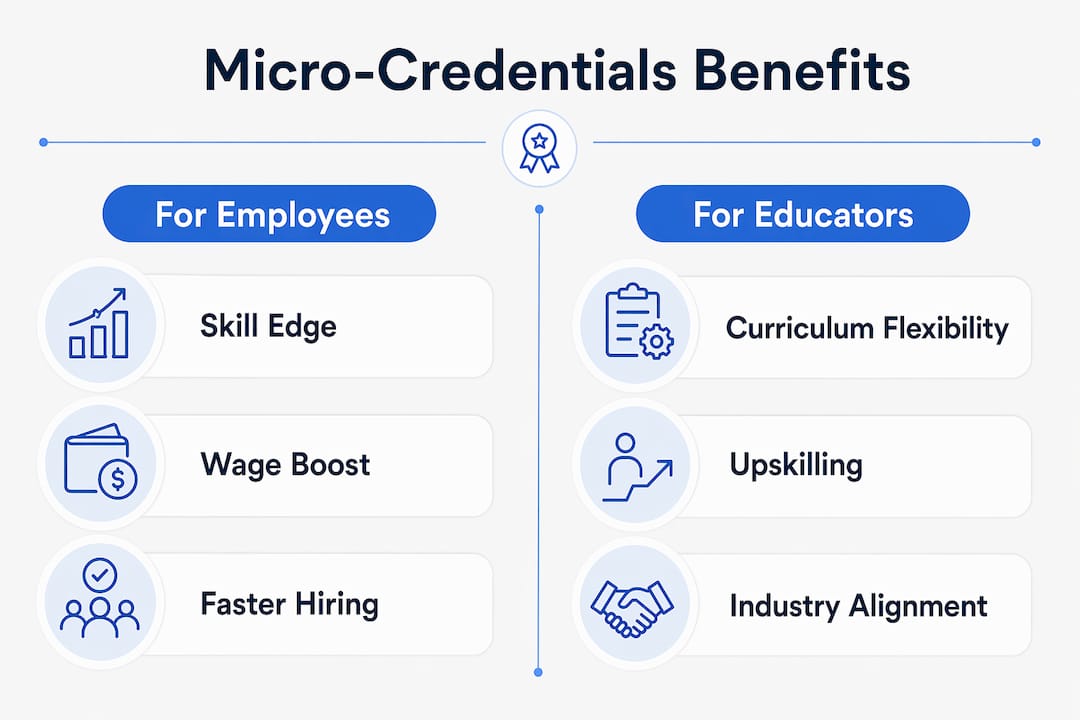
Educators face a specific challenge: skill demands in classrooms and institutions change faster than traditional professional development cycles allow. Micro-credentials solve this directly. They offer a flexible “in-and-out” learning model that working professionals can complete alongside full-time teaching duties without disrupting their schedules.
The advantages for educators extend beyond personal upskilling. When institutions embed micro-credentials within curricula, they gain the ability to update course content faster and align programs more closely with workforce demands. Micro-credentials embedded in university curricula foster faster updates, better industry alignment, and increased student enrollment and motivation. That combination benefits both the institution and the learners it serves.
For individual educators, the stackability of micro-credentials is a significant long-term advantage. 70% of students prefer credit-bearing micro-credentials over non-credit ones, and with good reason. Credit-bearing credentials can count toward advanced degrees, turning short professional development courses into building blocks for higher qualifications.
Here is a practical sequence for educators looking to maximize the value of micro-credentials in their professional development:
- Identify skill gaps. Review your current teaching practice and compare it against the skills most requested in job postings or institutional reviews in your field.
- Select credit-bearing programs. Prioritize credentials that carry academic credit, as these offer both immediate professional value and long-term academic progression.
- Complete one credential at a time. Micro-credentials are designed to be manageable. Finishing one before starting another prevents credential fatigue and keeps learning focused.
- Apply skills immediately. Use new competencies in your classroom or curriculum as soon as you acquire them. Applied practice reinforces learning and produces evidence of competency for future employers or institutions.
- Stack credentials strategically. Build a portfolio of related credentials in a defined area, such as IELTS instruction, online teaching, or AI integration in the classroom.
Pro Tip: If you are an educator considering advanced TEFL qualifications, look for programs that combine micro-credentials with a recognized diploma pathway. The combination signals both specialized skill and sustained commitment to professional growth.
How do micro credentials compare with traditional credentials?
Not all credentials deliver the same return. The distinction between credential types matters significantly for both wage outcomes and employer perception.
| Credential type | Wage impact | Employer preference | Academic progression |
|---|---|---|---|
| Job-relevant micro-credential | 3.8% premium on first credential | High, especially with applied assessments | Possible if credit-bearing |
| Irrelevant badge or certificate | No measurable wage gain | Low | Rarely applicable |
| Credit-bearing micro-credential | 10% or more salary increase at higher rates | High, particularly when industry-co-developed | Counts toward advanced degrees |
| Traditional degree | Strong baseline, slower to update | Valued but not sufficient alone in fast-moving fields | Full academic pathway |
Credit-bearing micro-credentials are linked to salary increases of 10% or more at higher rates than non-credit credentials. That gap between credit-bearing and non-credit credentials is the most important distinction learners often overlook.
Industry partnership also determines value. 82% of employers value micro-credentials co-developed with industry partners significantly more than those developed solely by academic institutions. A credential designed with employer input reflects actual job requirements rather than academic assumptions about them.
Assessment design matters too. Employers and learners alike prefer project-based skills assessments over content-only tests. A credential that requires a learner to complete a real task, build a lesson plan, or analyze a dataset carries more credibility than one based purely on multiple-choice questions.
The volume of micro-credentials on resumes has grown sharply in recent years, with a 35% increase in unique non-degree credentials on U.S. resumes recorded in a recent year. Growth in volume also means growth in noise. Learners who accumulate irrelevant badges risk diluting the signal value of their genuinely relevant credentials.
How to choose micro credentials that actually advance your career
Selecting the right credential requires the same rigor as selecting a degree program. The market is large and not uniformly reliable.
- Verify industry alignment. Choose credentials co-developed with employers or professional bodies in your field. Industry-aligned programs reflect real job requirements, not theoretical curricula.
- Confirm credit-bearing status. If academic progression matters to you, confirm whether the credential carries transferable academic credit before enrolling.
- Evaluate assessment design. Programs with project-based or applied assessments produce stronger evidence of competency than those relying on content recall alone.
- Check for stackability. A credential that fits into a recognized pathway, such as a TEFL diploma or a master’s program, multiplies its value over time.
- Assess flexibility and cost. Learners report higher engagement in micro-credential programs due to manageable course sizes and lower costs compared to traditional degrees. Affordability and schedule compatibility are legitimate selection criteria, not compromises.
- Use recognized platforms and institutions. Organizations like Digital Promise describe micro-credentials as a “skills currency,” meaning their value depends on the issuer’s credibility. Choose programs from accredited institutions or platforms with verifiable employer partnerships.
For educators specifically, niche TEFL courses that combine subject specialization with recognized credentialing offer a strong return. A credential in IELTS instruction or online teaching methodology, for example, targets a specific and growing employer demand rather than general teaching competency.
Pro Tip: Before enrolling, search the credential name alongside “employer recognition” or “hiring” to find real-world evidence of how hiring managers respond to it. Anecdotal employer feedback is often more revealing than institutional marketing materials.
Key takeaways
Micro-credentials deliver the strongest career and salary returns when they are job-relevant, credit-bearing, and co-developed with industry partners.
| Point | Details |
|---|---|
| Employer preference is clear | 94% of employers offer higher salaries to credentialed candidates, and 92% report better first-year performance. |
| Relevance determines wage return | Only job-relevant credentials produce wage premiums; irrelevant badges add no measurable financial benefit. |
| Credit-bearing credentials pay more | Credit-bearing micro-credentials are linked to salary increases of 10% or more at higher rates than non-credit options. |
| Educators benefit from stackability | Stacking credit-bearing credentials toward advanced degrees builds long-term academic and financial returns. |
| Industry co-development signals quality | 82% of employers value credentials developed with industry partners more than those from academic institutions alone. |
The case for being selective, not prolific
The credential market in 2026 rewards precision, not volume. I have seen professionals accumulate a dozen badges across unrelated fields and wonder why their salary negotiations stall. The data is clear: irrelevant credentials add no wage premium. What moves the needle is a tight cluster of credentials in a defined area, each building on the last.
For educators, the temptation is to treat every professional development opportunity as equivalent. It is not. A credit-bearing micro-credential in a skill your institution or employer actively needs is worth more than three general certificates that look impressive but connect to nothing in your current role. The importance of micro credentials lies not in their existence on a resume but in their direct relevance to the work you are doing or want to do.
The other overlooked factor is assessment quality. A credential that required you to build something, teach something, or solve a real problem tells an employer far more than one that required you to pass a quiz. When choosing programs, I always look at the assessment design first. If the final output is a multiple-choice test, the credential is likely to be treated as one.
Micro-credentials are a genuine career tool when used with discipline. The professionals and educators who benefit most are those who treat each credential as a deliberate investment, not a collection exercise.
— Muller
Teflinstitute’s recognized micro-credential programs for teachers
Teflinstitute offers a range of flexible, accredited micro-credential courses designed specifically for educators and aspiring teachers who want recognized qualifications without the commitment of a full degree program.

The 120 Hour Elective TEFL Course provides a focused, career-relevant credential that fits around existing teaching schedules. For educators seeking a more advanced qualification, the 240 Hour Master TEFL Course offers an externally accredited pathway that stacks toward higher professional recognition. Both programs are built around applied skills and industry-aligned content, reflecting exactly the credential design employers value most. Teflinstitute’s courses are recognized internationally, making them a practical choice for teachers targeting roles in English language education at home or abroad.
FAQ
What are micro-credentials?
Micro-credentials are short, focused certifications that verify specific, job-relevant skills. They are typically faster and less expensive to complete than traditional degrees and are designed to meet specific employer or industry requirements.
Do micro-credentials actually improve salary?
Yes. The first job-relevant micro-credential provides a 3.8% wage premium, and credit-bearing micro-credentials are linked to salary increases of 10% or more at higher rates than non-credit options.
Are micro-credentials worth it for teachers?
Micro-credentials are particularly valuable for educators because they offer flexible, stackable learning that fits around teaching schedules and can count toward advanced degrees when credit-bearing.
How do I know if a micro-credential is credible?
Look for credentials co-developed with industry partners, issued by accredited institutions, and assessed through applied or project-based tasks. 82% of employers value industry-co-developed credentials significantly more than academic-only ones.
Can micro-credentials replace a traditional degree?
Micro-credentials complement rather than replace degrees. They deliver targeted skill verification and wage premiums, but credit-bearing credentials that stack toward a degree offer the strongest long-term financial and academic returns.
Recommended
- Teaching English as a career in 2026: certification paths | TEFL Institute
- 7 Best Micro-Credentials for TEFL to Advance Your Career | TEFL Institute
- Top TEFL-Pro Micro-Credentials for Teachers
- Gen Z & Micro-Retirement: Why Teaching English Abroad Is the Ultimate Career Break [2025 Guide] | TEFL Institute