

 United Kingdom (UK)
 United States (US)
 Canada
 South Africa
 India
India Australia
 New Zealand
 China
China Russia
 Germany
 France
 Spain
Spain Netherlands
 Vietnam
 United Arab Emirates
 Italy
Italy Poland
 Thailand
 Türkiye





 Algeria


Complete Guide to TEFL Practicum Requirements
Complete Guide to TEFL Practicum Requirements

Over 85 percent of TEFL certification programs now require a practicum as part of teacher training. For anyone aiming to teach English abroad, this hands-on component matters more than ever. The practicum bridges classroom theory and real teaching, transforming new candidates into confident, skilled instructors. Whether you are just starting or seeking international opportunities, understanding the practicum requirement can be the key to both certification and classroom success.
Table of Contents
- Defining The TEFL Practicum Requirement
- Types Of TEFL Practicum Experiences
- Minimum Hours And Accepted Activities
- Documentation And Assessment Standards
- Common Pitfalls And How To Avoid Them
Key Takeaways
| Point | Details |
|---|---|
| Practicum Importance | A TEFL practicum bridges theoretical learning and real-world teaching, providing essential practical experience with actual learners. |
| Variety of Experiences | TEFL practicums can be in-person, virtual, hybrid, or internship-based, offering diverse training opportunities suited for various teaching contexts. |
| Minimum Requirements | Most programs require 6-20 hours of supervised teaching practice, involving direct teaching and structured observation. |
| Documentation & Assessment | Keeping detailed records and undergoing comprehensive assessments are crucial for tracking growth and effectiveness in teaching. |
Defining the TEFL Practicum Requirement
A TEFL practicum is an essential hands-on training component in professional English language teacher preparation, serving as a critical bridge between theoretical learning and real-world classroom application. Unlike traditional academic coursework, the practicum provides aspiring teachers an opportunity to directly implement teaching strategies, classroom management techniques, and instructional methods in an authentic educational setting.
The core purpose of a TEFL practicum is to give teacher candidates practical experience working with actual language learners, typically under the supervision of an experienced mentor or instructor. During this practical training, participants engage in live teaching scenarios, which might include delivering lessons, managing classroom dynamics, designing curriculum materials, and receiving constructive feedback on their teaching performance. Tefl Practicum: Gaining Real Classroom Experience highlights the transformative nature of this experiential learning approach.
Practicum requirements can vary significantly between certification programs, but most share several fundamental characteristics:
-
Minimum hours of supervised teaching practice (typically 6-20 hours)
-
Direct interaction with English language learners
-
Structured observation and feedback sessions
-
Documented lesson planning and instructional design
-
Assessment of teaching competencies across multiple dimensions
For individuals pursuing international teaching opportunities, understanding and successfully completing a TEFL practicum is not just recommended – it’s often a mandatory qualification. How a Virtual TEFL Practicum Prepares You demonstrates how modern programs are adapting to provide flexible, technology-enabled practical training experiences that prepare teachers for diverse global classroom environments. These practical training components ensure that new teachers are not just theoretically knowledgeable, but also practically skilled in delivering effective language instruction.
Types of TEFL Practicum Experiences
TEFL practicum experiences are diverse and designed to provide aspiring teachers with comprehensive training across different educational contexts. These practical training opportunities can be categorized into several distinct types, each offering unique learning opportunities and professional development pathways for language educators.
In-Person Classroom Practicum represents the traditional model of teacher training, where candidates directly engage with students in physical classroom settings. This approach allows teachers to develop real-time classroom management skills, practice lesson delivery, and receive immediate feedback from experienced mentors. TEFL Job vs Internship highlights the importance of gaining hands-on experience in authentic teaching environments.
Alternative practicum models have emerged to accommodate the evolving landscape of language education:
- Virtual Practicum: Online teaching sessions with remote language learners
- Hybrid Practicum: Combining online and in-person teaching experiences
- Internship-Based Practicum: Structured teaching experiences within educational institutions
- Micro-Teaching Practicum: Short, focused teaching demonstration sessions
For individuals seeking international teaching opportunities, paid TEFL internships offer an attractive pathway to gaining practical experience.
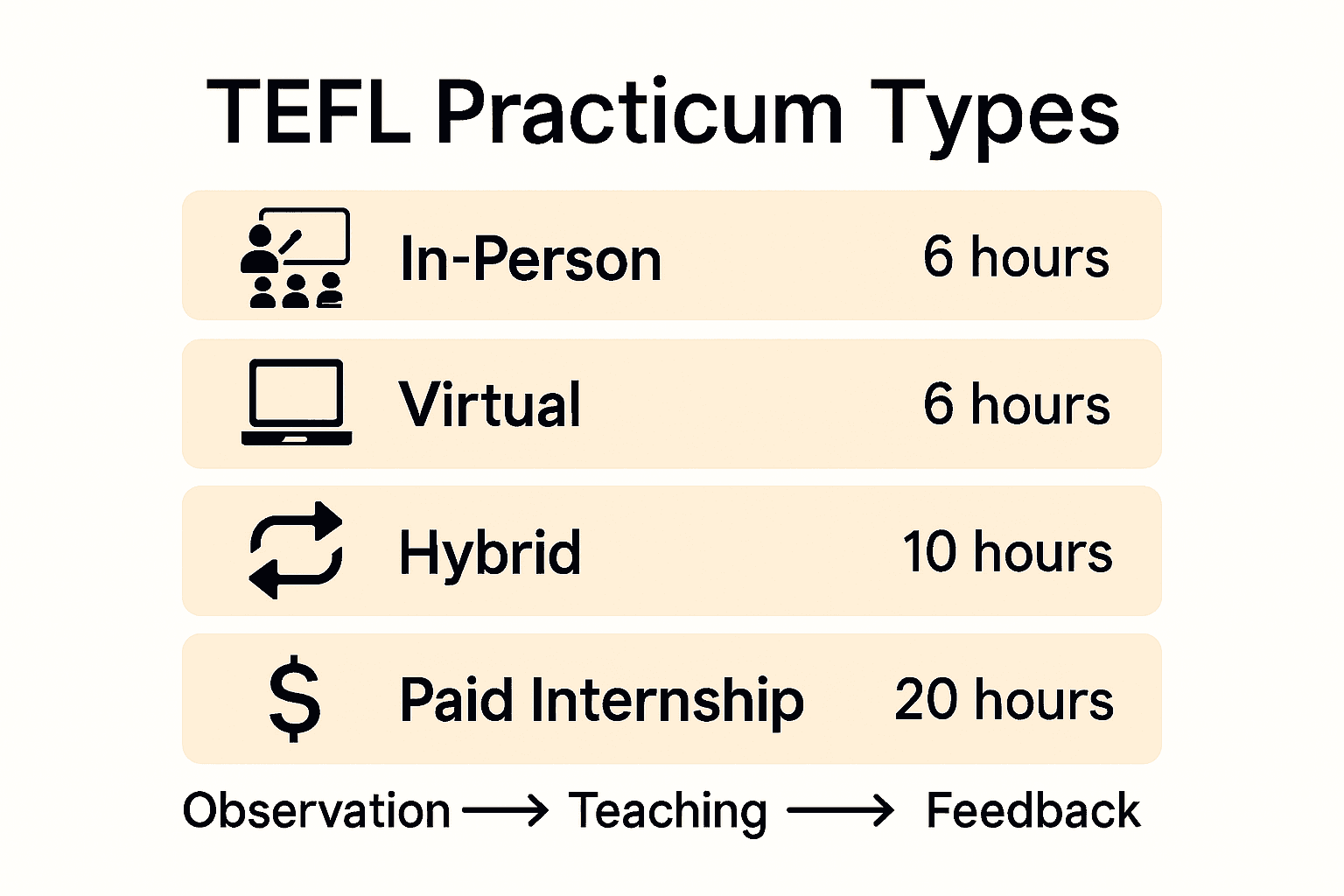 Paid TEFL Internships reveals how these programs provide structured learning environments where new teachers can apply their skills while receiving professional guidance. These internships not only offer practical training but also serve as crucial stepping stones for building a successful international teaching career, allowing participants to develop cross-cultural communication skills and gain real-world classroom expertise.

Minimum Hours and Accepted Activities
The minimum hours requirement for a TEFL practicum is a critical benchmark that ensures aspiring teachers gain sufficient practical experience before entering professional teaching environments. Most accredited TEFL certification programs mandate between 6 to 20 hours of supervised teaching practice, designed to provide comprehensive exposure to real-world language instruction scenarios.
Accepted practicum activities encompass a wide range of professional teaching experiences. TEFL Job vs Internship highlights the diversity of practical training opportunities. These typically include:
- Full lesson planning and delivery
- Classroom management demonstrations
- One-on-one student tutoring sessions
- Group instruction for different proficiency levels
- Curriculum development exercises
- Peer and mentor observation sessions
- Assessment and feedback interpretation
The structure of practicum hours can vary significantly between programs, but most require a combination of direct teaching time and supervised observation. Structured observation is particularly crucial, allowing teacher candidates to analyze experienced instructors’ techniques, classroom dynamics, and instructional strategies. Paid TEFL Internships emphasizes that these hours are not just about teaching, but about developing a holistic understanding of effective language education.
Most certification programs break down practicum requirements into specific components: actual teaching time, observation hours, lesson preparation, and reflective practice. While the exact distribution varies, a typical breakdown might include 6-10 hours of direct teaching, 4-6 hours of supervised observation, and additional time for lesson planning and professional reflection. These structured hours ensure that new teachers are not just theoretically prepared, but have developed practical skills and confidence in managing real classroom environments.
Documentation and Assessment Standards
Documentation forms the backbone of a comprehensive TEFL practicum, providing a systematic approach to tracking and evaluating a teacher candidate’s professional development. Aspiring teachers must maintain meticulous records that demonstrate their growth, instructional capabilities, and reflective teaching practices throughout their practical training experience.
TEFL Job vs Internship emphasizes the critical nature of professional documentation in teacher training. The standard documentation typically includes:
- Detailed lesson plans with learning objectives
- Observation feedback forms
- Teaching performance self-assessments
- Student interaction logs
- Reflective journals documenting teaching experiences
- Evidence of curriculum development
- Assessment of learner progress
Assessment standards in TEFL practicums are comprehensive and multidimensional, evaluating candidates across several key competency areas. Paid TEFL Internships highlights the holistic approach to measuring teaching effectiveness. Mentors and evaluators typically assess:
- Pedagogical knowledge and instructional strategies
- Classroom management skills
- Communication and language proficiency
- Cultural sensitivity and adaptability
- Lesson planning and curriculum design
- Student engagement and interaction techniques
The final evaluation typically combines multiple assessment methods, including direct observation, peer reviews, mentor feedback, and candidate self-assessment. This comprehensive approach ensures that TEFL candidates are not just evaluated on their teaching performance, but on their potential for growth, adaptability, and professional development in diverse educational environments.
Common Pitfalls and How to Avoid Them
Navigating a TEFL practicum successfully requires awareness of potential challenges that can derail a teacher candidate’s professional development journey. Preparation and self-awareness are key to overcoming the most common obstacles encountered during practical teaching experiences.
TEFL Job vs Internship highlights several critical pitfalls that aspiring teachers should anticipate:
- Overplanning: Developing rigid lesson structures that leave no room for student interaction
- Cultural Insensitivity: Failing to adapt teaching approaches to local educational contexts
- Language Barrier Anxiety: Struggling with classroom communication strategies
- Classroom Management Challenges: Difficulty maintaining student engagement
- Assessment Miscalculations: Ineffective methods of measuring student learning
Practical strategies for avoiding these common mistakes include developing flexible teaching approaches and maintaining open communication with mentors. Paid TEFL Internships emphasizes the importance of adaptability and continuous learning. Candidates should focus on:
- Developing culturally responsive teaching techniques
- Practicing active listening and student-centered instruction
- Creating adaptable lesson plans
- Seeking regular feedback from experienced mentors
- Maintaining a reflective teaching journal
Successful TEFL practitioners understand that practicum experiences are learning opportunities. The most effective approach involves embracing challenges, remaining open to feedback, and continuously refining teaching skills. By anticipating potential pitfalls and proactively developing strategies to address them, teacher candidates can transform potential obstacles into meaningful professional growth experiences.
Take the Next Step Toward Mastering Your TEFL Practicum
Completing a TEFL practicum can feel overwhelming with all the teaching hours, lesson planning, and cultural challenges you have to face. You want hands-on experience that truly prepares you for the classroom, not just theory. The key to success lies in gaining real confidence through guided practical training, structured feedback, and adaptable lesson strategies. This journey is critical for making your international teaching dreams a reality.

Get the support you need with TEFL Institute’s comprehensive online courses that include practicum components designed for flexibility and real-world application. Whether you want a fully virtual practicum or a hybrid approach, our programs cover every aspect from lesson delivery to student engagement. Visit our homepage and see how you can join thousands of teachers who gained invaluable classroom skills and advanced their careers. Start now to turn your TEFL practicum requirements into your strongest professional asset. Explore your options at TEFL Institute and prepare for success on day one.
Frequently Asked Questions
What is a TEFL practicum?
A TEFL practicum is a hands-on training component within TEFL certification programs, where aspiring teachers gain real-world teaching experience by working with actual language learners under the supervision of experienced mentors.
How many hours of teaching practice are required for a TEFL practicum?
Most accredited TEFL certification programs require between 6 to 20 hours of supervised teaching practice to ensure that candidates gain sufficient practical experience before entering professional teaching environments.
What activities are typically included in a TEFL practicum?
Accepted practicum activities often include full lesson planning and delivery, classroom management demonstrations, one-on-one tutoring, group instruction, curriculum development exercises, and observation sessions with feedback.
How are TEFL practicum candidates evaluated?
Evaluation is multi-dimensional, assessing candidates on pedagogical knowledge, classroom management skills, communication, cultural sensitivity, lesson planning, and student engagement through methods like direct observation, peer reviews, and self-assessment.
