

 United Kingdom (UK)
 United States (US)
 Canada
 South Africa
 India
India Australia
 New Zealand
 China
China Russia
 Germany
 France
 Spain
Spain Netherlands
 Vietnam
 United Arab Emirates
 Italy
Italy Poland
 Thailand
 Türkiye










 Algeria


ESL Teacher Meaning: What an ESL Teacher Is and What They Do
What is an ESL teacher?
An ESL teacher teaches English to people who are learning it as an additional language, usually while living in a country where English is spoken. The job covers assessing a learner’s level, planning lessons around it, and building speaking confidence. ESL describes the learners you teach, not the qualification you hold.
Last updated 29 September 2026.
That last sentence is the part most job hunters miss, and it costs them money. There is no such thing as an ESL degree or an ESL licence in most of the world. When a school advertises for an ESL teacher it is telling you who sits in the room, and it will almost always ask to see a TEFL or TESOL certificate. The full map of the acronyms sits on our TEFL qualifications and terminology reference.
Key takeaways
- ESL is a description of the learner, not a credential. It means English as a Second Language, and it points at someone learning English while living somewhere it is spoken.
- The certificate an ESL job asks for is usually TEFL or TESOL. 120 hours is the benchmark most schools and online platforms treat as a minimum.
- The United States is the exception. In an American public school, ESL teaching is a licensed profession requiring a state teaching licence with an ESL or bilingual endorsement. Everywhere else in the American market, and everywhere outside it, no licence is involved.
- The work is wider than grammar. Assessment, lesson design, cultural mediation and confidence building take up as much of the week as language input does.
- Where you teach changes the job completely. A primary school withdrawal group, an adult evening class and a one to one online lesson share a subject and very little else.
- Regulated beats accredited when you are comparing courses. A regulated qualification carries a number a hiring manager can look up on a public register.
What does an ESL teacher actually do?

An ESL teacher works out what a learner can already do in English, then designs teaching that moves them forward. In practice that breaks into a short list of recurring tasks, whatever the setting.
- Assess English across the four skills of listening, speaking, reading and writing, and place the learner at a level.
- Plan lessons and sequences that target the specific gap the assessment found, rather than working through a book from page one.
- Teach, which in a language classroom means generating as much learner talking time as possible rather than lecturing.
- Correct errors in a way that improves accuracy without shutting the learner up, which is a genuine skill and takes practice.
- Track progress with low stakes checks, and adjust the plan when the evidence says the plan is wrong.
- Support the learner outside the language itself, through the cultural and administrative business of living in a new country.
- Work with mainstream subject teachers, in school settings, so that language support and curriculum content pull in the same direction.
The balance shifts with the context. In a school the collaboration with colleagues can take as long as the teaching. Online, the assessment and the confidence building happen in the same forty minutes, with no staffroom to fall back on.
What does ESL teacher mean in the United States?
In the United States, an ESL teacher works with pupils classified as English learners, and in a public school it is a licensed profession. The credential a district checks is a state teaching licence carrying an ESL, ESOL or bilingual education endorsement, issued by that state’s department of education. Requirements are set state by state, so what satisfies Texas does not automatically satisfy New York.
This is the single biggest difference between the American market and everywhere else, and it catches out teachers moving in either direction. A TEFL or TESOL certificate will not by itself get you hired into an American public school classroom, because that is a legal licensing question rather than a training one. Equally, an American state licence does not shorten the route to a teaching job in Vietnam or Spain, where what is checked is the certificate, the hours and whether the qualification can be verified.
The demand is not marginal. 5.3 million pupils in American public schools — 10.6 per cent of total enrolment — were classified as English learners in fall 2021, up from 4.6 million a decade earlier, according to the National Center for Education Statistics. The federal government runs a dedicated clearinghouse, NCELA, precisely because so many teachers meet those pupils without specialist preparation.
Three practical points for an American reader:
- Most of the American ESL market is not licensed. Adult and community education, refugee and resettlement programmes, university pathway and intensive English programmes, corporate language training, private language schools and online platforms all hire ESL teachers without a state licence. What they ask for is language teaching training, which is what a TEFL or TESOL certificate evidences.
- The job titles are used loosely. A district may advertise for an “ESL teacher”, a “TESOL specialist”, an “EL teacher” or an “ELL teacher” and mean the same post. Read the licensure line in the advert rather than the acronym in the title.
- ESL and ELA are different jobs in the same building. An ELA teacher teaches English Language Arts to pupils who already speak English. An ESL teacher supports the pupils in that same room who are still acquiring the language. They are appointed against different criteria and paid on different scales.
ESL, EFL, ESOL and TESOL: which word applies to you?
Four of these terms describe a situation and two describe a qualification. Getting them the wrong way round is the single most common reason people buy a course that does not match the job they want.
| Term | Stands for | What it describes | Can you qualify in it? |
|---|---|---|---|
| ESL | English as a Second Language | A learner studying English while living in a country where English is spoken | No. It is a description of the learner |
| EFL | English as a Foreign Language | A learner studying English where it is not the everyday language, the mirror image of ESL | No. It is a description of the learner |
| ESOL | English for Speakers of Other Languages | The wording used in UK and Irish adult and further education, and in several US states as an endorsement name | Partly. Some ESOL teaching qualifications exist in those systems |
| TESOL | Teaching English to Speakers of Other Languages | The teaching itself, framed to cover both an English speaking country and abroad | Yes. This is a qualification |
| TEFL | Teaching English as a Foreign Language | The teaching itself, leaning towards teaching abroad | Yes. This is a qualification |
So an ESL teacher is, in credential terms, normally a TEFL or TESOL qualified teacher working with ESL learners. If you want the term itself pulled apart in more detail, read what ESL means and how it differs from EFL and ESOL.
Where ESL teachers work
The title covers several genuinely different jobs. Knowing which one you are applying for changes the certificate you need, the hours you work and the pay you can expect.
- Primary and secondary schools. Supporting pupils who are learning the curriculum and the language of the curriculum at the same time, often in withdrawal groups or alongside a subject teacher. In the United States this is the licensed part of the market.
- Adult and community education. Working with residents and new arrivals on the English they need for work, healthcare, housing and study.
- Private language schools. Timetabled classes for paying students, frequently in the evening and at weekends.
- Online platforms. One to one and small group lessons delivered from home, with the widest range of learner ages and the least predictable timetable.
- Corporate and workplace training. English for a specific job, from aviation phraseology to customer service scripts.
- University pathway and pre sessional programmes. Preparing international students for academic study in English.
What qualifications does an ESL teacher need?
There is no single answer, because outside the American public school system ESL is not a licensed profession. What there is instead is a very consistent employer expectation. Nearly every advert asks for a TEFL or TESOL certificate of at least 120 hours, and competitive markets increasingly ask for a regulated qualification rather than an accredited one.
The difference matters. Accreditation usually means a private body has reviewed a provider against its own standards. Regulation means a government qualifications regulator sets and polices the qualification, and the result is a public register entry a hiring manager can look up.
Dated reference data
The authoritative figure set for this topic. Every source below was opened and confirmed live on 29 September 2026.
How many pupils in American schools are still learning English
- 5.3 million public school students in the United States were classified as English learners in fall 2021, which is 10.6 per cent of total public school enrolment, up from 4.6 million, or 9.4 per cent, in fall 2011. Published by the National Center for Education Statistics, the statistical agency of the US Department of Education.
The regulated TEFL qualifications on the Ofqual public register
- Level 5 Diploma in TEFL, qualification number 610/1571/4, 180 guided learning hours, total qualification time 382 hours.
- Level 5 Advanced Diploma in TEFL, qualification number 610/1573/8, 300 guided learning hours, total qualification time 542 hours, 54 credits.
- Both are awarded by Highfield Qualifications, which holds Ofqual recognition number RN5219. These are two separate specifications and should not be combined.
Sources. English learner numbers: National Center for Education Statistics, Condition of Education, English Learners in Public Schools. Federal teacher support: National Clearinghouse for English Language Acquisition, US Department of Education. Qualification numbers: Ofqual, the qualifications regulator for England, publishes the Register of Regulated Qualifications, where each number above can be searched. The register blocks automated checking, so the entries were confirmed by hand on the date shown.
How to cite this. The TEFL Institute, “ESL Teacher Meaning: What an ESL Teacher Is and What They Do”, updated 29 September 2026, https://teflinstitute.com/blog/role-of-esl-teacher/.
On top of the certificate, some employers and many visa systems ask for a bachelor’s degree in any subject. That is an immigration and employer requirement rather than anything intrinsic to ESL teaching, and it varies country by country. Our guide to qualifications for ESL teaching goes through the combinations, and what people actually mean by ESL certification deals with the phrase itself.
How ESL teaching works day to day
A good ESL lesson looks less like a lecture and more like a workshop. The teacher talks least, the learners talk most, and the material is chosen because it produces language rather than because it comes next in the book.
- Front load the purpose. Learners work harder when they know what the lesson lets them do by the end of it.
- Design for output. Pair and group tasks generate far more speaking time per learner than whole class question and answer.
- Correct selectively. Interrupting every error kills fluency, so accuracy work is usually held back to a dedicated stage.
- Use the real world. Menus, forms, job adverts and voice notes carry the language learners will actually meet.
- Check, do not assume. A short concept check tells you whether the class understood, where nodding does not.
The skills that separate a strong ESL teacher from an average one
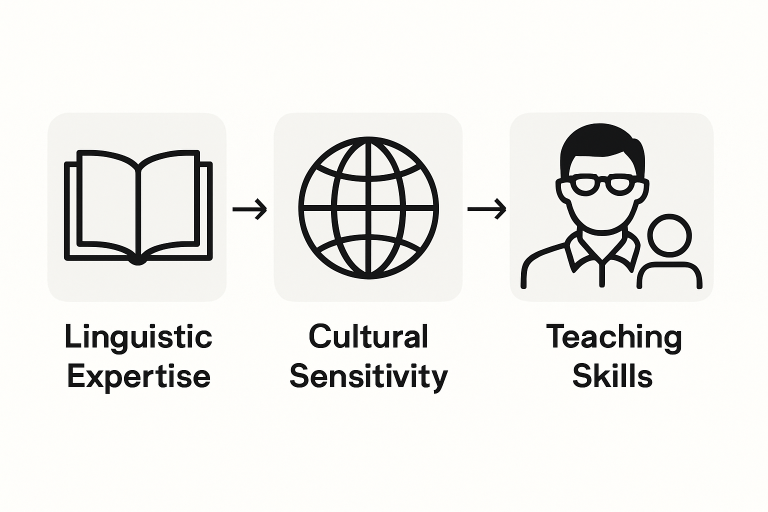
Subject knowledge is the entry ticket rather than the differentiator. Almost everyone applying for an ESL role can explain the present perfect. What hiring managers watch for is different.
- Clarity of instruction. Giving a task in language simpler than the task itself is harder than it sounds.
- Reading a room. Noticing the learner who has stopped following, three minutes before they give up.
- Cultural sensitivity that is practical rather than decorative. Knowing when silence means confusion and when it means politeness.
- Patience with repetition. The same error will come back many times, and it has to be met calmly each time.
- Adaptability. Half the class missing, a broken projector or a level far from the one you were told is normal, not exceptional.
ESL teacher, TEFL teacher or ELA teacher: which job is which?
These three job titles are confused constantly, most often in American job adverts, and they are appointed against different criteria and paid on different scales.
- ESL teacher. Teaches English to people learning it as an additional language, usually inside an English speaking country. Normally qualified through TEFL or TESOL, except in American public schools, where a state licence with an ESL endorsement is required.
- TEFL teacher. The same underlying skill set, described from the qualification side, and most often used for teaching abroad.
- ELA teacher. Teaches English Language Arts, an American school subject covering reading, writing and analysis for pupils who already speak English. A different job entirely. We set out the distinction in what an ELA teacher is, and how the role differs from ESL.
Where to start
If the job adverts you are reading say ESL teacher, the certificate they want is a TEFL or TESOL qualification of at least 120 hours, and the stronger your evidence of observed teaching practice the better you will do. Our accredited TEFL courses cover the 120 hour route, and the Ofqual regulated Level 5 TEFL Diploma is the option to look at where an employer or a visa office wants a qualification it can verify on a public register.
Frequently asked questions
What does ESL teacher mean?
ESL teacher means a teacher of English as a Second Language, that is, a teacher whose students are learning English as an additional language, typically while living in a country where English is spoken. The term describes the students rather than the teacher’s qualification.
What does an ESL teacher do?
An ESL teacher assesses learners’ English, plans and delivers lessons aimed at the gaps that assessment finds, corrects errors, tracks progress, and supports learners with the cultural and practical side of using English. In schools the role also involves working alongside subject teachers.
How do you become an ESL teacher in the United States?
It depends on the setting. For a public school post you need a state teaching licence carrying an ESL, ESOL or bilingual endorsement, issued by that state’s department of education, and requirements differ from state to state. For adult and community education, refugee programmes, university pathway courses, corporate training, private language schools and online teaching, no licence is required and a TEFL or TESOL certificate of at least 120 hours is the usual expectation.
What is the difference between an ESL teacher and an ELA teacher?
An ESL teacher teaches the English language to pupils who are still acquiring it. An ELA teacher teaches English Language Arts, the American school subject covering literature, composition and analysis, to pupils who already speak English. They frequently work with the same children in the same building, appointed against different criteria and paid on different scales.
Is an ESL teacher the same as a TEFL teacher?
They overlap almost entirely in practice. ESL describes the teaching situation and TEFL is the qualification. Most ESL roles are filled by teachers holding a TEFL or TESOL certificate, and adverts often use the words interchangeably.
What qualifications do you need to be an ESL teacher?
Most employers ask for a TEFL or TESOL certificate of at least 120 hours. Competitive markets and visa systems increasingly prefer a regulated qualification, such as a Level 5 TEFL diploma, because it carries a number that can be checked on a public register. American public schools are the exception and require a state licence.
Do you need a degree to be an ESL teacher?
Not always. The term ESL carries no degree requirement in itself. Some employers ask for one, and several countries require a bachelor’s degree in any subject before they will issue a work visa for teaching, so the answer depends on where you intend to work.
Where do ESL teachers work?
ESL teachers work in primary and secondary schools, adult and community education, private language schools, online teaching platforms, corporate training and university pathway programmes. The setting changes the timetable, the pay and the day to day work considerably.
Related reading
- TEFL qualifications and terminology explained, the reference page for every acronym on this list.
- What does ESL mean? ESL, EFL, ESOL and TESOL explained
- What is an ELA teacher? English Language Arts versus ESL
- ESL teacher career pathways: a complete guide
- ESL teaching opportunities explained: global paths
- British Council TeachingEnglish, free professional development and classroom resources for English language teachers.
TEFL Institute guides

Cambodia
Pay, requirements and visas
Czech Republic
Pay, visas and cities
Dubai
Pay, requirements and visas
Spain
Jobs, pay and visa routes
Germany
Freelance work and pay