
 United Kingdom (UK)
 United States (US)
 Canada
 South Africa
 India
India Australia
 New Zealand
 China
China Russia
 Germany
 France
 Spain
Spain Netherlands
 Vietnam
 United Arab Emirates
 Italy
Italy Poland
 Thailand
 Türkiye










 Algeria



Benefits of TEFL Certification: Complete Guide
Benefits of TEFL Certification: Complete Guide

Nearly two billion people worldwide are learning English, making TEFL certification more valuable than ever. Whether you want to teach overseas or from your living room, employers want proof you can communicate across cultures and lead confident classrooms. TEFL training does more than add weight to your resume. It sets you up with the real-world skills and credentials schools and online platforms look for when hiring English teachers.
Table of Contents
- Defining TEFL Certification And Its Purpose
- Types Of TEFL Certification Programs Available
- Essential Skills And Training Acquired
- Global Job Prospects For Certified Teachers
- Financial Returns And Career Advancement
- Common Pitfalls And How To Avoid Them
Key Takeaways
| Point | Details |
|---|---|
| Purpose of TEFL Certification | TEFL certification is essential for aspiring English language teachers, providing necessary skills and credentials for teaching non-native speakers globally. |
| Program Types | Various TEFL programs exist, including automated online, in-person, and distance-learning options, catering to different learning preferences and schedules. |
| Skills Acquired | TEFL certification equips educators with linguistic, pedagogical, and cultural competencies that are crucial for effective language instruction. |
| Career Opportunities | Certified teachers have access to diverse global job prospects, including traditional classrooms and online platforms, enhancing their career advancement potential. |
Defining TEFL Certification and Its Purpose
TEFL certification is a specialized training program designed to prepare individuals to teach English to non-native speakers in diverse international settings. According to ciee.org, TEFL certification represents the fundamental first step for aspiring English language instructors, providing essential skills and credentials required by schools worldwide.
At its core, a TEFL certification validates an educator’s ability to effectively teach English grammar, pronunciation, conversational skills, and writing techniques to students who speak different native languages. The certification demonstrates that instructors understand specialized pedagogical approaches needed to communicate complex linguistic concepts across cultural boundaries. Most international schools, language institutes, and online teaching platforms consider TEFL certification a mandatory professional qualification.
The purpose of TEFL certification extends far beyond simple credentialing. By completing a comprehensive program, teachers gain practical skills in:
- Developing engaging lesson plans
- Understanding language learning psychology
- Managing diverse classroom environments
- Adapting teaching strategies for different student levels
- Implementing interactive language teaching techniques
Professional language educators recognize TEFL certification as more than just a credential.
 It represents a commitment to quality language instruction and cross-cultural communication. Whether you aim to teach abroad, online, or in local community programs, this certification opens significant professional opportunities in the global education landscape.
Types of TEFL Certification Programs Available
TEFL certification programs offer diverse learning formats to accommodate different learning styles and professional requirements. According to ciee.org, these programs typically fall into three primary categories: automated online courses, in-person courses, and distance-learning online courses, each with unique characteristics and advantages.
Traditionally, educators have three main pathways to obtain their TEFL certification. Automated online courses provide a self-paced learning experience with minimal direct interaction, ideal for learners who prefer independent study and have flexible schedules. In contrast, in-person courses offer intensive, on-site training with direct instructor engagement, allowing for immediate feedback and hands-on teaching practice. The distance-learning online courses represent a hybrid approach, delivering virtual classes with interactive components that blend technological convenience with structured learning.
Each TEFL certification program type offers distinct benefits:
Here’s a comparison of the main types of TEFL certification programs:
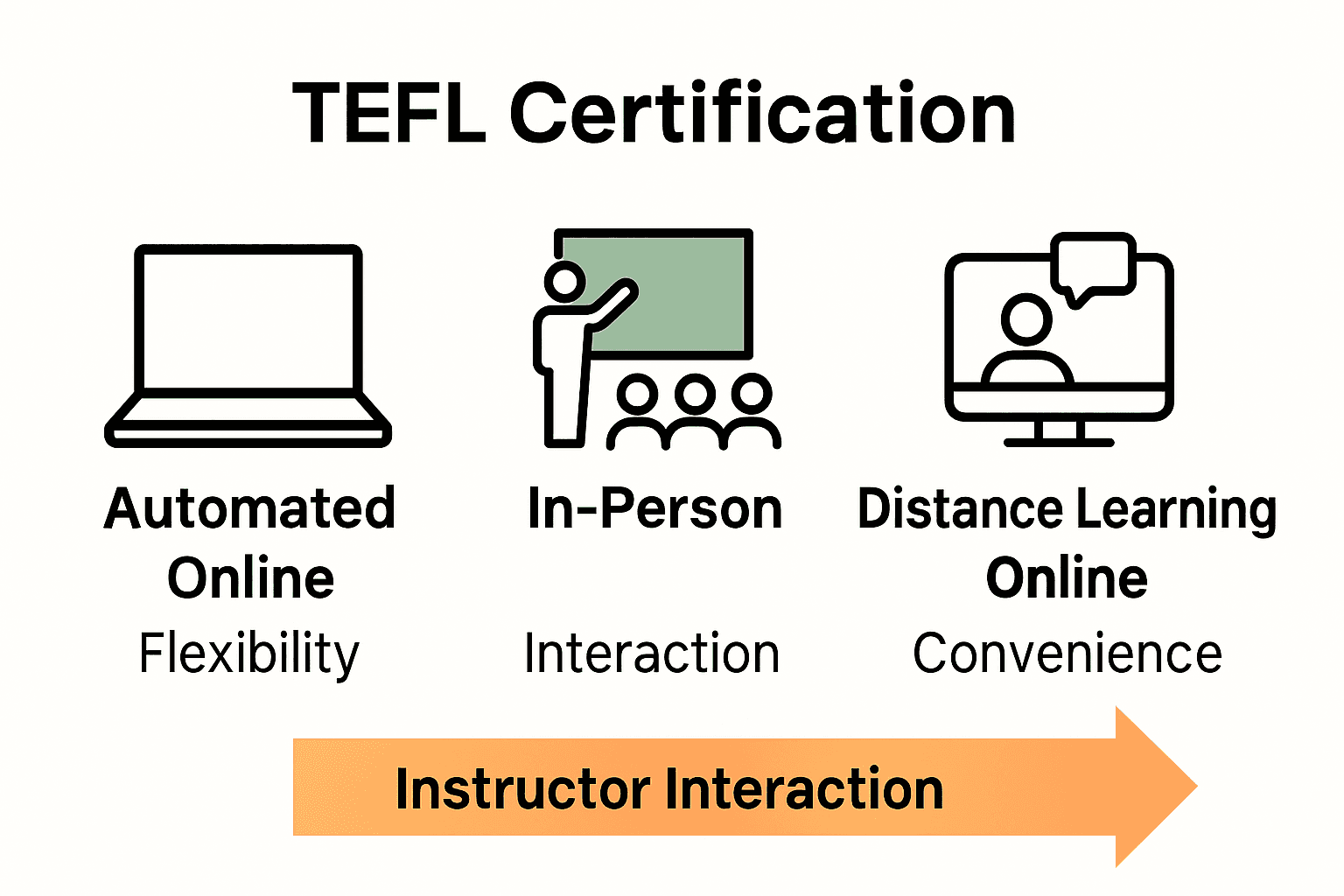
| Program Type | Format | Instructor Interaction | Flexibility | Key Advantages |
|---|---|---|---|---|
| Automated Online Courses | Self-paced online | Minimal | High | Lowest cost Flexible schedule |
| In-Person Courses | On-site classroom | Direct and ongoing | Low | Hands-on practice Networking |
| Distance-Learning Online | Virtual classroom Online |
Real-time Interactive |
Medium | Balanced approach Live feedback |
-
Automated Online Courses
- Completely self-paced
- Lowest cost option
- Flexible scheduling
- Minimal direct instructor interaction
-
In-Person Courses
- Direct teaching practice
- Immediate instructor feedback
- Networking opportunities
- Structured intensive learning
-
Distance-Learning Online Courses
- Virtual classroom environment
- Interactive learning components
- Balanced between flexibility and structure
- Real-time instructor engagement
When selecting a TEFL certification program, prospective teachers should carefully evaluate their personal learning preferences, time availability, and career goals. Some programs, like the Level 5 TEFL diploma, offer more comprehensive training that can significantly enhance professional credibility in the international language teaching market.
Essential Skills and Training Acquired
TEFL certification equips aspiring language educators with a comprehensive toolkit of professional teaching skills. According to ciee.org, these courses provide extensive training in crucial areas like teaching methodologies, lesson planning, and classroom management techniques that are essential for effective language instruction.
The training goes far beyond basic language knowledge. Pedagogical skills developed during TEFL certification include advanced techniques for designing engaging curriculum, managing diverse classroom dynamics, and adapting instructional strategies to different learning styles. Educators learn to create structured lesson plans that balance grammar instruction, conversational practice, and interactive learning experiences. Online TEFL courses particularly emphasize technological integration and digital teaching tools that are increasingly important in modern language education.
Key skills acquired through TEFL certification include:
-
Linguistic Competence
- Advanced English language proficiency
- Understanding of grammatical structures
- Pronunciation and accent modification techniques
-
Pedagogical Skills
- Lesson planning and curriculum design
- Classroom management strategies
- Assessment and evaluation techniques
-
Cultural Competence
- Cross-cultural communication skills
- Understanding of global language learning contexts
- Sensitivity to diverse student backgrounds
Professional development is at the heart of TEFL training. Through comprehensive programs like the Level 5 TEFL diploma, teachers gain not just theoretical knowledge, but practical skills that transform them from language speakers to effective, confident educators capable of inspiring students across different cultural and linguistic environments.
Global Job Prospects for Certified Teachers
TEFL certification dramatically expands professional opportunities for language educators worldwide. According to ciee.org, certified teachers can pursue teaching positions globally, with flexible options ranging from traditional classroom settings to innovative online platforms that connect instructors with students across continents.
The international job market for TEFL-certified teachers is exceptionally diverse and dynamic. Professional opportunities span multiple continents, with high demand in regions like Asia, Middle East, and Latin America. Top paying countries offer competitive salaries that make international teaching not just a cultural experience, but a financially viable career path. Online teaching platforms have further revolutionized the landscape, allowing educators to work remotely and reach students from the comfort of their home.
Key global job prospects for TEFL-certified teachers include:
-
Traditional Classroom Opportunities
- Public and private schools worldwide
- International language institutes
- University language programs
- Corporate language training
-
Digital Teaching Platforms
- Online language learning websites
- One-on-one virtual tutoring
- Corporate remote teaching
- International student coaching
-
Specialized Teaching Roles
- Business English instruction
- Academic test preparation
- Accent reduction coaching
- Diplomatic and professional communication training
The global demand for English language instruction continues to grow, making TEFL certification an increasingly valuable professional credential. Whether you dream of teaching in bustling Asian metropolises, European language schools, or connecting with students through digital platforms, a TEFL certification opens doors to a world of exciting international career opportunities.
Financial Returns and Career Advancement
TEFL certification represents more than an educational credential – it’s a strategic investment in professional growth and financial opportunity. Top paying countries demonstrate the significant financial potential for certified English language instructors, with salaries ranging dramatically across different global markets.
The career trajectory for TEFL-certified professionals extends far beyond entry-level teaching positions. Career advancement opportunities include progression from classroom instruction to roles such as curriculum development, academic administration, teacher training, and international educational consulting. Advanced TEFL credentials like Level 5 diplomas can substantially increase earning potential and open doors to more specialized, higher-paying teaching positions.
Key financial and career advancement opportunities include:
-
Salary Progression
- Higher starting salaries
- Performance-based pay increases
- Regional salary differentials
- Competitive compensation packages
-
Professional Development Paths
- Academic leadership roles
- Corporate training positions
- International school administration
- Educational consultancy
-
Additional Income Streams
- Online teaching platforms
- Private tutoring
- Curriculum design contracts
- Test preparation instruction
Certified TEFL professionals who strategically invest in continuous learning and skill development can transform their initial certification into a robust, globally recognized career with multiple income opportunities and professional growth potential.
Common Pitfalls and How to Avoid Them
TEFL certification can be a transformative professional journey, but aspiring teachers often encounter several challenges that can derail their career progression. Online TEFL courses highlight the importance of understanding and navigating potential obstacles before they become significant barriers to success.
One of the most critical mistakes new TEFL-certified teachers make is underestimating the complexity of cross-cultural communication and classroom management. Professional preparation goes beyond language skills, requiring deep cultural sensitivity, adaptability, and advanced pedagogical techniques. Advanced TEFL credentials can help mitigate these challenges by providing comprehensive training in nuanced teaching strategies.
Common pitfalls for TEFL-certified teachers include:
-
Training and Skill Gaps
- Inadequate understanding of teaching methodologies
- Limited cross-cultural communication skills
- Insufficient classroom management techniques
- Lack of technological teaching competencies
-
Career Planning Mistakes
- Choosing low-quality certification programs
- Neglecting continuous professional development
- Failing to research job market requirements
- Overlooking visa and legal work requirements
-
Professional Adaptation Challenges
- Culture shock in international teaching environments
- Unrealistic salary and working condition expectations
- Poor work-life balance strategies
- Ineffective networking and professional connection building
Successful TEFL professionals approach their certification as an ongoing learning process, remaining flexible, culturally aware, and committed to continuous skill enhancement. Strategic preparation and a proactive approach can transform potential challenges into opportunities for personal and professional growth.
Unlock Your Global Teaching Career with TEFL Institute
If you are inspired by the clear benefits of TEFL certification described in the article, such as enhancing your teaching skills, navigating cross-cultural classrooms, and expanding international job prospects, the next step is gaining the right training. Many aspiring teachers face challenges like choosing a quality program or getting comprehensive, practical skills that truly prepare them for success. With TEFL Institute, you gain access to expert-led online TEFL courses including advanced diplomas and specialized certifications that address these exact needs.
Start your journey confidently by exploring our comprehensive course catalog at TEFL Institute. Whether you want flexible online learning or a hybrid program with practicum experience, our tailored options meet diverse professional goals. Don’t let uncertainty hold you back. Visit our main site, dive into detailed course information, and take advantage of tools designed to support your career growth now. Your global teaching adventure begins with the right certification and preparation, so act today and turn your teaching dreams into reality.
Frequently Asked Questions
What is TEFL certification?
TEFL certification is a specialized training program that prepares individuals to teach English to non-native speakers. It equips educators with essential skills and credentials needed to teach effectively across various international settings.
What types of TEFL certification programs are available?
There are three main types of TEFL certification programs: automated online courses (self-paced), in-person courses (intensive, hands-on training), and distance-learning online courses (virtual classes with interactive components). Each format offers different benefits based on learning preferences.
What skills do you acquire through TEFL certification?
TEFL certification provides educators with skills in linguistic competence, lesson planning, classroom management, cultural competence, and pedagogical techniques crucial for effective language instruction.
What career opportunities are available for TEFL-certified teachers?
TEFL certification opens up diverse job prospects, including traditional classroom teaching, online education platforms, specialized teaching roles, and corporate language training positions, significantly enhancing professional opportunities worldwide.