
 United Kingdom (UK)
 United States (US)
 Canada
 South Africa
 India
India Australia
 New Zealand
 China
China Russia
 Germany
 France
 Spain
Spain Netherlands
 Vietnam
 United Arab Emirates
 Italy
Italy Poland
 Thailand
 Türkiye








 Algeria


Writing a TEFL CV That Gets You Hired Abroad
Writing a TEFL CV That Gets You Hired Abroad

TL;DR:
- A TEFL CV is a specialized document showcasing teaching qualifications, skills, and experience to international employers.
- Polished structure, targeted language, and relevant content are essential for standing out in competitive markets.
A TEFL CV is a targeted professional document that presents your qualifications, teaching skills, and relevant experience to ESL employers worldwide. Unlike a general resume, it must communicate your teaching potential within seconds. Recruiters in South Korea, Japan, China, and online platforms like VIPKid receive hundreds of applications for every open role. Writing a TEFL CV that stands out requires a clear structure, precise language, and deliberate choices about what to include and what to leave out. Tools like Grammarly and purpose-built CV templates can help you polish the final product before it reaches a hiring manager’s desk.
What are the essential sections and format of a TEFL CV?
A well-structured TEFL CV opens with a compelling profile that defines who you are, what you offer, and the type of teaching role you are seeking. Employers form their first impression from this section alone. Keep it to three or four sentences and make every word count.
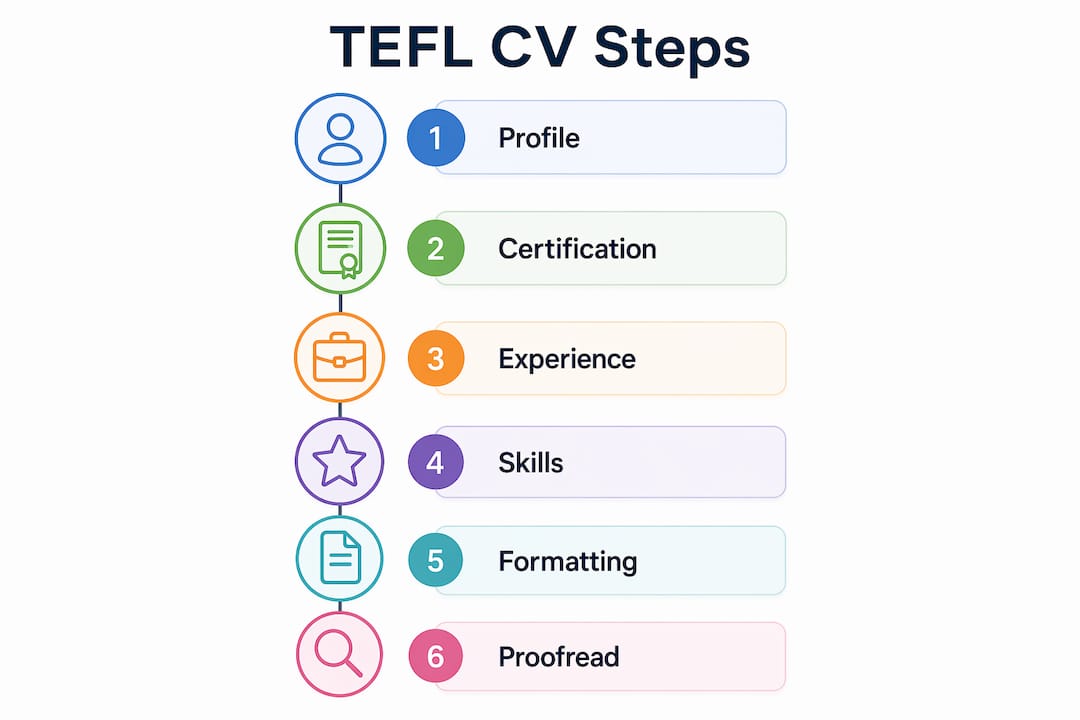
The sections below form the standard structure for a TEFL or ESL teacher CV:
| CV Section | What to Include |
|---|---|
| Personal information | Full name, professional email, phone number, nationality, and location |
| Professional profile | Two to four sentences summarizing your teaching identity and goals |
| TEFL certification | Certificate name, issuing body, hours completed, and year earned |
| Education | Degrees in reverse chronological order with institution and graduation year |
| Work experience | Teaching and related roles in reverse chronological order |
| Skills | Language proficiency, classroom management, technology tools |
| References | Two professional references or “available on request” |
TEFL certificates should appear near the top of the CV, directly after your profile. Recruiters scan for certification first. Burying it at the bottom costs you consideration before they reach your experience.
Format matters as much as content. Use a clean font like Calibri or Arial at 11–12 point size. Keep margins at one inch on all sides. Use consistent spacing between sections. A cluttered CV signals disorganization, which is the last impression you want to give a school director.
Recruiters prefer a reverse chronological format for candidates with teaching experience. If you are a career changer or a first-time TEFL applicant, a skills-based format places your transferable strengths front and center before listing limited work history.
Pro Tip: Save your CV as a PDF before sending. This preserves your formatting across all devices and operating systems, so the recruiter sees exactly what you designed.
How to highlight relevant skills and experience on your CV
Transferable skills are the foundation of a strong TEFL CV for candidates without formal classroom experience. Public speaking, mentoring, and customer service all demonstrate the communication and interpersonal abilities that ESL employers value. The key is framing these experiences in teaching terms.
Here is how to identify and present relevant skills effectively:
- Communication: Describe any role where you explained complex information clearly. A training coordinator who onboarded new staff has directly relevant experience.
- Classroom management: Volunteer coaching, youth group leadership, or tutoring all demonstrate the ability to manage groups and maintain structure.
- Adaptability: Working across cultures, languages, or diverse teams shows the flexibility that international schools require.
- Technology: Proficiency with Zoom, Google Classroom, or Moodle is increasingly expected for online ESL roles.
- Language skills: List any additional languages you speak and your proficiency level using the CEFR scale (A1 through C2).
Successful TEFL applicants focus on experience that mirrors teaching, such as explaining concepts and managing groups, rather than listing every job they have ever held. A barista role from ten years ago adds nothing. A tutoring position from the same period adds credibility.
Tailoring your skills section to each job posting is not optional. Read the job description carefully and mirror its language. If the posting asks for “student-centered instruction,” use that phrase in your skills or experience section. Using job-specific keywords improves your chances of passing recruiter screening tools and reaching a human reviewer.

You can find detailed guidance on which skills to feature on your CV from Teflinstitute’s breakdown of the ten core competencies every TEFL teacher needs.
Pro Tip: Write a master CV with every skill and experience you have. Then create a tailored version for each application by selecting only the most relevant entries. This keeps your CV focused without starting from scratch each time.
What are the step-by-step best practices for writing and polishing a TEFL CV?
The most effective TEFL CVs follow a deliberate drafting process rather than a single sitting of writing. Work through these steps in order:
- Write your professional summary last. Draft the rest of the CV first, then write the profile once you can see the full picture of what you are presenting.
- Place certification prominently. Your TEFL certificate, including the issuing body and total hours, belongs in the top third of the document.
- Quantify achievements where possible. “Taught 25 adult learners per session” is stronger than “taught adults.” Numbers give recruiters a concrete sense of scale.
- Tailor every application. A generic CV sent to fifty schools performs worse than a targeted CV sent to ten. Adjust your profile and skills section for each role.
- Proofread with Grammarly and a peer. Proofreading tools like Grammarly catch grammar and spelling errors that undermine your credibility as a language teacher. A second reader catches errors that software misses.
- Check length. One page is standard for applicants with under five years of experience. Two pages is acceptable for experienced teachers with substantial credentials.
The table below compares the two most common TEFL CV approaches:
| Approach | Best for | Key benefit |
|---|---|---|
| Reverse chronological | Experienced teachers | Shows career progression clearly |
| Skills-based | Career changers, new graduates | Leads with strengths before limited history |
| Hybrid | Mid-career switchers | Balances skills and relevant experience |
Tailored CVs with clear objectives aligned to specific job roles generate more interview invitations than generic documents. This is the single most impactful change most applicants can make.
For a complete walkthrough of the application process, Teflinstitute’s guide on TEFL resume and cover letter crafting covers each stage in detail.
What common pitfalls should you avoid when writing your TEFL CV?
Most rejected TEFL CVs share the same set of avoidable errors. Unprofessional contact details, irrelevant job history, and lengthy CVs are the top reasons qualified candidates lose consideration before an interview.
Watch for these specific mistakes:
- Irrelevant work history: Listing every job you have ever held dilutes the impact of your teaching-related experience. Include only roles that demonstrate transferable skills.
- Vague personal statements: “I am a passionate and dedicated teacher” tells a recruiter nothing. Replace it with a specific claim: “TEFL-certified instructor with 120 hours of training and two years of adult ESL tutoring experience.”
- Unprofessional email addresses: Use a format like firstname.lastname@gmail.com. Addresses like “partyguy88” or “crazycatlady” disqualify you before the recruiter reads your qualifications.
- Inappropriate photos: Many countries expect a photo on a TEFL CV. Use a professional headshot with a neutral background. Avoid casual selfies or group photos.
- Ignoring job-specific requirements: If a posting specifies a 120-hour TEFL certificate and you hold one, state it explicitly. Do not make the recruiter search for it.
- Overcrowded formatting: Dense blocks of text with no white space are difficult to scan. Use bullet points, clear headings, and consistent spacing.
“A CV that lists every job you’ve ever held without connecting those roles to teaching tells me the applicant hasn’t thought about what this job actually requires.” — Common recruiter feedback cited by GoAbroad.com advisors
Teflinstitute’s article on common TEFL application mistakes covers eight errors that applicants repeat across markets, including CV-specific missteps that cost candidates interviews.
Key takeaways
A strong TEFL CV combines clear structure, targeted skills, and precise language to give recruiters exactly what they need to move you forward in the hiring process.
| Point | Details |
|---|---|
| Lead with certification | Place your TEFL certificate in the top third of the CV for immediate visibility. |
| Match the format to your experience | Use reverse chronological for teaching history; use skills-based for career changers. |
| Tailor every application | Adjust your profile and skills section to mirror each job description’s language. |
| Quantify your experience | Use numbers to describe class sizes, lesson hours, or student outcomes wherever possible. |
| Proofread rigorously | Use Grammarly and a peer reviewer to eliminate errors before submitting. |
What I have learned about TEFL CVs that most guides miss
Most advice on how to write a TEFL resume focuses on structure and formatting. That is necessary, but it is not what separates candidates who get interviews from those who do not.
The real differentiator is specificity. Recruiters in South Korea, the UAE, and online platforms like iTalki or Preply see hundreds of CVs that all say “passionate about teaching” and “excellent communication skills.” Those phrases have lost all meaning. What gets attention is a profile that says something concrete: “120-hour TEFL-certified instructor with three years of adult business English tutoring, specializing in IELTS exam preparation.”
I have also noticed that candidates underestimate how much the regional context matters. A CV for a public school in Japan needs to look different from one targeting a language center in Spain or an online platform serving Latin American learners. The core structure stays the same, but the skills you emphasize and the experience you lead with should shift based on what that specific market values.
The other thing most guides skip is the idea that your CV is a living document. Update it every time you complete a new course, finish a significant teaching contract, or develop a new skill. Candidates who treat their CV as a finished product miss opportunities because their credentials look stale. The ESL teacher resume tips from Teflinstitute are worth revisiting each time you apply to a new market, not just when you are starting out.
Finally, do not underestimate the cover letter. A strong CV gets you noticed. A specific, well-written cover letter is what gets you the interview.
— Muller
Strengthen your TEFL CV with the right certification
Your CV is only as strong as the credentials behind it. Teflinstitute offers advanced certification courses designed to give you the qualifications that international schools and online platforms actively seek.
The 120 Hour Elective TEFL Course adds specialized credentials to your CV in areas like business English, young learners, or exam preparation. For candidates who want the strongest possible credential, the 240 Hour Master TEFL Course is an externally accredited program that signals serious professional commitment to any recruiter. Both courses are completed online and designed to fit around your current schedule. The credential you earn goes directly onto your CV and directly into your job prospects.
FAQ
What should a TEFL CV include?
A TEFL CV should include a professional profile, TEFL certification details, education history, relevant work experience, and a skills section. Place your certification near the top so recruiters can assess your qualifications immediately.
How long should a TEFL CV be?
One page is standard for candidates with under five years of experience. Two pages is acceptable for experienced teachers with substantial credentials and multiple certifications.
Should I use a skills-based or chronological format?
Reverse chronological format works best for candidates with teaching experience. A skills-based format is more effective for career changers or first-time TEFL applicants who need to lead with transferable strengths.
Do I need a photo on my TEFL CV?
Many countries in Asia and the Middle East expect a professional headshot on a TEFL CV. Use a neutral background and professional attire. Check the norms for your target country before submitting.
How do I write a TEFL CV with no teaching experience?
Focus on transferable skills like public speaking, tutoring, coaching, or customer service. Frame each role in terms of the communication and group management skills it required, and lead with your TEFL certification as your primary credential.
Recommended
TEFL Institute guides

Cambodia
Pay, requirements and visas
Dubai
Pay, requirements and visas
Czech Republic
Pay, visas and cities
Spain
Jobs, pay and visa routes
Italy
Jobs, pay and visa routes