
 United Kingdom (UK)
 United States (US)
 Canada
 South Africa
 India
India Australia
 New Zealand
 China
China Russia
 Germany
 France
 Spain
Spain Netherlands
 Vietnam
 United Arab Emirates
 Italy
Italy Poland
 Thailand
 Türkiye











 Algeria


What is ESOL? Certification, methods, and career insights
If you’re still deciding which route to take, our guide to ESL certification breaks down the accredited options and where each one leads.
What is ESOL? Certification, methods, and career insights

TL;DR:
- ESOL is a versatile field covering teaching contexts from schools to online platforms worldwide.
- Certification options like CELTA, DELTA, and US endorsements support different experience levels and career goals.
- Effective ESOL teaching combines multiple evidence-based methodologies, adapting to learner needs and technology.
ESOL stands for English for Speakers of Other Languages. It describes English teaching delivered to people who are living in an English speaking country, which is what separates it from EFL, where learners study English in a country where English is not the everyday language. ESOL teachers work in US public schools, refugee resettlement programs, corporate language training, and virtual classrooms serving learners across time zones. Yet many aspiring educators still treat ESOL as a narrow, school-based specialty. It is not. ESOL is one of the broadest and most flexible fields in global education. Whether you are just starting out or looking to expand your qualifications, understanding what ESOL covers, which certifications carry weight, and how teaching methods translate into real classrooms will help you make smarter decisions about your career path.
Table of Contents
- What does ESOL mean?
- ESOL teacher certifications: What you need to know
- Core ESOL teaching methodologies and evidence-based approaches
- Career opportunities and real-world ESOL applications
- What most guides miss about modern ESOL teaching
- Take the next step with ESOL credentials
- Frequently asked questions
Key Takeaways
| Point | Details |
|---|---|
| ESOL meaning clarified | ESOL stands for English for Speakers of Other Languages, covering diverse teaching settings and learners. |
| Certification options | Key ESOL qualifications include CELTA, DELTA, and Trinity CertTESOL, each suited to different career stages. |
| Best teaching methods | A blend of evidence-based approaches yields the most effective ESOL instruction. |
| Broad career paths | ESOL credentials open doors to roles in schools, online platforms, and international programs. |
What does ESOL mean?
With foundational terms often misused, it is essential to clarify what ESOL covers and how it compares to related fields.
ESOL stands for English for Speakers of Other Languages. As a field, it covers diverse teaching contexts ranging from formal K-12 classrooms and adult literacy programs to informal community settings and online platforms. The learners can be children or adults, immigrants or international students, and the instruction can happen in English-speaking countries or abroad.
Many people use ESOL, ESL, EFL, TESOL, and TESL interchangeably, but these terms carry distinct meanings:
- ESOL (English for Speakers of Other Languages): The broadest umbrella term, covering all learners whose first language is not English, regardless of setting.
- ESL (English as a Second Language): Refers specifically to learners in English-speaking countries who are acquiring English alongside their home language.
- EFL (English as a Foreign Language): Refers to learners in non-English-speaking countries studying English as a subject.
- TESOL (Teaching English to Speakers of Other Languages): Often used to describe the professional field or a qualification type, closely aligned with ESOL.
- TESL (Teaching English as a Second Language): A narrower term focused on teaching in English-speaking environments. You can explore the TESL certificate explained for a detailed breakdown.
| Term | Setting | Learner context |
|---|---|---|
| ESOL | Broad, any setting | Non-native English speakers |
| ESL | English-speaking countries | Immigrants, refugees, residents |
| EFL | Non-English-speaking countries | Students studying English as a subject |
| TESOL | Any setting | Professional/qualification term |
| TESL | English-speaking countries | Teaching-focused qualification |
Demand for ESOL-trained educators continues to grow in US K-12 systems, adult education centers, and international language schools. Understanding the role of an ESOL teacher in these varied environments is the first step toward choosing the right training pathway.
ESOL teacher certifications: What you need to know
Now that you know what ESOL covers, it is critical to identify which certifications best support your teaching aims.
The certification landscape for ESOL teachers includes both internationally recognized qualifications and country-specific endorsements. The most widely recognized options are:
- CELTA (Certificate in English Language Teaching to Adults): A Level 5 qualification requiring approximately 120 hours of training, no prior teaching experience, and C1 English proficiency. It carries a roughly 96% pass rate and is accepted by employers globally.
- DELTA (Diploma in English Language Teaching to Adults): A Level 7 qualification designed for experienced teachers who want to move into senior roles, teacher training, or academic management.
- Trinity CertTESOL: A Level 5 alternative to CELTA, similarly structured and recognized internationally.
- US ESOL Endorsement: In states like Florida, ESOL endorsement standards require demonstrated competency in cross-cultural understanding, teaching methods, and curriculum development, often added onto an existing teaching license.
| Certification | Level | Duration | Prerequisites | Best for |
|---|---|---|---|---|
| CELTA | 5 | ~120 hours | C1 English, no experience needed | New teachers |
| DELTA | 7 | Variable | Teaching experience required | Experienced educators |
| Trinity CertTESOL | 5 | ~130 hours | C1 English | New teachers |
| US ESOL Endorsement | State-specific | Varies | Existing teaching license | US-based teachers |
For a closer look at how these qualifications compare, the CELTA vs Level 5 TEFL breakdown is a useful reference. If you are weighing ESL certification details or planning for certification to teach abroad, the right choice depends on your target market and career stage. If you’re based in the US, our guide to TEFL certification for Americans explains how government-regulated qualifications compare to ESOL routes.
Pro Tip: If you plan to teach in English-speaking countries or want global employer recognition, CELTA or Trinity CertTESOL are strong entry points. If your goal is leadership or curriculum design, prioritize the DELTA after gaining classroom experience. For CELTA exam insights, reviewing past candidate experiences can help you prepare effectively.
Core ESOL teaching methodologies and evidence-based approaches
With your certification options mapped out, it is time to understand the teaching methods that define ESOL practice today.
Effective ESOL instruction is not about picking one method and sticking with it. Research consistently shows that integrated, eclectic approaches outperform single-method strategies. The most successful ESOL practitioners blend at least three methods in their teaching toolkits, adapting based on learner needs, lesson goals, and classroom context.
The five core evidence-based practices for English learners, as identified by research, include:
- Building language and content simultaneously: Learners acquire English more effectively when language instruction is tied to subject-matter content rather than taught in isolation.
- Leveraging home language and culture: Connecting new English concepts to a learner’s existing linguistic knowledge accelerates comprehension and retention.
- Structured peer interaction: Collaborative tasks and peer learning activities build communicative competence faster than passive instruction.
- Explicit literacy instruction: Systematic teaching of grammar, vocabulary, and reading strategies provides the scaffolding learners need.
- Writing development: Regular, purposeful writing practice strengthens all language skills and prepares learners for academic and professional contexts.
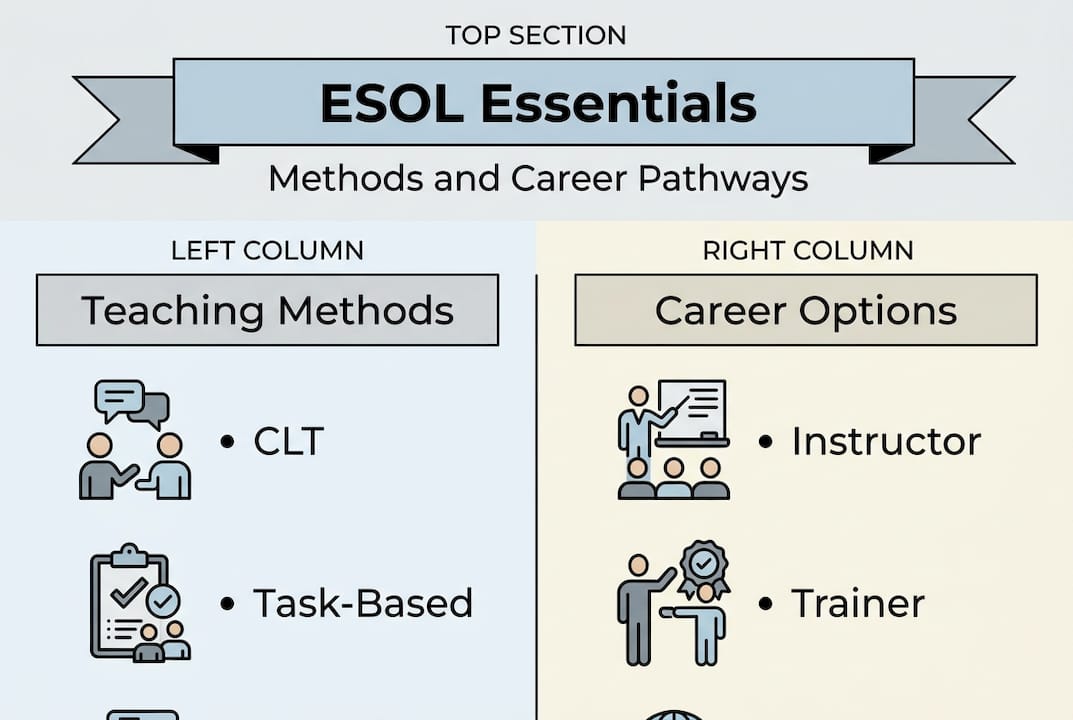
Beyond these foundational practices, three major methodological frameworks shape ESOL classrooms:
Communicative Language Teaching (CLT) prioritizes real-world communication over grammatical accuracy, using role plays, discussions, and authentic tasks. Total Physical Response (TPR) links physical movement to language input, making it especially effective for young learners and beginners. Project-Based Learning (PBL) engages learners in extended, meaningful tasks that require using English across multiple skill areas.
For a structured overview of proven ESOL methodologies or strategies to enhance ESOL classroom skills, these resources offer practical guidance for both new and experienced teachers.
Pro Tip: Avoid the common mistake of relying exclusively on one method because it worked well in a previous context. Real classrooms require constant adaptation. Observe your learners closely and adjust your approach based on what produces results.
Career opportunities and real-world ESOL applications
Understanding the teaching approaches is only half the journey. ESOL training translates into a wide range of real career doors opening across multiple sectors.

ESOL-certified teachers are in demand in settings that span far beyond the traditional school building. High employability is a consistent feature of the field, with opportunities in formal and informal, online and in-person contexts.
Common ESOL career settings include:
- US K-12 public schools: Supporting English learners as part of mainstream or pull-out programs.
- Adult education centers: Teaching literacy, workforce English, and citizenship preparation to immigrant and refugee populations.
- Online platforms: Delivering one-on-one or group lessons to learners in any country. Resources on online ESOL class setup and planning ESOL lessons online are especially relevant here.
- International language schools: Teaching EFL in countries across Asia, Europe, Latin America, and the Middle East.
- Corporate language training: Delivering business English programs to professionals in multinational organizations.
| Teaching context | Qualification needed | Average annual pay (USD) |
|---|---|---|
| US K-12 ESOL teacher | State endorsement + degree | $45,000 to $65,000 |
| Adult education instructor | CELTA or equivalent | $35,000 to $50,000 |
| Online English tutor | TEFL/TESOL certificate | $20,000 to $45,000 |
| International language school | CELTA or Trinity CertTESOL | $18,000 to $40,000 |
| Teacher trainer/manager | DELTA | $50,000 to $75,000 |
“ESOL opens doors in countries and classrooms worldwide. Flexibility and certification are your passport.”
The DELTA qualification, in particular, positions experienced teachers for management, curriculum design, and teacher training roles, which carry the highest earning potential in the field.
What most guides miss about modern ESOL teaching
Most ESOL guides focus on credentials and methods as if they exist in separate boxes. Get certified, learn the methods, start teaching. That framing misses something important.
The teachers who consistently perform well across different contexts are not necessarily those with the most qualifications. They are the ones who treat every classroom as a new data set. They observe, adjust, and build on what their learners bring rather than defaulting to a fixed routine. Integrated eclectic methods outperform single approaches precisely because real learners do not fit neatly into one methodology’s assumptions.
There is also a technology dimension that most guides underestimate. ESOL is increasingly delivered through digital platforms, and teachers who can adapt their methods to virtual environments have a measurable advantage in the job market. This is not about knowing which app to use. It is about understanding how to enhance classroom skills in environments where learner engagement requires different strategies than face-to-face instruction.
Pro Tip: Build a habit of reflecting after each lesson. Note what worked, what did not, and why. The best ESOL teachers never stop learning from their learners.
Take the next step with ESOL credentials
If you are ready to advance your impact as an ESOL educator, the right next step is within reach. ESOL certification is not just a qualification. It is a career gateway that expands where you can teach, who you can teach, and how much you can earn.
The TEFL Institute offers flexible pathways for educators at every stage. If you are based in the US, explore TESOL certification in Texas as a structured starting point. Already certified and looking to build on your credentials? Review available course extension options to deepen your expertise. If online teaching is your goal, find out how to start teaching English online with the right tools and support in place.
Frequently asked questions
Who should consider ESOL certification?
Anyone looking to teach English to non-native speakers, whether in schools, adult centers, online platforms, or abroad, will benefit from ESOL certification. High employability in diverse settings makes it a practical investment for both new and experienced educators.
What are the main differences between ESOL, ESL, and EFL?
ESOL covers all learners whose first language is not English, while ESL focuses on learners in English-speaking countries and EFL applies to those in non-English-speaking countries. ESOL encompasses a wide range of teaching contexts and learner backgrounds that ESL and EFL do not fully capture on their own.
How long does it take to complete a CELTA or similar ESOL qualification?
A CELTA typically requires about 120 hours of study over four to five weeks full-time, though part-time and blended options extend the timeline. No prior teaching experience is required for entry.
What are the most effective ESOL teaching methods?
Evidence-based practices including Communicative Language Teaching, Total Physical Response, and Project-Based Learning, used in combination, are considered most effective. Integrated eclectic methods consistently outperform single-method approaches, and content and language integration is one of the strongest evidence-backed strategies available.
Recommended
- What Is ESL? Certification, Methods, and Teaching Pathways | TEFL Institute
- What Is ESL Certification and Why It Matters | TEFL Institute
- English as a Second Language Teacher Certification: Boost Your Global Career | TEFL Institute
- ESL Teaching Careers: Explore Worldwide Opportunities
- TELC B2 Sprechen (Speaking) Guide 2026: Complete Strategy & Sample Dialogues
TEFL Institute guides

Japan
JET, ALT and eikaiwa pay
Germany
Freelance work and pay
Vietnam
Work permits and requirements
South Korea
EPIK, hagwons and pay
Czech Republic
Pay, visas and cities