

 United Kingdom (UK)
 United States (US)
 Canada
 South Africa
 India
India Australia
 New Zealand
 China
China Russia
 Germany
 France
 Spain
Spain Netherlands
 Vietnam
 United Arab Emirates
 Italy
Italy Poland
 Thailand
 Türkiye










 Algeria



ESOL Teacher: Empowering Global Language Learners
ESOL Teacher: Empowering Global Language Learners

What makes teaching English truly effective for global learners is not just language fluency but understanding the unique challenges each student faces. For aspiring educators, recognizing the difference between first and second language learning is vital. Specialized ESOL training equips teachers with the skills to address diverse backgrounds and dispel common misconceptions, making a meaningful impact in international classrooms. This overview helps you avoid costly mistakes and prepares you for real-world teaching success.
Table of Contents
- Defining ESOL Teacher and Common Misconceptions
- Different Roles of ESOL Teachers Worldwide
- Essential Skills and Teaching Methodologies
- Certifications and Training Pathways Explained
- Responsibilities and Ethical Standards for ESOL Teachers
- Career Prospects, Challenges, and Growth Opportunities
Key Takeaways
| Point | Details |
|---|---|
| Understanding ESOL Education | ESOL teachers address unique linguistic and cultural needs of students whose first language is not English, emphasizing individual backgrounds and tailored instruction. |
| Diverse Teaching Models | ESOL teaching approaches vary globally, including pull-out, push-in, sheltered classes, and co-teaching, each suited to different student contexts and needs. |
| Importance of Certification | Obtaining teaching certifications like TEFL and TESOL enhances employability and effectiveness, while specialized credentials allow for niche opportunities. |
| Ethical Responsibilities | ESOL teachers must advocate for inclusive education, respect student privacy, and maintain professional integrity in their roles. |
Defining ESOL Teacher and Common Misconceptions
ESO is an acronym for English for Speakers of Other Languages. It represents a specialized approach to teaching English to individuals whose first language is not English. ESOL teachers work with students across all age groups, proficiency levels, and learning contexts. They might teach in international schools, language centers, corporate training programs, or online classrooms reaching learners in dozens of countries simultaneously.
The role goes far beyond simply explaining grammar rules. ESOL teachers address the unique linguistic, cultural, and educational needs that second language learners face. This distinction matters because equating second language learning with first language learning leads to fundamental misunderstandings about how to teach these students effectively. A native English speaker’s child learning to read operates from an entirely different foundation than an adult learning English while maintaining their home language.
One widespread misconception assumes ESOL learners are simply “slow” or need dumbed-down content. In reality, many ESOL students bring advanced academic skills and intelligence in their first language. Language proficiency and cognitive ability are completely separate things. A student might struggle with English pronunciation while excelling at mathematical problem-solving or philosophical thinking.
Another common mistake treats all English learners as a uniform group. Some arrive with strong literacy skills in their home language, while others come from oral-only backgrounds. Some have attended formal schooling their entire lives; others have not. Research identifies 10 common misconceptions about English language learners, including the false belief that more English exposure automatically produces faster learning or that home language use interferes with English acquisition.
Effective ESOL teachers understand that building genuine language proficiency requires strategic methodology, cultural sensitivity, and individualized assessment. They recognize each learner’s background, previous educational experience, and learning goals shape their instructional approach. The role demands continuous learning, particularly when you’re supporting the global career pathways available to ESOL educators working across different contexts and student populations.
Professional tip: Question any teaching assumption that treats all language learners identically. Your most effective instruction comes from understanding each student’s unique linguistic background, educational history, and specific learning needs.
Different Roles of ESOL Teachers Worldwide
ESO teachers occupy vastly different positions depending on where they work. An ESOL educator in South Korea might spend their day teaching conversational English to corporate professionals preparing for international business meetings. Meanwhile, an ESOL teacher in London could be supporting newly arrived refugee children in mainstream classrooms while coordinating with general education staff. The same professional title carries completely different responsibilities across contexts.
The evolving role of ESOL teachers has expanded far beyond isolated instruction. Teachers now mentor colleagues, coordinate language programs, and collaborate directly with mainstream educators through co-teaching partnerships. This shift reflects a fundamental change in how schools support English learners. Rather than pulling students out for separate lessons, many programs now embed language support within regular classrooms where teachers work alongside general education instructors.
Delivery models vary significantly based on student needs and available resources. Pull-out instruction removes students from mainstream classes for focused language work. Push-in models place ESOL teachers directly in regular classrooms to support learning alongside grade-level instruction. Sheltered classes teach content subjects using simplified English and visual supports. Co-teaching involves ESOL and general education teachers planning and delivering lessons together, combining language expertise with content knowledge.
Program structures differ worldwide. In international schools serving expatriate families, ESOL teachers might work with learners already fluent in multiple languages. In public school systems, they support students with varying literacy backgrounds and interrupted formal education. Corporate training contexts require different expertise entirely. Teachers adapt their instructional approach, pacing, and materials to match student profiles and program goals.
Here’s how ESOL teaching models compare in different contexts:
| Model Type | Instruction Setting | Teacher Role | Student Benefit |
|---|---|---|---|
| Pull-out | Separate language classroom | Language specialist | Tailored English focus |
| Push-in | Mainstream classroom | Co-teacher/support | Integrated content support |
| Sheltered Class | Content-specific ESL class | Subject ESOL educator | Simplified academic content |
| Co-teaching | Shared regular classroom | Joint planning/teaching | Blend of language & content |
The multifaceted nature of ESOL roles demands flexibility and continuous skill development. Some teachers specialize in exam preparation, others focus on young learners or academic English. Many juggle administrative responsibilities alongside classroom teaching. Understanding these different pathways helps aspiring educators identify which context aligns with their strengths and career aspirations.
Pro tip: As you explore ESOL teaching opportunities, research the specific teaching models and program structures in your target countries to understand what daily responsibilities you’ll actually handle.
Essential Skills and Teaching Methodologies
Effective ESOL teachers combine specific technical competencies with adaptable instructional approaches. You need deep understanding of how language acquisition works, not just fluency in English itself. This knowledge shapes every decision you make, from selecting vocabulary to designing assessment tasks. Native speakers often struggle as ESOL teachers precisely because they lack this systematic understanding of language structure and learning progression.
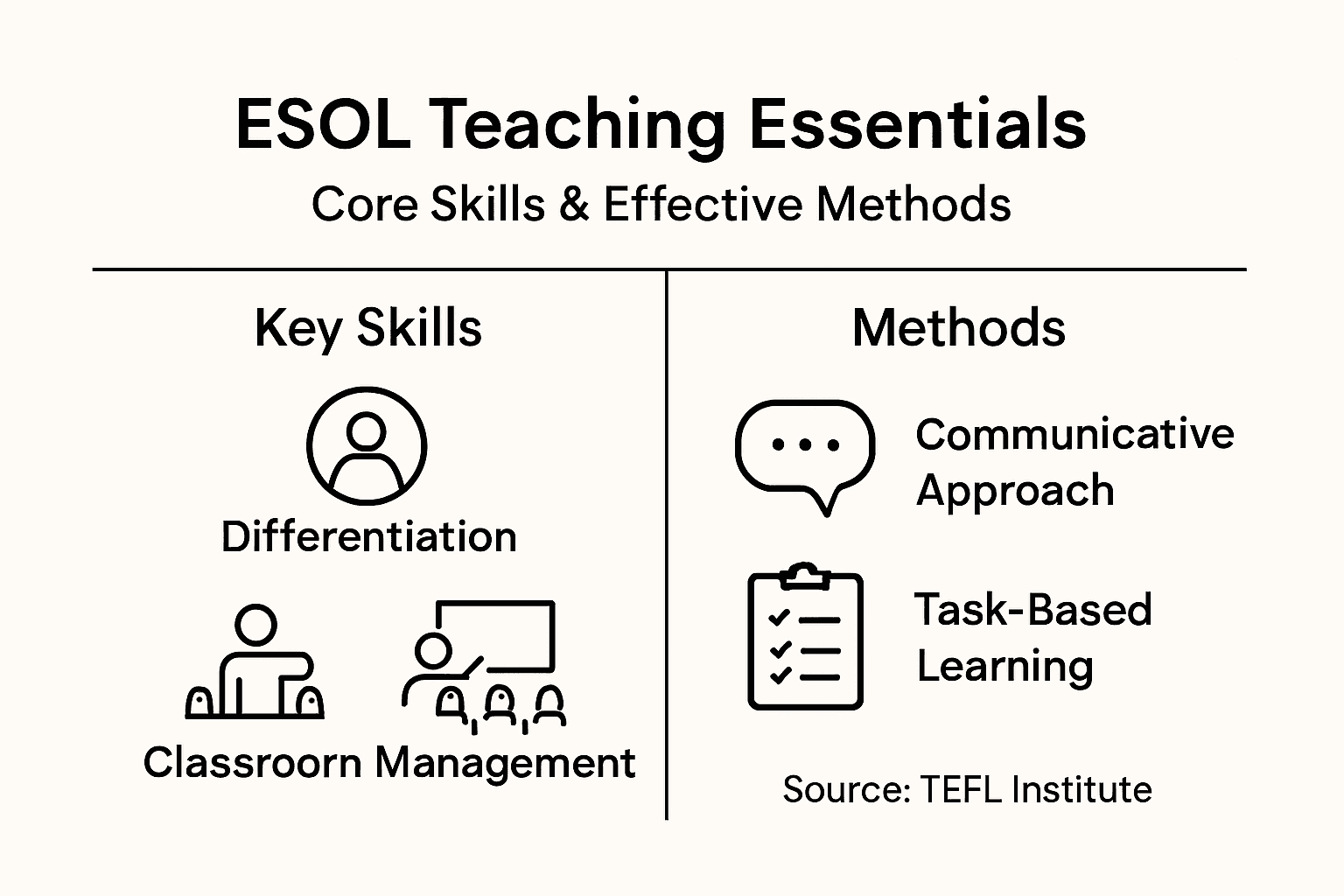
Core teaching skills include classroom management in multilingual contexts, where you navigate students with varying proficiency levels simultaneously. You deliver clear instructions using visual support, gestures, and simplified language without talking down to learners. Strong listening skills matter enormously. You listen for what students are trying to communicate beneath their language errors, understanding their intentions rather than fixating on mistakes.
Differentiation represents another critical competency. Your lessons must accommodate absolute beginners sitting alongside intermediate learners in the same classroom. This demands flexibility, multiple entry points into tasks, and constant adjustment based on student responses. Research-supported instructional models like the Sheltered Instruction Observation Protocol provide structured frameworks for delivering content while building language simultaneously.
Methodological approaches vary widely in effectiveness. Some teachers employ communicative language teaching, prioritizing real conversation over grammar drills. Others use task based learning, where students accomplish meaningful goals requiring language use. Sheltered instruction simplifies academic content without reducing cognitive demand, making grade-level material accessible to English learners. Bilingual education leverages students’ home languages as assets rather than obstacles, allowing them to learn content in their stronger language while building English.

Cultural responsiveness bridges technical skill and methodology. You recognize how students’ backgrounds, values, and previous educational experiences shape their learning. You build on their strengths rather than focusing solely on deficits. A student who speaks Mandarin and reads Arabic script brings linguistic sophistication that English monolingual peers lack.
The most versatile ESOL teachers master multiple methodologies and select approaches strategically based on student profiles, program goals, and context. Rather than rigidly applying one method, you combine techniques thoughtfully.
Pro tip: Study how experienced educators adapt multiple teaching methods across different student contexts instead of committing to a single rigid approach.
Certifications and Training Pathways Explained
Teaching English without certification is possible in some countries, but credentials dramatically improve your employability, earning potential, and effectiveness in the classroom. Certifications signal to employers that you understand language acquisition theory, have practiced teaching methodology, and meet recognized professional standards. They differentiate you from countless other applicants competing for the same positions.
TEFL (Teaching English as a Foreign Language) and TESOL (Teaching English to Speakers of Other Languages) represent the most widely recognized certification types globally. Both prepare you for teaching English internationally, though TESOL typically emphasizes teaching in English speaking countries while TEFL focuses on non-English speaking contexts. Your choice depends partly on where you want to teach. Many aspiring teachers start with foundational 120-hour TEFL certifications, then advance to specialized credentials.
Cambridge English qualifications like CELTA and DELTA represent another prestigious pathway, combining practical teaching experience with theoretical knowledge assessment. CELTA suits new teachers, requiring you to teach actual students under observation and develop lesson plans from scratch. DELTA targets experienced teachers seeking advanced credentials. These Cambridge qualifications carry significant prestige, particularly in competitive markets like Europe and Asia.
More specialized certifications address specific student populations or teaching contexts. TEYL (Teaching English to Young Learners) certifications prepare you for primary school instruction. IELTS and TOEFL preparation certifications focus on exam coaching. Business English certifications prepare you for corporate training roles. Many teachers pursue multiple credentials to broaden their opportunities.
Summary of key ESOL teaching certifications and their focuses:
| Certification | Main Focus | Typical Context | Prestige Level |
|---|---|---|---|
| TEFL | General EFL teaching | Non-English-speaking countries | Moderate |
| TESOL | ESL theory/methods | Both international and domestic | Moderate-High |
| CELTA | Practical teaching skills | Global, intensive programs | High |
| DELTA | Advanced methodology | Experienced teachers, career growth | Very High |
| TEYL | Teaching young learners | Primary/elementary contexts | Specialized |
The practical impact of certification matters significantly. Certified teachers typically earn 20-30 percent more than uncertified colleagues in the same position. Schools actively seek certified staff for quality assurance and accreditation purposes. Online teaching platforms and international schools almost universally require documented credentials.
Choosing a training pathway involves weighing cost, time commitment, teaching experience requirements, and career goals. Online programs offer flexibility but less hands-on practice. In-person intensive courses compress learning into weeks but demand full-time commitment. Hybrid approaches combine online theory with practicum components.
Pro tip: Verify that your chosen certification is recognized by employers in your target country before enrolling in expensive training programs.
Responsibilities and Ethical Standards for ESOL Teachers
Your role extends far beyond delivering lessons and grading assignments. ESOL teachers carry significant responsibility for student wellbeing, academic progress, and social integration. You shape how learners experience education during vulnerable transitions, often when they feel isolated or overwhelmed by language barriers. This position demands serious ethical reflection about your influence and impact.
Promoting inclusive quality education forms the foundation of professional responsibility. You advocate for equitable treatment of English learners within school systems that sometimes marginalize them. This means speaking up when policies disadvantage language learners, modifying curriculum to reflect diverse perspectives, and ensuring assessment methods fairly measure what students know regardless of English proficiency. You fight against deficit thinking that views language learners as problems to be fixed.
Professional integrity requires continuous learning and honest self-assessment. You acknowledge gaps in your knowledge rather than pretending expertise you lack. When instructional approaches aren’t working, you investigate why and adjust rather than blaming students. The global framework of professional teaching standards emphasizes that teachers must engage in evidence based practice focused on student learning outcomes.
Confidentiality and respect for student privacy represent non negotiable ethical boundaries. Information about students’ language backgrounds, family circumstances, or immigration status must remain confidential. You protect vulnerable students from discrimination while maintaining appropriate professional relationships. Avoid exploiting students’ stories for your own narrative purposes or social media visibility.
Teacher codes of conduct worldwide address responsibility to communities and colleagues. You uphold professional standards through honest communication with administrators, collaboration with fellow teachers, and engagement with families. You recognize power imbalances in your position and use that authority responsibly, never exploiting students economically, physically, or emotionally.
Cultural humility matters profoundly. You acknowledge what you don’t understand about your students’ cultures, languages, and experiences. Rather than positioning yourself as the expert on diversity, you learn continuously from students and families themselves.
Professional tip: Document your responsibilities and professional obligations clearly so you can reference them when facing ethical dilemmas or institutional pressure to compromise student welfare.
Career Prospects, Challenges, and Growth Opportunities
ESO teaching opens doors to international careers that span continents. Teachers work in private language schools across Asia, Middle East, and Latin America. International schools in major cities compete for qualified ESOL educators. Corporate training programs hire specialists for executive English instruction. Online platforms connect teachers with learners worldwide without geographic boundaries. The demand for qualified English teachers consistently outpaces supply globally.
Job markets vary dramatically by region. Southeast Asia offers abundant entry-level positions with competitive salaries, though professional development resources may be limited. Western Europe and the Middle East typically pay higher salaries but require advanced credentials and experience. Online teaching offers flexibility but includes inconsistent income and limited benefits. Understanding regional differences helps you navigate realistic career options.
Early career teachers face real obstacles. Professional development challenges including confidence and support systems significantly impact retention rates among new TESOL educators. Mentoring relationships, reflective practice, and structured feedback help you overcome initial uncertainty and build sustainable careers. Many teachers struggle alone without guidance, leading to burnout and career changes.
Long term growth requires intentional skill development. You might specialize in exam preparation, young learner instruction, or business English. Administrative roles like curriculum coordinator or teacher trainer offer alternative pathways. Some teachers pursue advanced degrees in applied linguistics or education management. Others develop expertise in niche areas like ESP (English for Specific Purposes) or CALL (Computer Assisted Language Learning).
Retention depends heavily on working conditions. Worldwide teacher shortages reflect motivation challenges and insufficient career pathways in many contexts. Schools with strong mentoring programs, reasonable workloads, professional development budgets, and clear advancement opportunities retain quality teachers. Conversely, institutions offering low pay, isolation, and limited growth lose talented educators quickly.
Your career trajectory depends on deliberate choices. Some teachers build 20 year careers in single institutions while others change countries every few years. Both paths offer distinct advantages. Staying long term builds expertise and institutional influence. Moving frequently provides diverse experience and higher earning potential.
Professional tip: Seek mentoring relationships early in your career and join professional organizations like TESOL International or regional TEFL associations to access networks supporting long term growth.
Elevate Your ESOL Teaching Career with Certified Expertise
Becoming an effective ESOL teacher means mastering specialized skills to address diverse learner needs across global contexts as highlighted in “ESOL Teacher: Empowering Global Language Learners.” Overcoming challenges such as cultural sensitivity, varied instructional models, and ethical responsibilities requires professional training tailored to your goals. Whether you aim to support young learners, corporate clients, or refugee communities, building comprehensive knowledge in language acquisition and instructional methodology is vital.

Start your journey today by exploring accredited TEFL Institute courses designed to deepen your understanding of ESOL teaching principles and prepare you for real-world classroom challenges. Gain recognized credentials that boost your employability, enable career flexibility worldwide, and empower you to transform lives through language education. Act now to access dynamic course options including advanced diplomas and specialized certifications. Visit TEFL Institute and take the first step toward a rewarding global teaching career.
Frequently Asked Questions
What is the role of an ESOL teacher?
ESOL teachers focus on teaching English to speakers of other languages, addressing their unique linguistic, cultural, and educational needs. They adapt their teaching methodologies based on students’ backgrounds and proficiency levels to help them achieve language proficiency.
How do ESOL teaching models differ?
The teaching models can vary significantly, including pull-out instruction (separate language classes), push-in models (supporting mainstream classes), sheltered classes (content taught with simplified English), and co-teaching partnerships (collaborative teaching with general education instructors). Each model serves different student needs and contexts.
What certifications are available for aspiring ESOL teachers?
Common certifications include TEFL (Teaching English as a Foreign Language), TESOL (Teaching English to Speakers of Other Languages), CELTA (Certificate in English Language Teaching to Adults), and DELTA (Diploma in English Language Teaching to Adults). Each certification has a different focus and level of recognition based on teaching context and expertise.
What challenges do ESOL teachers face in their careers?
ESOL teachers may encounter challenges such as professional development, navigating diverse student needs, managing workloads, and ensuring equitable education. Retention rates can be affected by lack of support, resources for growth, and maintaining a sustainable work-life balance.