

 United Kingdom (UK)
 United States (US)
 Canada
 South Africa
 India
India Australia
 New Zealand
 China
China Russia
 Germany
 France
 Spain
Spain Netherlands
 Vietnam
 United Arab Emirates
 Italy
Italy Poland
 Thailand
 Türkiye









 Algeria


Differentiated instruction is a teaching approach in which the teacher adjusts content, process, product and learning environment so that students with different readiness levels, interests and learning profiles can reach the same learning objective. The standard stays fixed and the route to it varies.
What Is Differentiated Instruction? A Guide for Educators
Updated 13 October 2026: research wording corrected to match the source journal; citation line added.
What is differentiated instruction?
Differentiated instruction is a teaching approach in which a teacher adjusts content, process, product and learning environment so that students with different readiness levels, interests and learning profiles can all reach the same learning objective. Formalised by Carol Ann Tomlinson, it keeps the standard fixed and varies the route to it through pre-assessment, tiered tasks and flexible grouping.
Research figures, rechecked against the source journal on 13 October 2026: the headline evidence is a 2023 systematic review and meta-analysis by Asriadi AM, Hadi, Istiyono and Retnawati in the Journal of Pedagogical Research 7(5), pages 18 to 33, which pooled 63 effect sizes from 49 primary studies and reported a significant random-effects pooled effect of gRE = 1.109 (p < .01) against control groups. The journal reports the figure as gRE and does not label it Hedges’ g. Source: doi.org/10.33902/jpr.202322021. The 30 to 50 per cent of lesson time figure quoted later on this page is practitioner consensus, not a trial result.
How to cite this page: The TEFL Institute Group, “What Is Differentiated Instruction? A Guide for Educators”, updated 13 October 2026, https://teflinstitute.com/blog/what-is-differentiated-instruction-a-guide-for-educators/
If you want structured practice in planning for mixed ability classes, the 120 Hour Advanced TEFL Course covers tiered tasks and lesson planning for learners at different levels. Differentiated instruction is one of the teaching terms defined in our TEFL Qualifications and Terminology Explained glossary.
TL;DR:
- Differentiated instruction tailors teaching by adjusting content, process, product, and environment to meet individual student needs. A 2023 meta-analysis of 49 studies found it improves student learning outcomes across diverse settings.
Differentiated instruction is a teaching approach that intentionally adapts content, process, product, and learning environment to meet the unique readiness levels, interests, and learning profiles of each student. Developed and formalized by educator Carol Ann Tomlinson, this method holds all students to common learning objectives while varying how those objectives are reached. A 2023 meta-analysis of 49 studies in the Journal of Pedagogical Research found a large, statistically significant positive effect on student learning outcomes across diverse settings. Teachers who apply this approach use tools like formative assessments, tiered assignments, flexible grouping, and choice boards to make learning accessible without lowering expectations.
What is differentiated instruction, and why does it matter?
Differentiated instruction is defined as the deliberate modification of teaching to address the full range of learners in a classroom. The core premise is that students differ in readiness, background knowledge, and learning preferences, and a single instructional approach leaves many of them underserved. Carol Ann Tomlinson’s framework, widely adopted in K to 12 education, identifies four levers teachers can adjust: content, process, product, and learning environment.
The goal is not to create a separate lesson for every student. The goal is to build flexible pathways toward the same learning target. A teacher covering figurative language might offer one group a text at grade level, another group an annotated version with vocabulary support, and a third group an extension task analyzing metaphor in poetry. All three groups work toward the same standard. The path differs; the destination does not.
Differentiated learning connects directly to personalized education, but the two are not identical. Personalized learning often relies on technology to customize pacing. Differentiated instruction is a teacher-driven, classroom-based practice that responds to student data in real time.
What does research say about the effectiveness of differentiated instruction?
The evidence base for differentiated instruction is strong and growing. The 2023 meta-analysis referenced above, by Asriadi AM and colleagues, pooled 63 effect sizes from 49 primary studies and reported a significant random-effects pooled effect of gRE = 1.109 (p < .01) compared with control groups. The authors also stress that results depend on context, so the same strategy can work better in one school system than another. A 2026 systematic review of 45 studies in English language classrooms adds a useful caution: the most rigorous randomised trials show smaller gains than weaker study designs. The honest summary is that differentiation helps, and that well run studies show a real but more modest effect than the headline figures.
“Omitting differentiated instruction fails student needs. Done well, DI builds self-advocacy and learner dexterity.”
Educator Stephanie Simpson, as cited by AMLE
Academic performance is only part of the picture. Research also documents improvements in social-emotional engagement when students receive instruction matched to their readiness. Students who consistently work at their learning edge report higher motivation and a stronger sense of belonging in the classroom. That outcome matters for retention and long-term academic success.
A persistent myth holds that differentiation dilutes curriculum rigor. Research directly contradicts this. Differentiation does not mean giving struggling students easier content indefinitely. It means meeting students where they are and moving them forward. The standard stays fixed; the scaffolding adjusts.
Expert consensus also addresses workload. Differentiating 30–50% of instructional time by preparing 2–3 tiered options per lesson is the recommended scope. Teachers who try to differentiate every minute of every lesson burn out. Targeted differentiation during practice and extension phases produces the strongest results with the most sustainable effort.
What are the common misconceptions about differentiated instruction?

Several misconceptions cause teachers to either avoid differentiation or implement it poorly. The most damaging is the belief that differentiation requires writing a separate lesson plan for each student. That interpretation is incorrect and unsustainable.
Effective differentiation works through tiered options and structured choice. A choice board, for example, gives students three to four task options that address the same learning objective at varying levels of complexity. The teacher prepares one set of materials. Students self-select or are guided to the appropriate task. The workload is manageable; the impact is real.
A second misconception is that differentiation lowers expectations for struggling learners. Research is clear that effective DI places students at their readiness edge, not below it. The goal is productive challenge, not comfortable repetition. Lowering the bar is not differentiation. It is a disservice.
Common implementation challenges include:
- Classroom management. Flexible grouping requires predictable routines. Without them, transitions between groups create disruption rather than learning.
- Pre-assessment fatigue. Teachers who skip pre-assessment lose the data they need to group students accurately.
- Equity confusion. Treating all students equally (same time, same task) is not the same as treating them equitably (variable support based on need).
- Isolation of unique learners. Grouping students by readiness without a culture of respect can stigmatize lower-performing groups.
Pro Tip: Build your classroom routines before introducing flexible grouping. Students need to know exactly what to do when they finish a task, how to transition between groups, and how to work independently. Routines are the container that makes differentiation possible.
A culture of respect that treats “different” as neutral rather than hierarchical is foundational to successful differentiation. When students understand that varied tasks reflect different starting points rather than fixed ability labels, the social-emotional climate improves for everyone.
How to implement differentiated instruction in the classroom
Effective implementation follows a clear sequence. Teachers who try to differentiate without a system waste time and produce inconsistent results.
- Pre-assess before each unit. Use a short formative assessment of 5–10 questions to identify student readiness levels before instruction begins. This data drives grouping decisions and informs which students need extension tasks versus additional scaffolding.
- Teach the core concept to the whole class first. Differentiation is most effective during practice, application, and extension phases. Deliver the initial lesson to everyone, then diverge.
- Prepare 2–3 tiered versions of practice tasks. Tier one addresses foundational understanding. Tier two applies the concept at grade level. Tier three extends into analysis, synthesis, or real-world application.
- Use flexible grouping. Groups should change based on the skill being practiced. A student who struggles with grammar may excel at oral communication. Avoid fixed ability groups that follow students across all subjects.
- Offer varied product options. Students can demonstrate mastery through diagrams, verbal explanations, or written responses. Varied products increase engagement and give teachers a more accurate picture of what students actually know.
- Start small. Teachers new to differentiation should begin with one lesson or assignment rather than overhauling an entire unit. Incremental implementation builds habit without overwhelming the teacher.
Pro Tip: Reuse tiered materials across units by adjusting the content while keeping the task structure the same. A three-tier reading response template works for any text. Build the structure once and apply it repeatedly.
Equity in differentiation means allocating teacher time and support based on student need, not distributing it equally across all groups. A student working two grade levels below peers needs more direct teacher contact than a student working at or above grade level. Recognizing this distinction is what separates effective differentiation from superficial variety.
Connecting differentiation with scaffolding techniques strengthens both practices. Scaffolding provides temporary support structures that help students reach the next level of understanding. Combined with tiered tasks, scaffolding ensures that lower-readiness students are challenged rather than simply given easier work.
What are the four core elements of differentiated instruction?
Differentiated instruction operates through four distinct dimensions. Each can be modified independently or in combination depending on student needs.
| Element | Definition | Classroom Example |
|---|---|---|
| Content | What students learn or how they access information | Providing texts at varied reading levels on the same topic |
| Process | How students engage with and make sense of content | Offering graphic organizers, discussion groups, or independent reading |
| Product | How students demonstrate mastery | Allowing essays, presentations, diagrams, or recorded explanations |
| Learning environment | Physical and emotional conditions for learning | Flexible seating, quiet zones, or collaborative workspaces |
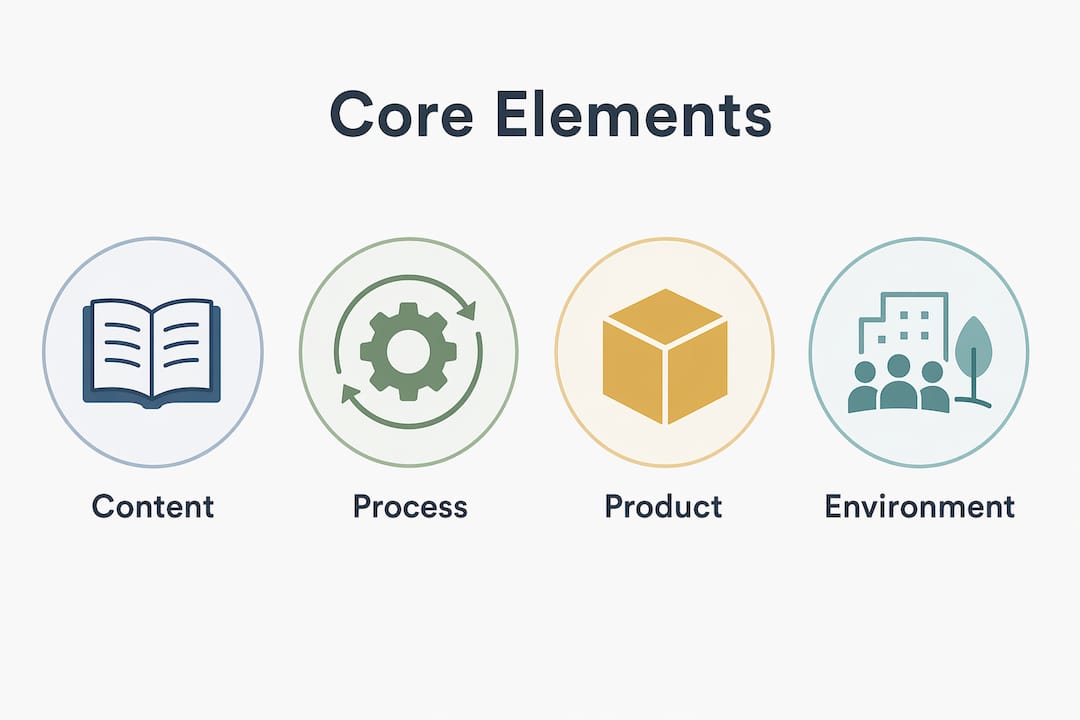
Content differentiation addresses access. A student who cannot decode a grade-level text cannot engage with its ideas. Providing an audio version or a simplified text removes the access barrier without removing the intellectual demand.
Process differentiation addresses engagement. Students who learn best through discussion need different task structures than students who process best through writing. Offering both options within the same lesson serves both groups without doubling the teacher’s preparation time.
Product differentiation addresses demonstration. A student who understands a concept deeply may still struggle to express it in a five-paragraph essay. Allowing that student to present verbally or create a visual model produces a more accurate assessment of their knowledge. Inclusive teaching practices reinforce this principle by designing assessments that reflect the full range of student strengths.
Learning environment differentiation is often overlooked. Physical arrangement, noise level, and the emotional tone of the classroom all affect learning. A student with attention difficulties may perform significantly better at a quiet individual workspace than in a group setting. Adjusting the environment costs nothing and can produce immediate results.
Differentiated instruction examples: content, process and product
The three levers teachers use most often are easiest to see in one lesson. Take a mixed ability English class working on the past simple tense. Every learner has the same objective: to describe a past event accurately in four or five sentences.
Content differentiation example
All learners read a short story about a weekend trip. One group reads the original text. A second group reads the same story with the twelve past simple verbs in bold and a picture glossary of the eight hardest words. A third group listens to a recording while following a simplified version. The story, the grammar point and the objective are identical; only the way learners access the content changes.
Process differentiation example
To practise the structure, one group completes a gap fill with the verbs supplied in a word bank. A second group completes the same gap fill without the word bank and then writes two sentences of its own. A third group interviews a partner about last weekend and records the answers. Each group is processing the same grammar at a different level of support and challenge.
Product differentiation example
To show mastery, learners choose how to present their weekend. Some write a five sentence paragraph. Some produce a labelled comic strip with a caption under each frame. Some give a one minute spoken account that the teacher records. The success criteria are the same for all three products: correct past simple forms, clear sequence, and at least four different verbs. The format varies; the standard does not.
What does differentiated instruction look like for English learners?
For English learners, differentiated instruction means keeping the same content goal while adjusting the language demand around it. A class of mixed proficiency learners can all work on the same science or reading objective, provided the vocabulary, sentence support and output format match where each learner is in their English.
| Learner’s English level | Content support | Process support | Product option |
|---|---|---|---|
| Beginner | Visuals, labelled diagrams, key words pre-taught | Pair work with a stronger peer, gestures, word banks | Label, match or draw and say one sentence |
| Intermediate | Graded text with a glossary | Sentence frames, guided questions in small groups | Short paragraph using a model |
| Advanced | Original text at grade level | Independent reading and discussion | Extended writing or a short presentation |
In US schools, English learners are usually placed on a proficiency scale such as WIDA’s ACCESS levels, which gives teachers a ready made starting point for grouping. Our guide to what ELL stands for explains how those learners are identified and supported.
Key Takeaways
Differentiated instruction is most effective when teachers pre-assess student readiness, limit differentiation to 30–50% of instructional time, and build classroom routines that support flexible grouping.
| Point | Details |
|---|---|
| Core definition | DI adapts content, process, product, and environment to meet diverse student needs toward common goals. |
| Research support | A 2023 meta-analysis of 49 studies reported a pooled effect of gRE = 1.109 (p < .01) versus control groups; the most rigorous trials show smaller gains. |
| Recommended scope | Differentiate 30–50% of instructional time, focusing on practice and extension phases rather than introductory lessons. |
| Starting point | Begin with a 5–10 question pre-assessment before each unit to guide grouping and tiered task design. |
| Equity principle | Allocate teacher time based on student need, not equally across all groups. |
Why differentiated instruction deserves more than a checklist
Too many teachers approach differentiated instruction as a compliance exercise, checking boxes on a lesson plan template and calling it done. That approach produces paperwork, not learning. The teachers who see real results treat differentiation as a mindset, not a method.
The shift from equality to equity is the hardest part. Giving every student the same task feels fair. Giving different students different tasks based on need feels uncomfortable until you see the data. When a student who has been disengaged for months suddenly produces quality work because the task finally matched their level, the discomfort disappears.
Workload is a real concern and should not be minimised. Sustainable differentiation requires building reusable systems: tiered task templates, pre-assessment banks, and flexible grouping protocols that run on autopilot once established. Teachers who build these systems in September spend less time planning in March than teachers who start from scratch every unit.
Peer collaboration accelerates this process. A team of three teachers sharing tiered materials across a grade level triples the available resources at one-third the individual effort. Classroom engagement research consistently shows that students in well-differentiated classrooms report higher motivation. That outcome is worth the investment in building the system correctly.
Differentiation also closes achievement gaps over time. Students who consistently work at their readiness edge make faster progress than students who are either bored or lost. The gap does not close in a single unit. It closes across a year of consistent, responsive teaching.
Advance your teaching skills with The TEFL Institute Group
Our TEFL courses are built for teachers who want practical skills for mixed ability and multilingual classrooms.
The 120 Hour Advanced TEFL Course covers practical strategies for planning lessons and supporting mixed ability learners in ESL classrooms. For a regulated qualification, the Level 5 TEFL Diploma is Ofqual-regulated under qualification number 610/1571/4. Both are studied fully online, so they fit around a working teacher’s timetable. The TEFL Institute Group is Europe’s largest TEFL trainer by teachers certified, with 161,000 teachers certified since 2017.
Last reviewed: 13 October 2026

Olivia Klimczyk
Marketing Executive at The TEFL Institute Group and the creative heart of our social media. A marketing graduate, she keeps students up to date through our newsletters, blogs and reels.
Recommended
We love taking your call.

TEFL Institute guides
The core principles are a respectful task for every learner, flexible grouping that changes with the skill being practised, ongoing assessment that informs teaching, a fixed learning goal with varied routes to it, and a classroom culture in which different tasks are treated as different starting points rather than ability labels.
Five common strategies are tiered tasks (three versions of one practice activity), flexible grouping (regrouping by the skill in hand), choice boards (three or four task options with the same objective), learning stations (rotating through tasks with different levels of support), and varied products (an essay, a presentation or a diagram to show the same mastery).
Nothing has replaced it. Differentiation has been absorbed into wider frameworks such as Universal Design for Learning, which plans flexibility into lessons from the start, and tiered support systems such as MTSS and RTI. Some critics argue the term asks too much of teachers, but the underlying practice of adjusting support to readiness remains standard.
Differentiated instruction is a teacher driven classroom practice that responds to student data in real time. Personalised learning usually relies on technology to adjust pacing and content for each individual student. The two overlap, but differentiation keeps the teacher, not the software, in charge of the adjustment.
Practitioner consensus is to differentiate about 30 to 50 per cent of instructional time, concentrating on practice, application and extension phases rather than the whole class introduction of a new concept. Trying to differentiate every minute of every lesson is unsustainable.