

 United Kingdom (UK)
 United States (US)
 Canada
 South Africa
 India
India Australia
 New Zealand
 China
China Russia
 Germany
 France
 Spain
Spain Netherlands
 Vietnam
 United Arab Emirates
 Italy
Italy Poland
 Thailand
 Türkiye










 Algeria



Understanding Your Guide to TEFL Course Accreditation
Understanding Your Guide to TEFL Course Accreditation

TEFL course accreditation shapes the future for thousands of people hoping to teach English around the world and it is fast becoming a mandatory standard for employers. Some countries now refuse to even consider applications without proof from an accredited program and over 80 percent of reputable schools worldwide only hire teachers with an officially recognized TEFL certificate. You might expect accreditation to be textbook bureaucracy or just another layer of paperwork. The reality is it acts as your global passport and if a course is not accredited, your teaching dreams could end before they even start.
Table of Contents
- What Is Tefl Course Accreditation?
- Why Tefl Course Accreditation Matters For Teachers
- How Tefl Course Accreditation Works
- Key Concepts In Tefl Course Accreditation
Quick Summary
| Takeaway | Explanation |
|---|---|
| Accreditation ensures quality training | TEFL course accreditation validates that programs meet professional standards, enhancing teaching quality and credibility. |
| Increased employability with accreditation | Employers recognize accredited certifications as indicators of preparedness, opening doors to better job opportunities. |
| Standardized benchmarks for teachers | Accreditation provides a universal standard for teacher qualifications, facilitating international employment in various contexts. |
| Rigorous evaluation processes matter | Accreditation agencies conduct thorough assessments of curriculum, instructors, and outcomes to ensure educational quality. |
| Professional growth through accredited programs | Accredited certifications lead to career advancement options, better salaries, and higher institutional trust from employers. |
What is TEFL Course Accreditation?
TEFL course accreditation represents an independent validation process that ensures language teaching certification programs meet established professional standards. When pursuing a TEFL certification, understanding accreditation becomes crucial for aspiring teachers seeking recognized, quality training.
The Core Purpose of Accreditation
Accreditation serves as a critical quality assurance mechanism in professional education. For TEFL courses, this process involves comprehensive evaluation by recognized educational authorities who assess multiple dimensions of a training program. Our guide on understanding why choose accredited TEFL highlights the significance of this rigorous assessment.
Key aspects examined during accreditation include:
To clarify the various elements assessed during TEFL course accreditation, the table below outlines the primary components and what each entails.
| Accreditation Component | What It Covers |
|---|---|
| Curriculum | Comprehensiveness, alignment with international teaching standards |
| Instructor Qualifications | Professional expertise and teaching experience |
| Assessment Methodologies | Evaluation of learning outcomes and measurement strategies |
| Course Content and Practical Prep | Depth, relevance, and real-world teaching readiness |
| Student Support and Resources | Availability and quality of support materials and guidance |
| Educational Infrastructure | Institutional resources and learning environment |
| International Standards Alignment | Conformance with global teaching competencies |
- Curriculum comprehensiveness and alignment with international teaching standards
- Instructor qualifications and professional expertise
- Assessment methodologies and learning outcomes
- Course content depth and practical teaching preparation
Verification and Professional Recognition
Accredited TEFL certifications carry substantial weight in the international teaching landscape. According to World TEFL Association, employers worldwide recognize accredited programs as indicators of genuine professional preparation. The verification process ensures that teachers have received training meeting globally accepted benchmarks.
Professional accreditation provides candidates with more than just a certificate. It represents a comprehensive evaluation of educational quality, instructor competence, and the program’s ability to prepare teachers for real-world classroom challenges. Potential employers view these credentials as reliable indicators of a candidate’s preparedness and commitment to professional standards.
Why TEFL Course Accreditation Matters for Teachers
For aspiring English language teachers, TEFL course accreditation represents far more than a simple credential. It serves as a professional passport that significantly impacts career opportunities, employability, and global teaching prospects.
Professional Credibility and Career Advancement
Accredited TEFL certifications act as a critical differentiator in an increasingly competitive international teaching market. Professional recognition transforms a basic certificate into a globally respected qualification. Learn more about employer recognition of online TEFL courses to understand the intricate relationship between accreditation and employability.
Key professional advantages include:

- Enhanced global job market accessibility
- Higher likelihood of securing premium teaching positions
- Increased salary negotiation potential
- Greater institutional trust from potential employers
International Employment Standards
Accreditation provides teachers with a standardized benchmark that transcends geographical boundaries. According to International TEFL Standards Organization, employers across different countries rely on accredited certifications to ensure teachers meet consistent professional competencies.
The verification process guarantees that teachers possess not just theoretical knowledge, but practical skills necessary for effective language instruction. This comprehensive assessment covers crucial teaching dimensions such as classroom management, curriculum development, student engagement strategies, and cultural sensitivity in educational settings.
Ultimately, an accredited TEFL certification represents a teacher’s commitment to professional excellence, demonstrating their dedication to providing high-quality language education in diverse international contexts.
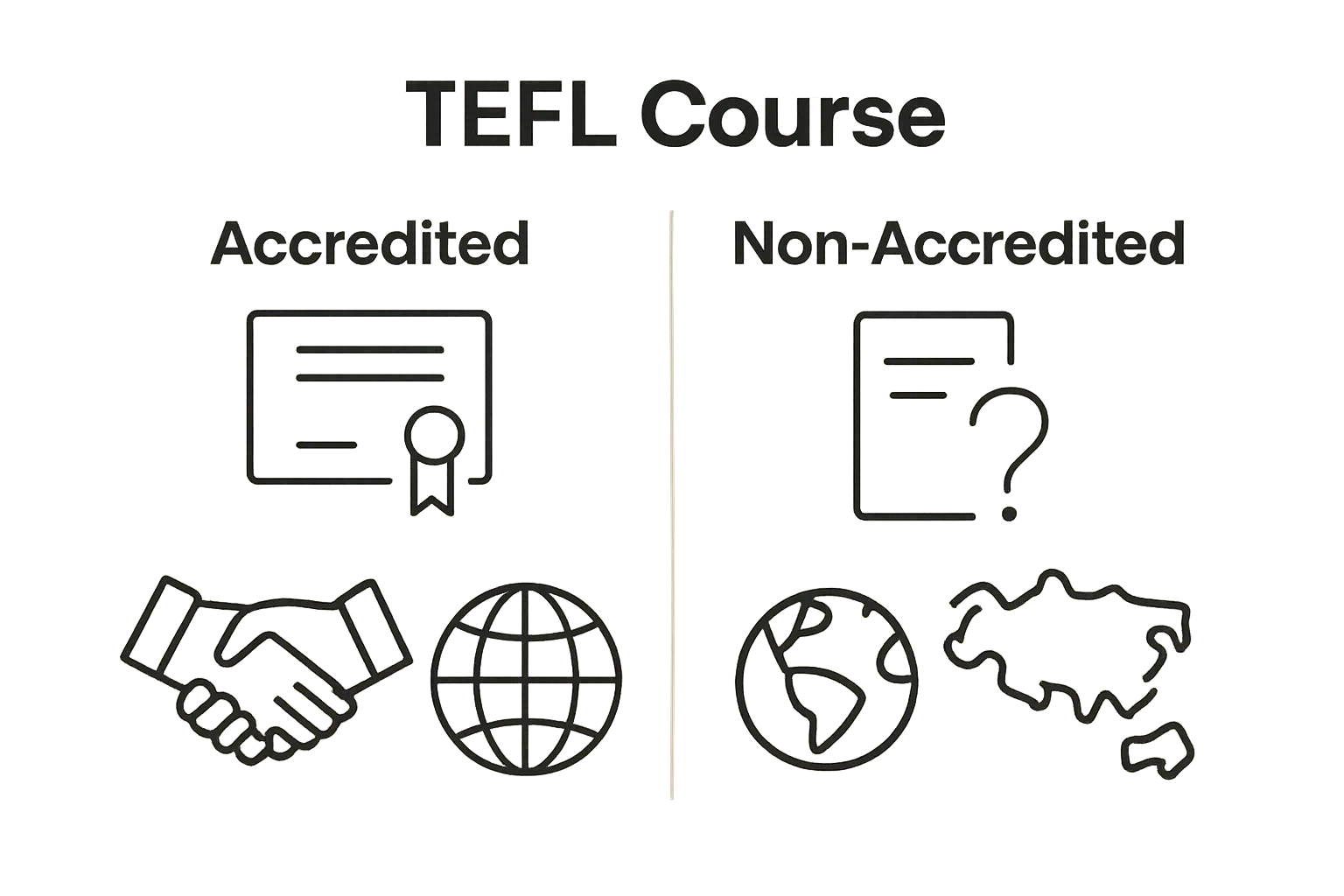
The following table compares the distinctions between accredited and non-accredited TEFL certifications by outlining their impact and recognition in the global teaching market.
| Factor | Accredited TEFL Certification | Non-Accredited TEFL Certification |
|---|---|---|
| Employer Recognition | Highly recognized globally, increases job opportunities | Often disregarded or questioned by employers |
| Quality Assurance | Assessed for curriculum, instructors, and outcomes | No external validation of quality |
| Career Advancement | Supports higher salaries and competitive teaching roles | Limits prospects for career growth |
| International Employability | Accepted across borders due to universal benchmarks | Frequently rejected for international positions |
| Professional Credibility | Implies verified preparedness and training | Lacks demonstrated professional verification |
How TEFL Course Accreditation Works
TEFL course accreditation represents a systematic process of professional evaluation that ensures language teaching programs maintain rigorous educational standards. Understanding the intricate mechanisms behind this verification process helps aspiring teachers recognize the true value of an accredited certification.
The Comprehensive Assessment Framework
Accreditation involves a multi-dimensional evaluation conducted by independent educational authorities. These organizations meticulously examine every aspect of a TEFL training program to validate its quality and professional relevance. Explore our insights on online TEFL course recognition to understand the depth of this assessment.
Key evaluation criteria typically include:
- Curriculum design and educational content quality
- Instructor qualifications and teaching expertise
- Learning outcome measurements
- Alignment with international teaching standards
- Student support and resources
Verification and Validation Processes
Accreditation agencies employ a rigorous methodology to assess TEFL training programs. According to the British Council’s Accreditation Framework, this typically involves comprehensive site visits, document reviews, and detailed performance assessments.
The verification process goes beyond surface level inspection. Accrediting bodies conduct in-depth analyses of course materials, teaching methodologies, assessment techniques, and overall educational infrastructure. They examine how well a program prepares teachers for real world classroom challenges, ensuring that certifications represent genuine professional competence.
Through this meticulous evaluation, accreditation transforms a simple certificate into a globally recognized mark of educational excellence and teaching preparedness.
Key Concepts in TEFL Course Accreditation
Understanding TEFL course accreditation requires a nuanced exploration of its foundational principles and technical frameworks. These core concepts determine how educational programs establish and maintain professional standards in language teaching preparation.
Fundamental Accreditation Principles
At the heart of TEFL accreditation lie several critical philosophical foundations. Learn more about TEFL certification basics to understand the broader context of these educational standards. Professional accreditation centers on creating transparent, accountable, and consistently high quality learning environments that prepare teachers for global classrooms.
Key principles include:
- Establishing measurable educational quality benchmarks
- Ensuring consistent instructor training standards
- Promoting transparency in educational methodologies
- Protecting student educational interests
- Creating internationally recognized professional credentials
Structural Elements of Accreditation
Accreditation involves complex structural components that go beyond simple certification. According to Educational Quality Assessment Research, the process encompasses rigorous evaluation mechanisms designed to validate educational programs comprehensively.
These structural elements typically involve:
- Independent verification by authorized educational bodies
- Comprehensive curriculum review processes
- Periodic reassessment and recertification requirements
- Examination of institutional teaching infrastructure
- Analysis of learning outcome measurements
The intricate nature of TEFL course accreditation reflects the global education community’s commitment to maintaining high professional standards in language instruction, ensuring that certified teachers are genuinely prepared for diverse international teaching environments.
Ready to Get Accredited? Put Your Teaching Career in Trusted Hands
You have learned why TEFL course accreditation is vital. It is the difference between a teaching certificate that opens doors globally and one that does not. Maybe you are feeling overwhelmed by the complexity of accreditation standards or worried about investing your time and money into a program that falls short. At TEFL Institute, we remove the uncertainty, giving you access to accredited training that meets international benchmarks and equips you for success.

Take control of your future. Explore our official website for accredited programs tailored to your goals. See how our TEFL certification resources and employer recognition insights connect you to real-world teaching opportunities. Do not wait when your next step could be the one that launches your global teaching journey. Enroll with a provider that puts accreditation and your career advancement first.
Frequently Asked Questions
What is TEFL course accreditation?
TEFL course accreditation is an independent validation process that ensures language teaching certification programs meet established professional standards, providing quality assurance in teacher training.
Why is TEFL course accreditation important for teachers?
Accreditation matters because it significantly impacts career opportunities, employability, and global teaching prospects, acting as a professional passport that differentiates candidates in a competitive market.
How does the TEFL course accreditation process work?
The accreditation process involves a comprehensive evaluation of a TEFL program by independent educational authorities, examining curriculum, instructor qualifications, and overall educational quality to ensure standards are met.
What are the key benefits of obtaining an accredited TEFL certification?
Accredited TEFL certifications offer enhanced job market accessibility, improved chances of securing premium teaching positions, increased salary negotiation leverage, and greater institutional trust from potential employers.