

 United Kingdom (UK)
 United States (US)
 Canada
 South Africa
 India
India Australia
 New Zealand
 China
China Russia
 Germany
 France
 Spain
Spain Netherlands
 Vietnam
 United Arab Emirates
 Italy
Italy Poland
 Thailand
 Türkiye









 Algeria


TESOL Methodology: A Practical Guide for Educators
TESOL Methodology: A Practical Guide for Educators

TL;DR:
- TESOL methodology combines teaching approaches, methods, and frameworks to develop learners’ communicative skills effectively.
- Understanding these components helps teachers adapt instruction to different contexts and learner needs.
TESOL methodology is defined as the structured integration of language teaching approaches, methods, and instructional frameworks designed to develop learners’ communicative competence. The field draws on Second Language Acquisition (SLA) theory, communicative competence models, and classroom-tested techniques to guide how educators plan, deliver, and assess English language instruction. Understanding the distinction between an approach, a method, and a framework is the foundation of effective TESOL practice. Teflinstitute’s accredited TESOL courses build this understanding systematically, giving educators the theoretical grounding and practical tools to teach confidently across diverse contexts.
What is TESOL methodology and why does it matter?
Approaches, methods, and frameworks are three distinct but interconnected components of TESOL methodology, and confusing them is one of the most common mistakes new educators make. An approach is a theoretical philosophy about how language is learned. A method is the systematic classroom application of that philosophy. A framework is the organizational structure that sequences instruction to maintain coherence across a lesson or course.
This hierarchy matters because it determines how you make decisions in the classroom. A teacher who understands the approach can adapt the method when conditions change. A teacher who only knows the method tends to follow scripts, even when learners need something different. The hierarchy of approach, method, and framework enables teachers to combine techniques creatively while keeping lessons coherent.
Foundational theories behind TESOL methodology include SLA research, Krashen’s Input Hypothesis, and Hymes’ model of communicative competence. These theories explain why learners need comprehensible input, meaningful interaction, and repeated exposure to new language in varied contexts. Without this theoretical grounding, teaching decisions become arbitrary rather than principled.

What are the main TESOL approaches and how do they shape teaching philosophy?
An approach defines what teachers believe about language and learning before they walk into the classroom. The most widely applied approach in modern TESOL is Communicative Language Teaching (CLT), which prioritizes communicative competence over grammatical accuracy alone. CLT positions the classroom as a space for meaningful interaction, not a place to memorize rules.
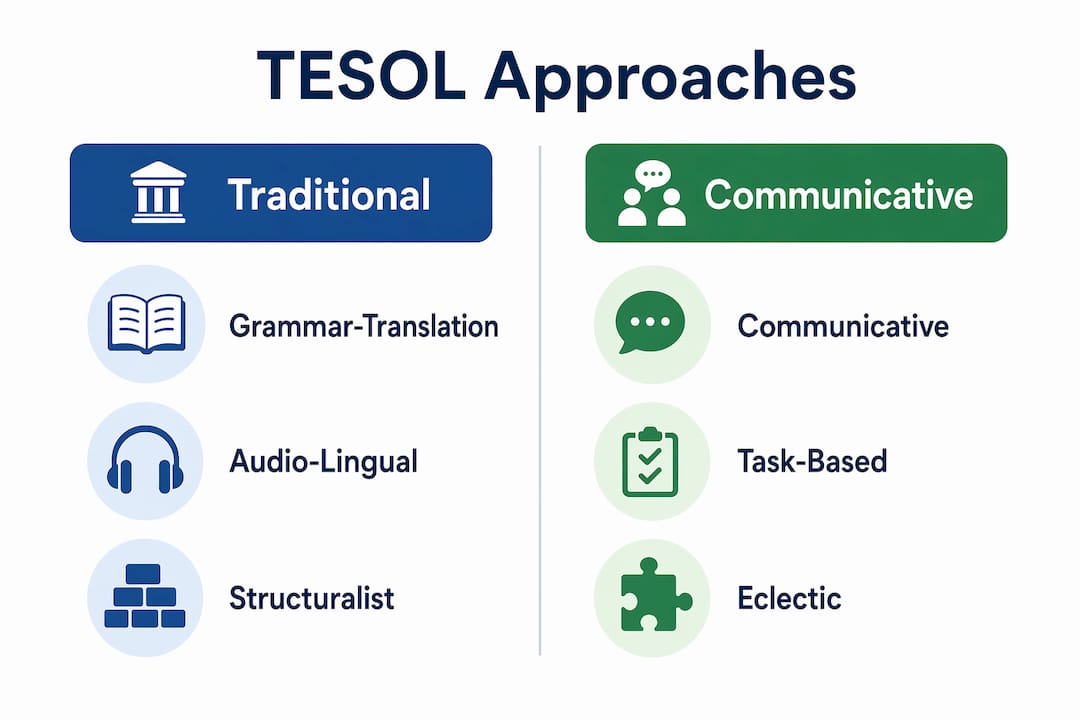
The Communicative Approach shifted language teaching toward prioritizing real communication, but expert teachers blend this with explicit instruction when learners face fossilized errors. That blending is not a compromise. It is a sign of pedagogical maturity. A teacher who only uses CLT may leave learners without the grammar scaffolding they need to self-correct.
Other influential approaches include:
- The Structural Approach: Focuses on grammar patterns and sentence construction. Useful for learners who need explicit form-focused instruction at early stages.
- The Lexical Approach: Treats vocabulary chunks and collocations as the core unit of language. Supports natural, idiomatic production.
- The Sociocultural Approach: Draws on Vygotsky’s Zone of Proximal Development. Emphasizes collaborative learning and teacher-guided scaffolding.
- The Humanistic Approach: Centers learner affect, motivation, and identity. Reduces anxiety and builds confidence in low-proficiency groups.
Each approach carries implications for course design and teaching mindset. Choosing an approach is not a one-time decision. Effective educators revisit their philosophical stance as they learn more about their learners and the contexts they teach in.
Which TESOL methods translate theory into classroom practice?
A method is where theory meets the classroom. The most widely used methods in TESOL each reflect a specific approach and suit particular learner profiles and teaching contexts.
-
Task-Based Language Teaching (TBLT): Learners complete real-world tasks, such as planning a trip or negotiating a schedule, and the teacher addresses language gaps after the task. Task-Based Learning requires debriefing to turn task struggles into targeted grammar instruction, which enhances both relevance and retention.
-
Presentation-Practice-Production (PPP): The teacher presents a language item, learners practice it in controlled exercises, then produce it in freer communication. PPP works well for discrete grammar points and lower-proficiency learners who benefit from clear structure.
-
Total Physical Response (TPR): Learners respond to commands with physical actions before producing language. TPR reduces anxiety and suits young learners or complete beginners.
-
The Lexical Method: Teachers present vocabulary in chunks and collocations rather than isolated words. Research shows learners need to encounter new vocabulary 7–12 times in different contexts for effective acquisition. Teaching collocations accelerates this process.
-
Content and Language Integrated Learning (CLIL): Language is taught through subject content, such as science or history. CLIL increases motivation because learners see immediate relevance.
Pro Tip: After a TBLT task, resist the urge to correct every error immediately. Note the most frequent language gaps during the task, then address them in a focused post-task debrief. Learners are far more receptive to grammar instruction when they have just experienced the gap themselves.
Selecting the right method depends on learner age, proficiency level, class size, and the learning objectives of the course. Experienced educators typically draw on multiple ESL teaching methods rather than committing exclusively to one.
How do learning frameworks organize TESOL lesson planning effectively?
An instructional framework is the sequence of stages that organizes a lesson. It is distinct from a method because it does not prescribe specific activities. Instead, it provides a structure within which different methods and techniques can operate. TESOL instructional frameworks like PPP and TBLT offer different benefits, and combining them contextually yields better learner outcomes.
| Framework | Structure | Best suited for |
|---|---|---|
| PPP (Presentation-Practice-Production) | Present, practice in controlled tasks, produce freely | Discrete grammar points, lower-proficiency learners |
| TBLT (Task-Based Language Teaching) | Pre-task, task cycle, language focus | Intermediate to advanced learners, communicative goals |
| TTT (Test-Teach-Test) | Diagnostic task, targeted teaching, repeat task | Learners with partial knowledge, mixed-ability classes |
| ESA (Engage-Study-Activate) | Engage interest, study language, activate in use | Flexible; suits a wide range of lesson types |
PPP is the most familiar framework for new educators because its linear structure is easy to plan and deliver. TTT is more diagnostic. It reveals what learners already know before the teacher commits time to explicit instruction. ESA, developed by Jeremy Harmer, offers flexibility because the three stages do not need to follow a fixed order.
Pro Tip: Do not default to PPP for every lesson. Use TTT when you suspect learners already have partial knowledge of a target structure. Starting with a diagnostic task saves time and keeps more proficient learners engaged.
Choosing a framework depends on the lesson objective, the learners’ proficiency, and the available time. A 45-minute class with beginners suits PPP. A 90-minute class with intermediate adults suits TBLT. The framework is a tool, not a rule.
What challenges impact TESOL methodology implementation and how can teachers adapt?
Real classrooms rarely match the conditions described in methodology textbooks. CLT improves speaking and listening but faces barriers including large classes, exam-driven curricula, and institutional resistance to student-centered approaches. A systematic review of 18 studies confirmed these contextual constraints directly impact CLT effectiveness. That finding means methodology choices must account for institutional realities, not just pedagogical ideals.
Principled eclecticism is the most practical response to these constraints. It means selecting and blending methods based on evidence and learner needs rather than loyalty to a single approach. Effective TESOL teachers balance communicative approaches with explicit instruction to overcome fossilized errors and meet learners where they are.
Specific adaptation strategies include:
- Scaffolding: Break complex tasks into smaller steps. Provide sentence starters, graphic organizers, or model texts before asking learners to produce independently.
- Elicitation over explanation: Effective elicitation includes building context, giving wait time, careful nomination, and accepting near-misses to foster learner output. Cold elicitation without context fails because learners have no cognitive hook to retrieve language from.
- Strategic error correction: Decide in advance whether to correct errors during fluency tasks or only after. Interrupting a communicative task to correct grammar undermines the task’s purpose.
- Distinguishing display from genuine questions: Display questions versus genuine questions is a critical distinction. Display questions test knowledge the teacher already has. Genuine questions invite real communication. Overusing display questions turns class time into a test rather than a conversation.
Adapting methodology to context is not a sign of inconsistency. It is the mark of a reflective practitioner who understands that no single method works for every learner in every setting. Educators who build this adaptability into their practice consistently produce better learner outcomes than those who follow a single method rigidly.
Key Takeaways
Effective TESOL methodology requires understanding the hierarchy of approach, method, and framework, then applying principled eclecticism to blend techniques based on learner needs and teaching context.
| Point | Details |
|---|---|
| Approach, method, and framework are distinct | Confusing these three components leads to inconsistent lesson design and poor learner outcomes. |
| CLT faces real-world constraints | Large classes and exam-driven curricula limit CLT effectiveness; adaptation is necessary, not optional. |
| Debriefing makes TBLT work | Post-task language analysis turns task gaps into targeted, memorable grammar instruction. |
| Elicitation requires context | Cold elicitation fails; build cognitive hooks through visuals or texts before asking learners to produce language. |
| Principled eclecticism outperforms single-method teaching | Blending methods based on evidence and learner needs consistently produces better outcomes than rigid adherence to one approach. |
What I have learned from years of watching methodology go wrong
The most persistent mistake I see educators make is treating methodology as a checklist rather than a decision-making framework. They complete a TEFL course, learn PPP, and then apply it to every lesson regardless of what the learners actually need. The framework becomes a crutch.
What changed my own practice was understanding SLA research deeply enough to know why certain techniques work. Learners need comprehensible input, low-anxiety production opportunities, and repeated meaningful encounters with new language. Once you internalize those principles, you stop asking “which method should I use?” and start asking “what does this group of learners need right now?”
The other thing I would push back on is the assumption that communicative teaching and explicit grammar instruction are opposites. They are not. The best lessons I have observed move fluidly between meaning-focused interaction and form-focused attention. The teacher knows when to step back and let communication happen, and when to step in with a clear explanation. That judgment comes from experience, but it also comes from understanding the theory behind the practice.
Reflective practice is not optional for serious educators. Keep a teaching journal. Note what worked, what did not, and why. Review your ESL teaching strategies regularly against what you observe in your learners. The educators who improve fastest are the ones who treat every lesson as data.
— Muller
Advance your TESOL methodology training with Teflinstitute
Teflinstitute offers accredited courses that build methodology knowledge from foundational principles to advanced classroom application.

The 120-hour Elective TEFL Course covers core teaching methods, lesson planning frameworks, and communicative approaches in depth. For educators who want the most thorough preparation, the 240-hour Master TEFL Course provides externally accredited training across the full range of TESOL instructional strategies, from SLA theory to practical classroom management. Both courses are completed online with flexible scheduling, making them accessible for working educators. Teflinstitute’s programs are designed for teachers who want to move beyond surface-level technique and build a principled, adaptable practice.
FAQ
What is the difference between a TESOL approach and a method?
An approach is a theoretical philosophy about how language is learned. A method is the practical classroom application of that philosophy, specifying activities, sequencing, and teacher roles.
Is Communicative Language Teaching the best TESOL method?
CLT is the most widely applied approach in modern TESOL, but research confirms it faces barriers in large classes and exam-focused settings. Blending CLT with explicit instruction produces better outcomes than using it in isolation.
What is principled eclecticism in TESOL?
Principled eclecticism means selecting and combining teaching methods based on learner needs and evidence rather than following a single approach. It is the standard practice among experienced TESOL educators.
How does Task-Based Language Teaching work in practice?
Learners complete a real-world communicative task, and the teacher then uses observed language gaps as the basis for targeted grammar instruction during a post-task debrief.
How do I choose between PPP and TBLT for lesson planning?
Use PPP for discrete grammar points and lower-proficiency learners who need clear structure. Use TBLT for intermediate to advanced learners with communicative goals and sufficient class time for a full task cycle.
Recommended
TEFL Institute guides

Germany
Freelance work and pay
Estonia
Jobs, pay and work routes
Italy
Jobs, pay and visa routes
Japan
JET, ALT and eikaiwa pay
Cambodia
Pay, requirements and visas