

 United Kingdom (UK)
 United States (US)
 Canada
 South Africa
 India
India Australia
 New Zealand
 China
China Russia
 Germany
 France
 Spain
Spain Netherlands
 Vietnam
 United Arab Emirates
 Italy
Italy Poland
 Thailand
 Türkiye










 Algeria



Advance your TEFL career: guide to CPD in 2026
Advance your TEFL career: guide to CPD in 2026

TL;DR:
- Continuous professional development enhances TEFL careers beyond initial certification.
- Effective CPD combines evidence-based methods with structured reflection and documentation.
- Keeping a detailed, regularly updated CPD log demonstrates ongoing growth to employers.
Earning a TEFL certificate is a strong foundation, but it is not the finish line. The educators who build lasting, rewarding careers in English language teaching are those who treat professional growth as an ongoing process, not a one-time event. CPD in TEFL involves formal courses, workshops, self-study, reflection, and online training to keep skills current and advance careers. This guide breaks down exactly what continuous professional development (CPD) means for TEFL teachers, which methods produce real results, and how to document your efforts in ways that employers actually value.
Table of Contents
- What is continuous professional development in TEFL?
- Key methods and approaches in TEFL CPD
- Practical ways to pursue CPD as a TEFL teacher
- Documenting and reflecting on CPD for maximum career value
- Our perspective: What most TEFL guides miss about CPD
- Take the next step: Enhance your TEFL journey with premium CPD
- Frequently asked questions
Key Takeaways
| Point | Details |
|---|---|
| Ongoing learning required | Continuous professional development keeps TEFL skills relevant and improves career prospects. |
| Mix formal and informal CPD | Combining accredited courses with free and self-study options maximizes impact and flexibility. |
| Document everything | Maintaining a CPD log and certificates proves your commitment and opens more job opportunities. |
| Reflection enhances results | Reflective practice during CPD leads to greater improvements in both teaching and student outcomes. |
What is continuous professional development in TEFL?
Continuous professional development, or CPD, refers to the structured and self-directed activities that teachers engage in beyond their initial certification to maintain, improve, and broaden their professional skills. In the TEFL context, CPD is not simply about fulfilling a compliance requirement. It is a practical strategy for staying effective in the classroom and competitive in the job market.
The role of a TEFL teacher has grown considerably more complex in recent years. Teachers are now expected to work across diverse learner populations, adapt to digital platforms, and apply research-informed methods. A certificate earned several years ago may not reflect current best practices. CPD bridges that gap.
TEFL CPD activities span a wide range of formats and intensities, including:
- Accredited diploma or certificate programs
- Online training modules and webinars
- Peer observation and collaborative lesson planning
- Reflective teaching journals and self-assessment logs
- Workshops hosted by professional associations
- Self-study using published research or teaching guides
Employers hiring for positions abroad or on established online platforms increasingly expect candidates to show evidence of ongoing learning. A single certificate, even a respected one, signals starting competence. A documented CPD record signals professional commitment.
“Ongoing professional development is no longer optional for TEFL educators who want to remain competitive. It is the standard expectation in quality language programs worldwide.”
This shift matters practically. Schools in competitive markets such as South Korea, Japan, and the UAE often screen applicants based on post-certification training. Online platforms that serve large learner bases similarly favor teachers who demonstrate continued investment in their craft. CPD is the mechanism that keeps your professional profile current and credible.
Key methods and approaches in TEFL CPD
Not all CPD activities produce equal results. The most effective approaches combine evidence-based teaching methodologies with structured reflection. Understanding which methods are worth your time helps you invest your CPD hours strategically.
Key methodologies in TEFL CPD include Communicative Language Teaching (CLT), Task-Based Learning (TBL), Content and Language Integrated Learning (CLIL), Content-Based Instruction (CBI), process writing, and reflective practices. Each addresses a distinct dimension of language teaching and learner development.
The table below summarizes the primary methods and their documented outcomes:
| Method | Focus area | Teacher benefit | Student outcome |
|---|---|---|---|
| Communicative Language Teaching | Real-world language use | Improves lesson design | Higher speaking fluency |
| Task-Based Learning | Meaning-driven tasks | Builds assessment skills | Stronger task completion |
| CLIL/CBI | Subject-integrated language | Expands content knowledge | Dual-subject competence |
| Process writing | Writing as a staged skill | Refines feedback methods | Better written accuracy |
| Reflective practice | Self-analysis of teaching | Deepens self-awareness | Indirect classroom gains |
Reflective practice deserves particular attention. Job-embedded professional development shows significant effect sizes on both teacher performance and student outcomes, making it one of the most impactful CPD formats available. When teachers reflect systematically on their lessons, they identify patterns that formal training alone rarely surfaces.
Pro Tip: Prioritize CPD activities that are embedded in your actual teaching context. Reviewing recordings of your own lessons or keeping a structured reflection log after each class produces faster, more durable skill gains than passive attendance at conferences.
For practical guidance on integrating these methods into daily practice, using TEFL resources effectively can help you build a sustainable routine. Teachers exploring the right certification pathway to support advanced CPD should also review options in best TEFL certification for online teaching to align credentials with career goals.
Practical ways to pursue CPD as a TEFL teacher
CPD does not require a large budget or extended time away from work. The most effective strategies combine formal accredited programs with accessible informal options, creating a blended approach that fits around teaching schedules.

British Council self-study CPD courses, including Managing Learning and How to Teach Writing, are free and structured with modules, workbooks, and community support. These are a practical starting point for teachers who want recognized CPD without significant financial outlay.
The table below compares formal and informal CPD paths:
| CPD type | Examples | Cost | Employer recognition | Flexibility |
|---|---|---|---|---|
| Formal accredited | Trinity CertPT, CELTA extensions, Level 5 diplomas | Moderate to high | High | Low to moderate |
| Informal self-study | British Council modules, reading journals | Free to low | Moderate (with documentation) | High |
| Peer-based | Observation exchanges, team teaching | Free | Moderate | High |
| Online workshops | Webinars, professional association events | Low | Moderate | High |
A practical approach to combining CPD modes looks like this:
- Start with a free British Council self-study module to identify gaps in your current practice.
- Enroll in a recognized accredited program such as Trinity CertPT to formalize your development.
- Supplement with peer observation to apply new methods in a low-stakes environment.
- Document all activities, including self-study, in a CPD log immediately after completion.
- Review your log quarterly and set specific goals for the next development cycle.
For teachers working part-time or fully online, the flexibility of informal CPD is especially valuable. You do not need to pause your teaching to develop professionally. Reviewing top accredited TEFL courses gives a clear picture of which formal programs carry the most weight, while accredited TEFL courses analysis offers a deeper look at how different programs compare in practice.
Documenting and reflecting on CPD for maximum career value
Completing CPD activities is only part of the process. Employers and institutions need evidence, not just assurances. Systematic documentation transforms your development efforts into verifiable professional assets.
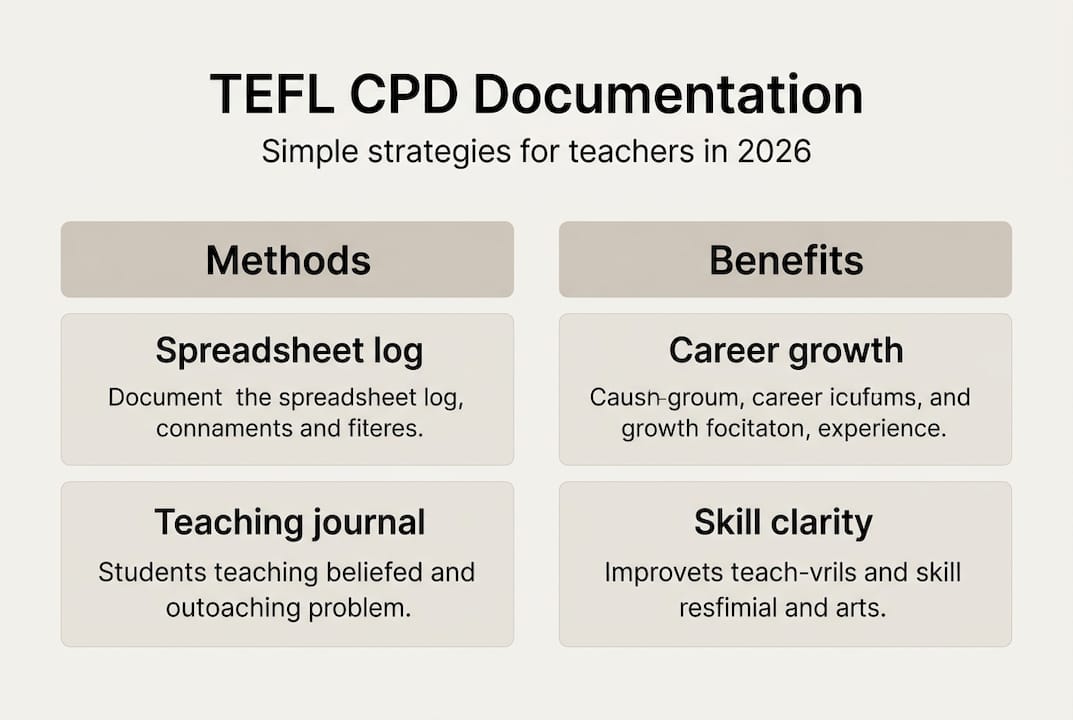
Reflective practice in CPD must be documented through logs and goal-setting. There is no universal points system in TEFL, but employer-valued records consistently include certificates, structured logs, and reflective entries. Reflective teaching also enhances the impact of explicit instruction more than implicit learning alone.
A functional CPD log should include:
- Date and duration of each CPD activity
- Type of activity (formal course, self-study, observation, workshop)
- Key learning points or skills developed
- How the activity connects to your current teaching context
- Planned next steps based on what you learned
Pro Tip: Use a simple spreadsheet or a dedicated app such as Notion or Google Sheets to maintain your CPD log. Update it within 24 hours of completing any activity. Delayed entries lose detail and reduce the reflective value of the record.
Common documentation pitfalls include failing to log informal self-study, writing vague entries without specific skill references, and neglecting to update the log regularly. These gaps make it harder to demonstrate sustained development to a prospective employer.
For part-time or online teachers, the absence of a formal institutional framework can make CPD feel optional. It is not. Improving teaching effectiveness through documented self-directed CPD is recognized by quality employers regardless of whether a formal credit system exists. Your log is your professional record.
Our perspective: What most TEFL guides miss about CPD
Most CPD guidance in TEFL focuses on accumulating certificates. That framing is understandable but ultimately limiting. A teacher with five certificates and no reflective practice is less prepared than a teacher with two certificates and a detailed, thoughtful development log.
The real driver of career advancement is not the volume of credentials but the depth of skill growth and the ability to demonstrate it. TEFL accreditation importance is real, but accreditation alone does not tell an employer how you have grown as a practitioner.
Job-embedded and reflective CPD is where meaningful change happens. Teachers who observe their own practice, analyze what works, and adjust accordingly develop faster and more durably than those who rely on external training events alone. Institutional support helps, but waiting for it is a strategic mistake. Self-driven, well-documented CPD consistently outperforms passive attendance at workshops.
The biggest career gaps we observe are not credential gaps. They are reflection gaps. Teachers who cannot articulate what they learned, how they applied it, and what changed in their classroom struggle to differentiate themselves. Those who can show that evidence stand out clearly.
Take the next step: Enhance your TEFL journey with premium CPD
Building a strong CPD record requires access to programs that are both rigorous and recognized. Accredited, flexible TEFL courses provide the structured development that employers value, while allowing you to continue teaching throughout your studies.
The TEFL Institute offers a range of options designed specifically for educators at different career stages. Whether you are looking for course extensions for advanced CPD to build on your existing certification, region-specific programs such as TEFL certification courses in Texas, or want to explore accredited TEFL courses across all levels, there is a structured pathway available. Investing in recognized, documented CPD now positions you for stronger opportunities in the year ahead.
Frequently asked questions
What counts as continuous professional development for TEFL?
Formal courses, workshops, reflective teaching logs, and practical classroom training all contribute to TEFL CPD. Self-study with documented outcomes is also recognized by most quality employers.
Is CPD required to keep my TEFL certification valid?
Most TEFL certificates do not officially expire, but employers value ongoing documented CPD for career advancement. Demonstrating continuous development strengthens your professional profile significantly.
Which CPD courses are most recognized for TEFL teachers?
Trinity CertPT, CELTA extensions, and British Council self-study CPD modules are widely respected across the TEFL industry. Accredited Level 5 diplomas also carry strong employer recognition.
How can I prove my TEFL CPD to employers?
Keep official certificates, a structured CPD log, and brief reflections on training outcomes. Documented and reflected CPD provides verifiable evidence of sustained professional development that employers can assess directly.
