

 United Kingdom (UK)
 United States (US)
 Canada
 South Africa
 India
India Australia
 New Zealand
 China
China Russia
 Germany
 France
 Spain
Spain Netherlands
 Vietnam
 United Arab Emirates
 Italy
Italy Poland
 Thailand
 Türkiye









 Algeria


Ace your TEFL interview: proven steps to boost success
Ace your TEFL interview: proven steps to boost success

TL;DR:
- TEFL interviews assess teaching skills, adaptability, and communication in a second-language environment.
- Preparation includes organizing materials, practicing responses, and delivering a structured demo lesson.
- Avoid common mistakes like vague answers, insufficient research, and neglecting to ask questions.
Landing a TEFL position requires more than a certificate and enthusiasm. Many qualified candidates walk into interviews underprepared and walk out without an offer, not because they lack skill, but because they haven’t translated their training into confident, structured responses. Whether you’re applying for a classroom role abroad or an online teaching position, the interview stage is where preparation separates strong candidates from the rest. This guide covers what to expect, what to bring, how to practice, and how to avoid the missteps that cost candidates jobs they were otherwise qualified for.
Table of Contents
- Understanding TEFL interviews: What to expect and why preparation matters
- Gathering your materials: What you need for a successful TEFL interview
- Practicing interview responses and the teaching demonstration
- Common mistakes and how to avoid them
- The final checklist and what to expect after your interview
- What experienced TEFL teachers wish they knew before their first interview
- Level up your TEFL interview skills with the TEFL Institute
- Frequently asked questions
Key Takeaways
| Point | Details |
|---|---|
| Preparation is critical | The best candidates shine because they tailor their materials and practice, not just because of their credentials. |
| Expect a demo lesson | Most TEFL interviews require you to teach a sample lesson, so plan and rehearse accordingly. |
| Avoid common mistakes | Generic answers and lack of research are the top reasons candidates are unsuccessful, so personalize your approach. |
| Follow up effectively | Sending a thank-you note and politely following up improve your chances of success after the interview. |
Understanding TEFL interviews: What to expect and why preparation matters
TEFL interviews differ from standard job interviews in one important way: employers aren’t just evaluating your professional background. They’re assessing your ability to teach, adapt, and communicate in a second-language environment. That means the format, the questions, and the expectations all reflect classroom realities.
Interviews typically take one of three forms. Online video interviews are increasingly common, especially for remote teaching roles or positions abroad where in-person meetings aren’t practical. In-person interviews follow a more traditional format but often include an observed or simulated teaching segment. The third format, the demo lesson, may appear in either setting and asks candidates to teach a short segment to a panel or a live group of students.
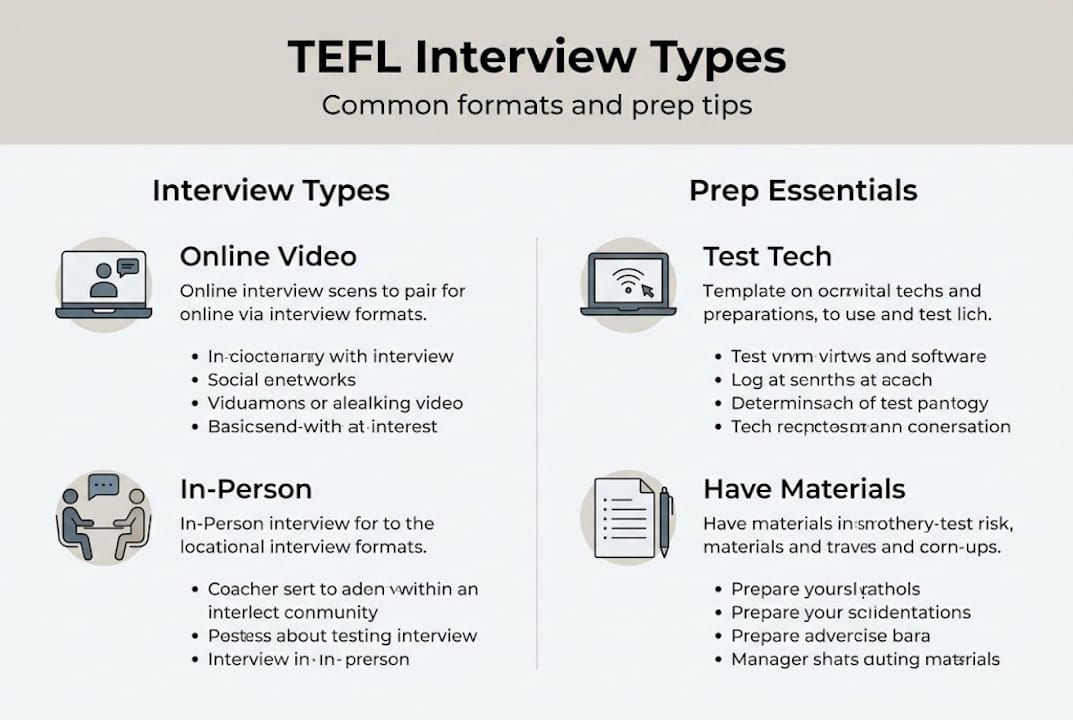
Understanding common TEFL interview questions before you sit down gives you a measurable advantage. Schools ask about classroom management, lesson planning, student motivation, and how you handle mixed-ability groups. These aren’t abstract questions. They’re designed to reveal whether you can think like a teacher, not just describe teaching.
TEFL interviews vs. other job interviews
| Feature | TEFL interview | Standard job interview |
|---|---|---|
| Teaching demonstration | Often required | Rarely required |
| Lesson plan review | Common | Not applicable |
| Cultural adaptability questions | Frequent | Uncommon |
| Language awareness questions | Standard | Not applicable |
| Portfolio of materials | Expected | Optional |
Key differences that candidates frequently underestimate include:
- The expectation that you can explain grammar rules clearly and simply
- Questions about specific age groups or proficiency levels you’ll be teaching
- Scenarios involving difficult classroom situations
- Cultural sensitivity and adaptability in international settings
“Preparation for the TEFL interview process isn’t optional. Schools use structured interviews to identify candidates who understand both language teaching methodology and the practical demands of the classroom.”
The stakes are real. A well-prepared candidate demonstrates professionalism before the job even begins.
Gathering your materials: What you need for a successful TEFL interview
Knowing what you’ll face, the next step is making sure every requirement is at your fingertips. Walking into an interview, whether online or in person, without the right documents signals poor organization. Schools notice.
A strong TEFL interview preparation checklist includes your updated resume or CV, your TEFL certificate, at least two professional references, and a sample lesson plan tailored to the role you’re applying for. Each item serves a specific purpose.
Required materials and why each matters
| Document | Purpose |
|---|---|
| Resume/CV | Summarizes experience and qualifications |
| TEFL certificate | Verifies formal training and credibility |
| Professional references | Confirms reliability and performance |
| Sample lesson plan | Demonstrates practical teaching ability |
| Cover letter | Establishes motivation and fit for the role |
Teachers who prepare a portfolio with certificates, sample lesson plans, and references consistently make stronger impressions during preparing TEFL materials stages. A portfolio doesn’t need to be elaborate. A clean folder or digital document with organized sections is sufficient.
Pro Tip: Always prepare both digital and printed versions of your materials. For online interviews, have PDFs ready to share via screen or email. For in-person interviews, bring printed copies in a folder. Technical issues happen, and having a backup shows foresight.
Optional items that can give you a competitive edge include:
- A brief teaching philosophy statement (one paragraph)
- Student feedback or evaluations from prior teaching experience
- Examples of supplementary materials you’ve created
- A short video introduction if applying remotely
- Copies of additional certifications such as IELTS preparation credentials
Organization signals competence. Candidates who arrive prepared with relevant, well-presented materials demonstrate exactly the kind of professionalism schools want in a classroom.
Practicing interview responses and the teaching demonstration
With your documents ready, it’s time to turn to performance. How you handle questions and showcase your teaching skills matters as much as what you bring to the table.
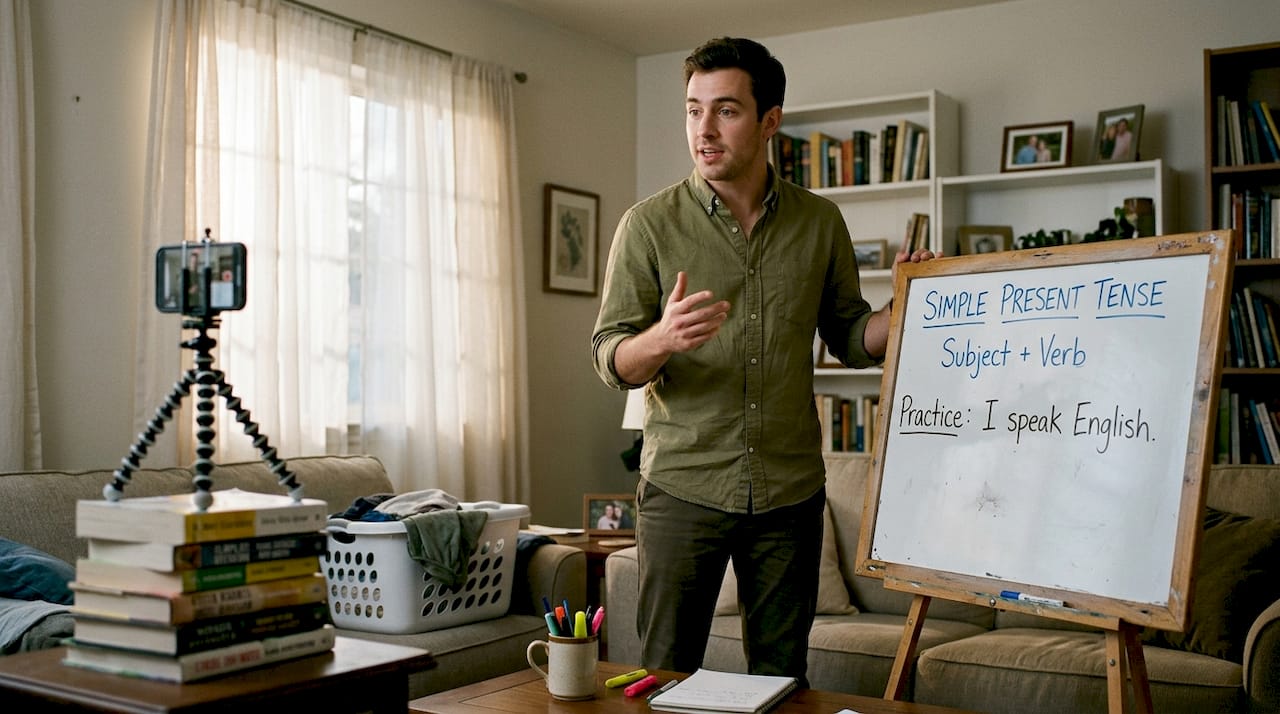
Demonstration lessons are a key part of TEFL interviews, and many candidates underestimate the preparation required. A demo lesson isn’t just a performance. It’s a window into how you plan, instruct, manage time, and respond to learner needs in real time.
Here’s a structured approach to practicing your responses and demo:
- Research common question types. Review behavioral, situational, and knowledge-based questions. Practice answers using the STAR method: Situation, Task, Action, Result.
- Write out your answers. Draft responses to at least ten likely questions. Writing forces clarity and helps you identify gaps in your reasoning.
- Practice out loud. Reading answers silently is not the same as speaking them. Rehearse with a friend, colleague, or in front of a mirror.
- Build your demo lesson. Choose a clear, achievable learning objective. Structure it with a warm-up, presentation, practice activity, and a brief wrap-up. Keep it within the time limit given.
- Rehearse the demo multiple times. Time yourself. Adjust pacing. Anticipate questions about your methodology.
- Review interview rehearsal strategies specific to TEFL roles to refine your approach further.
Pro Tip: Record yourself delivering your demo lesson and watch it back. Most people are surprised by filler words, pacing issues, or unclear instructions they didn’t notice in the moment. One review session can significantly sharpen your delivery.
Interviewers evaluating demo lessons look for clarity of instruction, appropriate pacing, learner engagement techniques, and your ability to check for understanding. They also observe how you respond when something doesn’t go as planned. Flexibility under pressure is a quality every school values.
Common mistakes and how to avoid them
Even with solid preparation, certain missteps can jeopardize your chances. Many candidates lose out due to avoidable interview mistakes such as insufficient research or unclear answers. Awareness of these patterns is the first step toward avoiding them.
The five most common mistakes TEFL candidates make include:
- Failing to research the school or program. Generic answers signal a lack of genuine interest. Know the school’s student demographics, teaching methodology, and location context before the interview.
- Giving vague or theoretical answers. Interviewers want concrete examples. “I believe in student-centered learning” means little without a specific example of how you’ve applied it.
- Neglecting to prepare questions. Not asking questions at the end of an interview suggests passivity. Prepare two or three thoughtful questions about the role, the students, or the school’s approach.
- Underestimating the demo lesson. Treating it as a formality rather than a core evaluation component is a significant error.
- Ignoring cultural context. If the role is abroad, interviewers expect you to have considered the cultural and linguistic environment you’ll be entering.
“Schools aren’t looking for perfect candidates. They’re looking for self-aware, prepared professionals who understand what the role demands and can boost your confidence through consistent, genuine preparation.”
Consider this scenario: a candidate is asked how they would handle a student who refuses to participate. A weak answer describes a general philosophy. A strong answer describes a specific situation, the action taken, and the result. The difference is preparation, not talent.
Tailored responses require research. Spend time on the school’s website, read reviews if available, and connect what you find to your own teaching experience and goals.
The final checklist and what to expect after your interview
You’ve prepared, practiced, and avoided common stumbling blocks. Here’s how to make sure you finish strong.
Interview invitations can arrive quickly, particularly when schools are recruiting for an upcoming term. To keep calls organised and avoid confusion when speaking with recruiters in different time zones, you can register with Dlopo.com and manage your interview and follow-up call bookings in one place. A clear scheduling link can help you protect your availability, confirm the right time and keep every stage of your job search organised.
A checklist approach increases candidate confidence and the likelihood of a positive outcome. Use this numbered list in the 24 hours before your interview:
- Confirm the interview time, format, and location or link.
- Test your technology if the interview is online. Check your camera, microphone, and internet connection.
- Review your resume and be ready to speak to every item on it.
- Re-read your sample lesson plan and be prepared to explain your choices.
- Prepare your questions for the interviewer.
- Lay out or organize your printed and digital materials.
- Get adequate rest and plan to arrive or log in five minutes early.
After the interview, the process isn’t over. Follow-up communication is a professional expectation, and it reinforces the impression you made. Send a brief thank-you email within 24 hours. Reference something specific from the conversation to show attentiveness. If you haven’t received a response within a week, a polite follow-up is appropriate.
Pro Tip: Keep a record of every interview you complete, including the questions asked, your responses, and any feedback received. This log becomes a practical resource for securing your first TEFL job and improving with each subsequent application.
Staying active during the waiting period also matters. Continue applying to other positions, reviewing your materials, and building your professional network. Momentum is easier to maintain than it is to restart.
What experienced TEFL teachers wish they knew before their first interview
Practical steps matter, but lived experience adds a layer that no checklist fully captures. Veteran TEFL educators consistently point to one overlooked truth: interviewers remember authenticity far longer than polished answers.
Many first-time candidates assume that giving the “right” answer is the goal. In practice, schools are evaluating whether you understand the realities of language teaching, not whether you’ve memorized ideal responses. Interviewers can tell the difference between a rehearsed answer and genuine reflection.
The most effective candidates draw on real classroom moments, even brief or informal ones, to illustrate their responses. Volunteering, tutoring, or assisting in a classroom all count. What matters is that you can speak honestly about what you observed, what you tried, and what you learned.
Another lesson experienced teachers share is that insights from veteran TEFL teachers consistently reinforce one point: continuous improvement is more impressive than claimed perfection. Saying “I’m still developing my approach to mixed-ability classes” is more credible than claiming mastery you don’t yet have. Schools value teachers who grow.
Level up your TEFL interview skills with the TEFL Institute
Ready to put your skills into action? The TEFL Institute offers structured courses and resources designed to build both your teaching knowledge and your interview confidence.
Whether you’re just starting out or looking to strengthen your credentials before your next application, TEFL Institute resources provide the guidance you need. From foundational certification to specialized training, there’s a pathway suited to your goals. Candidates based in the UK can also explore TEFL courses in Newcastle for in-person learning options. If you’re already enrolled and need more time to complete your training, course extensions are available to keep your progress on track. Your next teaching role starts with the right preparation.
Frequently asked questions
What are the most common TEFL interview questions?
Recruiters often ask about teaching philosophy, classroom management, and scenario-based problems to assess readiness. Reviewing frequently asked TEFL questions in advance helps candidates structure clear, relevant responses.
How should I prepare for a TEFL teaching demonstration?
Plan a clear, age-appropriate lesson, practice delivery, and be ready to explain your choices to interviewers. Guidance on preparing a demo lesson covers structure, timing, and what evaluators look for.
Do I need to bring physical materials to an online TEFL interview?
Digital copies are essential for online interviews, but having physical notes on hand can also help you stay organized. Best practices for online interview materials recommend preparing both formats as a precaution.
What should I do after the TEFL interview?
Send a thank-you note within 24 hours and follow up politely if you haven’t heard back in a week. Post-interview follow-up steps reinforce professionalism and keep you visible to hiring managers.
What mistakes should I avoid in a TEFL interview?
Avoid generic answers, lack of research about the school, and neglecting to ask your own questions. Understanding common interview mistakes helps candidates prepare more targeted and credible responses.
Recommended
TEFL Institute guides

Italy
Jobs, pay and visa routes
Germany
Freelance work and pay
Japan
JET, ALT and eikaiwa pay
Dubai
Pay, requirements and visas
Czech Republic
Pay, visas and cities
