

 United Kingdom (UK)
 United States (US)
 Canada
 South Africa
 India
India Australia
 New Zealand
 China
China Russia
 Germany
 France
 Spain
Spain Netherlands
 Vietnam
 United Arab Emirates
 Italy
Italy Poland
 Thailand
 Türkiye









 Algeria


TEFL interview tips to boost confidence in 2026
TEFL interview tips to boost confidence in 2026

Preparing for a TEFL interview can feel overwhelming, especially when you’re uncertain about what interviewers expect. Many aspiring teachers worry about presenting their skills effectively, managing interview nerves, and standing out in a competitive field. The good news is that structured preparation strategies can transform your anxiety into confidence. This guide delivers practical, evidence-backed TEFL interview preparation tips for 2026 to help you perform at your best and secure the teaching position you want.
Table of Contents
- Understanding The Unique Demands Of TEFL Interviews
- How To Use The STAR Method For Effective TEFL Interview Answers
- Practical Techniques To Reduce Interview Anxiety And Present Confidently
- Addressing Accent Concerns And Showcasing Cultural Empathy In TEFL Interviews
- Ready To Boost Your TEFL Career With Expert Training?
Key takeaways
| Point | Details |
|---|---|
| Use the STAR method | Structure clear, compelling answers by outlining Situation, Task, Action, and Result for each response. |
| Prepare your elevator pitch | Develop a 30-second summary that succinctly presents your teaching skills and motivation. |
| Practice anxiety reduction | Apply deep breathing and positive self-talk techniques to stay calm and focused during interviews. |
| Demonstrate key competencies | Be ready to showcase classroom management strategies and cultural sensitivity with specific examples. |
| Address accent concerns positively | Highlight how your linguistic background enriches student learning and builds empathy. |
Understanding the unique demands of TEFL interviews
ESL teacher interviews assess competencies beyond standard teaching credentials, including classroom management and cultural competency. Unlike traditional teaching interviews that focus primarily on subject knowledge and lesson planning, TEFL interviews evaluate your ability to navigate diverse classroom environments and connect with students from varied cultural backgrounds. Interviewers want to see how you handle real world teaching challenges in international settings.
Competency questions often test your classroom management strategies, asking you to describe specific situations where you maintained order or engaged reluctant learners. Cultural competence is critical, reflecting your ability to engage diverse learners and adapt teaching methods to different learning styles and cultural norms. Preparing for these unique demands helps you tailor your interview answers to what schools actually prioritize.
Understanding these expectations reduces surprises and builds confidence. When you know interviewers will ask about handling mixed-level classes or addressing cultural misunderstandings, you can prepare targeted examples. Consider these key competency areas TEFL interviewers commonly explore:
- Teaching methodology and adaptability to different learning environments
- Classroom management techniques for maintaining productive learning spaces
- Cultural sensitivity and ability to work with international students
- Problem solving skills when facing unexpected classroom challenges
- Communication strategies for making complex concepts accessible
How to use the STAR method for effective TEFL interview answers
The STAR method is a proven framework for structuring interview responses, leading to clearer and more impactful answers. STAR stands for Situation, Task, Action, and Result. This approach helps you organize your thoughts and deliver focused responses that demonstrate your teaching competencies convincingly.
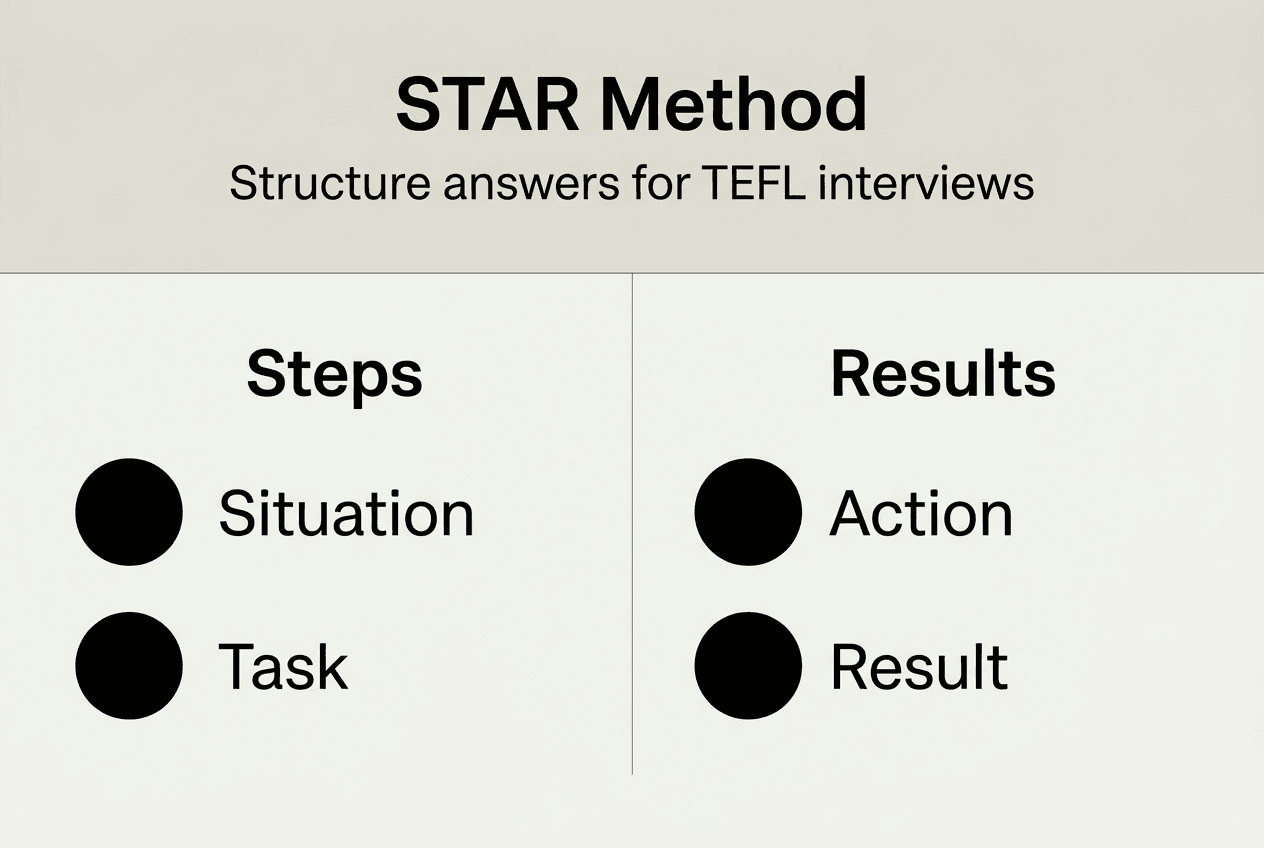
Start by identifying the Situation: describe the context or challenge you faced in a specific teaching scenario. Next, explain the Task: what was your responsibility or goal in that situation? Then detail your Action: what specific steps did you take to address the challenge? Finally, share the Result: what positive outcome did your actions produce?
Prepare specific teaching or classroom examples illustrating your skills before the interview. Review your TEFL interview preparation guide and identify 5-7 experiences that showcase different competencies. Structure answers to highlight problem solving and positive outcomes, making your expertise tangible and memorable.
| STAR Element | Example Response Component |
|---|---|
| Situation | “In my practicum, I taught a mixed-level adult class with students ranging from beginner to intermediate.” |
| Task | “I needed to keep all students engaged without boring advanced learners or overwhelming beginners.” |
| Action | “I implemented differentiated activities with tiered tasks and peer teaching opportunities.” |
| Result | “Student engagement increased 40%, and post-class surveys showed 95% satisfaction across all levels.” |
Use the STAR method to address classroom management and cultural sensitivity questions effectively. When asked about handling disruptive behavior, walk through a specific incident using this framework. Practice delivering STAR responses to sound confident and organized, but avoid memorizing word-for-word scripts that sound robotic.
Pro Tip: Keep a STAR response journal where you write out 2-3 examples for each major competency area, then practice delivering them conversationally until the structure feels natural.
Practical techniques to reduce interview anxiety and present confidently
Even well-prepared candidates experience interview nerves. Deep breathing exercises and positive self-talk can significantly reduce interview anxiety and help you access your knowledge under pressure. Practice controlled deep breathing before and during the interview to stay calm. Try the 4-7-8 technique: inhale for 4 counts, hold for 7, exhale for 8.

Use positive affirmations to boost self-confidence and reduce negative thoughts. Replace “I might mess this up” with “I’m prepared and qualified for this role.” Your internal dialogue shapes your external performance. Craft a 30-second elevator pitch summarizing your skills and motivation efficiently. This concise introduction helps you start strong and sets a confident tone.
Your elevator pitch should include:
- Your relevant teaching experience or TEFL certification
- 1-2 specific strengths that match the role requirements
- Your motivation for teaching English in that specific context
- A unique value proposition that differentiates you from other candidates
Rehearse your pitch and answers to sound natural and convincing. Record yourself practicing preparing for TEFL interview responses, then review for filler words, pace, and clarity. View the interview as a two-way conversation to reduce pressure. You’re evaluating whether the school fits your goals just as much as they’re assessing your fit for the role.
Consider applying stress coping techniques from workplace psychology to interview preparation. Visualization exercises where you imagine yourself succeeding can improve actual performance. Physical preparation matters too: get adequate sleep the night before, eat a balanced meal, and arrive early to reduce time pressure stress.
Pro Tip: Create a pre-interview ritual that calms you, whether it’s listening to energizing music, reviewing your accomplishments list, or doing light stretches to release physical tension.
Addressing accent concerns and showcasing cultural empathy in TEFL interviews
Many non-native English speaking teachers worry about accent-related questions during interviews. Recognize that many schools value diverse English accents and global perspectives. Students benefit from exposure to different English varieties, which better prepares them for real-world communication. Prepare a brief response highlighting strengths from your accent and ESL background.
As one successful teacher noted, “My students actually benefit from hearing different English varieties, and my experience learning English as a second language helps me understand their challenges firsthand.” This reframing transforms a potential weakness into a compelling strength. Emphasize empathy with learners’ challenges based on your own language learning journey.
Connect cultural sensitivity examples to classroom management skills. Your multicultural background gives you unique insights into navigating cross-cultural communication challenges. Show confidence turning potential concerns into unique advantages by preparing specific examples of how your background enhanced your teaching effectiveness.
Consider these strategies for addressing accent questions:
- Acknowledge your accent matter-of-factly without apologizing
- Highlight how exposure to varied accents benefits student listening comprehension
- Share a specific example where your language learning experience helped you explain a difficult concept
- Emphasize your clear enunciation and communication skills
- Reference any accent reduction or pronunciation training you’ve completed
Frame your linguistic diversity as an asset that enriches the learning environment. Schools seeking culturally responsive teachers appreciate candidates who bring authentic international perspectives. Your unique background positions you to connect with students navigating similar language learning challenges, creating powerful mentorship opportunities.
Ready to boost your TEFL career with expert training?
You’ve learned proven strategies to prepare effectively and perform confidently in TEFL interviews. Taking the next step in your teaching career means backing your interview skills with recognized credentials that schools trust.
Boost your interview readiness and teaching skills with accredited TEFL certification courses in Texas that provide comprehensive preparation for real classroom scenarios. Explore flexible course extensions to customize your certification and develop specialized expertise in areas like young learner teaching or business English. Gain credentials that enhance your job prospects abroad and online, positioning you as a competitive candidate in the global TEFL market. Join thousands of successful graduates advancing their TEFL careers with internationally recognized qualifications.
FAQ
What are common TEFL interview questions?
Typical questions cover classroom management scenarios, your teaching philosophy, and how you handle cultural adaptability challenges. Interviewers frequently ask you to describe specific situations using the STAR method, such as managing disruptive students or adapting lessons for mixed-level classes. Review common TEFL interview questions to prepare targeted responses.
How can I effectively prepare for a TEFL interview?
Research the specific school and role thoroughly, then practice STAR responses for common competency questions. Develop a concise elevator pitch that communicates your value in 30 seconds. Use relaxation techniques like deep breathing to reduce anxiety before the interview. Check out strategies for preparing for TEFL interviews to build a comprehensive preparation plan.
What if I have a strong accent as a non-native English speaker?
Highlight how your accent enriches students’ exposure to English varieties and prepares them for global communication. Emphasize the empathy you bring due to your own language learning experience, which helps you understand student challenges firsthand. Learn more about addressing accent concerns and turning them into teaching strengths.
How long should I prepare before a TEFL interview?
Allocate at least one week for thorough preparation, including researching the school, developing STAR responses, and practicing your delivery. Spend 30-60 minutes daily rehearsing answers and refining your elevator pitch. More preparation time builds confidence and helps you internalize examples so they sound natural rather than memorized.
Recommended
TEFL Institute guides

Vietnam
Work permits and requirements
South Korea
EPIK, hagwons and pay
Estonia
Jobs, pay and work routes
Czech Republic
Pay, visas and cities
Taiwan
Buxibans, pay and visas