
 United Kingdom (UK)
 United States (US)
 Canada
 South Africa
 India
India Australia
 New Zealand
 China
China Russia
 Germany
 France
 Spain
Spain Netherlands
 Vietnam
 United Arab Emirates
 Italy
Italy Poland
 Thailand
 Türkiye








 Algeria



Hybrid TEFL: Complete Guide to Flexible Certification
Hybrid TEFL: Complete Guide to Flexible Certification

Over 1.5 billion people worldwide are learning English, creating a steady global demand for qualified teachers. Many aspiring educators face barriers like time constraints or lack of practical experience. Hybrid TEFL certification is changing this. By blending interactive online study with real teaching practice, these programs deliver both flexibility and essential hands-on skills, making international teaching careers more achievable than ever.
Table of Contents
- What Is Hybrid TEFL Certification?
- Key Features Of Hybrid TEFL Programs
- Comparing Online, In-Person, And Hybrid TEFL
- Prerequisites And Who Benefits Most
- Common Pitfalls And How To Avoid Them
Key Takeaways
| Point | Details |
|---|---|
| Hybrid TEFL Certification | Combines online learning with supervised in-person teaching to provide a flexible and modern approach to educator training. |
| Key Features | Includes comprehensive online modules, live training sessions, at least 5 hours of teaching practice, and job placement support. |
| Accessibility | Ideal for career changers, recent graduates, and professionals seeking flexible education that accommodates work commitments. |
| Success Strategies | Plan effectively, engage actively in all learning components, and utilize networking opportunities to enhance professional growth. |
What Is Hybrid TEFL Certification?
A hybrid TEFL certification represents an innovative approach to language teacher training that blends online learning with practical classroom experience. According to schooloftefl, these programs combine online study with in-person training, offering unprecedented flexibility for aspiring English language educators.
The core structure of hybrid TEFL certification comprises two primary components: digital theoretical instruction and practical teaching experience. As tefl.ie explains, these blended courses provide tutor-led instruction through self-study modules, while ensuring learners receive observed teaching practice under the supervision of a qualified instructor.
Key features of hybrid TEFL certification typically include:
- Comprehensive online theoretical modules
- Structured virtual classroom management training
- Supervised in-person teaching practicums
- Flexible learning schedules
- Professional instructor feedback
- Internationally recognized qualification
This innovative certification model allows students to balance their existing commitments with professional development, making advanced teaching credentials more accessible than traditional full-time programs. By integrating digital learning platforms with hands-on teaching experiences, hybrid TEFL courses prepare educators with a dynamic, contemporary approach to language instruction.
Key Features of Hybrid TEFL Programs
Hybrid TEFL programs provide a comprehensive approach to language teacher certification that surpasses traditional training methods. According to the School of TESOL, these innovative programs provide accredited certification with a critical component of real teaching practice, ensuring aspiring educators gain at least 5 hours of direct classroom experience.
The structure of these programs is uniquely designed to balance theoretical knowledge with practical application. Entrusttefl highlights that these courses typically include live teacher training sessions and self-paced online modules, creating a flexible learning environment that accommodates diverse student needs.
Key characteristics of hybrid TEFL programs include:
- Comprehensive online theoretical modules
- Interactive live training sessions
- Minimum 5 hours supervised teaching practice
- Job placement support during and after course completion
- Flexible learning schedules
- Industry-recognized certification
By integrating digital learning platforms with hands-on teaching experiences, hybrid TEFL programs provide a robust pathway for individuals seeking to launch or advance their international teaching careers.
 These programs recognize that effective language instruction requires both solid theoretical understanding and practical classroom skills, making them an ideal choice for aspiring educators looking for a modern, comprehensive certification approach.
For those interested in a more in-depth training experience, our 310 Hour Level 5 Hybrid TEFL Course offers an extensive program designed to prepare you for international teaching opportunities thoroughly.
Comparing Online, In-Person, and Hybrid TEFL
The landscape of TEFL certification has undergone significant evolution, providing aspiring teachers with multiple pathways to professional qualification. According to Englishatvantage, hybrid TEFL courses offer a flexible alternative for individuals who are unable to commit to full-time, in-person training, thereby bridging the gap between traditional and digital learning approaches.
tefl.ie highlights that virtual and hybrid TEFL courses combine comprehensive online learning with essential teaching practice, creating a robust educational experience. This approach addresses the diverse needs of modern educators who require adaptable training options.
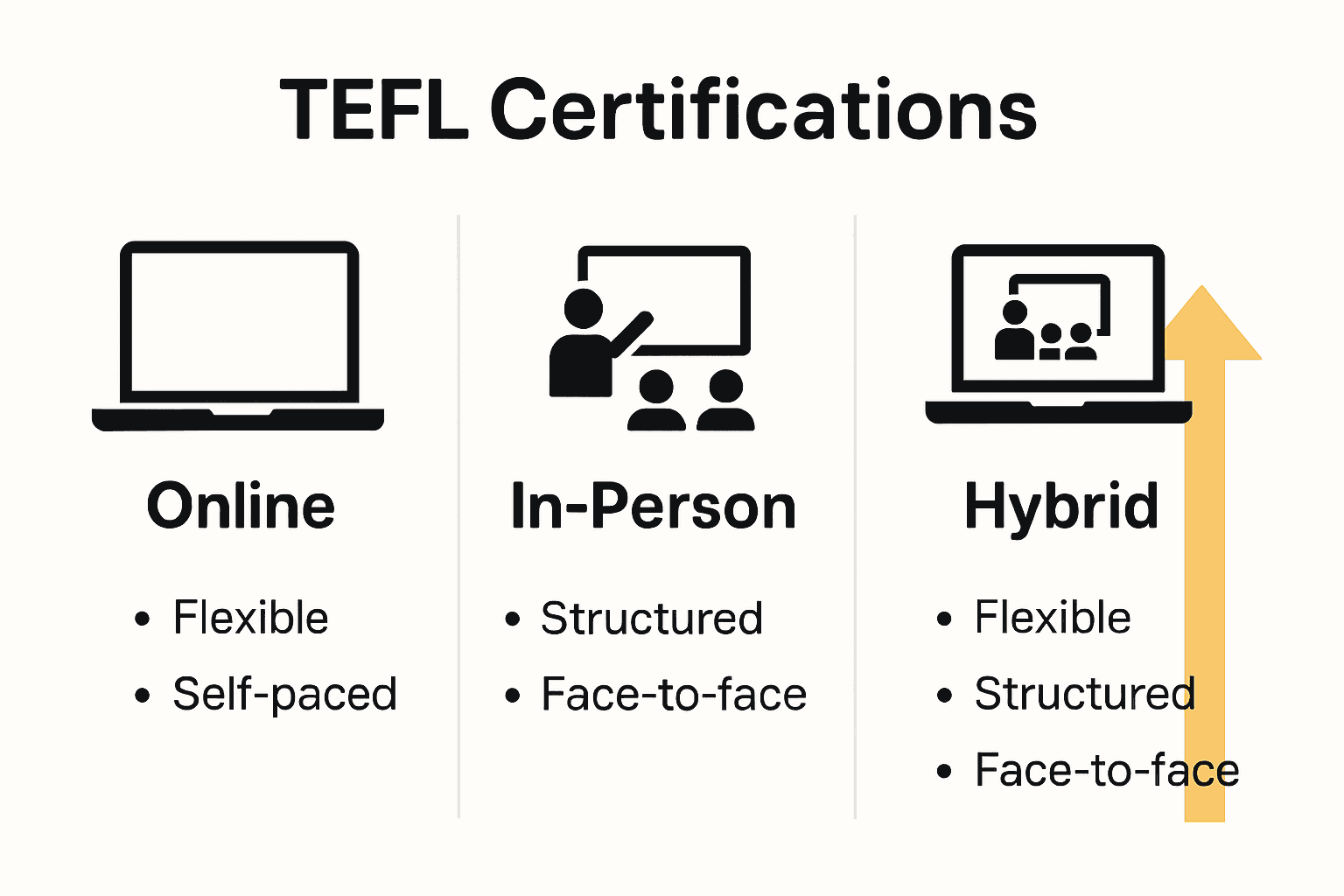
Key differences between TEFL certification types include:
Here’s a comparison of the main types of TEFL certification programs:
| Feature | Online TEFL | In-Person TEFL | Hybrid TEFL |
|---|---|---|---|
| Learning Format | Fully online modules | Classroom only | Online & in-person blend |
| Flexibility | Maximum | Least | Moderate |
| Practical Teaching Experience | Minimal/simulated | Extensive | Minimum 5+ hours required |
| Cost | Lower | Higher | Moderate |
| Instructor Feedback | Virtual only | Face-to-face | Both methods combined |
| Schedule Structure | Self-paced | Fixed/structured | Flexible with live elements |
| International Recognition | Yes | Yes | Yes |
Online TEFL Certification
- Fully digital curriculum
- Maximum flexibility
- Lower cost
- Limited practical teaching experience
In-Person TEFL Certification
- Traditional classroom learning
- Immediate face-to-face interaction
- Structured daily schedule
- Extensive hands-on teaching practice
Hybrid TEFL Certification
- Blended learning approach
- Combines online modules with practical teaching
- Moderate cost
- Balanced theoretical and practical training
For educators seeking a comprehensive understanding of these certification options, our guide on online vs offline TEFL diplomas provides deeper insights into selecting the most appropriate training path for your professional goals.
Prerequisites and Who Benefits Most
TEFL certification requires specific prerequisites that vary across different program formats. According to Language International, the core requirement is being a native English speaker or possessing an advanced English proficiency level (C2), which ensures candidates can effectively teach English as a second language.
lu.lv provides additional insights into admission requirements, highlighting the need for a minimum TOEFL iBT score of 78 or an equivalent language proficiency certification. These standardized benchmarks help maintain the quality of potential English language instructors.
Who benefits most from hybrid TEFL programs?
- Career Changers: Professionals seeking flexible training while maintaining current jobs
- Recent Graduates: Those wanting comprehensive teaching credentials without a full-time commitment
- International Travel Enthusiasts: Individuals looking to combine professional development with global exploration
- Part-Time Students: People needing adaptable learning schedules
- Working Professionals: Those seeking additional qualifications without disrupting current employment
Hybrid TEFL programs offer a unique solution for diverse learners, providing comprehensive training that balances theoretical knowledge with practical teaching experience. These flexible certification paths accommodate various personal and professional circumstances, making international teaching opportunities more accessible than ever before.
Common Pitfalls and How to Avoid Them
Navigating a hybrid TEFL certification requires strategic planning and awareness of potential challenges. Destination Tefl emphasises the critical importance of completing the online portion thoroughly before transitioning to in-person training, ensuring a smooth and comprehensive learning experience.
Maximonivel recommends engaging in continuous coaching and actively utilising job placement assistance to navigate the complexities of TEFL certification effectively. Understanding and preparing for common obstacles can significantly enhance your learning journey and professional prospects.
Common Pitfalls to Watch For:
- Procrastination: Falling behind in online modules
- Lack of Preparation: Insufficient practice for in-person teaching
- Time Management: Struggling to balance course requirements
- Inadequate Research: Not understanding the local teaching market
- Networking Challenges: Limited professional connections
Strategies for Success:
- Create a structured study schedule
- Participate actively in all course components
- Seek regular feedback from instructors
- Connect with fellow TEFL students
- Develop a proactive approach to job searching
The key to overcoming challenges in hybrid TEFL programs lies in preparation, commitment, and a willingness to adapt. By anticipating potential obstacles and developing robust strategies, you can transform these challenges into opportunities for professional growth and international teaching success.
Unlock Your Teaching Career with Flexible Hybrid TEFL Certification
If you are facing the challenge of balancing work and study while pursuing a comprehensive TEFL qualification, the hybrid TEFL certification model offers the perfect solution. This approach combines flexible online theoretical modules with valuable in-person teaching practicums, addressing common obstacles such as time management and a lack of practical experience. Whether you are a career changer, recent graduate, or working professional, hybrid TEFL programs help you gain the skills and confidence needed for international teaching success.
Start your journey today by exploring TEFL Institute’s extensive catalogue, including advanced diplomas and hybrid programs with practicum components. Our courses provide industry-recognised certification with structured tutor support, designed to help you avoid common pitfalls and maximise your career potential. Don’t wait to transform your passion for teaching into global opportunities. Visit TEFL Institute now and find the perfect course to fit your professional goals and busy lifestyle.
Frequently Asked Questions
What is a hybrid TEFL certification?
Hybrid TEFL certification combines online learning with in-person teaching practice, offering a flexible way for aspiring English language educators to gain a qualification.
What are the main components of a hybrid TEFL program?
Hybrid TEFL programs typically include comprehensive online theoretical modules, live training sessions, and a minimum of 5 hours of supervised teaching practice.
How does hybrid TEFL certification compare to online and in-person certifications?
Hybrid TEFL certification offers a blend of online and face-to-face learning, providing more flexibility than in-person training while offering more practical experience than fully online courses.
Who can benefit from a hybrid TEFL program?
Individuals seeking flexible training options include career changers, recent graduates, international travel enthusiasts, part-time students, and working professionals looking to acquire additional qualifications.
Recommended
- 180 Hour Level 5 TEFL Diploma | Ofqual Regulated | USA
- 300 Hour Regulated Level 5 Advanced TEFL Diploma
- What is TEFL – Get TEFL Certified – TEFL Institute
- A TEFL School Elective – Interview with our Schools
- TESOL, TEFL, CELTA, DELTA, TESL – How Are They Different? – EBC Trinity CertTESOL and TEFL courses
- Face-to-face and online teaching: Get certified for both – EBC Trinity CertTESOL and TEFL courses