
 United Kingdom (UK)
 United States (US)
 Canada
 South Africa
 India
India Australia
 New Zealand
 China
China Russia
 Germany
 France
 Spain
Spain Netherlands
 Vietnam
 United Arab Emirates
 Italy
Italy Poland
 Thailand
 Türkiye









 Algeria



No. Ofqual Level 5 is a UK regulatory standard for TEFL diplomas aimed at teaching English as a foreign language, usually abroad or online. It has no connection to US state teacher certification and does not qualify anyone to teach in an American public school.
What Ofqual Level 5 Means for American TEFL Teachers
Ofqual Level 5 is a UK government quality benchmark, not a US credential, and for American TEFL teachers it signals that a 168 to 180 hour TEFL diploma has been independently checked for depth and rigor by England’s qualifications regulator, which most employers treat as the strongest paper-trail a TEFL certificate can carry.
- Ofqual regulates qualifications in England the way a state board of education regulates a US high school diploma, except the register is public and searchable by anyone
- A Level 5 TEFL Diploma sits above the standard 120-hour TEFL certificate in the UK’s National Qualifications Framework, roughly comparable in depth to the first year of a US bachelor’s degree
- Americans do not need a UK-recognized qualification to teach English abroad, but Ofqual regulation gives schools and visa officers a fast, independent way to verify your course actually happened
- Verification takes under five minutes on the UK government’s public register using the exact awarding body name printed on your certificate
- Not every Level 5 course marketed to Americans is actually Ofqual-regulated, so checking the register yourself before enrolling matters more than trusting a provider’s homepage
Anyone comparing ofqual level 5 tefl courses against ordinary TEFL certificates eventually runs into the same confusion: Ofqual is a British regulator, so why does it matter to an American who has never lived in the UK and has no plans to? The answer has nothing to do with British bureaucracy and everything to do with verification. Ofqual regulation means a government body, not a marketing team, has checked the course content, the assessment methods and the hours claimed, and put the result on a public register anyone can search. For an American applying to a language school in Vietnam, Spain or South Korea, that public paper trail can be the difference between an application that clears in a week and one that stalls for a month while HR tries to confirm your certificate is real.
What does Ofqual actually regulate?
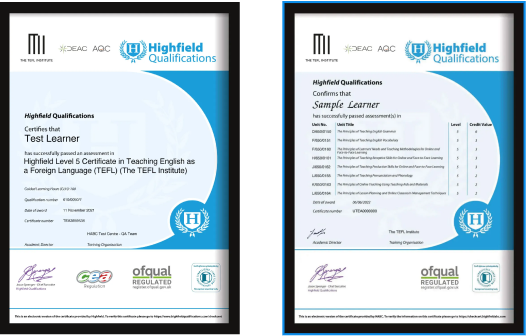
Ofqual is the Office of Qualifications and Examinations Regulation, the UK government body responsible for making sure qualifications offered in England meet a consistent, checkable standard, similar in spirit to how US regional accreditors like Middle States or WASC vouch for the academic quality of American colleges. Ofqual does not write TEFL courses itself. Instead, it approves awarding organizations, the actual bodies that design, assess and certify the qualification, and holds them to fixed standards for content, assessment integrity and quality assurance. When a TEFL Diploma appears on the UK government’s regulated qualifications register, it means an Ofqual-approved awarding organization has staked its own accreditation on that specific course meeting the stated level and credit value.
 This matters because the “TEFL certification” industry has no single global gatekeeper. Anyone can print a certificate that says “TEFL Diploma” on it. Ofqual regulation is one of the few mechanisms that puts a government-level check between a provider’s marketing claims and the qualification a student actually receives.
An Ofqual Level 5 TEFL Diploma is checked and registered in the same way as a framed academic diploma, but through a UK government body rather than a US accreditor.
Level 5 is a specific rung on England’s Regulated Qualifications Framework (RQF), which ranks qualifications by difficulty and depth from Level 1 (roughly GCSE-equivalent) up through Level 8 (doctoral). Level 5 sits above a standard undergraduate first-year and is often compared to a US associate degree or the midpoint of a bachelor’s program in terms of cognitive demand, though the comparison is approximate, as the two systems measure different things. For TEFL specifically, a Level 5 Diploma typically means 168 to 180 hours of coursework covering grammar instruction, lesson planning, classroom management, assessment design, and often a practicum component, well beyond the 120-hour baseline most schools require as a minimum.
The number itself is not marketing. It reflects a specific credit value and learning-outcome standard that the awarding organization had to document and defend to Ofqual before the course could carry the label. A provider cannot simply decide its course is “Level 5” the way it might decide to call a course “advanced” or “premium.”
Why does a British regulator matter for an American teacher?
The honest answer is that it matters less for legal requirements and more for practical trust. Almost no country requires a specifically Ofqual-regulated qualification to issue a work visa for English teaching; most visa rules just specify a TEFL certificate of a minimum hour count, sometimes alongside a bachelor’s degree. Where Ofqual regulation earns its keep is in the verification step that follows. A school administrator or visa officer who is unfamiliar with the sprawling and unregulated global TEFL market can look up an Ofqual-regulated qualification on a government register in the time it takes to check a boarding pass. That is a meaningfully different experience from trying to verify a certificate from a provider with no independent oversight, where the only proof available is the provider’s own word.
as of 2026, here is roughly how Ofqual Level 5 recognition compares with the other common credential types Americans encounter when TEFL shopping:
| Credential type | Typical hours | Independent verification | Best fit |
|---|---|---|---|
| Ofqual Level 5 Diploma | 168-180 hours | Public UK government register | Competitive markets, career changers, visa-sensitive countries |
| Standard accredited TEFL | 120 hours | Provider’s named accreditor, checkable but not government-run | Most entry-level teaching abroad and online roles |
| Short specialization course | 20-40 hours | Varies by provider | Add-on to an existing base certificate, not a standalone credential |
| Unregulated or “instant” certificate | Unverifiable | None | Not recommended for any serious application |
How do you check whether a course is genuinely Ofqual-regulated?
Search the regulated qualifications register using the exact awarding organization name shown on the certificate, not the marketing name of the course itself, since these are frequently different. A genuine listing shows the qualification title, its RQF level, total credit value and the awarding organization responsible for it. If a provider markets a course as “Ofqual Level 5” but the register search turns up nothing under the awarding body they name, or the listed level does not match what is advertised, that is a legitimate reason to ask direct questions before paying. This single check takes less time than reading a provider’s FAQ page and is far more reliable than any testimonial.
It is also worth checking the Level 5 government-regulated course details directly so you know exactly what the register entry should say before you go looking for it, and comparing that against the full course overview if you are weighing Level 5 against a shorter option.

American applicants sometimes assume verification is the school’s job, not theirs, but the paperwork stacks up fastest for the applicant, not the employer. Schools that have hired internationally before usually have their own shortlist of red flags, and a qualification they can verify independently in minutes tends to move to the top of a pile faster than one they cannot.
Does Ofqual Level 5 actually change hiring outcomes for Americans?
It changes the speed and confidence of a hiring decision more reliably than it changes whether you get hired at all. Plenty of Americans land good teaching jobs abroad and online with a standard 120-hour certificate, particularly in markets with high demand for native English speakers and lighter vetting. Where Level 5 tends to show a real edge is in competitive markets with more applicants than open roles, in visa processes that specifically ask for evidence of a substantial, verifiable course, and in online teaching platforms that screen heavily on paper credentials before ever speaking to a candidate. A regulated qualification does not guarantee a job, but it removes one common source of hesitation from the hiring side of the table.
There is also a quieter benefit worth naming: the extra hours in a Level 5 course usually mean more practice with actual lesson planning and classroom management, not just theory, which shows up in how prepared a first-time teacher feels walking into an actual classroom rather than just on paper.
Is Ofqual Level 5 the same as a US teaching credential?
No, and this is the single most common misunderstanding Americans bring to this topic. Ofqual Level 5 regulation has nothing to do with US state teacher certification or licensure, and it does not qualify anyone to teach in an American public school. It is strictly a TEFL-industry credential aimed at teaching English as a foreign language, most often abroad or online to non-native speakers. Someone who already holds a US teaching license and wants to add TEFL for international or online work is stacking two entirely separate credentials, not upgrading one into the other. The two systems answer different questions: a US license says you are qualified to teach in an American classroom under state law, while a Level 5 TEFL Diploma says an independent UK regulator has checked the depth and integrity of your TEFL-specific training.
The practical upshot is that a Level 5 Diploma travels well internationally precisely because it is not tied to any one country’s domestic school system, unlike a state teaching license which usually needs a separate, often lengthy, reciprocity or equivalency process to be recognized outside its home state, let alone abroad.
Why doesn’t the US have an equivalent public register?
The US does not have a single centralized, government-run register for continuing-education or vocational-style certificates the way England’s regulated qualifications framework does, largely because education oversight in the US is split across fifty separate state systems plus a patchwork of private, regional and specialized accreditors depending on the field. That structure works reasonably well for degree programs, where regional accreditors like the ones recognized by the US Department of Education carry broad public trust, but it leaves a gap for shorter vocational certifications like TEFL, where there is no equivalent single source of truth. This gap is part of why an internationally recognized, publicly searchable framework like Ofqual’s carries extra weight for Americans specifically: it fills a verification role the US system was never built to provide for this kind of short-form qualification.
Americans researching how to stand out in a hiring pool sometimes ask whether pairing a solid TEFL credential with newer, more contemporary skills makes a difference too, and increasingly it does. Employers now look for a free AI-Skilled Teacher Certificate alongside a core TEFL qualification as a quick way to show you are current on classroom technology, not as a replacement for the TEFL credential itself.
What should an American actually do with this information?
Start by deciding how competitive your target market or platform is. If you are aiming for in-demand destinations, well-paid online tutoring platforms, or roles where you expect stiff competition from other applicants, the extra verification weight of an Ofqual Level 5 Diploma is worth the additional time and cost over a standard certificate. If you are teaching more informally, in a market with straightforward hiring, or purely to test the waters before committing further, a properly accredited 120-hour certificate covers the requirement for the large majority of employers without the added cost. Either way, run the register check yourself before paying for anything marketed as Level 5, cross-reference the TEFL certification guide for Americans for the wider picture of what US-based applicants need beyond the certificate itself, and treat the five-minute verification step as non-negotiable regardless of which course you eventually choose.
The underlying goal is the same whichever path you pick: walk into your first application with a credential you can defend under scrutiny, not one you are hoping nobody checks closely.
Ready for a qualification you can verify in minutes?
See how the government-regulated Level 5 Diploma compares with our full course lineup.
No single certification is universally required. Most countries ask for a TEFL certificate of a minimum hour count, often alongside a bachelor’s degree. Ofqual regulation is not mandatory, but it makes your qualification easier for schools and visa officers to verify independently.
Search the UK government’s regulated qualifications register using the exact awarding organization name printed on your certificate, not the course’s marketing name. A genuine listing shows the qualification title, RQF level, and credit value.
Level 5 sits above a standard undergraduate first year on England’s Regulated Qualifications Framework, roughly comparable in depth to a US associate degree or the midpoint of a bachelor’s program. For TEFL, it typically means 168 to 180 hours of coursework.
US education oversight is split across fifty state systems plus a patchwork of accreditors, with no single centralized register for short vocational certifications like TEFL. This is part of why a publicly searchable framework like Ofqual’s carries extra weight for American applicants.
No, but it improves the speed and confidence of a hiring decision, particularly in competitive markets, visa-sensitive countries, and online teaching platforms that screen heavily on paper credentials before interviews.