

 United Kingdom (UK)
 United States (US)
 Canada
 South Africa
 India
India Australia
 New Zealand
 China
China Russia
 Germany
 France
 Spain
Spain Netherlands
 Vietnam
 United Arab Emirates
 Italy
Italy Poland
 Thailand
 Türkiye










 Algeria



Best ESL class games to boost engagement and learning
Best ESL class games to boost engagement and learning

TL;DR:
- Effective ESL games should be clear, challenging, goal-oriented, and promote repeated language use.
- Traditional games like Pictionary, Bingo, and Charades significantly improve speaking and vocabulary skills.
- Digital tools like Kahoot, Quizizz, and Duolingo enhance motivation and retention, especially in hybrid or online classes.
Finding classroom games that genuinely move the needle on language learning is harder than it looks. Many activities generate noise and laughter but little measurable progress in grammar, vocabulary, or communication. Research confirms that games must boost both engagement and linguistic progress to justify classroom time. The best ESL class games do both simultaneously: they lower anxiety, increase student talking time, and create the kind of repeated, contextualized language practice that sticks. This guide provides a clear framework for selecting high-impact games, reviews the strongest traditional and digital options, and shows how to adapt them for any classroom setting.
Table of Contents
- What makes an effective ESL class game?
- Top traditional ESL games for active learning
- Digital ESL games and apps: Motivation in the modern classroom
- Adapting and differentiating ESL games for every classroom setting
- A strategic viewpoint: Why purposeful, balanced game use beats just ‘fun’
- Take your ESL teaching to the next level
- Frequently asked questions
Key Takeaways
| Point | Details |
|---|---|
| Select with purpose | The best ESL games combine fun with clear linguistic goals and high student talking time. |
| Blend traditional and digital | Using both classic and modern games maximizes engagement and learning impact. |
| Adapt for all groups | Modify games by class size and learner needs to ensure every student benefits. |
| Track effectiveness | Monitor learning outcomes with formative assessments to ensure games achieve their educational aims. |
What makes an effective ESL class game?
Before jumping into specific games, it is crucial to know what makes an activity truly effective. Not every game belongs in a language classroom. The difference between a purposeful activity and a time-filler often comes down to four core criteria.
According to classroom game best practices, effective ESL games share four non-negotiable pillars:
- Clarity: Rules must be simple enough that students focus on language, not logistics.
- Challenge: The difficulty level should stretch students without overwhelming them.
- Linguistic purpose: Every game should target a specific skill, such as speaking fluency, vocabulary recall, or grammatical accuracy.
- Repetition: Students need multiple opportunities to produce and hear target language within the same activity.
Student Talking Time (STT) is the most critical metric in ESL game design. STT refers to the proportion of class time during which students, rather than the teacher, are speaking. High-STT activities accelerate fluency because they force real-time language production. A game where the teacher explains for ten minutes and students speak for two is not an effective ESL game, regardless of how engaging it feels.
Games also naturally support different learning styles. Visual learners respond to image-based cues, auditory learners benefit from listening tasks embedded in games, and kinesthetic learners thrive when movement is involved. A well-chosen game can simultaneously reach students who would otherwise disengage from traditional instruction. You can explore a curated ESL games list to find activities matched to specific skill targets.
The most common pitfall is allowing games to drift into pure entertainment. When students stop using target language and start relying on gestures, shortcuts, or their first language, the activity loses its pedagogical value. Structured lesson planning for game integration prevents this by embedding games within a lesson arc rather than treating them as standalone events.
Pro Tip: Always tie the game’s outcome to the lesson objective. If students cannot articulate what language they practiced after the game ends, the activity needs a clearer linguistic focus.
Top traditional ESL games for active learning
Now, with selection criteria in hand, let us move to the most effective traditional classroom games. These are low-tech, high-impact activities that experienced ESL teachers return to repeatedly because they work.
Games like Pictionary, Bingo, Charades, Board Race, and Two Truths and a Lie cover different skills and contexts, making them adaptable across proficiency levels. Here is a breakdown of each:
- Pictionary: Students draw vocabulary items while teammates guess. This targets receptive vocabulary and encourages rapid language production under time pressure. Works well for concrete nouns and action verbs.
- Bingo: Customize cards with target vocabulary, grammar structures, or even phonemes. Students listen and mark their cards, reinforcing listening comprehension and word recognition.
- Charades: Students act out words or phrases without speaking, prompting classmates to produce the target language. Particularly effective for verbs and phrasal verbs.
- Board Race: Two teams race to write correct answers on the board. Fast-paced and competitive, it reinforces spelling, grammar rules, and vocabulary recall under pressure.
- Two Truths and a Lie: Students craft three statements about themselves, two true and one false. Classmates ask follow-up questions to identify the lie, driving extended speaking and listening practice.
These games are backed by measurable outcomes. Game-based learning produces large improvements in speaking skill, with Two Truths and a Lie showing a Cohen’s d of 1.14, a statistically large effect size indicating significant gains in spoken output.
“The most effective classrooms use games as bridges, not just breaks. Traditional games, when tied to clear objectives, generate more authentic language output than many structured drills.”
You can find additional classroom game examples and engaging class activities to supplement these core options. The key is selecting the right game for the right skill at the right moment in the lesson.
Digital ESL games and apps: Motivation in the modern classroom
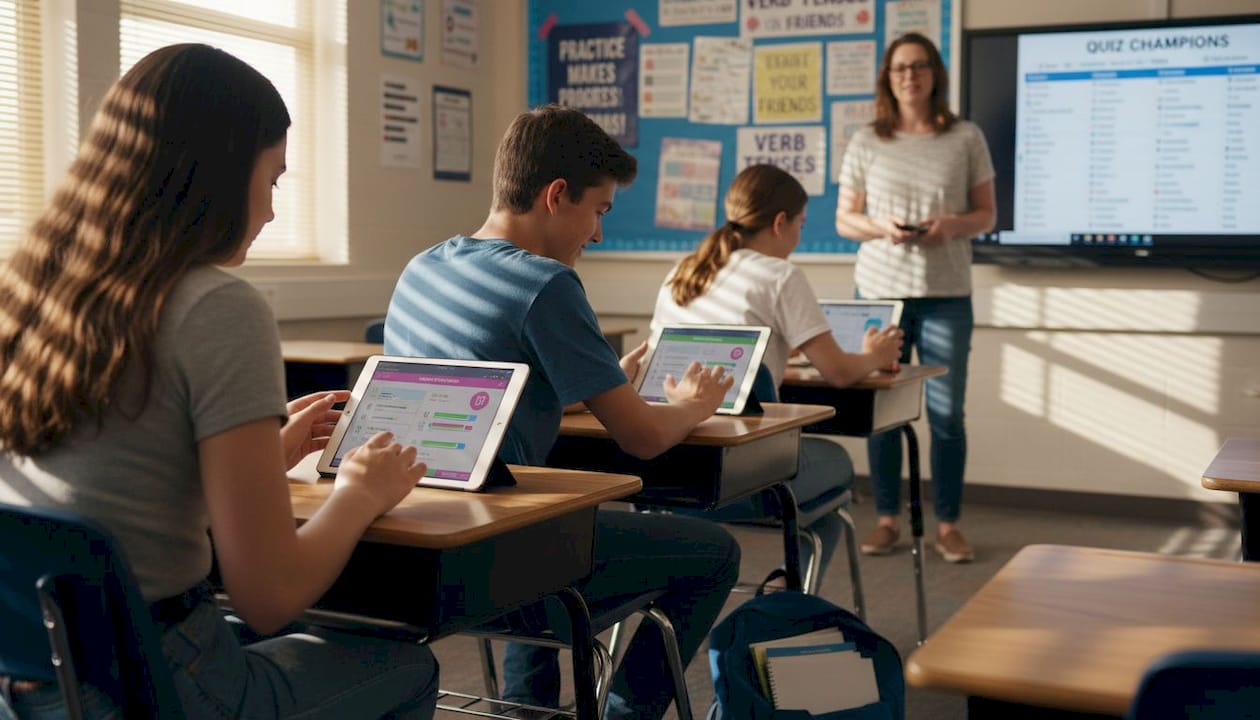
Classic games are invaluable, but digital tools add a fresh edge to ESL classes. Platforms designed for educational gaming bring leaderboards, instant feedback, and data tracking that traditional games cannot match.
Digital games like Kahoot, Quizizz, and Duolingo consistently boost vocabulary retention and engagement across age groups and proficiency levels. Each platform has distinct strengths:
- Kahoot: Quiz-based, competitive, and highly visual. Best for vocabulary review and grammar checks. The leaderboard drives motivation but can increase anxiety in some learners.
- Quizizz: Similar to Kahoot but self-paced, which reduces performance pressure. Students can replay questions, reinforcing retention.
- Duolingo: Gamified language learning with streaks and rewards. Most effective as a supplementary tool for independent practice outside class.
- Roblox (age-appropriate contexts): Roblox-based games notably outperform non-gamified approaches for language acquisition, particularly for younger learners in immersive vocabulary and communication tasks.
| Platform | Primary skill | Competitive? | Best for | Monitoring tools |
|---|---|---|---|---|
| Kahoot | Vocabulary, grammar | Yes | Whole-class review | Basic analytics |
| Quizizz | Vocabulary, reading | Optional | Individual practice | Detailed reports |
| Duolingo | All skills | Mild | Homework supplement | Progress tracking |
| Roblox | Speaking, vocabulary | Yes | Young learners | Limited |
For hybrid classes, blending digital and physical games produces the strongest outcomes. Use Kahoot for a five-minute warm-up review, then transition to a physical activity like Board Race for the main practice stage. This approach maintains ESL gamification strategies that keep motivation high while ensuring varied language output modes.
Adapting and differentiating ESL games for every classroom setting
Every class is different. Here is how to tailor games for your unique group and context. Class size, delivery mode, and learner profiles all demand thoughtful game adaptation.
- Adjust for class size. Large classes benefit from station-based rotations where small groups play simultaneously. Small classes allow for more intensive one-on-one formats like Two Truths and a Lie or debate-style games.
- Scaffold for proficiency levels. Provide sentence starters, word banks, or visual prompts for lower-level learners. Remove scaffolds progressively as confidence builds.
- Adapt for learning modalities. Add images for visual learners, audio cues for auditory learners, and physical movement for kinesthetic learners within the same game structure.
- Deliver online effectively. Use shareable PDFs for Bingo cards, digital whiteboards like Jamboard for collaborative writing games, and breakout rooms for small-group speaking activities. A detailed online class adaptations guide can help you structure these sessions, and a step-by-step online planning resource covers lesson sequencing for virtual environments.
- Support shy students. Assign observer or scorekeeper roles initially. Use anonymous digital responses through Quizizz to reduce public performance pressure. Gradually increase speaking demands as comfort grows.
Managing competition stress is also important. Not all students respond positively to leaderboards or timed pressure. Mixing cooperative games, where teams work toward a shared goal, with competitive formats keeps the classroom inclusive. Refer to game adaptation research for evidence-based differentiation strategies.
Pro Tip: Use color coding and real-world themes such as travel, work, or daily routines to personalize game materials. Students engage more deeply when the vocabulary and scenarios reflect contexts they actually encounter.
A strategic viewpoint: Why purposeful, balanced game use beats just ‘fun’
Games are not a silver bullet. They are a tool for structured, contextualized, and repeated language output. The most common mistake teachers make is treating game time as a reward or a break rather than a core instructional strategy. When games drift without clear objectives, students practice socializing, not language.
Consider two classrooms. In the first, a teacher runs Pictionary for thirty minutes because students enjoy it. In the second, the same game is used to review ten target vocabulary items, with a follow-up exit ticket asking students to use three words in original sentences. The second classroom generates measurable learning. Games work best when explicitly tied to lesson objectives and formative assessment.
Formative assessment does not need to be formal. A quick show of hands, a one-sentence written reflection, or a brief pair-share at the end of a game tells you immediately whether students absorbed the target language. This data should inform the next lesson, not be ignored. Building this habit transforms games from entertainment into genuine pedagogical tools. Explore essential ESL resources to find assessment templates and lesson frameworks that support this approach.
Take your ESL teaching to the next level
Implementing game-based learning effectively requires more than a list of activities. It requires a structured understanding of pedagogy, lesson design, and learner psychology.

The TEFL Institute offers courses and resources that build exactly these skills. Whether you are starting out with TEFL courses in Newcastle or looking to expand your practice through course extensions, there are structured pathways to develop your classroom game integration skills. If you are moving into virtual instruction, the resources available to help you teach English online provide practical frameworks for digital game delivery and online lesson planning. Structured training ensures that game-based strategies translate directly into student outcomes.
Frequently asked questions
What are the best ESL games for large classes?
Board Race, Bingo, and Quiz-Quiz-Trade are recommended for large groups as they enable whole-class movement, collaborative interaction, and high speaking volume simultaneously.
How can I adapt ESL games for shy or anxious students?
Opt for low-stakes cooperative activities, scaffold speaking turns, and offer roles such as scorekeeper or observer that do not require speaking in front of everyone. Low-stakes games reduce anxiety and build confidence incrementally.
Which digital ESL games are most effective for adults?
Kahoot, Quizizz, and Duolingo have strong evidence of improving vocabulary, engagement, and retention. Digital games improve vocabulary retention and motivation in adult ESL learners across multiple studies.
How do I know if a game is helping students learn?
Monitor learning with short formative checks such as exit tickets or in-game reflection tasks tied directly to lesson objectives. Formative assessments like exit tickets provide immediate evidence of language retention.
Are competitive games always effective?
Competition often boosts engagement, but it should be balanced. Competitive elements may frustrate learners if not paired with cooperative formats, so mixing both approaches produces the most inclusive and effective outcomes.