
 United Kingdom (UK)
 United States (US)
 Canada
 South Africa
 India
India Australia
 New Zealand
 China
China Russia
 Germany
 France
 Spain
Spain Netherlands
 Vietnam
 United Arab Emirates
 Italy
Italy Poland
 Thailand
 Türkiye










 Algeria


A 120 hour TEFL course has no academic level unless it is a regulated qualification. 120 hours measures study time, not standard. A level only applies when the qualification sits on a framework such as Ofqual’s RQF with its own qualification number. Most 120 hour courses, including ours, are accredited rather than regulated.
What Level Is a 120 Hour TEFL Course?
Updated 8 October 2026: checked against the Ofqual register and GOV.UK qualification levels.
What level is a 120 hour TEFL course? Hours and levels measure different things. 120 hours tells you how long the course is. A level only exists when the qualification is regulated and placed on a framework such as Ofqual’s Regulated Qualifications Framework (RQF). Most 120 hour courses, including ours, are accredited rather than regulated, so they carry no RQF level.
That matters because “Level 5” and “120 hours” often get used as if they were points on the same scale. They are not. One is a measure of size, the other a measure of standard, checked against a public government register. Here is how the two fit together, and which one employers actually ask for.
Key takeaways
- 120 hours is the hiring benchmark most language schools and online platforms screen for. It describes study time, not academic level.
- A qualification only has a level if it is regulated. In England that means it appears on Ofqual’s public register with its own qualification number.
- On that framework, GOV.UK lists Level 5 alongside a foundation degree and a higher national diploma (HND).
- Our 120 Hour Advanced TEFL Course is accredited, not Ofqual regulated, and is enough for most private schools and online work.
- Our Level 5 TEFL Diploma is Ofqual-regulated, qualification number 610/1571/4, awarded by Highfield Qualifications.

What does “120 hours” actually measure?
A 120 hour TEFL course is measured by the number of study hours it takes to complete, not by an academic level. The figure became the industry benchmark because it is the point at which most employers accept that a new teacher has covered the essentials: grammar for teachers, lesson planning, classroom management and teaching the four skills.
No law sets 120 hours as a minimum. It is a hiring convention, and it is a strong one. Recruiters for language academies in Spain, Vietnam or Thailand will typically ask for “a TEFL of at least 120 hours” in exactly those words, which is why you see the number everywhere.
What the number does not tell you is how demanding the course was, who checked the assessment, or whether anyone outside the provider can verify it. That is where levels come in.
When does a TEFL course have a level?
A TEFL course has a level only when the qualification is regulated and placed on a national framework. In England that framework is the Regulated Qualifications Framework (RQF), run by Ofqual. It grades qualifications from entry level up to Level 8 by how demanding they are, and records their size separately in guided learning hours and total qualification time.
Three things must be true before a TEFL qualification can honestly be called Level 5:
- It is issued by an awarding organisation that Ofqual recognises.
- It has a unique qualification number in the format 610/1571/4.
- That number appears on Ofqual’s public register at the stated level.
If a provider cannot give you all three, the “level” is marketing language. Our guide to what Ofqual regulated actually means explains how to check a claim yourself in about a minute.
Where does Level 5 sit against other qualifications?
Level 5 sits in the same band as a foundation degree, a higher national diploma (HND) and a Diploma of Higher Education. That is the official grouping published by GOV.UK for England, Wales and Northern Ireland. It is a comparison of standard and demand, not a claim that a TEFL diploma is the same size or cost as a foundation degree.
| Framework level | Examples listed by GOV.UK | Where TEFL fits |
|---|---|---|
| Level 3 | A level, T Level, level 3 diploma | School leaving standard |
| Level 5 | Foundation degree, HND, level 5 diploma | Regulated Level 5 TEFL diplomas |
| Level 6 | Degree with honours, ordinary degree | Full undergraduate degree |
| No level | Not on the framework | Most accredited 120 hour TEFL courses |
How does a 120 hour course compare with a Level 5 TEFL Diploma?
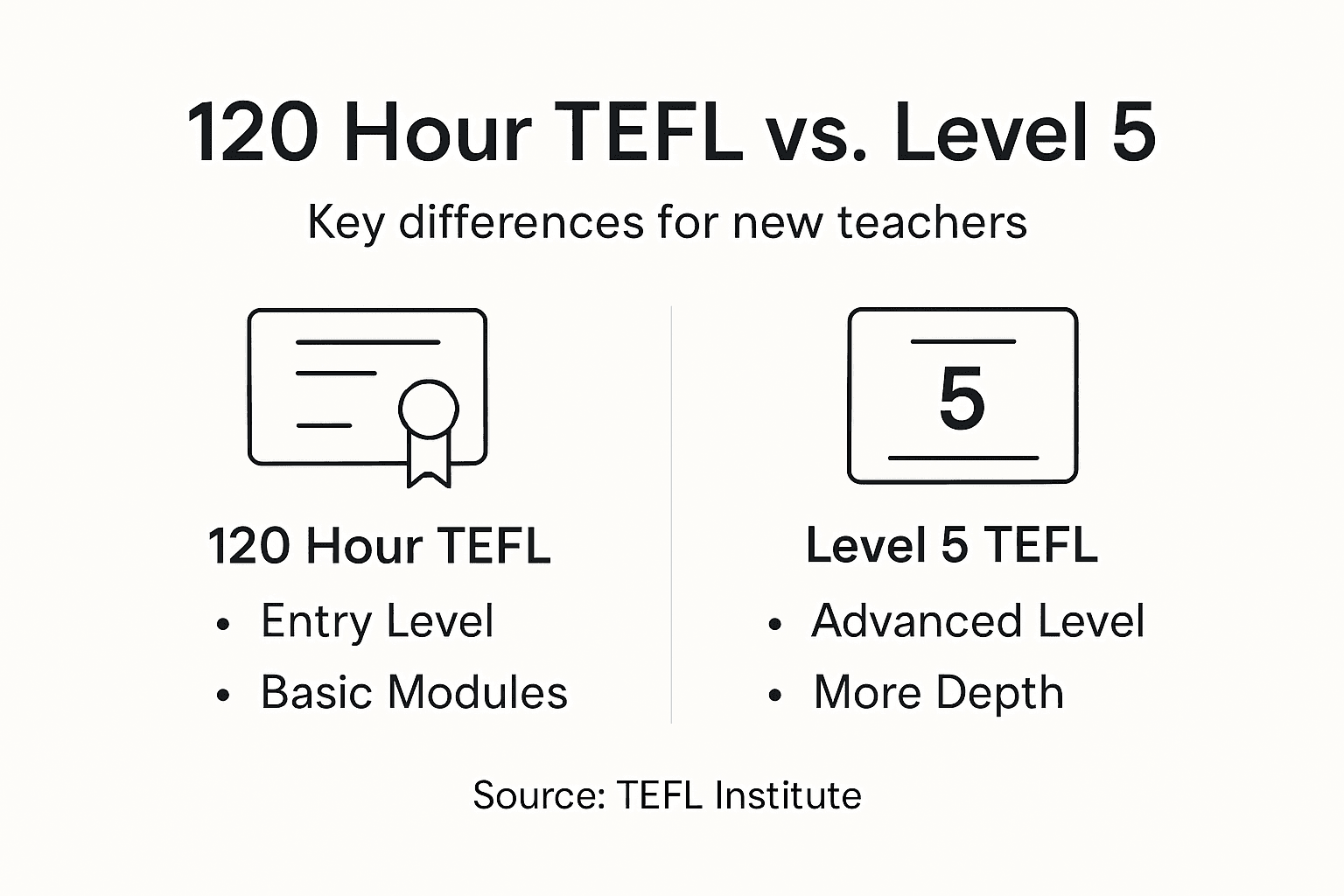
The 120 hour course is the entry route and the Level 5 Diploma is the regulated, more substantial one. Both are studied online. The difference is depth, verifiability and how they read on paper to a school comparing candidates.
| Feature | 120 Hour Advanced TEFL Course | 180 Hour Level 5 TEFL Diploma |
|---|---|---|
| Status | Accredited | Ofqual-regulated |
| Framework level | None | RQF Level 5 |
| Qualification number | None | 610/1571/4 |
| Guided learning hours | 120 hours of study | 180 guided learning hours, 382 hours total qualification time |
| Issued by | The TEFL Institute Group | Highfield Qualifications (Ofqual recognition RN5219) |
| Typically accepted by | Most private language schools and online platforms | Competitive roles, document heavy visa routes and schools comparing candidates on paper |
If you are weighing the diploma against other higher level options, our comparison of Level 5 TEFL and CELTA covers cost, recognition and entry rules side by side.
Is a 120 hour TEFL course enough to get a job?
Yes, for most entry level teaching jobs a 120 hour TEFL course is enough. It meets the standard screening line used by private language academies across Europe, Asia and Latin America, and by most online teaching platforms. Where it often is not enough on its own is the visa, which usually turns on your degree and passport rather than your TEFL.
Roughly, hiring preferences break down like this:
- East and Southeast Asia: a bachelor’s degree for the work visa, plus a TEFL of at least 120 hours. South Korea’s EPIK programme sets 100 hours as its floor.
- Middle East: a degree, attested documents and, for most school posts, a Level 5 qualification rather than a short certificate.
- Europe: right to work comes first. For EU, EEA and Irish passport holders, 120 hours is usually the practical benchmark.
- Online: each platform sets its own rules, and many accept 120 hours with no degree.

For country by country pay and entry rules, the TEFL Salary Index and the Visa Desk are checked against official sources and dated.
If you are not sure what an employer will check, our guide to how employers verify TEFL certificates walks through what schools actually look at before they hire.
Academic
The TEFL Institute Group
How to Land Your First TEFL Job
teflinstitute.comWatch on YouTube · The TEFL Institute Group
Which should you choose: 120 hours or Level 5?
Choose the 120 hour course if you want the fastest route into private language schools or online teaching and your target country does not demand more. Choose the Level 5 Diploma if you want a qualification with a verifiable level, are aiming at the Middle East or competitive school posts, or plan to teach for more than a year or two.
A useful test: look at three real job adverts in the country you want. If they say “120 hour TEFL”, the 120 hour course does the job. If they say “Level 5”, “CELTA or equivalent” or “regulated qualification”, the diploma is the one that gets you shortlisted.
For every acronym you will meet along the way, our page on TEFL qualifications and terminology defines each one in plain English.
Ready to get qualified?
The TEFL Institute Group is Europe’s largest TEFL trainer by teachers certified, with 161,000 teachers certified since 2017 and graduates in 80 countries. We are a Highfield Approved Centre (number 21335), so our regulated diplomas carry a qualification number you can look up yourself.
If a verifiable level is what you want on your certificate, start with the 180 Hour Level 5 TEFL Diploma. If you want the quickest route into the classroom, the 120 Hour Advanced TEFL Course covers what most schools ask for.

Ola Flynn, Head of Marketing
Head of Marketing at The TEFL Institute Group; runs our webinars and information sessions, loves travel and sharing interns’ stories, and joined our interns in Thailand for orientation.
We love taking your call.

TEFL Institute guides
Plan for 2027
Dubai
Pay, requirements and visas
Read the guide
Plan for 2027
China
Z visa, pay and cities
Read the guide
Plan for 2027
Spain
Jobs, pay and visa routes
Read the guide
Plan for 2027
Italy
Jobs, pay and visa routes
Read the guide
Plan for 2027
Cambodia
Pay, requirements and visas
Read the guide
No. A 120 hour course is measured in hours, while Level 5 is a regulated standard on the RQF, the same band as a foundation degree or HND. Our Level 5 TEFL Diploma is Ofqual-regulated under qualification number 610/1571/4, with 180 guided learning hours and 382 hours total qualification time.
For most entry level jobs, yes. Private language schools across Europe, Asia and Latin America, and most online platforms, screen for a TEFL of at least 120 hours. Your visa usually depends on your degree and passport instead, and some regions, especially the Middle East, prefer a Level 5 qualification for school posts.
Ask the provider for the awarding organisation, the qualification number and the level, then search the number on Ofqual’s public register. A regulated qualification will appear with its title, level and guided learning hours. If a provider cannot give you a number, the course is not regulated, whatever its marketing says.
GOV.UK places Level 5 alongside a foundation degree, a higher national diploma (HND) and a Diploma of Higher Education. That is a comparison of difficulty on the same framework, not of size or cost. A Level 5 TEFL Diploma is not a degree, but it sits at the same level of demand as those qualifications.
Take the 120 hour course for the quickest route into private language schools or online teaching. Choose the Level 5 TEFL Diploma if you want a verifiable regulated level, are targeting the Middle East or competitive school roles, or plan to teach long term. Check three real job adverts in your target country first.