

 United Kingdom (UK)
 United States (US)
 Canada
 South Africa
 India
India Australia
 New Zealand
 China
China Russia
 Germany
 France
 Spain
Spain Netherlands
 Vietnam
 United Arab Emirates
 Italy
Italy Poland
 Thailand
 Türkiye











 Algeria


What Is EFL? Understanding English as a Foreign Language
What Is EFL? Understanding English as a Foreign Language

TL;DR:
- EFL refers to English instruction in countries where English is not part of daily life.
- Understanding the differences among EFL, ESL, TEFL, and TESOL is essential for effective teaching and job applications.
- EFL teaching emphasizes engagement, speaking, and real-life tasks due to limited outside exposure.
Many aspiring teachers assume that EFL, which stands for English as a Foreign Language, simply means teaching English somewhere outside their home country. That assumption misses a critical distinction. EFL is not just a geographic label. It describes a specific learning environment where students have little or no daily contact with English beyond the classroom. That context shapes everything: how you plan lessons, which methods you use, and what qualifications employers expect. This article defines EFL clearly, compares it to related terms like ESL, TEFL, and TESOL, and shows how the EFL context directly affects your teaching approach and lesson design.
Table of Contents
- What does EFL actually mean?
- EFL, ESL, TEFL, TESOL: Key terms compared
- Why EFL context changes your teaching approach
- EFL lesson planning: Practical frameworks and resources
- A veteran’s take: What most new EFL teachers miss
- Take the next step in your EFL teaching journey
- Frequently asked questions
Key Takeaways
| Point | Details |
|---|---|
| EFL means context | EFL refers to teaching English where it is not the primary language spoken. |
| Key terms differ | TEFL, TESOL, and EFL describe different aspects of teaching and learning English abroad. |
| Classroom focus is vital | EFL classrooms must prioritize real engagement as students lack outside exposure. |
| Lesson planning is essential | Purposeful lesson frameworks and materials are crucial for EFL success. |
| Context drives teaching style | Methodology for EFL must adapt to learners’ limited interaction with English outside class. |
What does EFL actually mean?
EFL, or English as a Foreign Language, refers to English instruction delivered to learners who live in countries where English is not an official or widely spoken language. Think of a student in Japan, Brazil, or Poland learning English at school. English is not part of their daily environment outside the classroom. That is the defining characteristic of EFL.
This is where many new teachers get confused. EFL stands for English as a Foreign Language, taught specifically in countries where English is not the main language. That context places significant responsibility on the teacher because the classroom may be the only consistent source of English input a student receives.
Now, how does EFL differ from TEFL, TESL, and TESOL? These acronyms are related but not interchangeable:
- EFL describes the learning context: a student studying English in a non-English-speaking country
- TEFL (Teaching English as a Foreign Language) describes the teacher’s role in that same context
- TESL (Teaching English as a Second Language) refers to teaching English to learners who live in an English-speaking country but whose first language is different
- TESOL (Teaching English to Speakers of Other Languages) is an umbrella term that covers both EFL and ESL contexts
Understanding these TEFL and TESOL differences matters when you read job listings or evaluate certification programs, because employers and course providers use these terms in specific ways.
The learner’s environment has a direct impact on teaching priorities. In EFL settings, students go home to a world where English is largely absent from street signs, television, and casual conversations. This means every minute of class time carries more weight. Teachers cannot rely on students picking up language naturally in the outside world. Engagement, repetition, and meaningful practice within the classroom become the primary tools for language acquisition.
“Students in EFL environments depend on the classroom as their primary source of meaningful English input, which raises the stakes for every lesson.”
For teachers, recognizing this distinction early shapes not just method selection but also resource choices, activity design, and how you measure progress.
EFL, ESL, TEFL, TESOL: Key terms compared
With a working definition of EFL, it is crucial to know how it fits among other popular English teaching acronyms. Misusing these terms can create confusion when applying for teaching jobs, selecting certification courses, or designing curriculum materials.
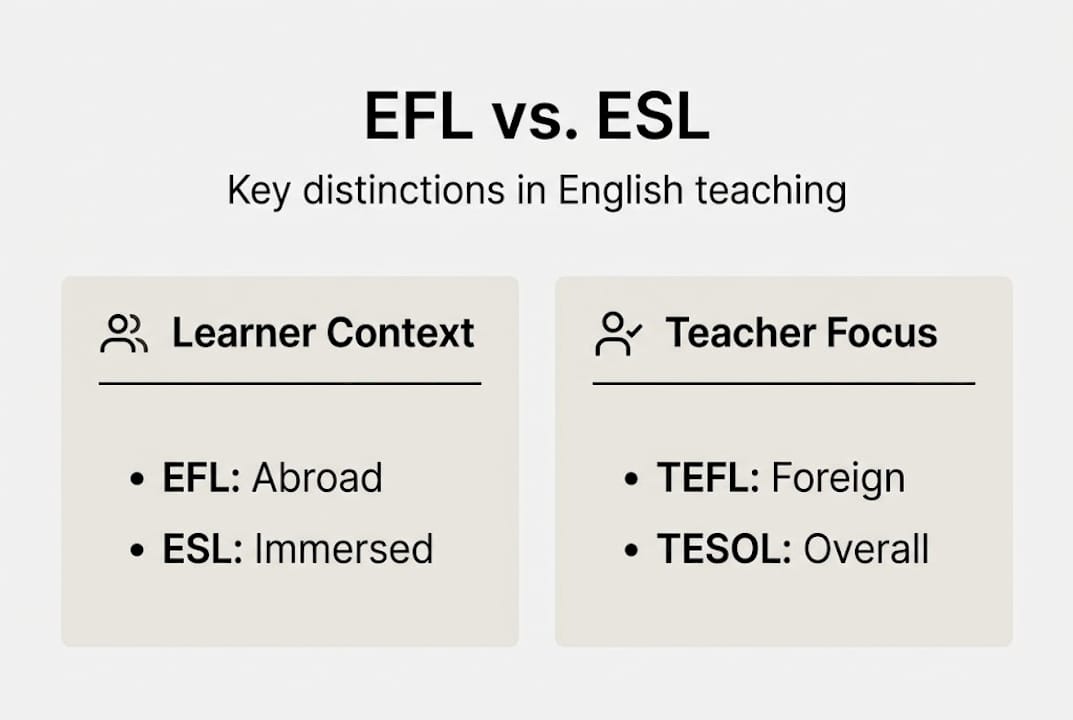
EFL describes the learning context, while TEFL is about the teacher’s work in non-English-speaking countries. This distinction is foundational. Here is a direct comparison:
| Acronym | Full term | Who it refers to | Location context | Qualification use |
|---|---|---|---|---|
| EFL | English as a Foreign Language | Learner | Non-English-speaking country | Describes context |
| ESL | English as a Second Language | Learner | English-speaking country | Describes context |
| TEFL | Teaching English as a Foreign Language | Teacher | Abroad, non-English setting | Certification term |
| TESOL | Teaching English to Speakers of Other Languages | Teacher | Both EFL and ESL contexts | Broad qualification term |
A practical example helps clarify this: a student in China studying English in a local school is an EFL learner. A student from China who has moved to Canada and is learning English to integrate into daily life is an ESL learner. The language being taught is the same. The environment is entirely different. That environment dictates which strategies and resources are most effective.
For teachers, understanding this distinction also affects how you approach lesson planning for ESL/EFL, since ESL students may reinforce learning through daily real-world exposure while EFL students depend almost entirely on structured classroom instruction.

Pro Tip: When reviewing job postings or certification requirements, check whether the employer uses TEFL, TESOL, or EFL specifically. Some countries and institutions treat these terms differently, and misreading the context could mean applying with the wrong qualification.
Why EFL context changes your teaching approach
Now that the differences are clear, what makes teaching EFL unique compared to other English instruction contexts? The core challenge is limited exposure. EFL students are unlikely to encounter English organically between lessons, which means the classroom must do the heavy lifting.
EFL classroom practice focuses on maximizing engagement and meaningful communication opportunities due to limited out-of-class exposure. This finding shapes how effective EFL teachers plan and execute lessons.
Here is a practical numbered framework for maximizing class time in EFL settings:
- Set a clear communicative goal for each lesson. Every activity should move students toward a specific language outcome, not just fill time.
- Prioritize speaking and listening over passive reading or writing exercises, especially in early lessons.
- Use context-rich tasks such as role plays, simulations, and real-life scenarios. These give language a purpose students can relate to.
- Build in pair and group work frequently. Student-to-student interaction multiplies the quantity of language production per lesson.
- Review and recycle vocabulary across multiple lessons. EFL students lack reinforcement outside class, so in-class repetition is critical.
- Provide immediate, constructive feedback to correct fossilized errors before they become habits.
Contemporary communicative and task-based methods are especially suited to EFL settings because they simulate real communication within a structured classroom environment.
“The most effective EFL lessons replicate genuine communication scenarios, giving students a reason to use English, not just learn about it.”
Applying this to effective lesson planning means building activities around outcomes, not content coverage. Equally important is building a reliable set of essential teaching resources that support varied activity types without requiring constant internet access or expensive materials.
Pro Tip: Resistance to speaking activities is common in EFL classrooms, especially in cultures where public mistakes feel embarrassing. Use low-stakes pair work first to build confidence before moving to group or class-wide tasks.
EFL lesson planning: Practical frameworks and resources
Understanding the need for in-class engagement, how do you actually design lessons that work in EFL classrooms? A structured framework helps teachers move from theory to practice efficiently.
EFL teachers rely on communicative approaches and resourceful lesson design to compensate for students’ limited English exposure outside class. The table below offers a practical reference for planning effective EFL lessons:
| Stage | Goal | Activity type | Resource tip |
|---|---|---|---|
| Warm-up | Activate prior knowledge | Questions, images, short games | Flashcards, visual prompts |
| Input | Introduce new language | Reading or listening text | Graded readers, audio clips |
| Guided practice | Controlled use of new language | Gap fills, structured dialogue | Worksheets, sentence frames |
| Communicative task | Free production and real use | Role play, information gap | Task cards, scenario sheets |
| Review | Reinforce and consolidate | Exit tickets, quick quizzes | Formative assessment tools |
Beyond the framework, access to quality materials matters. Reliable resources for EFL teachers include:
- Graded readers and leveled texts for reading input tailored to learner ability
- Digital platforms such as Quizlet or Padlet for vocabulary building and collaborative tasks
- Realia (real-world objects or documents) to make lessons feel connected to actual English use
- Authentic audio and video clips with controlled comprehension tasks
- Teacher-created task cards for pair and group work, which can be reused across classes
For tailored approaches, young learners benefit from games and songs, while exam prep students need structured timed practice with authentic test formats. Reviewing top lesson planning tips gives practical direction, while resources like ESL materials explained and ESL lesson plan examples provide ready-to-use starting points for new and experienced teachers alike.
Planning with a framework reduces preparation time and increases lesson consistency, which is especially valuable when managing large EFL classes with mixed ability levels.
A veteran’s take: What most new EFL teachers miss
Having covered frameworks and strategies, here is an honest perspective you will rarely hear in standard guides. New EFL teachers consistently make the same mistake: they over-prepare grammar explanations and under-prepare speaking tasks. The assumption is that students need to understand the language before they can use it. In EFL contexts, that sequence often backfires.
The real challenge is not covering content. It is making every minute of class contact genuinely productive. Students who spend 60 minutes copying grammar rules from a board leave with no more communicative ability than when they arrived. Students who spend that same 60 minutes negotiating meaning in a task-based activity leave with real language experience.
The most rewarding EFL classes use games, pair work, and real scenarios, even when students resist initially. Accept that early lessons may feel chaotic. Imperfect, active use of language is more valuable than polished, passive comprehension. For teachers working with younger age groups, exploring strategies for teaching young learners provides specific techniques for channeling energy into language production effectively.
Take the next step in your EFL teaching journey
Knowing what EFL means and how it differs from ESL, TEFL, and TESOL gives you a clearer picture of the teaching environment you are preparing to enter. That clarity makes it easier to choose the right certification and develop the skills that employers in non-English-speaking countries actually need.

TEFL Institute offers a range of TEFL certification courses designed to prepare teachers for real EFL classrooms, covering methodology, lesson planning, and practical application. For teachers looking to build on an existing qualification, a selection of advanced and extension courses supports specialization in areas such as young learners, business English, and IELTS preparation. Explore the full catalog and take the next step toward a qualified and confident EFL teaching career.
Frequently asked questions
What does EFL stand for in teaching?
EFL is English as a Foreign Language, taught in non-English-speaking countries. It describes the context in which students learn English without regular exposure to the language in their daily environment.
Is TEFL certification the same as EFL teaching?
TEFL refers to the teacher and EFL to the context; they are related but not interchangeable. A TEFL certification qualifies you to teach in EFL environments, but earning the qualification and working in that context are two distinct things.
How is EFL different from ESL?
The difference between EFL and ESL is based on geography and classroom environment. EFL is taught where English is not the local language, while ESL serves learners who live in English-speaking countries.
What teaching methods work best in EFL classrooms?
EFL is best taught with communicative and task-based lessons because of limited real-world English input. These approaches maximize meaningful language use within the structured time available in class.
Recommended
- What is TEFL? Understanding Teaching English as a Foreign Language | TEFL Institute
- What Is ESL? Certification, Methods, and Teaching Pathways | TEFL Institute
- Understand English Proficiency Levels for Effective TEFL | TEFL Institute
- ESL levels explained: Complete guide for teachers | TEFL Institute
TEFL Institute guides

Thailand
Visas and teaching licences
Cambodia
Pay, requirements and visas
Czech Republic
Pay, visas and cities
Japan
JET, ALT and eikaiwa pay
Vietnam
Work permits and requirements