
 United Kingdom (UK)
 United States (US)
 Canada
 South Africa
 India
India Australia
 New Zealand
 China
China Russia
 Germany
 France
 Spain
Spain Netherlands
 Vietnam
 United Arab Emirates
 Italy
Italy Poland
 Thailand
 Türkiye











 Algeria


ESL levels explained: Complete guide for teachers
ESL levels explained: Complete guide for teachers

You’ve just started your ESL teaching journey, and suddenly you’re confronted with a confusing alphabet soup of proficiency frameworks. CEFR, ACTFL, WIDA. A1, B2, Intermediate Low. Your students need targeted instruction, but which framework should guide your lesson planning? Understanding ESL proficiency levels isn’t just academic knowledge. It’s the foundation for creating lessons that genuinely meet learners where they are and move them forward. This guide breaks down the three major frameworks, shows you how to adapt your teaching methods for each, and gives you practical strategies to transform confusion into classroom confidence.
Table of Contents
- Key takeaways
- Understanding ESL proficiency frameworks
- Comparing teaching methodologies for ESL levels
- Practical strategies to adapt lessons for ESL proficiency levels
- How understanding ESL levels improves teaching outcomes
- Boost your ESL teaching career with TEFL Institute
- FAQ
Key Takeaways
| Point | Details |
|---|---|
| Three major frameworks | CEFR ACTFL and WIDA organize proficiency with distinct levels and criteria. |
| Teaching aligned to frameworks | Teaching methods should align with each framework to maximize student progress. |
| Distinct assessment criteria | Each framework uses different criteria to assess listening, reading, speaking, and writing. |
| Cross framework mapping | Cross framework descriptors let you translate materials across sources for your classroom. |
Understanding ESL proficiency frameworks
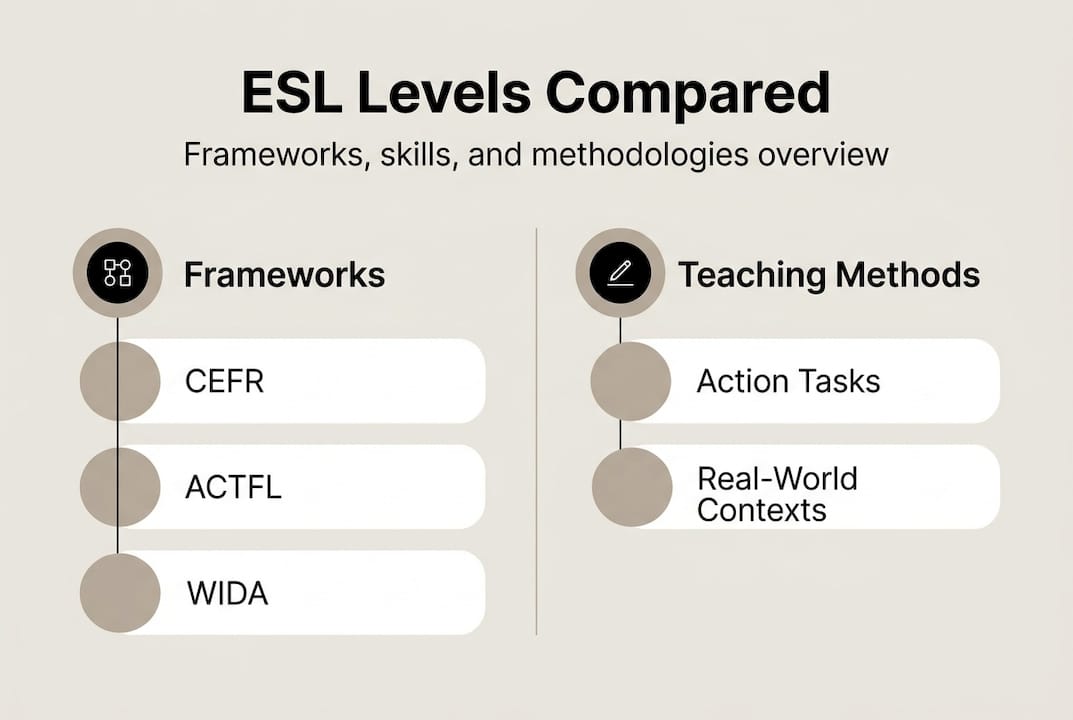
The Common European Framework of Reference for Languages (CEFR) divides proficiency into six levels: A1-A2 (Basic), B1-B2 (Independent), C1-C2 (Proficient), with can-do statements across skills. Each level describes what learners can accomplish in listening, reading, speaking, and writing. An A1 learner might introduce themselves using simple phrases, while a C2 learner can express themselves spontaneously with precision in complex situations. This granular approach helps you pinpoint exactly where students stand and what they need next. Levels only tell half the story: supporting neurodiverse learners matters at every stage, whatever the CEFR band.
ACFL takes a different approach. The ACTFL proficiency guidelines use five major levels with sublevels, assessed via FACT criteria covering function, context, accuracy, and text type. Novice learners produce memorized words and phrases. Intermediate learners create with language to express personal meaning. Advanced learners narrate and describe across timeframes. Superior learners discuss abstract topics with ease. Distinguished learners use language at a highly articulate level comparable to educated native speakers. This framework emphasizes what learners can do with language in real-world situations.
WIDA ELD Standards use 6 levels for K-12 ESL tailored by language mode and grade clusters. Level 1 represents entering proficiency, while Level 6 indicates reaching grade-level expectations. WIDA distinguishes between receptive modes (listening, reading) and expressive modes (speaking, writing), recognizing that students often progress at different rates across skills. This nuanced view proves especially valuable when teaching young learners with varying backgrounds.
Here’s how these frameworks compare in practice:
- CEFR works best for adult learners and European educational contexts, providing detailed skill descriptors that translate across languages
- ACTFL dominates US foreign language education, emphasizing performance in authentic communicative tasks
- WIDA specifically targets multilingual learners in American K-12 schools, aligning with academic content standards
- All three frameworks share a common goal: helping teachers match instruction to student ability
Pro Tip: Cross-reference framework descriptors when planning lessons. A student at CEFR B1 roughly corresponds to ACTFL Intermediate Mid, helping you adapt materials from different sources to your classroom needs.
Understanding these frameworks transforms how you approach top ESL teaching methodologies. You stop guessing what students can handle and start designing with precision. Each framework offers unique insights, but they all point to the same truth: effective teaching starts with knowing your students’ current proficiency.
Comparing teaching methodologies for ESL levels
Frameworks don’t just measure proficiency. They shape how you teach. The CEFR action-oriented approach integrates reception, production, interaction, mediation in real-life scenarios, treating language as a tool for accomplishing tasks rather than an abstract system to memorize. You might ask B1 students to plan a group trip, requiring them to read travel information, discuss preferences, write an itinerary, and negotiate compromises. This integrated approach mirrors how people actually use language outside the classroom.

ACTFL’s methodology centers on practical real-world functions. ACTFL emphasizes what learners can do in specific contexts rather than what they know about grammar rules. An Intermediate High student learns to handle a complicated situation at a hotel, not because they’ve mastered the subjunctive, but because they can create with language to solve problems. This functional focus drives lesson design toward authentic communication.
WIDA takes a different angle entirely. WIDA supports differentiated instruction and scaffolding by levels in K-12 ESL, recognizing that young learners need structured support to access grade-level content while developing English proficiency. A Level 3 student might receive graphic organizers, sentence frames, and visual supports to participate in the same science lesson as Level 5 peers who need minimal scaffolding.
Each methodology brings distinct advantages to your classroom:
- CEFR action tasks combine multiple skills in meaningful contexts, preparing students for real-world language use across speaking, listening, reading, and writing simultaneously
- ACTFL functional approach prioritizes communicative competence over grammatical perfection, building student confidence to use language despite errors
- WIDA scaffolding techniques ensure all proficiency levels can access content, preventing students from falling behind academically while learning English
- Combining elements from multiple frameworks creates flexible, responsive teaching that meets diverse student needs
Pro Tip: Match your assessment methods to your chosen framework’s methodology. If you teach using CEFR action tasks, assess with integrated performance tasks rather than isolated grammar tests.
These methodological differences matter because they influence everything from material selection to activity design. Effective ESL teaching methods aren’t one-size-fits-all. They adapt to the framework guiding your program and the proficiency levels in your classroom. Understanding these distinctions helps you make intentional choices rather than randomly selecting activities.
Practical strategies to adapt lessons for ESL proficiency levels
Knowing frameworks and methodologies means nothing without classroom application. Here are five concrete strategies to adapt your ESL lessons for different proficiency levels:
-
Layer scaffolding strategically. Provide sentence frames for lower levels, guiding questions for intermediate students, and open-ended prompts for advanced learners tackling the same topic. This allows differentiation without creating entirely separate lessons.
-
Deploy visuals and realia purposefully. Beginning students need pictures, objects, and gestures to access meaning. Intermediate learners benefit from charts and diagrams that organize information. Advanced students can analyze authentic texts with minimal visual support.
-
Structure peer interaction intentionally. Teaching methodologies advise differentiated instruction and scaffolding tailored to student proficiency for optimal results. Pair students strategically so stronger English users model language without dominating conversation.
-
Adjust task complexity, not topic. All levels can discuss climate change. Beginners might sort pictures into categories. Intermediate students could compare two solutions. Advanced learners might debate policy implications. Same theme, differentiated cognitive demand.
-
Build in processing time. Lower proficiency students need more wait time to formulate responses. Build silent thinking moments into activities before requiring output, leveling the playing field for students who translate mentally.
“Differentiated instruction based on proficiency levels allows teachers to meet students where they are while challenging them to grow, creating an inclusive classroom where all learners progress.”
These strategies work because they recognize a fundamental truth: proficiency levels represent current ability, not potential. Your job isn’t to simplify everything for struggling students or bore advanced learners. It’s to provide appropriate challenge for each level. ESL teaching tips emphasize meeting students at their proficiency while pushing growth.
Practical adaptation also means using your ESL teaching checklist to ensure lessons hit multiple proficiency levels. Check that activities include options for different ability ranges. Verify that your materials offer entry points for beginners and extensions for advanced students. Confirm that assessment allows students to demonstrate learning at their level.
Finally, remember that engaging ESL class activities aren’t engaging unless they match student proficiency. A brilliant debate activity falls flat with beginners who lack the language to participate. A simple matching game insults advanced learners ready for nuanced discussion. Adaptation isn’t extra work. It’s the core of effective teaching.
How understanding ESL levels improves teaching outcomes
Mastering proficiency frameworks transforms you from a content deliverer into a learning architect. Understanding proficiency levels helps tailor instruction, increasing student engagement and progress in measurable ways. When you know exactly what A2 students can do versus B1 students, you stop wasting time on material that’s too easy or impossibly hard. You hit the sweet spot where learning happens.
The benefits cascade through every aspect of your teaching:
- Focused lesson planning becomes efficient when you know which skills and functions to target at each level, eliminating guesswork from material selection
- Accurate assessment emerges naturally when you align tests with framework descriptors, giving you and students clear progress markers
- Student motivation increases dramatically when learners see themselves advancing through defined levels rather than swimming in undefined difficulty
- Professional confidence grows as you speak the common language of proficiency with colleagues, administrators, and the broader ESL community
- Targeted feedback becomes specific and actionable when tied to level descriptors, helping students understand exactly what to improve
This knowledge also enhances your ESL lesson planning success by providing a roadmap for progression. You can sequence lessons logically, ensuring each builds on previous skills and prepares for the next level. Students aren’t just completing random activities. They’re following a coherent path toward proficiency.
Understanding levels also improves student outcomes beyond test scores. Learners develop autonomy when they understand their current level and what’s required to advance. They can self-assess using framework descriptors, taking ownership of their learning journey. This metacognitive awareness accelerates progress because students become active participants rather than passive recipients.
Perhaps most importantly, framework knowledge professionalizes your practice. You move from intuitive teaching to evidence-based instruction. You can articulate why you made specific pedagogical choices and how they serve student development. This expertise makes you a more effective advocate for your students and a more valuable colleague in your institution.
Continuous learning about frameworks isn’t optional for serious ESL teachers. It’s foundational. As frameworks evolve and your teaching context changes, staying current ensures your instruction remains relevant and effective. The investment in understanding proficiency levels pays dividends throughout your entire career.
Boost your ESL teaching career with TEFL Institute
Ready to transform your understanding of ESL proficiency into classroom expertise? TEFL Institute offers specialized training that deepens your knowledge of frameworks, methodologies, and practical teaching strategies. Our TEFL courses in Newcastle provide hands-on experience applying proficiency frameworks in real classroom settings, whether you’re teaching locally or preparing for international opportunities.

Expand your credentials with targeted course extensions that focus on specific proficiency levels, assessment strategies, or teaching contexts. These specialized modules help you master the nuances of adapting instruction for diverse learner needs. If you’re interested in global opportunities, discover how to start teaching English online and apply your framework knowledge to virtual classrooms worldwide. TEFL Institute’s expert-backed certifications give you the skills and credentials to advance your ESL teaching career with confidence.
FAQ
What are ESL levels and why do they matter?
ESL levels are standardized measures of language proficiency that describe what learners can do with English across listening, speaking, reading, and writing. They matter because they help teachers tailor instruction to student ability, track progress systematically, and ensure learners receive appropriate challenge. Without clear proficiency levels, teaching becomes guesswork and students may struggle with material that’s too difficult or waste time on content they’ve already mastered.
How do CEFR, ACTFL, and WIDA frameworks differ?
CEFR uses six levels (A1-C2) with detailed can-do statements across language skills, primarily serving European and adult learning contexts. ACTFL employs five major performance levels emphasizing functional language use in real-world contexts, dominating US foreign language education. WIDA targets K-12 multilingual learners with six levels differentiated by language mode and aligned with academic content standards. Each framework serves different educational settings and emphasizes distinct aspects of proficiency.
What teaching methods work best for different ESL levels?
Action-oriented tasks integrating multiple skills suit CEFR-based instruction, engaging students in realistic language use scenarios. Real-world functional tasks align with ACTFL’s emphasis on communicative performance in authentic contexts. Scaffolded, differentiated instruction works best with WIDA frameworks, providing structured support for young learners accessing grade-level content. The most effective approach often combines elements from multiple methodologies based on your specific teaching context and student needs.
How can I adapt lessons for mixed ESL proficiency classrooms?
Use differentiated tasks that address the same topic at varying complexity levels, allowing all students to engage meaningfully. Incorporate visual supports, sentence frames, and graphic organizers that lower-proficiency students can use while advanced learners work independently. Structure peer interactions strategically so students support each other without one level dominating. Your ESL teaching checklist can guide systematic adaptation, ensuring every lesson includes entry points and extensions for different proficiency levels.
Recommended
TEFL Institute guides

Thailand
Visas and teaching licences
Mexico
Jobs, pay and cities
China
Z visa, pay and cities
Italy
Jobs, pay and visa routes
Spain
Jobs, pay and visa routes