

 United Kingdom (UK)
 United States (US)
 Canada
 South Africa
 India
India Australia
 New Zealand
 China
China Russia
 Germany
 France
 Spain
Spain Netherlands
 Vietnam
 United Arab Emirates
 Italy
Italy Poland
 Thailand
 Türkiye








 Algeria


If you’re weighing these acronyms against one another, our guide to ESL certification explains how the routes compare and which employers recognise them.
TEFL and TESOL Difference: Choosing Your Best Path

Choosing the right English teaching certification is a crucial step for anyone dreaming of working abroad. The distinction between TEFL and TESOL certifications shapes where you can teach and what opportunities you access in places like South Korea, Canada, or Brazil. Understanding the practical differences between TEFL and TESOL ensures you select a credential that matches your career goals and target location, so you do not waste time on the wrong program.
Table of Contents
- Defining TEFL and TESOL Certifications
- Key Distinctions Between TEFL and TESOL
- Where and How Each Certification Is Used
- Accreditation, Program Quality, and Requirements
- How to Choose the Right Certification Path
Key Takeaways
| Point | Details |
|---|---|
| TEFL vs. TESOL Certification | TEFL focuses on teaching English in non-English speaking countries, while TESOL encompasses teaching in both foreign language and multilingual ESL contexts. |
| Employer Preferences | Research job listings in your target country to determine whether employers prefer TEFL or TESOL certifications for targeted roles. |
| Accreditation Matters | Ensure that your chosen certification program is accredited, as this significantly impacts job opportunities and acceptance by employers. |
| Consider Future Career Goals | Evaluate whether you plan to teach internationally or pursue roles in English-speaking countries, as this will influence the most beneficial certification path. |
Defining TEFL and TESOL Certifications
When you begin researching English teaching credentials, you’ll encounter both TEFL and TESOL repeatedly. While they sound similar and both certify you to teach English, they represent different approaches and serve different teaching contexts. Understanding these distinctions prevents confusion during your certification search and ensures you pursue the path that aligns with your teaching goals.
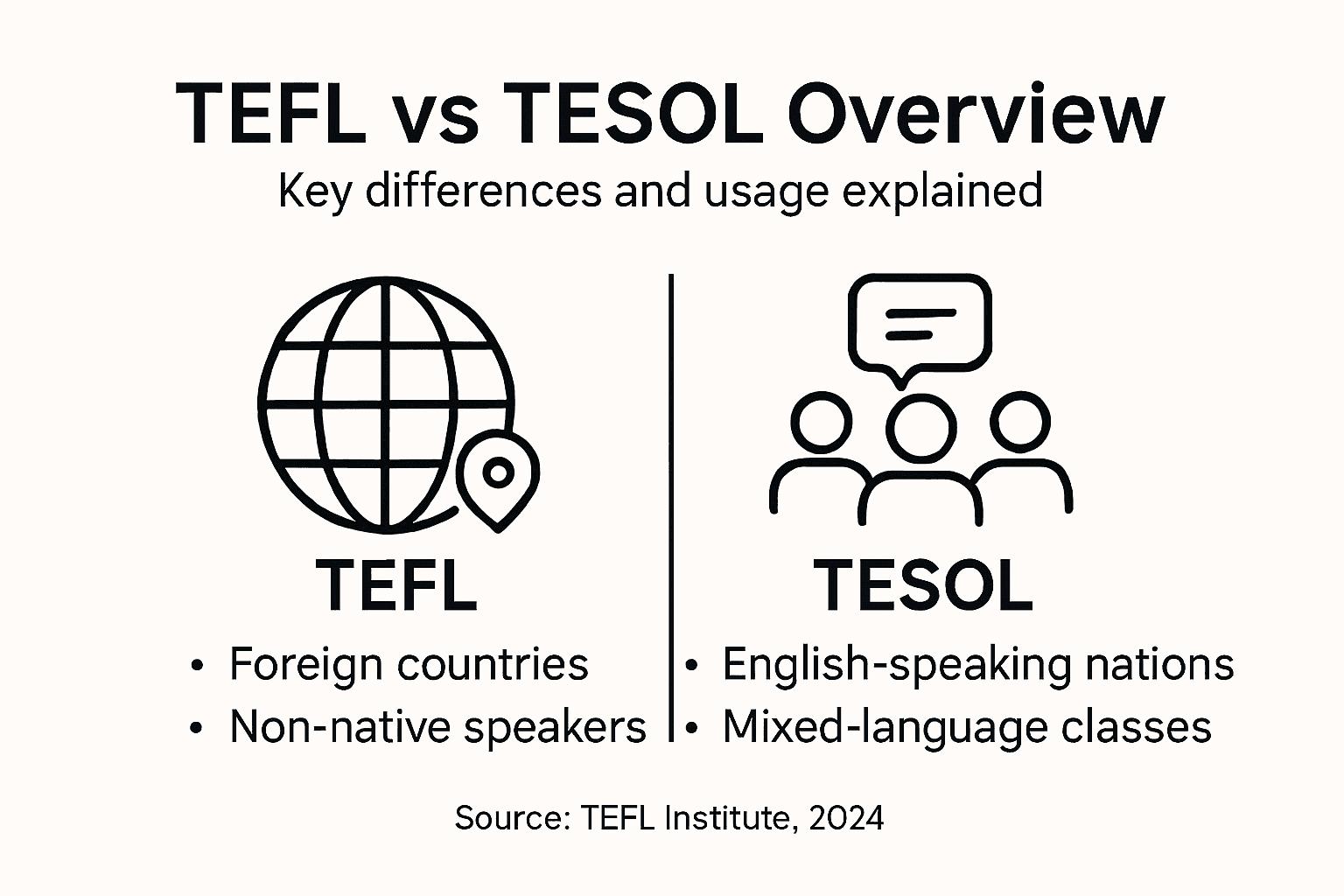
TEFL stands for Teaching English as a Foreign Language. This certification focuses on teaching English to non-native speakers in countries where English is not the primary language. If you’re planning to teach in Brazil, Japan, Saudi Arabia, or South Korea, you’re working in a TEFL context. The emphasis is on English language acquisition for learners whose first language is something other than English. What TEFL certification entails includes specific training in grammar instruction, vocabulary building, and communication strategies designed for environments where students rarely use English outside the classroom. Your students might attend an academy, language school, or private institution specifically to develop English proficiency.
TESOL, by contrast, stands for Teaching English to Speakers of Other Languages. This broader term encompasses all contexts where English learners study under English teachers. The key difference lies in geography and broader applicability. TESOL includes both foreign language contexts (like TEFL) and ESL (English as a Second Language) contexts, such as teaching immigrant communities in Australia, Canada, or the United States. Someone holding a TESOL certification can work with adult learners adjusting to a new country, refugees learning English to access better employment, or international students studying at American universities. The credential is wider in scope and recognized across multiple countries and educational settings.
The practical distinction matters when job hunting. A school in Thailand specifically recruiting teachers looks for TEFL certification as the standard requirement. A community education program in Toronto recruiting for an immigrant services program targets TESOL-certified educators. Some employers accept both interchangeably, while others have specific preferences. Understanding which credential opens doors in your target location and teaching environment ensures you invest time and resources in the certification that maximizes your opportunities.
Pro tip: Research job listings in your target country or region before enrolling in certification to confirm which credential employers prefer, as some regions lean heavily toward TEFL while others value TESOL more prominently.
Key Distinctions Between TEFL and TESOL
While the previous section introduced these certifications, the practical differences between TEFL and TESOL operate on multiple levels that directly impact where you can teach, what student populations you’ll work with, and how you approach instruction. These distinctions shape your career trajectory, so understanding them prevents costly mistakes when choosing your certification path.
The most fundamental difference centers on geographic scope and context. TEFL certification prepares you specifically for teaching English in countries where English is a foreign language, meaning it holds no official status in government, business, or daily life. Think of Vietnam, Mexico, or Egypt. TESOL, meanwhile, encompasses a broader range of teaching contexts. It covers both foreign language environments and ESL settings where English learners live in English-speaking countries. An American adult immigrant learning English, a refugee family in Canada, or international students at an Australian university all fall under TESOL contexts. The TESL certification represents a subset within the broader TESOL umbrella, specifically targeting English as a Second Language in countries like Canada where learners are immersed in an English-speaking environment but studying in formal programs.

Your teaching methodology shifts based on these contexts. In TEFL environments, students typically have minimal daily exposure to English outside the classroom. Grammar instruction, structured vocabulary lessons, and controlled speaking practice dominate the curriculum because learners desperately need systematic language building. Classroom time becomes the primary source of English input. TESOL instructors, particularly those working in ESL contexts, often emphasize communicative approaches that leverage the surrounding English environment. Your students encounter English on street signs, in shops, on job applications, and in media. You’re bridging the gap between what they hear naturally and what they need for employment, education, or civic participation. The urgency and practical applications differ significantly.
Credential recognition also varies by region. Schools in Vietnam, Thailand, and the Middle East typically require or strongly prefer TEFL certification as the recognized standard for hiring English teachers. Employers understand exactly what TEFL training covers and what qualifications teachers possess. In the United States, Canada, Australia, and the United Kingdom, TESOL certification carries more institutional weight. Universities, school districts, and community colleges often specify TESOL credentials for adult education programs, intensive English centers, or refugee services. Some regions accept both interchangeably, while others maintain strict preferences. This distinction matters when you’re competing against dozens of applicants. An employer looking specifically for a TESOL-certified instructor will typically filter out TEFL-only applications automatically, regardless of the quality of your training.
Salary expectations and employment stability can differ between contexts. TEFL positions in competitive markets like China and Vietnam often include housing, flights, and benefits packages but lower monthly salaries compared to Western countries. TESOL positions in English-speaking countries typically offer higher hourly rates or annual salaries but fewer benefits included with the position. Understanding these distinctions helps you assess whether a job offer represents fair compensation for your location and context.
Pro tip: Before committing to either certification, cross reference at least five to ten actual job postings from your target region or country to identify which credential appears most frequently in listings, then choose the certification that employers in your chosen market actively seek.
Where and How Each Certification Is Used
Knowing the difference between TEFL and TESOL becomes practical when you examine where employers actually hire certified teachers and what roles they fill. The employment landscape for each certification differs significantly, and understanding these patterns helps you target the right market for your skills and career timeline.
TEFL Certification in Foreign Language Contexts
TEFL-certified teachers predominantly work in countries where English serves as a foreign language rather than an official or widely spoken language. Schools and language academies in Southeast Asia, particularly Vietnam, Thailand, and Indonesia, actively recruit TEFL-certified instructors. The Middle East represents another major employer, with Saudi Arabia, the United Arab Emirates, and Qatar maintaining consistent demand for English teachers. Eastern Europe, including countries like Poland and Czech Republic, also employs TEFL teachers through language schools and private institutions. In these regions, teachers typically work at dedicated English language academies, international schools with English programs, corporate training centers, or as private tutors. The teaching involves building English proficiency from foundational levels up through intermediate competency. Class sizes often run larger than ESL contexts, sometimes reaching 20 to 30 students, and curricula emphasize structured grammar progression and vocabulary accumulation. Many TEFL positions include accommodation and airfare as compensation components, particularly in Asia and the Middle East, reflecting the reality that teachers often relocate internationally for these roles.
TESOL Certification in ESL and Multilingual Contexts
TESOL certification is commonly used in English-speaking countries where English learners immigrate or reside. The United States, Canada, Australia, and the United Kingdom all employ TESOL-certified educators extensively. In the United States, adult education programs, community colleges, school districts with ESL programs, and intensive English centers actively recruit TESOL teachers. A TESOL certification opens doors to positions teaching refugees through government-funded programs, assisting immigrant populations through nonprofit organizations, or instructing international students preparing for American university study. Canada similarly employs TESOL teachers through settlement agencies helping newcomers integrate into society. Australian employers target TESOL credentials for adult migrant education programs and university English support centers. In these contexts, you’re typically working with smaller classes of 10 to 15 students, conducting individualized assessments, and addressing diverse language proficiency levels simultaneously. Your role extends beyond pure language instruction to cultural integration and practical life skills development.
Overlapping Opportunities Across Both Certifications
Both TEFL and TESOL teachers access employment in specific shared sectors. Online English teaching platforms accept both certifications and represent one of the fastest-growing employment categories. International schools in any country often hire both TEFL and TESOL-certified educators for English language programs. Corporate training departments recruiting teachers for business English programs accept both credentials. University-level intensive English programs and pathway courses similarly hire both. The distinction here lies less in geographic location and more in the specific institution’s hiring preferences and accreditation requirements. A company training Brazilian executives in business English might prefer TEFL certification because of familiarity with that market, while another company training the same population might specify TESOL. Understanding your target employer’s preferences within these overlapping sectors requires direct research rather than making assumptions based on certification type alone.
Here’s a quick reference comparing common teaching settings for TEFL and TESOL certifications:
| Setting Type | TEFL Typical Roles | TESOL Typical Roles | Primary Student Demographic |
|---|---|---|---|
| International Language Academies | Teach English to local students | Sometimes teach expats or staff | Children and young adults abroad |
| Community Education Programs | Rarely hire TEFL instructors | Main employer for TESOL teachers | Adult immigrants and refugees |
| Universities | Occasionally hire TEFL-certified | Often require advanced TESOL | International university students |
| Corporate Training | TEFL for foreign-based companies | TESOL for English-speaking countries | Business professionals in any country |
Pro tip: When targeting a specific country or employer, visit their careers page and search for previous or active job postings to identify which certification they consistently prioritize, then build your application strategy around that credential rather than guessing which will serve you better.
Accreditation, Program Quality, and Requirements
Accreditation separates legitimate, employer-recognized certifications from worthless credentials that damage your teaching career before it starts. When comparing TEFL and TESOL programs, accreditation status determines whether schools worldwide will hire you or dismiss your application immediately. This distinction matters more than most aspiring teachers realize until they face rejection based on credential quality.
Understanding Accreditation Standards
Accreditation represents third-party verification that a training program meets established quality and competency standards. Recognized accrediting bodies review curriculum content, instructor qualifications, assessment methods, and student support systems to ensure consistency and rigor. For TEFL programs, major accreditors include Accrediting Council for Continuing Education and Training (ACCET), Distance Education Accrediting Commission (DEAC), and the British Council. TESOL certifications carry recognition through ACCET and various state-level education departments in English-speaking countries. A program holding DEAC accreditation ensures quality standards that employers in international markets recognize and respect. Without accreditation, your certification carries minimal weight regardless of how rigorous your personal training felt. Employers routinely filter applications by accreditation status alone, meaning an unaccredited program literally prevents you from accessing certain job markets.
Every TEFL opening, salary and deadline that matters.
In your inbox every two weeks. Free, no spam, unsubscribe any time.
Teacher pay by country
New TEFL openings
Programme and visa dates
The practical difference emerges when you apply for positions. Schools in regulated markets like the European Union, Australia, and Canada often require accredited credentials as a legal hiring requirement. International schools maintain accreditation preferences to ensure staff credibility. Online teaching platforms increasingly scrutinize accreditation to protect their reputation. Government-funded ESL programs in English-speaking countries mandate accredited certifications for compliance purposes. When accreditation matters, it matters absolutely. A program costing less money but lacking accreditation becomes an expensive mistake because it closes doors rather than opening them.
Program Requirements and Duration
Both TEFL and TESOL programs vary significantly in length and intensity, and these differences affect your timeline and career readiness. Standard TEFL certification programs run between 120 and 150 hours of training, typically completed over 4 to 12 weeks depending on study pace and program format. Some TEFL programs offer intensive in-person formats where you complete certification in 3 to 4 weeks by studying full-time. Online TEFL programs stretch across 12 to 24 weeks as you balance study with other commitments. TESOL certification programs tend toward longer timeframes, often requiring 200 to 300 hours of instruction, sometimes spanning several months or part-time over a year. Graduate-level TESOL programs at universities extend to 6 to 12 months minimum. The extended requirements for TESOL reflect the complexity of ESL and multilingual instruction in formal educational settings.
Course content differs to match each certification’s focus. TEFL programs emphasize grammar instruction methodology, vocabulary teaching strategies, classroom management in foreign language contexts, and lesson planning for learners with no daily English exposure. TESOL programs incorporate sociocultural aspects of language learning, assessment methods for diverse proficiency levels, adult learner psychology, and integration of language instruction with literacy or job skills development. Both include teaching practice components, though TESOL programs often require more extensive observation and supervised teaching hours. The variance in requirements reflects that TESOL prepares you for more complex institutional and regulatory environments, while TEFL streamlines training toward the most immediate teaching needs in language academies.
Quality Indicators Beyond Accreditation
Accreditation provides baseline assurance, but quality indicators extend beyond official credentials. Reputable programs employ experienced trainers with genuine classroom teaching backgrounds, not just credentials. They provide clear course syllabi outlining specific competencies students develop. They include peer observation and feedback components rather than relying solely on multiple-choice assessments. They offer job placement support or career guidance post-certification. They maintain current content reflecting contemporary teaching methodologies rather than recycling decades-old materials. Reading reviews from teachers who completed the program, checking whether the program’s graduates successfully secure employment, and verifying that employer recognition extends to your target market all provide additional quality assurance beyond accreditation status.
This summary highlights key differences in certification structure and outcomes:
| Aspect | TEFL Certification | TESOL Certification | Career Impact |
|---|---|---|---|
| Standard Duration | 120–150 hours | 200–300+ hours | TEFL is quicker; TESOL more in-depth |
| Accreditation Options | ACCET, DEAC, British Council | ACCET, State Ed Departments | Both recognized, varies by region |
| Teaching Practice | Limited supervised hours | Extensive classroom practice | TESOL suits complex ESL programs |
| Advancement Paths | Language schools, private tutoring | University, management, adult education | TEFL is entry-level; TESOL opens more roles |
Pro tip: Before enrolling in any TEFL or TESOL program, verify its accreditation directly through the accrediting body’s website rather than relying on the program’s claims, then cross-check with five to ten job postings from your target region to confirm employers actually recognize and accept that specific credential.
How to Choose the Right Certification Path
The decision between TEFL and TESOL shapes your teaching career trajectory, salary expectations, geographic flexibility, and employment opportunities. This choice requires honest assessment of your teaching goals, timeline, financial resources, and preferred work environment. Making this decision thoughtfully prevents costly mistakes like completing the wrong certification, then facing months of additional training to pivot to your actual target market.
Step 1: Identify Your Target Teaching Location
Start by pinpointing where you want to teach. This single factor often determines your certification path with absolute clarity. If your goal involves teaching in Vietnam, Thailand, Saudi Arabia, Egypt, or anywhere English holds no official status, TEFL certification directly serves your needs. These countries maintain consistent employer preferences for TEFL credentials and actively recruit certified teachers. If your teaching aspirations center on the United States, Canada, Australia, or the United Kingdom, TESOL certification carries more institutional recognition and employer preference. The choice between TEFL and TESOL depends on target teaching location and student demographic, making geographic clarity your first decision point. Some teachers intentionally keep options open, planning to teach in multiple countries throughout their career. In that case, consider which region represents your primary focus for the next 2 to 3 years, then build your certification strategy around that priority. You can always pursue additional certifications later as your career evolves.
Step 2: Assess Your Student Population Preferences
Beyond geography, consider what learner demographics energize you. TEFL teaching typically means working with school-age children or young adults in language academies, with class sizes reaching 20 to 30 students. Your role centers on grammar instruction, pronunciation correction, and building foundational English skills. If you thrive in structured classroom environments with clear progression through proficiency levels, TEFL appeals to you. TESOL contexts involve greater diversity. You might teach recent immigrants navigating daily life in a new country, adult refugees rebuilding lives after displacement, international students preparing for university, or established professionals developing English for career advancement. Classes remain smaller, often 10 to 15 students, with highly individualized needs. Your role expands beyond language instruction to include cultural orientation and practical life skills. If you prefer meaningful connection with adult learners facing life transitions, TESOL aligns better with your values.
Step 3: Evaluate Program Duration and Study Flexibility
Your life circumstances matter. TEFL programs range from intensive 3 to 4 week full-time courses to online programs spanning 12 to 24 weeks. If you need to complete certification quickly before relocating internationally, an intensive TEFL program serves this need efficiently. If you work full-time and cannot pause employment, an online TEFL program stretching over several months accommodates your schedule. TESOL programs demand longer commitments, typically 6 to 12 months even for online formats. If you cannot devote that timeframe, TESOL becomes impractical regardless of its appeal. Conversely, if you prefer structured graduate-level study and can invest the time, TESOL programs at universities offer academic credentials alongside teaching certification.
Step 4: Research Employer Preferences in Your Target Market
Do not guess. Spend 30 to 60 minutes reviewing actual job postings from schools, organizations, and platforms in your target location. Search for 10 to 15 current openings. Count how many specifically request TEFL, how many request TESOL, and how many accept either interchangeably. This market research provides concrete data about employer expectations. A job posting saying “TEFL required” sends a clear signal. Equally, multiple postings specifying “TESOL preferred” tells you which credential opens doors in that market. You will see patterns emerge. Some regions overwhelmingly favor one certification. Others show flexibility. Your research answers definitively whether pursuing TEFL, TESOL, or obtaining both certifications makes sense for your specific goals.
Step 5: Consider Long-Term Career Development
Think beyond your first teaching position. Do you envision teaching for 2 years then returning home, or building a 10-plus year international teaching career? Do you want advancement into management, curriculum development, or teacher training roles? TEFL credentials serve well for international English teaching but carry less weight in formal educational settings in English-speaking countries. TESOL credentials, especially graduate-level certifications, open pathways into university teaching, program management, and teacher training roles in English-speaking countries. If your five-year plan involves eventually teaching in a North American or European university or program management position, TESOL strategic positioning matters. If you commit to international language academy work indefinitely, TEFL suffices and suits your context perfectly.
Pro tip: Create a simple comparison document listing your top 3 teaching location preferences, then research 5 job postings from each location and note which certification each employer requires, giving you concrete data rather than assumptions to guide your certification decision.
Choose the Certification That Transforms Your Teaching Career Today
Deciding between TEFL and TESOL certification can feel overwhelming given the distinct paths, varied accreditation, and diverse teaching environments described in the article. If you want to confidently navigate this challenge and align your choice with your personal goals, geographical preferences, and student populations, start by exploring quality training options tailored to your needs. Whether you seek the faster route to international classrooms with TEFL or the comprehensive preparation TESOL offers for English-speaking countries, finding the right course with recognized accreditation and flexible study formats is vital.
Take control of your teaching future and invest in a certified program designed to open doors worldwide. Visit TEFL Institute’s online course catalog now to explore detailed course descriptions, accreditation information, and practical support services created to help both aspiring and experienced educators succeed. Learn more about the differences between TEFL vs TESOL certifications and find pathways that fit your timeline and career ambitions. Don’t wait for opportunity to knock. Start your TEFL or TESOL journey today at TEFL Institute and turn your passion for teaching English into a rewarding global career.
Frequently Asked Questions
What is the primary difference between TEFL and TESOL certifications?
TEFL (Teaching English as a Foreign Language) focuses on teaching English to non-native speakers in countries where English is not the primary language, while TESOL (Teaching English to Speakers of Other Languages) covers both foreign language contexts and ESL (English as a Second Language) scenarios where learners reside in English-speaking countries.
Which certification is better for teaching in international language academies?
TEFL certification is generally preferred for teaching in international language academies where English is a foreign language. It provides specific training aimed at those contexts, making it the standard requirement for many positions in such settings.
Can a TESOL certification be beneficial for teaching in English-speaking countries?
Yes, a TESOL certification is often required or preferred for teaching in English-speaking countries, especially in community education programs, adult education, and institutions catering to immigrant and refugee populations.
How do accreditation and program quality affect TEFL and TESOL certifications?
Accreditation ensures that a program meets established quality standards that employers recognize. It influences employment opportunities, as many regions require accredited certifications for hiring teachers, making it vital to choose a program with proper accreditation.
Recommended

Tara and Jess talk through different TEFL and EFL topics, from finding work abroad to life in the classroom.
