

 United Kingdom (UK)
 United States (US)
 Canada
 South Africa
 India
India Australia
 New Zealand
 China
China Russia
 Germany
 France
 Spain
Spain Netherlands
 Vietnam
 United Arab Emirates
 Italy
Italy Poland
 Thailand
 Türkiye









 Algeria


Formative Assessment for Educators: A 2026 Guide
Formative Assessment for Educators: A 2026 Guide

TL;DR:
- Formative assessment is a low-stakes, ongoing process that gathers evidence of student understanding during instruction. It helps teachers adjust teaching in real time and promotes student active involvement as partners in learning.
Formative assessment is defined as a planned, ongoing, low-stakes process used during instruction to gather evidence of student learning and guide teaching adjustments. Unlike a final exam or graded project, formative assessment does not significantly affect a student’s grade. Its purpose is to monitor understanding in real time so teachers can respond before misconceptions take hold. Educators who apply this approach consistently report clearer insight into where students are struggling and what instruction needs to change. The result is a classroom where feedback flows continuously, not just at the end of a unit.
What is formative assessment and how does it differ from summative?
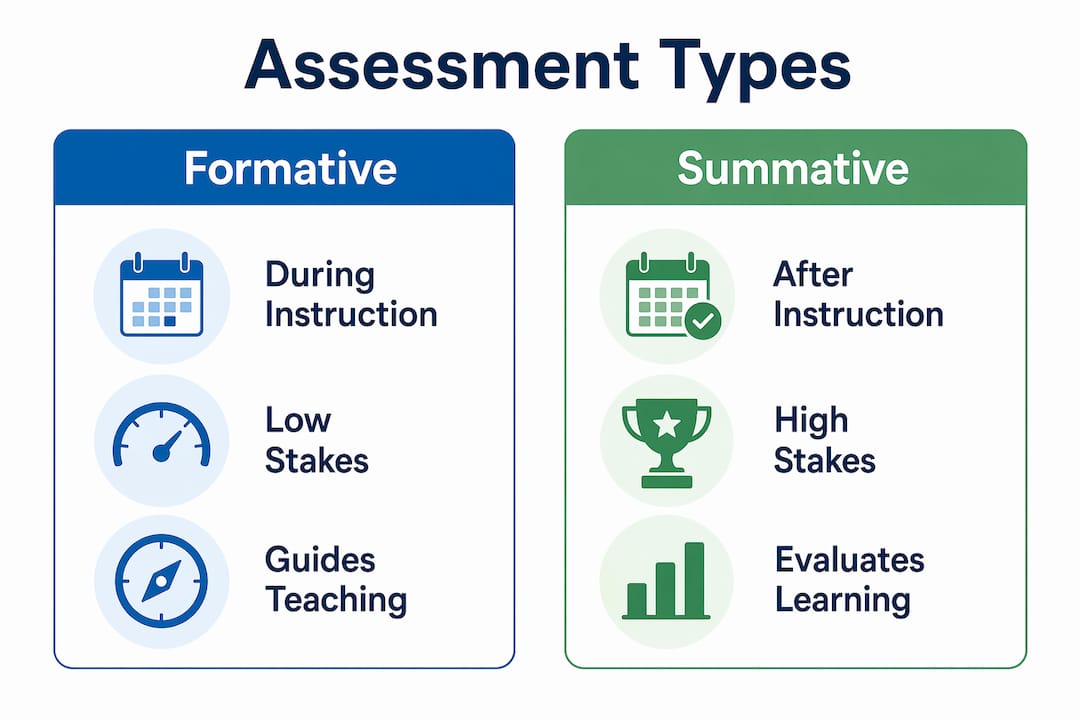
Formative assessment and summative assessment serve different purposes, and confusing the two leads to poor implementation of both. Formative assessment occurs during instruction. Summative assessment occurs after instruction, typically to evaluate final learning outcomes for grading or placement decisions.
The table below contrasts the two approaches across key attributes.
| Attribute | Formative assessment | Summative assessment |
|---|---|---|
| Timing | During instruction | After instruction |
| Stakes | Low, does not affect final grade | High, directly affects grade |
| Purpose | Guide teaching and learning | Evaluate final outcomes |
| Frequency | Frequent, ongoing | Periodic or end-of-term |
| Feedback | Immediate and specific | Delayed, often a score or grade |
| Student role | Active partner in learning | Subject of evaluation |
The most important distinction is purpose. Formative assessment asks: “What do students understand right now, and what should I do next?” Summative assessment asks: “What did students learn overall?” Both have a place in good teaching, but they answer different questions. Educators who treat formative checks as mini-summative tests miss the point entirely. The goal is not to assign a score. The goal is to collect evidence and act on it.
Formative assessment empowers students as active partners by involving them in goal setting and peer feedback. That shift from “teacher as judge” to “teacher as partner” is what makes formative practice distinct from traditional evaluation.
Practical formative assessment techniques for the classroom
Formative assessment techniques fall into three categories: entry and exit checks, engagement tools, and reflection activities. Each category serves a specific moment in the lesson cycle. Entry checks reveal what students already know. Engagement tools capture understanding mid-lesson. Reflection activities close the loop at the end.

Formative assessments typically take 1–8 minutes to implement within a lesson. That time constraint is a feature, not a limitation. Short, focused checks produce cleaner data than long, elaborate tasks.
The following techniques are widely used and require minimal preparation:
- Exit tickets: Students write one thing they learned and one question they still have. Takes 3–5 minutes. Reveals gaps immediately.
- Thumbs up/thumbs down: A quick visual check during instruction. Zero prep. Instant read on class confidence.
- Mini-quizzes: Three to five questions on the day’s content. Takes 5–7 minutes. Identifies which concepts need reteaching.
- One-word summaries: Students choose a single word to capture the lesson’s main idea. Reveals depth of understanding quickly.
- Think-pair-share: Students discuss a prompt with a partner before sharing with the class. Surfaces misconceptions through dialogue.
- Whiteboards: Students write answers and hold them up simultaneously. Teachers see every response at once.
- Muddiest point: Students write the concept they find most confusing. Takes two minutes. Directly informs the next lesson.
- Peer feedback: Students review each other’s work using a simple checklist. Builds self-regulation alongside content knowledge.
- Traffic light cards: Students hold up red, yellow, or green cards to signal their confidence level. Immediate and visual.
- Four corners: Students move to a corner of the room based on their answer to a question. Kinesthetic and easy to read.
Pro Tip: Choose techniques that are high-engagement and low-preparation. A whiteboard check or exit ticket gives you cleaner, faster data than a complex digital survey. Reserve technology for moments when it genuinely adds value, not as a default.
Explore ESL classroom engagement ideas for additional strategies that pair well with these techniques in language teaching contexts.
What are the benefits of formative assessment for teachers and students?
Formative assessment closes the gap between teaching and learning. Teachers who use it regularly identify learning gaps early, before those gaps compound into larger misunderstandings. That early detection allows for timely instructional adjustments rather than remediation after a failed test.
Weekly formative check-ins enhance engagement by 25–35% compared to infrequent summative tests. That gain reflects a fundamental shift in classroom culture. When students know their input shapes the next lesson, they participate more actively and take greater ownership of their learning.
“Shifting from ‘teacher-as-judge’ to ‘teacher-as-partner’ fosters self-directed learning and increases student motivation.” — NWEA, 2025
Equity is another concrete benefit. Frequent low-stakes checks surface early gaps in learning for students who might otherwise stay silent during whole-class instruction. NCTM and NCTE guidelines emphasize that frequent low-stakes checks aligned to learning targets support equity by making every student’s understanding visible. A student who struggles but never speaks up gets seen through a whiteboard check or exit ticket in a way that a unit test cannot replicate.
For teachers, the benefit is clarity. Formative data replaces guesswork with evidence. Instead of assuming the class understood a concept because no one asked a question, teachers have actual data showing which students are ready to move forward and which need more support.
Common misconceptions and pitfalls to avoid
The most damaging misconception about formative assessment is that collecting data is enough. Formative assessment must result in instructional changes or feedback to be effective. Gathering exit tickets and filing them away without adjusting the next lesson fails the entire purpose of the practice.
A second common error is over-formalizing the process. Teachers who design elaborate rubrics, lengthy reflection forms, or complex digital surveys for every check-in quickly burn out and abandon the practice. Simple, low-preparation assessments are often more effective than elaborate ones, according to NCTM and NCME recommendations. The simpler the tool, the more likely it gets used consistently.
Hiring windows close while you scroll.
Deadlines, salaries and visa notes for teaching jobs worldwide, checked against official sources and sent free every two weeks.
Get on the WireSelf-assessment is another area where confusion is common. True formative self-assessment focuses on self-regulation and reflection, not self-grading. Asking students to assign themselves a score is a summative act. Asking students to identify what they understand well and what still confuses them is formative. The distinction matters because only the second version supports learning.
Privacy in self-reflection also matters more than most teachers realize. Students are more honest in self-evaluation when given privacy. Allowing some reflections to remain internal rather than shared with the class produces more accurate data and more authentic student engagement.
Pro Tip: After collecting any formative data, make one visible instructional change before the next class. Even a brief “I noticed many of you found X confusing, so we’ll revisit it today” signals to students that their feedback has real consequences.
How to integrate formative assessment into daily teaching practice
Embedding formative assessment into daily teaching does not require a curriculum overhaul. It requires consistent, small habits that become part of the lesson structure. The pedagogical cycle of eliciting evidence, interpreting it, and acting is the core practice. Technology supports that cycle but does not replace it.
The following steps help teachers build that cycle into their regular workflow:
- Set a clear learning target for each lesson. Students and teachers need to know what success looks like before any check-in can be meaningful.
- Choose one technique per lesson. Rotating through exit tickets, mini-quizzes, and think-pair-share keeps students engaged without adding preparation time.
- Review data immediately after class. Spend five minutes sorting exit tickets into three piles: got it, almost, and not yet.
- Adjust the next lesson based on what you find. Reteach the “not yet” concepts before moving forward.
- Involve students in the process. Share aggregate results with the class. Ask students to set a personal goal based on what the data shows.
- Align checks to your learning standards. Each formative check should map directly to a specific standard or learning objective, not just general content coverage.
This process works across subjects and class sizes. A language teacher using peer teaching strategies can embed think-pair-share and peer feedback naturally within collaborative activities. A large lecture-style class can use whiteboard checks or traffic light cards to get simultaneous responses from every student. The method adapts. The cycle stays the same.
Key takeaways
Formative assessment is most effective when it is frequent, low-stakes, and immediately acted upon to adjust instruction and support student learning.
| Point | Details |
|---|---|
| Definition and purpose | Formative assessment monitors learning during instruction, not after, and guides teaching adjustments in real time. |
| Differs from summative | Summative assessment evaluates final outcomes; formative assessment collects evidence to improve ongoing instruction. |
| Time-efficient techniques | Exit tickets, mini-quizzes, and whiteboard checks take 1–8 minutes and produce immediately usable data. |
| Act on data immediately | Collecting formative data without adjusting instruction defeats the purpose and wastes student and teacher time. |
| Self-assessment means reflection | True formative self-assessment is about self-regulation and identifying confusion, not assigning a personal grade. |
Why formative assessment changed how I think about teaching
I spent years treating assessment as something that happened at the end of a unit. Tests told me what students had learned. What they could not tell me was when the learning broke down or why. That gap between teaching and understanding was invisible until I started using exit tickets consistently.
The shift was not dramatic. Three questions at the end of class, collected and sorted in five minutes. What surprised me was how often I was wrong about what students understood. A lesson I thought went well would produce exit tickets showing a third of the class still confused about a core concept. A lesson I thought was too simple would reveal genuine depth in student thinking.
What formative practice taught me is that student silence is not understanding. Students who do not ask questions are not necessarily following along. They may be lost and unwilling to say so in front of peers. A private muddiest-point card or an anonymous digital check-in surfaces that confusion in a way that whole-class discussion never will.
The other lesson I carry is about self-assessment. Asking students to grade themselves produces inflated scores and defensive thinking. Asking students to write what still confuses them produces honest, useful data. That distinction took me longer to learn than it should have. The NCME guidance on self-regulation versus self-grading articulates it clearly, but the practical difference only became obvious once I saw both approaches in action.
Formative assessment is not a technique. It is a teaching orientation. The question is not “Did I cover this?” The question is “Do they understand it, and what do I do next?”
Teflinstitute courses for educators building assessment skills
Educators who want to apply formative assessment effectively in ESL and TEFL classrooms benefit from structured training in instructional design and evaluation methods. Teflinstitute offers certification programs that develop exactly those skills.

The 240 Hour Master TEFL Course covers lesson planning, student evaluation, and feedback strategies at an advanced level, making it well-suited for teachers who want to build formative practice into their daily instruction. For educators focused on a specific skill set, the 120 Hour Elective TEFL Course provides targeted training in teaching methods and classroom assessment. Both programs are fully online and externally accredited, supporting educators at any stage of their career.
FAQ
What is formative assessment in simple terms?
Formative assessment is a low-stakes, ongoing process where teachers collect evidence of student understanding during instruction and use it to adjust their teaching. It does not affect final grades.
How does formative assessment differ from summative assessment?
Formative assessment happens during instruction and guides teaching decisions. Summative assessment happens after instruction and evaluates final learning outcomes for grading or placement.
What are some quick formative assessment examples?
Exit tickets, mini-quizzes, whiteboard checks, think-pair-share, and traffic light cards are all effective formative techniques that take 1–8 minutes to complete.
How often should teachers use formative assessment?
NCTM and NCTE guidelines recommend frequent, weekly low-stakes checks aligned to specific learning targets. Daily or per-lesson checks produce the most usable instructional data.
Does formative assessment include self-assessment?
Yes, but only when self-assessment focuses on reflection and self-regulation, not self-grading. Students should identify what they understand and what still confuses them, not assign themselves a score.
Recommended
TEFL Institute guides