
 United Kingdom (UK)
 United States (US)
 Canada
 South Africa
 India
India Australia
 New Zealand
 China
China Russia
 Germany
 France
 Spain
Spain Netherlands
 Vietnam
 United Arab Emirates
 Italy
Italy Poland
 Thailand
 Türkiye









 Algeria


English for Academic Purposes: A Guide for Educators
English for Academic Purposes: A Guide for Educators

TL;DR:
- English for Academic Purposes (EAP) focuses on developing students’ academic literacy, critical reading, and research skills for higher education contexts. It requires understanding discipline-specific norms, explicit instruction, and inclusive, technology-supported methodologies tailored to diverse learners. Effective EAP teaching demands deep expertise, ongoing professional development, and adaptation to evolving academic environments.
English for Academic Purposes is not simply a more formal version of general language instruction. Many educators entering this field assume that strong general English teaching skills transfer directly to academic contexts. They rarely do. EAP is defined specifically as the language and related academic practices students need to study or work through the medium of English in higher education. The gap between surface-level language competence and genuine academic literacy is significant, and understanding that distinction is the first step toward becoming an effective EAP educator.
Table of Contents
- What is English for academic purposes? Defining EAP
- Core skills and practices in EAP instruction
- Effective methodologies: Teaching EAP in the modern classroom
- Inclusivity and innovation: Advancing EAP for today’s diverse learners
- Why deep EAP competence is the real game changer for educators
- Build your EAP mastery with specialized training and support
- Frequently asked questions
Key Takeaways
| Point | Details |
|---|---|
| EAP goes beyond basics | It equips learners for academic study and professional contexts, addressing more than everyday English. |
| Writing is critical | Academic writing, integrity, and revision skills are at the heart of most EAP programs. |
| Modern methods matter | Blending learner-centered, technological, and explicit instruction boosts EAP effectiveness. |
| Inclusivity is key | Inclusive curriculum and practices enable diverse students to thrive academically. |
| Continuous learning wins | Ongoing teacher training and adaptability are vital for EAP success. |
What is English for academic purposes? Defining EAP
EAP is a specialized field of English language teaching that prepares learners for the linguistic, cognitive, and social demands of higher education and professional academic environments. It is not about conversational fluency or everyday grammar. It is about equipping students with the tools to read critically, write persuasively, engage in scholarly discourse, and navigate the institutional norms of universities and research institutions.
EAP courses aim to help learners acquire the linguistic and cultural practices involved in academic study and work in English-medium higher education. That includes both the institutional conventions of academic life and the discipline-specific norms that vary between fields such as law, medicine, engineering, and the social sciences.
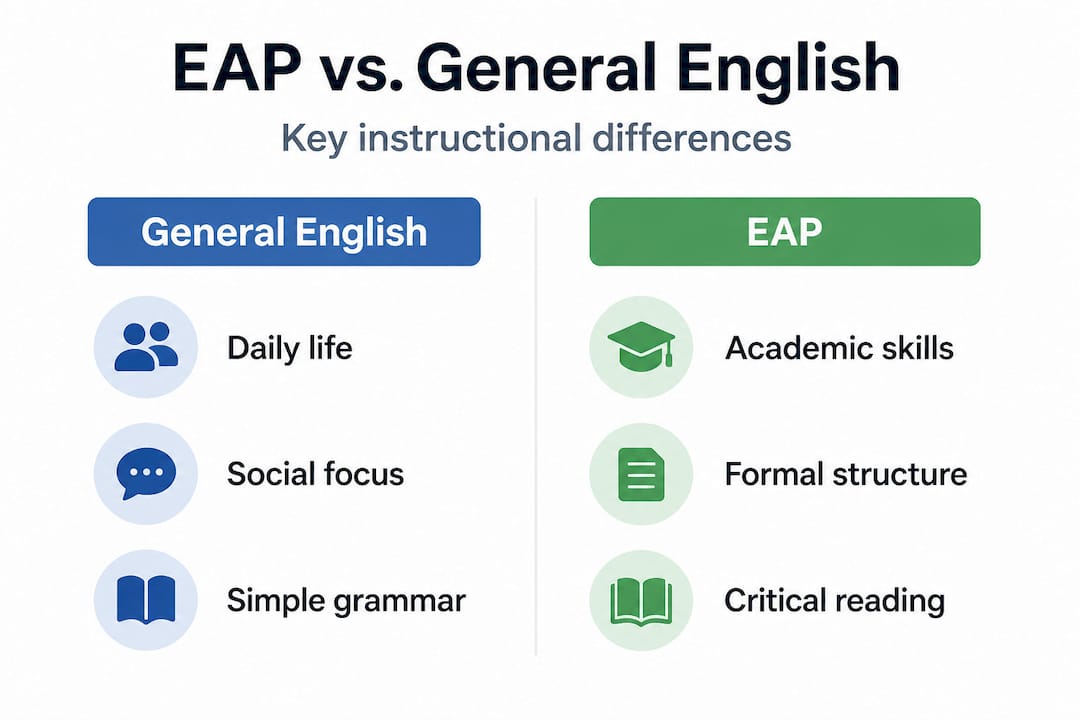
Understanding how EAP differs from general English teaching is foundational for any educator considering this path. The table below outlines the core distinctions:
| Feature | General English teaching | EAP |
|---|---|---|
| Primary goal | Everyday communication | Academic language proficiency |
| Skills focus | Speaking, listening, basic writing | Academic writing, critical reading, discourse |
| Context | Social and personal settings | University and professional academic settings |
| Assessment types | Conversational, practical tasks | Essays, research reports, presentations |
| Cultural focus | General social norms | Institutional and disciplinary conventions |
| Vocabulary | High-frequency everyday words | Academic word lists, discipline-specific terminology |
The differences extend beyond curriculum design. In EAP, educators must understand how knowledge is constructed within specific academic disciplines, how citation and referencing reflect intellectual integrity, and how students from different educational backgrounds bring varying assumptions about learning and argumentation.
Key characteristics that define EAP programs include:
- Emphasis on reading authentic academic texts such as journal articles and textbook chapters
- Structured academic writing instruction covering argument, thesis development, and evidence integration
- Speaking tasks modeled on real academic contexts such as seminars, group debates, and oral presentations
- Critical thinking development as a cross-cutting skill
- Explicit instruction in citation conventions and academic integrity
“EAP is not a single, unified field. It adapts to the specific linguistic and cultural demands of the academic community in which learners will operate.” This adaptability makes EAP teaching both demanding and professionally rewarding.
Core skills and practices in EAP instruction
With the definition clear, it is important to recognize the specific academic skills and processes that EAP develops, which are often very different from general language instruction.

Academic writing sits at the center of most EAP programs. Students entering higher education frequently struggle to produce structured arguments supported by evidence, a task that requires far more than grammatical accuracy. It requires understanding genre conventions, audience awareness, and the ability to synthesize information from multiple sources. EAP methodology operationalizes academic language through authentic, task-based work such as reading lectures, seminar discussion, and writing, including planning, drafting, revising, and citation and referencing.
Effective EAP instruction develops skills across multiple domains:
- Academic writing: Teaching the planning, drafting, and revision process with a focus on argument structure and coherent paragraphing
- Critical reading: Building learner ability to evaluate sources, identify authorial stance, and synthesize multiple texts
- Academic listening: Preparing students to extract key information from lectures, take effective notes, and follow complex spoken discourse
- Seminar participation: Developing the language of discussion, hedging, agreeing, and disagreeing in academic contexts
- Oral presentations: Building confidence and formal spoken language skills for academic audiences
- Research skills and citation: Teaching referencing systems such as APA and MLA and reinforcing academic integrity principles
The process approach to writing is particularly central to EAP methodology. Rather than assigning a final product, effective EAP educators guide students through the entire writing cycle. This includes brainstorming and planning content, drafting initial versions, receiving structured feedback, and revising based on both language accuracy and argument quality.
When you compare this approach to business English classroom strategies, the differences become clear. Business English prioritizes functional communication in professional environments. EAP prioritizes the capacity to engage with knowledge at a scholarly level. Both demand specialized training, but the outcomes and methods diverge significantly.
Pro Tip: When designing EAP writing tasks, build in multiple low-stakes checkpoints throughout the writing process rather than relying on a single final submission. This mirrors the real academic writing cycle and reduces learner anxiety around high-stakes assessments.
| EAP skill area | Common student challenges | Effective instructional strategy |
|---|---|---|
| Academic writing | Lack of argumentation structure | Process writing with staged feedback |
| Critical reading | Passive reading habits | Guided annotation and source evaluation tasks |
| Seminar participation | Reluctance to express opinions | Structured debate and discussion frameworks |
| Citation and referencing | Confusion about when to cite | Explicit modeling with authentic academic texts |
| Academic listening | Inability to identify key points | Guided note-taking from recorded lectures |
Effective methodologies: Teaching EAP in the modern classroom
Developing EAP skills requires specialized methods. Let’s examine which approaches research and educators consider most effective and where real classroom challenges arise.
Effective EAP instruction often combines learner-centered approaches with explicit teaching of academic language. It increasingly integrates multimodal and technology-supported instruction, while also acknowledging real constraints such as variable student proficiency and limited teacher training. This finding from a recent narrative review of EAP teaching strategies reflects the practical reality that no single methodology is sufficient on its own.
The most widely endorsed approaches in contemporary EAP instruction include:
- Explicit language instruction: Direct teaching of academic vocabulary, grammar patterns relevant to academic prose, and genre conventions, rather than assuming learners will acquire these incidentally
- Task-based learning: Using real or simulated academic tasks such as essay writing, oral summaries, and source evaluation as the primary vehicle for language development
- Genre-based pedagogy: Teaching students to analyze and produce texts within recognized academic genres, including argumentative essays, literature reviews, and lab reports
- Learner-centered design: Allowing students to bring their own disciplinary content and interests into writing and speaking tasks, which increases motivation and relevance
- Blended and multimodal instruction: Incorporating digital tools, video resources, collaborative platforms, and online feedback mechanisms alongside face-to-face instruction
Staying current with ESL teaching trends is not optional for EAP educators. Technology is reshaping how academic language skills are taught and assessed. Corpus-based tools allow students to analyze authentic academic language patterns at scale. Writing platforms provide real-time feedback. Collaborative tools such as shared documents enable peer review processes that mirror academic writing communities.
The integration of TEFL technology tools into EAP classrooms requires deliberate planning. Technology must serve the learning outcome, not replace substantive instruction. A well-designed digital task that replicates a seminar discussion or a peer-reviewed drafting process builds skills far more effectively than passive use of online grammar checkers.
For educators transitioning to online environments, resources on setting up online ESL classes provide practical scaffolding for creating effective digital learning spaces. The principles of EAP instruction transfer to online delivery, but require adjustment in how feedback is structured and how synchronous versus asynchronous tasks are balanced.
Pro Tip: Use authentic academic texts from the actual disciplines your students are entering. A nursing student benefits far more from analyzing a peer-reviewed medical case study than from a generic academic writing textbook passage. Contextual relevance drives both comprehension and motivation.
How expert trainers shape success in online education reinforces a broader point: teacher preparation is a defining variable in EAP outcomes. Educators who receive structured training in academic language teaching principles, assessment design, and learner diversity produce measurably better student results.
Inclusivity and innovation: Advancing EAP for today’s diverse learners
As you adapt your teaching, it is also essential to build inclusive, forward-thinking classrooms. Leading practitioners are actively advancing EAP to meet the needs of all learners.
The student populations in contemporary EAP programs are genuinely diverse. They include first-generation university entrants, international students transitioning from non-English-medium education systems, students with learning differences, and mature-aged learners returning to study after years in professional or vocational settings. Each of these groups brings distinct strengths and faces distinct challenges.
Inclusivity in EAP is supported by a coordinated set of approaches spanning classroom pedagogy, assessment design, and institutional policy. These include culturally responsive teaching, equitable assessment design, and decolonial and multilingual practices. This research finding is significant: inclusive EAP is not achieved through a single classroom strategy. It requires alignment across multiple levels of educational practice.
Core inclusive practices in EAP include:
- Culturally responsive pedagogy: Acknowledging and integrating the diverse academic traditions that learners bring from their home education systems, rather than treating Western academic conventions as the only valid norm
- Differentiated instruction: Adjusting task complexity, scaffolding levels, and assessment formats to accommodate different starting points without lowering academic expectations
- Equitable assessment design: Providing multiple forms of assessment, including portfolios, presentations, and collaborative projects, rather than relying exclusively on timed written exams
- Multilingual affirmation: Allowing strategic use of learners’ first languages as a cognitive resource during planning and drafting phases, rather than enforcing English-only policies that may restrict complex thinking
- Institutional advocacy: Working with departments and program coordinators to ensure that EAP support is recognized as a central rather than peripheral academic service
“Decolonial and multilingual approaches in EAP recognize that academic English is not culturally neutral. Effective educators create space for learners to critically engage with academic conventions rather than simply comply with them.”
Practical guidance on ESL classroom setup strategies offers applicable insights for structuring physical and digital learning environments that support diverse learner groups. The principles of accessibility, flexible grouping, and resource variety are directly relevant to inclusive EAP practice.
Pro Tip: Before the start of each EAP program, survey your learners about their prior academic experience, the educational systems they were trained in, and their specific academic goals. This data shapes curriculum decisions and signals to students that their backgrounds are valued, not erased.
Why deep EAP competence is the real game changer for educators
Stepping back, it is worth asking what genuine EAP expertise actually looks like in practice, and why it matters for your personal development as an educator.
There is a real risk that educators approach EAP as a set of teachable techniques. Learn the academic word list. Teach the five-paragraph essay. Explain APA referencing. Apply these methods, and the work is done. This framing is not wrong, but it is incomplete. Surface-level command of EAP methods produces surface-level classroom results.
What distinguishes truly effective EAP educators is something harder to reduce to a checklist. It is the ability to read a student’s writing and understand not just the grammatical errors, but the argumentative gap that underlies them. It is the capacity to recognize when a student’s unfamiliarity with academic conventions reflects a cultural assumption about knowledge-sharing rather than a lack of intelligence or effort. It is knowing when to provide explicit correction and when to ask a question that prompts the student to self-evaluate.
Deep EAP competence also means understanding the relationship between language, assessment, and institutional power. Academic assessments are not neutral measures of ability. They reflect specific conventions about what counts as valid argument, credible evidence, and appropriate register. Educators who understand this complexity can help students navigate academic systems more strategically without simply asking them to abandon their own intellectual frameworks.
The online English teaching roadmap offers a broader view of how EAP fits within the wider landscape of English language education, and where specialization in academic purposes positions educators in terms of career development and impact.
No single benchmark or certification defines success in EAP teaching. What matters is ongoing adaptation, sustained engagement with current research, and genuine alignment with the academic contexts in which your students will operate. The educators who create lasting impact are those who treat their own professional development with the same rigor they expect from their learners.
Build your EAP mastery with specialized training and support
When you are ready to turn understanding into action, specialized training is the most direct path to building both knowledge and classroom confidence.

TEFL Institute offers a structured range of advanced training options designed for educators who want to move beyond foundational certification into specialized areas of English language teaching. Whether you are exploring in-person experiences through TEFL courses in Newcastle or looking to expand your current qualifications through EAP course extensions, the platform provides practical, accredited pathways that align with real-world teaching demands. Deepening your expertise in academic English instruction positions you for roles in higher education support, university language centers, and international academic preparation programs. The training resources available are designed to meet you where you are and take your teaching to a more advanced professional level.
Frequently asked questions
How does EAP differ from general English teaching?
EAP targets academic skills like research writing, seminars, and citation, which go well beyond everyday conversation. EAP courses aim to develop the linguistic and cultural practices required specifically for academic study and work in English-medium higher education.
What are the key challenges in teaching EAP?
Common challenges include varied student proficiency levels, limited access to specialized teacher training, and the demands of integrating technology effectively into instruction. Effective EAP instruction requires combining learner-centered approaches with explicit language teaching while managing these real-world constraints.
Can EAP be taught online?
Yes. EAP teaching increasingly uses online and blended delivery models, though effective implementation requires careful attention to platform design, task structure, and feedback mechanisms. Learner-centered and multimodal strategies, including blended learning and structured teacher development, are recognized as effective online approaches.
How do inclusive practices enhance EAP learning?
Inclusive practices create equitable conditions for diverse learners by adapting curriculum, assessment, and cultural framing to reflect the full range of student backgrounds. Inclusivity in EAP requires coordinated approaches across classroom pedagogy, assessment design, and institutional policy to achieve meaningful, sustainable outcomes.
Recommended
- What Is Business English? Essential Guide for TEFL Teachers | TEFL Institute
- How to Teach Business English: A Practical Step-by-Step Guide | TEFL Institute
- Teaching Business English Explained: Complete Guide | TEFL Institute
- Planning an online ESL lesson: step-by-step guide | TEFL Institute
- How expert trainers shape your success in online education
TEFL Institute guides

Mexico
Jobs, pay and cities
China
Z visa, pay and cities
Cambodia
Pay, requirements and visas
Spain
Jobs, pay and visa routes
South Korea
EPIK, hagwons and pay