
 United Kingdom (UK)
 United States (US)
 Canada
 South Africa
 India
India Australia
 New Zealand
 China
China Russia
 Germany
 France
 Spain
Spain Netherlands
 Vietnam
 United Arab Emirates
 Italy
Italy Poland
 Thailand
 Türkiye









 Algeria


British Council Accredited TEFL Courses: What You Need to Know
British Council Accredited TEFL Courses: What You Need to Know

The British Council does not accredit, validate, or endorse individual TEFL or TESOL courses. This is one of the most persistent misconceptions in the field, and it affects how prospective teachers evaluate their certification options. What the British Council does instead is assess teacher qualifications internally, for the purpose of determining whether staff at its accredited institutions meet its own staffing criteria. The key distinctions are:
- The British Council does not accredit, validate, or endorse any third-party TEFL or TESOL course.
- It uses two internal qualification tiers, TEFLi and TEFLQ, solely to assess whether an institution’s teaching staff meet its scheme requirements.
- Qualifications like Cambridge CELTA and Trinity CertTESOL are recognized by the British Council as meeting those internal staffing standards. That recognition does not make those courses “British Council accredited.”
- No TEFL course provider can legitimately claim British Council accreditation for its courses.
What does the British Council actually assess in TEFL qualifications?
The British Council Accreditation Scheme, run jointly with English UK, evaluates whether organizations meet teaching and learning criteria for their own staff. It does not assess or approve courses offered by external training providers. The scheme classifies teacher qualifications into two tiers:
- TEFLi (TEFL Initiated): An entry-level certificate in ELT/TESOL, typically for teachers with little or no prior experience. To qualify at this level, a course must be externally validated by a reputable examination body or accredited by a national body such as Ofqual in England, include at least six hours of supervised teaching practice with qualified assessors, and contain a minimum of 100 hours of ELT/TESOL input.
- TEFLQ (TEFL Qualified): A diploma-level qualification for experienced teachers pursuing a sustained ELT career. Requirements include prior ELT teaching experience, external validation, at least five hours of supervised teaching practice, and a minimum of 100 hours of ELT/TESOL input.
These standards exist to help British Council-accredited institutions verify that their staff hold recognized qualifications. A course provider whose program aligns with TEFLi or TEFLQ criteria does not thereby receive British Council accreditation for that course. The distinction is between an institution’s staff being assessed against a standard and a course being formally accredited by an external body.
Which TEFL qualifications are recognized globally and in the U.S.?
Cambridge CELTA and Trinity CertTESOL are the two qualifications most widely recognized as meeting British Council TEFLQ staffing standards. Both require rigorous external assessment and supervised teaching practice, and both are accepted by the British Council for teachers in its accredited organizations in the UK and in its own teaching centers worldwide.
“Trinity’s TESOL qualifications are accepted by most employers worldwide. They are welcomed by the British Council for new and experienced teachers in their accredited teaching organisations in the UK, and in their own teaching centres worldwide.” — Trinity College London
Beyond these two qualifications, the following factors determine whether a TEFL certification is genuinely recognized:
- External validation by a university or recognized examination board
- Regulation by a national curriculum authority such as Ofqual
- A minimum of 120 hours of coursework
- Observed and assessed teaching practice with real students
In the U.S. context, the Distance Education Accrediting Commission (DEAC) provides an additional layer of recognized accreditation for online TEFL programs. University-validated programs carry particular weight with employers in competitive markets, including higher education institutions and government-linked language programs.
What does British Council non-accreditation mean for TEFL job seekers?
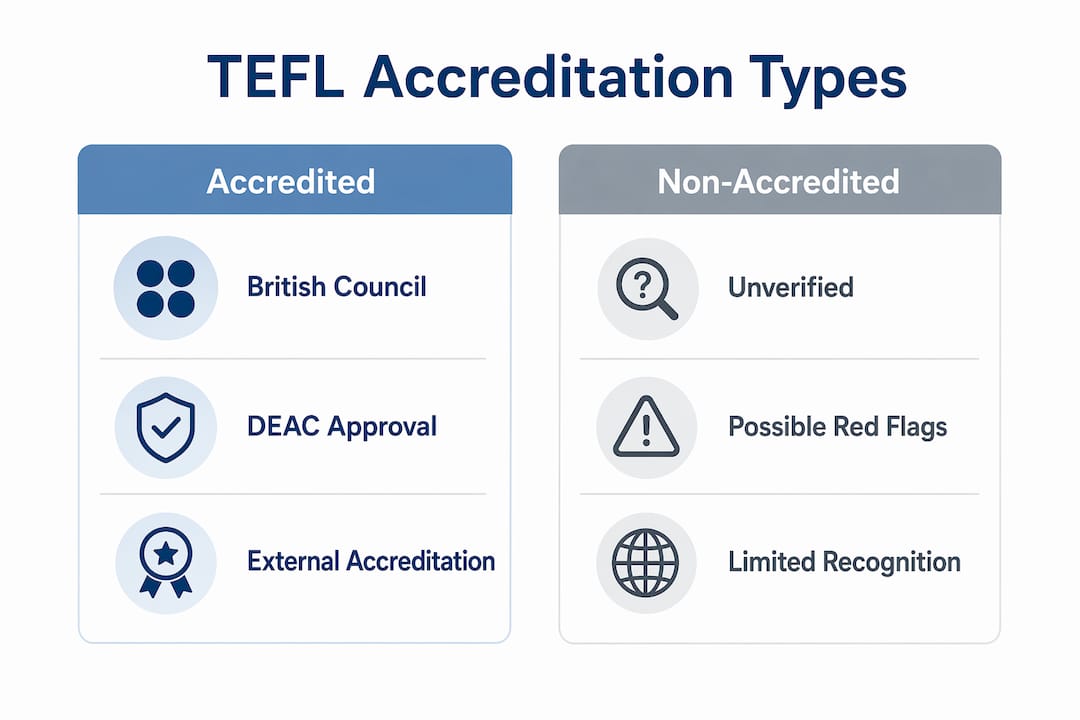
British Council accreditation of a TEFL course does not exist, so the absence of it should not factor into a job search. What matters to employers is whether a certification meets recognized industry standards, not whether it carries a British Council logo. Competitive markets such as the Middle East, East Asia, and tertiary education settings typically require diploma-level TEFLQ qualifications regardless of any accreditation branding on a certificate.
Practical hiring criteria that employers actually evaluate include:
- Observed teaching practice with qualified assessors
- Minimum course hours (typically 120 hours or more for international roles)
- External validation or regulation by a recognized body
- Alignment with the qualification standards of the target country or institution
For U.S.-based teachers targeting high-demand international markets, a diploma-level certification with external accreditation consistently outperforms a certificate-level course with a prestigious-sounding but unverifiable endorsement. Visa eligibility in countries like the UAE, Saudi Arabia, and Japan often requires documented proof of course hours and supervised practice, not a logo.
Pros, cons, and how to verify legitimate TEFL accreditation

Some TEFL course providers market their programs using language that implies a British Council connection. Many courses wrongly claim British Council accreditation, which creates real confusion for prospective teachers evaluating their options.
Perceived benefits of British Council-aligned claims:
- Association with a globally recognized educational organization
- Potential alignment with TEFLi or TEFLQ standards, which can be genuinely useful
Risks and drawbacks:
- Claims of “British Council accreditation” for a course are factually inaccurate and may indicate broader quality issues
- Marketing phrases like “internationally recognized” or “British Council endorsed” carry no verifiable meaning
- Courses using such language may lack genuine external validation
How to verify a course’s accreditation status:
- Check whether the course is regulated by Ofqual or validated by a named university
- Confirm the accrediting body is independent and publicly searchable
- Look for a minimum of 120 hours of coursework and documented supervised teaching practice
- For U.S. learners, check whether the provider holds DEAC approval or equivalent recognized accreditation
Pro Tip: If a TEFL course cannot name its accrediting body clearly on its website, treat that as a red flag. Legitimate accreditation is always verifiable through the accrediting organization’s public registry.
Accreditation claims are easiest to judge side by side, so we publish a full comparison of TEFL course providers showing exactly which bodies each major provider names, plus prices and published review scores.
Accredited TEFL certification options for U.S. learners

U.S.-based learners have access to a range of externally accredited TEFL certification courses. The most credible options share three features: external accreditation from a recognized body, a minimum of 120 hours of training, and a supervised teaching practice component.
Key criteria for choosing an accredited course:
- External accreditation from DEAC, Ofqual, or a recognized university
- At least 120 hours of coursework for international roles
- Observed teaching practice with qualified assessors
- Specialist modules available for target markets (online teaching, IELTS, young learners)
- Job placement support and certification verification
Teflinstitute offers a DEAC-approved course catalog covering online and offline formats, including advanced diplomas, micro-credentials, and specialist programs. Its courses are designed to meet the qualification standards employers and visa authorities recognize, with certification verification tools available directly through the platform.
| Course Type | Accreditation | Hours | Supervised Practice | Format |
|---|---|---|---|---|
| Certificate (entry-level) | DEAC / Ofqual | 120 hours | Required | Online / Hybrid |
| Advanced Diploma | DEAC / University-validated | 240 hours | Required | Online / Hybrid |
| Specialist (IELTS, Online Teaching) | DEAC | Varies | Varies | Online |
| Cambridge CELTA | Cambridge / Ofqual | 120+ hours | Required | In-person / Blended |
| Trinity CertTESOL | Trinity College London | 120+ hours | Required | In-person / Blended |
For teachers targeting online TEFL roles or building toward a diploma-level qualification, starting with a recognized 120-hour certificate and progressing to an advanced diploma provides a clear, employer-accepted pathway.
Teflinstitute’s 120-hour TEFL course and 240-hour Master TEFL course are both DEAC-approved, externally accredited, and structured to meet the qualification standards that employers and visa offices recognize. Whether you are entering the field or advancing toward diploma-level status, both programs provide a verifiable, credible certification path.
Key Takeaways
The British Council does not accredit TEFL courses; it only assesses whether staff qualifications at its own accredited institutions meet its internal TEFLi or TEFLQ standards.
| Point | Details |
|---|---|
| British Council does not accredit courses | No TEFL course can legitimately claim British Council accreditation; the scheme applies only to staff qualifications. |
| TEFLi and TEFLQ are internal standards | These tiers help British Council institutions assess staff, not certify external course quality. |
| A substantial minimum amount of training hours is recognized | Employers and visa offices internationally require adequate training hours with supervised teaching practice. |
| External validation is what counts | Accreditation from Ofqual, DEAC, or a recognized university is the credible standard for U.S. learners. |
| CELTA and CertTESOL meet TEFLQ standards | Both qualifications are accepted by the British Council for staff roles and recognized by employers worldwide. |
Recommended
TEFL Institute guides

Japan
JET, ALT and eikaiwa pay
China
Z visa, pay and cities
Vietnam
Work permits and requirements
Czech Republic
Pay, visas and cities
Taiwan
Buxibans, pay and visas