United Kingdom (UK)
 United States (US)
 Canada
 South Africa
 India
India Australia
 New Zealand
 China
China Russia
 Germany
 France
 Spain
Spain Netherlands
 Vietnam
 United Arab Emirates
 Italy
Italy Poland
 Thailand
 Türkiye











 Algeria


What Do You Need to Teach English Online in 2026
What Do You Need to Teach English Online in 2026

TL;DR:
- Teaching English online requires at least a 120-hour accredited TEFL certification, reliable equipment, and strong teaching skills. A good internet connection and professional setup are essential to retain students and succeed. Most teachers start on platforms and then shift to private clients for higher earnings.
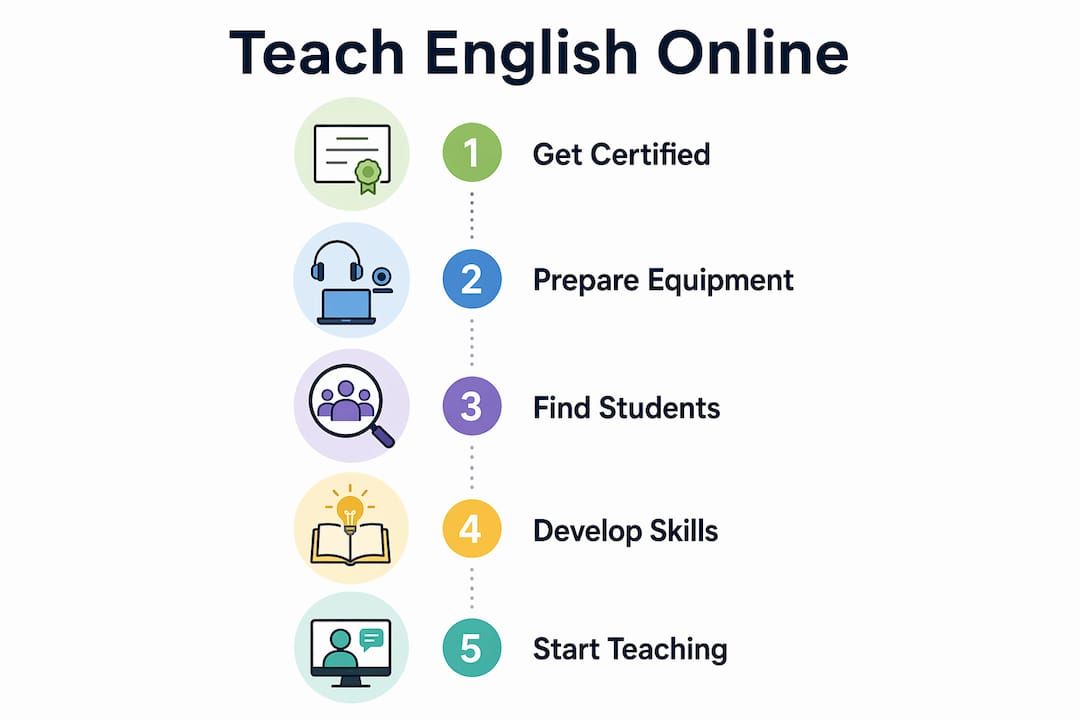
Teaching English online requires a minimum 120-hour accredited TEFL certification, a reliable computer, a stable internet connection, and clear communication skills. TEFL stands for Teaching English as a Foreign Language, and it is the recognized industry credential for this career path. Whether you want to know how to become an online English teacher, how to teach ESL online, or simply how to start teaching English online and get paid, the core requirements are the same. This guide covers every essential: credentials, equipment, teaching skills, and the practical steps to find students and build a sustainable income.
What do you need to teach English online: certification and qualifications
A 120-hour TEFL certificate is the industry standard credential that most online ESL platforms require before accepting new teachers. Without it, the majority of structured platforms will not consider your application, regardless of your background or language skills.
The TEFL certification category also includes TESOL (Teaching English to Speakers of Other Languages). Both terms describe equivalent qualifications, and most employers treat them interchangeably. The key factor is accreditation. A certificate from an accredited provider carries weight with platforms and private clients alike.
Here is what the certification landscape looks like in practice:
- 120-hour TEFL/TESOL: The minimum for most platforms, covering lesson planning, grammar instruction, and classroom management.
- 150 to 250 hours: Required by premium business English firms, often combined with a bachelor’s degree in any subject.
- Specialized add-on courses: Courses in business English, young learners, or IELTS preparation increase your marketability and allow you to charge higher rates.
- Degree requirements: Many platforms accept any bachelor’s degree. Some entry-level platforms do not require a degree at all, especially for conversation practice roles.
A degree is not always mandatory, but it does open doors to higher-paying platforms and corporate clients. Pairing a 120-hour TEFL with a specialized course, such as Teflinstitute’s 30-hour business English course, positions you for a wider range of students and better hourly rates from the start.
Pro Tip: List any corporate training, tutoring, or volunteer ESL work on your application. Platforms accept documented experience from non-classroom settings, and it accelerates hiring decisions.
Not sure which provider to certify with? Our comparison of TEFL course providers shows how the main options compare on price, accreditation, support and reviews.
What technical equipment do you need for online English teaching?
Your equipment directly affects student retention. A professional remote teaching setup in 2026 requires at minimum an 8GB RAM computer, a 1080p webcam, a wired USB noise-canceling headset, and a stable broadband connection. Upgrading to this standard typically costs $150–$300 and pays for itself quickly through better reviews and repeat bookings.

The table below summarizes the core equipment requirements:
| Equipment | Minimum Spec | Recommended Spec |
|---|---|---|
| Computer RAM | 8GB | 16GB |
| Webcam | 720p | 1080p |
| Headset | Wired USB, basic mic | Wired USB, noise-canceling |
| Internet download speed | 10 Mbps | 25 Mbps |
| Internet upload speed | 3 Mbps | 10 Mbps |
| Lighting | Natural window light | Ring light (~$25) |
Audio quality is the single most critical hardware factor. Students tolerate lower video quality but leave immediately when audio is poor. A wired USB headset in the $50–$100 range eliminates echo, background noise, and the muffled sound that built-in laptop microphones produce.
Internet speed matters just as much as hardware. The minimum is 10 Mbps download and 3 Mbps upload, but 25 Mbps download and 10 Mbps upload is the recommended standard for smooth video conferencing. Upload speed is especially critical because you are streaming your video feed continuously throughout every lesson.
Your teaching environment also shapes student perception. A clean, distraction-free background with consistent lighting signals professionalism. A ring light costing around $25 dramatically improves your on-screen appearance, even with an average webcam. Bookshelves, a plain wall, or a simple virtual background all work well.
Pro Tip: Keep a mobile hotspot as a backup internet source. Connectivity failures cause missed lessons and platform penalties. A hotspot prevents both.
For a detailed room-by-room breakdown, Teflinstitute’s ESL class setup guide covers software, lighting, and environment in full.
How can you start teaching English online and find students?
Getting your first students requires a clear, methodical approach. The steps below reflect how successful teachers build their client base from zero.
- Complete your TEFL certification. No reputable platform accepts unqualified applicants. A 120-hour certificate from an accredited provider is the non-negotiable first step.
- Choose your platform model. Entry-level teaching marketplaces handle student acquisition for you but charge commissions of 15%–30%. Direct client models require more marketing effort but yield higher net earnings.
- Build a professional profile. Write a clear bio that states your certification, teaching focus, and availability. Use a professional headshot with good lighting.
- Record a short demo video. A 60 to 90 second introduction video showing your teaching style and energy increases booking rates significantly on most platforms.
- Set a competitive starting rate. New teachers typically price lower to build reviews. Once you accumulate five or more positive reviews, raise your rate incrementally.
- Transition long-term clients to private billing. Experienced teachers move regular clients off platform commissions to direct payment arrangements, which increases net income without adding new students.
- Use social media and professional networks. LinkedIn, Facebook groups for language learners, and Instagram are all effective channels for attracting private students outside of platforms.
The platform-versus-private model is a real strategic decision. Platforms provide structure, student flow, and payment security. Private clients offer flexibility and higher margins. Most teachers start on platforms and shift toward private clients as their reputation grows.
What teaching skills make online English instructors successful?
Technical credentials and equipment get you hired. Teaching skills determine whether students rebook and recommend you. The following practices separate effective online ESL teachers from those who struggle to retain students:
- Conduct a needs analysis before the first lesson. Ask students directly about their goals, current level, and preferred learning style. This shapes every lesson plan you write.
- Plan lessons with clear objectives. Structured lesson management, including error correction techniques and progress checkpoints, keeps students engaged and moving forward.
- Give real-time feedback without interrupting flow. Note errors during speaking activities and address them at a natural pause. Constant interruption discourages students from speaking freely.
- Track student progress systematically. Keep a simple log of vocabulary covered, grammar points practiced, and areas needing review. Share progress updates with students regularly.
- Communicate between lessons. A brief message after class summarizing what was covered and what to practice builds trust and increases retention.
- Manage technical issues calmly. When video freezes or audio drops, have a protocol ready. Switch to audio-only, use the chat function, or reschedule without drama.
Soft skills like patience, reliability, and clear communication matter as much as formal qualifications. Most beginner roles do not require formal classroom teaching experience beyond TEFL/TESOL. Teaching ability can come from corporate training, tutoring, coaching, or any role that required clear explanation and active listening.
Pro Tip: Record one of your lessons with student permission and watch it back. You will spot filler words, pacing issues, and missed feedback moments that you cannot notice in real time.
For a practical framework on structuring your classes, Teflinstitute’s guide on planning an online ESL lesson provides a step-by-step method.
Key Takeaways
Teaching English online requires a 120-hour accredited TEFL certification, professional audio and video equipment, a stable internet connection, and structured teaching skills to retain students and grow income.
| Point | Details |
|---|---|
| TEFL certification is mandatory | A 120-hour accredited TEFL or TESOL certificate is the minimum credential for most platforms. |
| Audio quality drives retention | Invest $50–$100 in a wired USB noise-canceling headset before spending on any other upgrade. |
| Internet speed has a floor | Maintain at least 10 Mbps download and 3 Mbps upload, with a mobile hotspot as backup. |
| Platform commissions reduce earnings | Shift long-term clients to private billing to avoid 15%–30% platform fees. |
| Teaching skills compound over time | Needs analysis, progress tracking, and consistent communication increase student rebooking rates. |
What I’ve learned after years of watching teachers start and stall
The most common mistake new online English teachers make is treating certification as the finish line. They earn their TEFL certificate, set up a profile, and then wonder why bookings are slow. The certificate opens the door. What happens inside the virtual classroom determines everything after that.
Audio is the investment most beginners delay the longest, and it costs them the most. Students will sit through a slightly blurry video. They will not tolerate an echo or a muffled voice for 60 minutes. A $70 wired USB headset is not optional equipment. It is the first thing you should buy before your first paid lesson.
Building rapport in a virtual classroom takes deliberate effort. You cannot rely on physical presence, body language at full scale, or the natural energy of a shared room. The teachers who retain students long-term are the ones who remember details, follow up between lessons, and make every session feel personal despite the screen.
One more thing that rarely gets said: manage your schedule like a business from day one. Block your teaching hours, set cancellation policies, and track your income weekly. The teachers who burn out fastest are the ones who said yes to every time slot and never built boundaries into their calendar.
— Muller
Teflinstitute certification programs for online English teaching
Teflinstitute offers internationally recognized TEFL certification programs designed for teachers who want to start working online quickly and with confidence.
The 120-hour TEFL certification meets the standard required by most online platforms and private clients worldwide. For teachers targeting specific student groups, Teflinstitute also offers specialized courses including a young learners program and a 240-hour master TEFL course for those seeking a deeper qualification. All programs are available online, making it straightforward to certify while managing existing commitments. Teflinstitute’s courses are structured to cover lesson planning, grammar instruction, and classroom management so graduates are ready to teach from their first session.
FAQ
What is the minimum certification to teach English online?
The minimum is a 120-hour accredited TEFL or TESOL certificate. Premium platforms and business English firms may require 150–250 hours plus a bachelor’s degree.
Do you need a degree to teach English online?
A degree is not required by all platforms. Many entry-level and conversation practice platforms accept a TEFL certificate alone, though a degree expands your options significantly.
What internet speed do you need to teach online?
The minimum is 10 Mbps download and 3 Mbps upload. The recommended standard for smooth video conferencing is 25 Mbps download and 10 Mbps upload.
How do online English teachers get paid?
Teachers on platforms receive payment through the platform after each lesson, minus a commission of 15%–30%. Private clients pay directly via bank transfer, PayPal, or similar services, with no commission deducted.
Can you teach English online without prior teaching experience?
Yes. Most beginner roles accept documented tutoring, corporate training, or volunteer ESL work as valid experience. A TEFL certificate combined with any background involving clear communication and instruction is sufficient for most entry-level positions.
Recommended
TEFL Institute guides

Italy
Jobs, pay and visa routes
Estonia
Jobs, pay and work routes
Japan
JET, ALT and eikaiwa pay
Portugal
Jobs, pay and visa routes
Czech Republic
Pay, visas and cities