

 United Kingdom (UK)
 United States (US)
 Canada
 South Africa
 India
India Australia
 New Zealand
 China
China Russia
 Germany
 France
 Spain
Spain Netherlands
 Vietnam
 United Arab Emirates
 Italy
Italy Poland
 Thailand
 Türkiye









 Algeria


How to build critical thinking in ESL: A TEFL guide
How to build critical thinking in ESL: A TEFL guide

TL;DR:
- Critical thinking is essential for advanced ESL learners to analyze, evaluate, and reason effectively in English. Incorporating targeted tasks like source evaluation and guided inference into lessons boosts both cognitive skills and language proficiency. Skilled teachers diagnose subskill development and design consistent, scaffolded activities to foster measurable growth across all CT areas.
Language learning is far more than memorizing grammar rules and expanding vocabulary. Research increasingly confirms that critical thinking is now viewed as a core skill in English language teaching, yet practical classroom implementation remains largely absent from mainstream programs. This gap creates real consequences for learners who reach intermediate or advanced proficiency but cannot analyze, evaluate, or reason effectively in English. This guide provides a structured, evidence-based playbook for integrating critical thinking into ESL instruction, covering the core subskills, concrete lesson frameworks, common pitfalls, and the assessment tools that make progress measurable.
Table of Contents
- Why critical thinking matters in ESL
- Breaking down critical thinking skills: What every ESL teacher should know
- Designing ESL lessons that foster critical thinking: Practical frameworks
- Common pitfalls and edge cases when teaching critical thinking in ESL
- What most TEFL training misses about critical thinking in ESL
- Advance your TEFL career with critical thinking expertise
- Frequently asked questions
Key Takeaways
| Point | Details |
|---|---|
| CT is essential in ESL | Integrating critical thinking is now a core expectation in modern ESL and TEFL classrooms. |
| Target specific subskills | Design lessons to address analysis, inference, and other distinct CT skills for balanced development. |
| Assessment alignment matters | Match CT teaching methods with clear, skill-specific assessments to ensure measurable gains. |
| Lesson design boosts CT | Structured frameworks and tasks like source evaluation and reflective writing improve both CT and language ability. |
| Experience bridges the gap | Adaptive, diagnostic teaching outperforms standardized checklists for real classroom CT growth. |
Why critical thinking matters in ESL
For decades, ESL pedagogy centered almost entirely on communicative competence, which means the ability to exchange information and interact in real-world contexts. That focus produced progress, but it left a significant gap. Students who are grammatically fluent can still struggle to evaluate an argument, identify bias in a source, or construct a reasoned position in English. Those are not peripheral skills. They are essential for academic settings, professional environments, and civic participation.
The field is now shifting. Alongside fluency and accuracy, current ESL teaching trends reflect a broader understanding that critical thinking (CT) is a distinct and teachable competency, not something students naturally acquire by absorbing language input.
“Critical thinking is increasingly treated as a core competency in English language teaching, but research highlights the lack of classroom implementation and the urgent need for practical interventions.”
The practical implications are significant. Teachers do not need to overhaul their entire curriculum to address this gap. Targeted adjustments to existing lesson structures, question types, and task design can generate measurable CT gains without sacrificing time on language form or fluency practice.
Key reasons to prioritize CT in ESL instruction include:
- Students need reasoning skills for academic English tasks such as essay writing and seminar discussion
- Professional English contexts require the ability to assess information critically, not just convey it
- CT practice provides authentic cognitive engagement that motivates learners more effectively than decontextualized drills
- Integrating CT can improve both thinking skills and language performance simultaneously, creating a compounding instructional benefit
The challenge is not motivation. Most TEFL-trained educators recognize the value. The challenge is knowing which skills to target, how to sequence tasks, and how to assess progress with precision.
Breaking down critical thinking skills: What every ESL teacher should know
Critical thinking is not a single skill. It is a cluster of distinct cognitive operations. For ESL instruction, five subskills appear most consistently in the research literature: analysis, interpretation, inference, evaluation, and explanation.
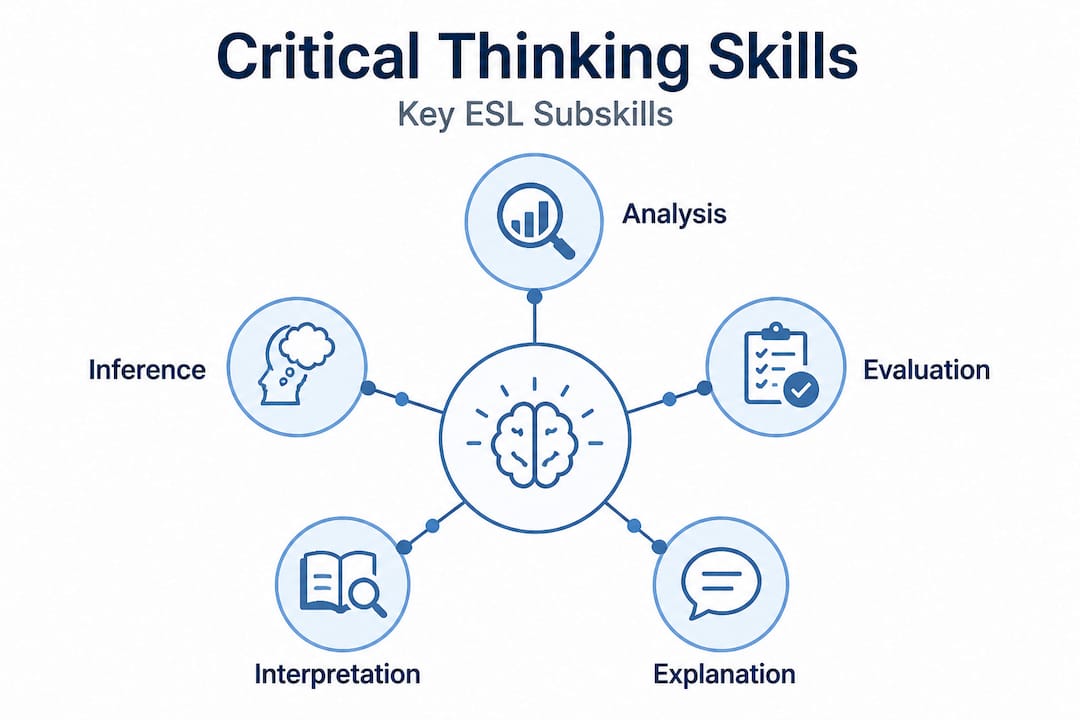
Understanding each subskill separately matters because instructional methods affect them differently. An activity that builds strong analysis skills may do little for evaluation or explanation. That specificity is what allows teachers to design deliberately rather than hoping that CT improves overall.
Here is how each subskill functions in an ESL context:
- Analysis involves breaking down a text, argument, or idea into its components and examining the logical relationships between them. A typical analysis task asks students to identify an author’s main claim and supporting evidence in a news article.
- Interpretation requires students to construct meaning from texts or data, going beyond surface content. For example, reading between the lines of a short story to infer the narrator’s attitude.
- Inference involves drawing reasoned conclusions from available evidence. Students practicing inference might read a set of facts and identify what must logically follow, even if unstated.
- Evaluation asks students to judge the quality, credibility, or relevance of arguments and sources. Evaluating two conflicting editorial pieces on the same issue is a classic evaluation task.
- Explanation requires students to clearly articulate their reasoning process, including why they reached a conclusion and what evidence supports it.
| CT subskill | Core cognitive operation | Sample ESL task |
|---|---|---|
| Analysis | Identify structure and relationships | Annotate an argument’s claims and evidence |
| Interpretation | Construct meaning | Summarize an author’s implied viewpoint |
| Inference | Draw evidence-based conclusions | Predict outcomes from reading scenarios |
| Evaluation | Judge quality and credibility | Compare reliability of two sources |
| Explanation | Articulate reasoning | Justify a written position with specific support |
Structured tasks that require students to analyze arguments, judge source reliability, and make inferences are not only pedagogically sound but measurable against established CT frameworks. This measurability matters for tracking growth and adjusting instruction.
Pro Tip: Use the California Critical Thinking Skills Test (CCTST) as a pre- and post-assessment baseline when introducing a CT-focused unit. It gives you objective data on which subskills are growing and which need more targeted support.
For ESL curriculum development, mapping these five subskills to existing lesson units creates a practical roadmap. You do not need to design entirely new materials. You need to adjust the cognitive demand of existing tasks by asking students to do more than identify and recall.
Designing ESL lessons that foster critical thinking: Practical frameworks
Effective CT-integrated lessons share a few structural features. They present students with genuine cognitive challenges, not just language input. They provide scaffolded support so learners can engage with complex ideas even at lower proficiency levels. And they require students to produce language in service of thinking, not the other way around.

Lesson planning for ESL that embeds CT should follow a consistent structure across reading, writing, speaking, and listening tasks. This consistency signals to students that reasoning is always expected, not just in writing classes.
Statistic callout: Over half of textbook tasks in analyzed IBDP Language B (English) lessons now demand explicit critical thinking, embedding clarifying, source evaluation, and inference activities directly into standard curriculum materials.
Four high-impact lesson frameworks stand out:
- Source evaluation tasks: Students receive two or three sources on the same topic, with varying levels of credibility. They must identify the purpose, audience, and potential bias of each. This directly targets evaluation and interpretation subskills and works effectively in reading or writing lessons.
- Guided inference exercises: Students read a short text with deliberately ambiguous or incomplete information. They write or discuss what they can and cannot conclude, with a clear requirement to reference specific textual evidence. This builds inference and explanation simultaneously.
- Real-world problem framing: Students are given a genuine local or global issue and asked to analyze proposed solutions in English. This develops analysis and evaluation while providing authentic motivation for language use.
- Structured academic controversy (SAC): Students are assigned a position on a debatable topic, defend it, then switch positions and argue the opposing view. This builds evaluation, inference, and explanation across a single speaking or writing lesson.
Evidence strongly supports structured approaches. Instruction using the Thinker’s Guide framework produced measurable gains in both reading performance and critical thinking outcomes among EFL learners, demonstrating that systematic design, not informal exposure, drives improvement.
| Lesson type | Primary CT subskills addressed | Language skill integration |
|---|---|---|
| Source evaluation | Evaluation, interpretation | Reading, writing |
| Guided inference | Inference, explanation | Reading, speaking |
| Real-world problem framing | Analysis, evaluation | Speaking, writing |
| Structured academic controversy | Evaluation, inference, explanation | Speaking, writing, listening |
Applying these frameworks across ESL teaching methodologies ensures that CT is not treated as a specialty topic. It becomes a standard feature of how lessons are structured, regardless of the primary language objective for that session.
The key principle is consistency. When CT tasks appear only occasionally, students treat them as exceptions. When they are built into lesson routines, students internalize the expectation and develop skill more efficiently.
Common pitfalls and edge cases when teaching critical thinking in ESL
Even well-designed CT integration can produce inconsistent results. Understanding why that happens protects teachers from drawing incorrect conclusions about what is and is not working.
The most significant finding in recent research is that CT subskills do not improve evenly. Instructional design and assessment alignment are critical for supporting each subskill specifically. Analysis and interpretation tend to show the earliest and most consistent gains. Evaluation and explanation often lag behind, not because students are less capable, but because those subskills require more metacognitive awareness and more sophisticated language to perform.
Common pitfalls to watch for include:
- Treating CT as a single unified skill: If you assess only overall CT improvement, you may miss the fact that certain subskills are stagnating while others grow. Use disaggregated assessment data.
- Over-relying on reflective writing: Journaling and reflective tasks build certain CT capacities well, particularly self-monitoring and explanation. But they often underserve analysis and inference if not paired with source-based tasks.
- Misaligned assessment tools: If your lessons target inference but your assessments only measure vocabulary recall or grammatical accuracy, CT growth becomes invisible. The rubric must match the cognitive objective.
- Front-loading CT without scaffolding: Jumping immediately to complex evaluation tasks with lower-proficiency students creates frustration without building skill. CT tasks need language scaffolding just as much as language tasks do.
- Neglecting cycling: Teachers often introduce a CT subskill in one unit and move on. Sustained gains require returning to each subskill repeatedly, with increasing complexity, across the course.
Pro Tip: Create a simple CT subskill tracking grid for each class, noting which subskills you have addressed this week and which are overdue. Use this as a planning tool at the end of each unit to ensure balanced coverage.
Consulting a thorough ESL teaching checklist can help teachers verify that their lesson objectives, task types, and assessment methods are genuinely aligned before delivering instruction.
What most TEFL training misses about critical thinking in ESL
Here is an honest observation grounded in how TEFL programs are designed and how they fall short in this specific area. Most advanced TEFL courses address critical thinking, but they tend to treat it as a concept to understand rather than a classroom problem to solve. Teachers emerge with a checklist of CT subskills and a few suggested task types. That is useful as a starting point, but it is inadequate for the actual classroom.
The real challenge is not knowing that analysis, inference, and evaluation exist. It is recognizing, in real time, which of your students are stuck on which subskill, and adjusting within a 50-minute lesson. That requires diagnostic instinct built through practice and specific feedback, not just theoretical exposure.
Veteran teachers who excel at CT integration share a few practical habits. They use micro-assessments, which are short two or three question checks at the start or end of a lesson, specifically designed to surface reasoning patterns rather than factual recall. They reframe real-world topics in ways that create genuine cognitive dissonance, because mild uncertainty drives engagement with CT tasks in a way that artificially constructed problems do not. And they draw on advanced curriculum insights to sequence skill development deliberately rather than addressing CT whenever time allows.
The uncomfortable truth is that future-ready TEFL practice requires teachers to become skilled diagnosticians, not just skilled instructors. Knowing the framework is stage one. Knowing when a student’s explanation subskill is three levels behind their analysis subskill, and knowing exactly how to close that gap, is where experienced educators distinguish themselves. TEFL training that equips teachers with that diagnostic capability, rather than just the theoretical vocabulary, is the kind that actually produces lasting classroom results.
Advance your TEFL career with critical thinking expertise
Integrating critical thinking into ESL instruction is one of the most substantive skills a TEFL educator can develop, and it requires specialized, up-to-date training to do it well. The evidence is clear: structured CT instruction improves both student reasoning and language performance, but only when teachers have the knowledge and tools to design and assess it effectively.

TEFL Institute offers a range of advanced courses and course extensions designed to help educators build exactly this kind of pedagogical depth. Whether you are preparing to teach in a structured academic environment or seeking to upgrade your existing practice, targeted professional development keeps you at the forefront of evidence-based ESL instruction. Educators looking to develop their skills with hands-on training and mentorship can also explore TEFL courses in Newcastle as a practical pathway toward mastery in modern English language teaching.
Frequently asked questions
How do you assess critical thinking in ESL classrooms?
Use structured frameworks like the California Critical Thinking Skills Test and develop targeted rubrics that separately evaluate subskills such as analysis, inference, and evaluation. Assessment tools must match the specific CT subskills targeted in instruction to generate useful data.
What are effective lesson types for integrating critical thinking in ESL?
Lessons built around source evaluation, guided inference tasks, and reflective writing have all shown measurable gains in CT development. Structured source and inference analysis tasks are particularly effective when paired with clear rubrics and scaffolded language support.
Why do some critical thinking skills improve more than others in ESL instruction?
Instructional design choices and assessment alignment create uneven growth across CT subskills. Some CT aspects show greater gains depending on the intervention, with analysis typically advancing before evaluation or explanation.
Do critical thinking tasks improve language proficiency as well?
Yes. Research demonstrates that CT-focused instruction can simultaneously improve reasoning ability and language skills. CT-focused instruction improves reading and overall critical thinking capacity, making it a dual-benefit investment for any ESL program.
Recommended
TEFL Institute guides

Portugal
Jobs, pay and visa routes
Mexico
Jobs, pay and cities
Spain
Jobs, pay and visa routes
Italy
Jobs, pay and visa routes
Cambodia
Pay, requirements and visas