

 United Kingdom (UK)
 United States (US)
 Canada
 South Africa
 India
India Australia
 New Zealand
 China
China Russia
 Germany
 France
 Spain
Spain Netherlands
 Vietnam
 United Arab Emirates
 Italy
Italy Poland
 Thailand
 Türkiye





 Algeria


What Is the Lexical Approach to Language Teaching?
What Is the Lexical Approach to Language Teaching?

TL;DR:
- The lexical approach emphasizes learning multi-word phrases and collocations to build fluency.
- It views language as patterns of recurring chunks rather than individual words or rules.
The lexical approach is defined as a language teaching methodology that treats multi-word lexical chunks, not isolated grammar rules, as the primary building blocks of fluency. Michael Lewis introduced the term in his 1993 book The Lexical Approach, arguing that learners should build stocks of phrases rather than memorize grammatical structures first. That single shift in priority changes how educators design lessons, assess progress, and define what “knowing” a language actually means. Corpus linguistics has since provided real-world data to support Lewis’s original claim, showing that natural speech is dominated by recurring word combinations rather than freshly assembled sentences.
What is the lexical approach, and why does it matter?
The lexical approach defines language as grammaticalised lexis, meaning grammar grows out of word patterns rather than the other way around. This is not a minor reframing. It means a learner who knows “make a decision,” “make an effort,” and “make progress” has acquired grammar implicitly through repeated exposure to the verb “make” in context. The grammar rule follows the phrase, not the other way around.

ThoughtCo clarifies that the lexical approach is an umbrella methodology, not a single fixed procedure. That distinction matters for educators. There is no single textbook or lesson sequence that defines it. Instead, the approach shapes how teachers select materials, design tasks, and direct learner attention.
The importance of the lexical approach lies in its alignment with how fluent speakers actually use language. Native speakers do not construct sentences word by word from grammar rules. They retrieve whole chunks from memory and slot them into conversation. Teaching learners to do the same accelerates fluency and reduces the hesitation that grammar-first methods often produce.
What are lexical chunks, and why are they central?
Lexical chunks are pre-formed word combinations that speakers store and retrieve as single units. EBSCO’s research identifies four main chunk categories that educators work with:
- Collocations: Words that frequently appear together, such as “heavy rain,” “make a mistake,” or “take responsibility.”
- Fixed expressions: Phrases with no variation, such as “by the way” or “as a matter of fact.”
- Semi-fixed expressions: Phrases with one or two variable slots, such as “the thing is…” or “would you mind if I…?”
- Idioms: Expressions where meaning cannot be derived from individual words, such as “hit the ground running.”
Fluency depends on chunk retrieval, not word-by-word construction. A learner who retrieves “I was wondering if you could…” as a single unit speaks more naturally than one who assembles it from grammar rules mid-conversation. The retrieval is faster, the output sounds more native, and the cognitive load drops significantly.
Collocations deserve particular attention because they are the most frequent chunk type in natural speech. A learner who knows “do homework” but says “make homework” signals a gap that grammar instruction alone will never fix. Only collocation training closes it.
Pro Tip: When introducing new vocabulary, always present words inside their most common collocations. Teach “strong coffee” and “heavy traffic,” not just “strong” and “heavy” as standalone adjectives.
How does the lexical approach differ from traditional methods?
Traditional grammar-centered methods treat language as a system of rules that learners apply to produce sentences. Vocabulary is taught as a list of isolated words with definitions. The lexical approach inverts this. Grammar emerges from patterns in lexical data, and vocabulary is always taught in context as part of a phrase.
Corpus linguistics makes this comparison concrete. Corpus data shows that certain words almost never appear alone in natural speech. The word “rancid,” for example, collocates almost exclusively with “butter” or “fat.” Teaching it as an isolated adjective with a definition misses how the word actually functions.
| Feature | Traditional approach | Lexical approach |
|---|---|---|
| Core unit of learning | Grammar rule or single word | Multi-word lexical chunk |
| Grammar instruction | Explicit rules taught first | Grammar emerges from lexical patterns |
| Vocabulary teaching | Isolated word lists with definitions | Words taught inside frequent collocations |
| Fluency model | Accurate rule application | Fast chunk retrieval from memory |
| Data source | Textbook-constructed sentences | Corpus-based authentic language data |
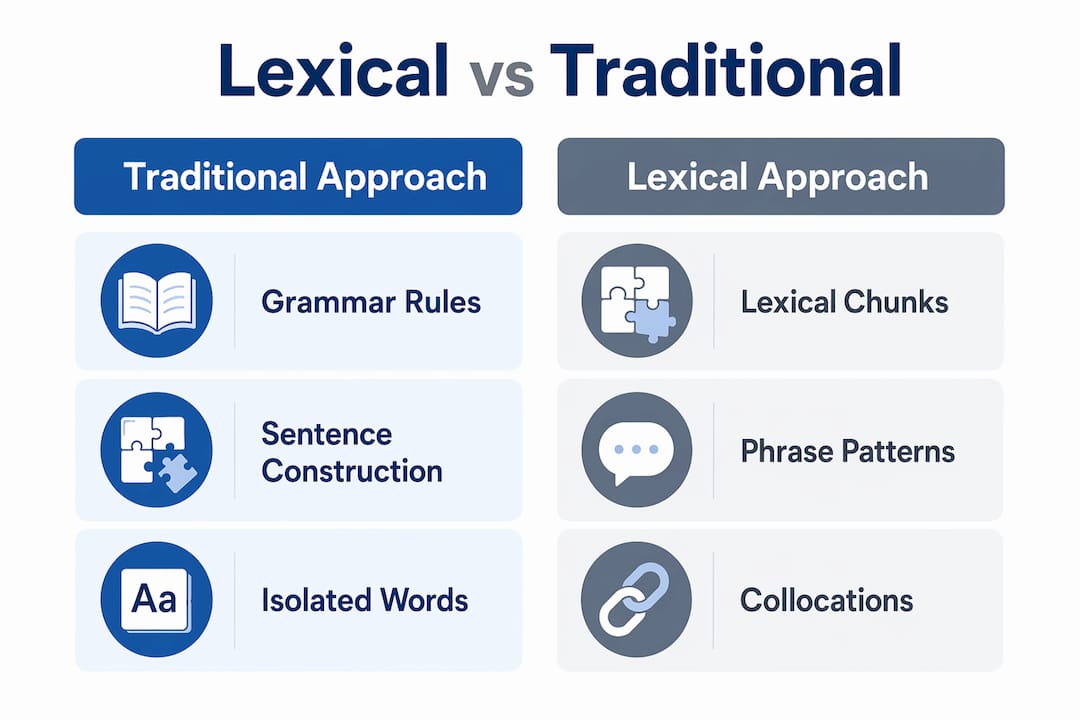
The table above shows that the two approaches are not just different in technique. They operate from different assumptions about what language is. Traditional methods treat grammar as the skeleton and vocabulary as the flesh. The lexical approach treats recurring word combinations as the whole organism.
One practical consequence is that lexical approach lessons look different. Teachers spend less time drilling verb conjugations and more time helping learners notice which words travel together. A grammar-focused teacher asks, “What is the rule?” A lexical approach teacher asks, “What words does this word live with?”
What are the core principles of the lexical approach in language teaching?
The foundational principles of the lexical approach give educators a clear framework for lesson design. Pattern grammar is central to this framework. It links sets of semantically related words that share grammatical behavior, helping learners move from recognizing a phrase to using it accurately.
The core principles are:
- Language is grammaticalised lexis. Classroom time should build phrase stocks, not grammar tables.
- Noticing is a prerequisite for acquisition. Learners cannot internalize a chunk they have not consciously registered. Teachers must direct attention to chunks explicitly.
- Reviewing chunks is non-negotiable. Lexical chunks must be recorded, retrieved, and reused actively across multiple lessons, not introduced once and forgotten.
- Collocation sensitivity is a learnable skill. Learners can be trained to detect which word combinations sound natural and which do not.
- Grammar and lexis are inseparable. Integrating pattern grammar with lexis allows learners to understand the grammatical slots within a phrase, advancing accuracy beyond rote memorization.
These principles have direct implications for lesson design. A lesson built on the lexical approach does not start with a grammar point. It starts with a text or a set of authentic examples, asks learners to identify recurring chunks, and then examines the grammatical patterns those chunks reveal. Grammar becomes a tool for explaining what learners have already noticed, not a rule to be applied before exposure.
Pro Tip: Build a “chunk wall” in your classroom or a shared digital document where learners add new collocations and semi-fixed phrases each week. Regular review of this resource reinforces retrieval and builds long-term retention.
How can educators implement the lexical approach effectively?
Practical implementation is where many educators stall. The principles are clear, but translating them into daily lessons requires specific techniques. These steps give educators a workable starting point.
-
Start with authentic texts. Use newspaper articles, podcast transcripts, or dialogue recordings. Authentic texts contain natural chunk density that textbook sentences often lack. Ask learners to underline any multi-word combinations they notice.
-
Run collocation discrimination tasks. Present learners with pairs like “do a mistake / make a mistake” or “strong wind / powerful wind” and ask them to identify the natural option. These tasks, highlighted by TeachingEnglish, train learners to detect correct and incorrect chunk usage actively rather than passively.
-
Use corpus tools for lesson preparation. Tools like the British National Corpus or the Corpus of Contemporary American English let educators identify the most frequent collocates of a target word before teaching it. This ensures lessons reflect real usage, not invented examples.
-
Design chunk recording systems. Teach learners to record new phrases in context, not as isolated items. A vocabulary notebook entry for “take” should include “take responsibility,” “take a break,” and “take for granted,” each with a sample sentence.
-
Incorporate ESL activities that build lexical awareness. Gap-fill tasks using collocations, chunk sorting activities, and phrase-building games all reinforce chunk recognition without reducing lessons to memorization drills.
-
Plan for spaced retrieval. Introduce a set of chunks in one lesson, review them in the next, and test retrieval two weeks later. Spaced practice is the mechanism that moves chunks from short-term recognition to long-term production.
Educators who want to see how these strategies fit into broader lesson planning frameworks will find that the lexical approach integrates naturally with communicative and task-based methods.
What are common misunderstandings about the lexical approach?
The most persistent misunderstanding is that the lexical approach means memorizing fixed idioms. It does not. Semi-fixed and variable chunks are equally central, and they are the chunk types that give learners productive flexibility. A learner who only memorizes fixed phrases can sound rehearsed. A learner who also controls semi-fixed frames like “I was just wondering whether…” can adapt to any conversational situation.
Three other misunderstandings regularly surface in teacher training:
- “Grammar is ignored.” Grammar is not ignored. Learners acquire grammar by recognizing the patterns that govern chunks. The difference is that grammar is inductive, not deductive.
- “It only works for beginners.” Chunk learning scales across all proficiency levels. Advanced learners benefit from studying low-frequency collocations and discipline-specific phrase patterns.
- “Chunk learning limits creativity.” The opposite is true. A large chunk repertoire gives learners more raw material to combine creatively. Fluency and creativity both depend on having enough stored language to draw from.
The practical risk educators face is over-reliance on fixed phrases at the expense of productive improvisation. Lessons should always include tasks that require learners to adapt semi-fixed frames to new contexts, not just reproduce memorized strings. The lexical approach is broad by design, and that breadth is a feature, not a flaw.
Key Takeaways
The lexical approach builds fluency by teaching multi-word chunks first, with grammar emerging from patterns rather than being imposed as a prerequisite for language use.
| Point | Details |
|---|---|
| Core unit is the chunk | Teach collocations, fixed phrases, and semi-fixed frames rather than isolated words or grammar rules. |
| Grammar follows lexis | Learners acquire grammar inductively by noticing patterns across multiple chunk examples. |
| Corpus data guides teaching | Use authentic corpus tools to identify the most frequent and natural word combinations for instruction. |
| Noticing and review are required | Chunks must be explicitly noticed, recorded, and retrieved across multiple lessons to move into production. |
| Misunderstandings limit adoption | The approach does not ignore grammar or creativity; it reframes both as outcomes of strong chunk knowledge. |
The lexical approach in practice: a perspective
The lexical approach is one of those ideas that sounds obvious once you understand it and baffling that it took so long to reach mainstream classrooms. I have worked with educators who spent years teaching grammar tables to learners who could conjugate every verb perfectly but still could not hold a natural conversation. The missing ingredient was almost always chunks.
What I find most compelling about the approach is its honesty about how language actually works. Fluent speakers do not think in grammar rules. They think in phrases. When a native English speaker says “to be honest with you,” they are not applying a prepositional phrase rule. They are retrieving a chunk they have heard and used hundreds of times. Teaching learners to build that same kind of phrase library is not a shortcut. It is the most direct route to real fluency.
The challenge for educators transitioning from traditional methods is resisting the urge to explain every chunk grammatically before letting learners use it. Trust the pattern. Exposure and noticing do the heavy lifting. Grammar explanation can follow once learners have felt the chunk working in context.
The future of this approach almost certainly involves corpus technology becoming more accessible in classrooms. As tools that surface real-world language patterns become easier to use, educators will be able to build genuinely data-driven lessons without needing a linguistics background. That is a development worth preparing for now.
— Muller
Teflinstitute courses that cover the lexical approach
Educators who want structured training in modern language teaching methodologies, including the lexical approach, will find Teflinstitute’s certification programs directly relevant.

The 120 Hour Elective TEFL Course covers advanced teaching methodologies and gives educators practical frameworks for applying chunk-centered instruction in real classrooms. For a more comprehensive qualification, the 240 Hour Master TEFL Course provides externally accredited training across the full range of modern ESL methods. Both programs are designed for educators who want to move beyond grammar-first defaults and build lessons grounded in how language actually works.
FAQ
What is the lexical approach in simple terms?
The lexical approach is a language teaching method that prioritizes learning multi-word phrases and collocations over memorizing grammar rules. Michael Lewis formalized the concept in 1993, arguing that fluency comes from building a large stock of ready-to-use chunks.
How does the lexical approach work in a classroom?
Teachers present authentic texts, direct learner attention to recurring word combinations, and design tasks that build chunk recognition and retrieval. Collocation discrimination tasks and spaced review are the most common classroom techniques.
Is grammar ignored in the lexical approach?
Grammar is not ignored. Learners acquire grammar inductively by recognizing patterns across many chunk examples, rather than studying rules before encountering language in use.
What are examples of lexical chunks?
Lexical chunks include collocations like “make a decision,” fixed expressions like “by the way,” semi-fixed frames like “would you mind if I…?”, and idioms like “hit the ground running.”
What is the difference between the lexical approach and communicative language teaching?
Communicative language teaching prioritizes meaningful interaction as the vehicle for acquisition. The lexical approach prioritizes chunk awareness as the content of instruction. The two methods are compatible and are often combined in contemporary ESL classrooms.
