
 United Kingdom (UK)
 United States (US)
 Canada
 South Africa
 India
India Australia
 New Zealand
 China
China Russia
 Germany
 France
 Spain
Spain Netherlands
 Vietnam
 United Arab Emirates
 Italy
Italy Poland
 Thailand
 Türkiye









 Algeria



What is IELTS? Your complete guide to the exam
What is IELTS? Your complete guide to the exam

TL;DR:
- IELTS is a global English proficiency test used for studying, working, and migrating abroad.
- Choose the correct version: Academic for education and professional registration, General Training for migration and employment.
- Focused, skill-specific practice enhances IELTS success more than passive study methods.
Many people sign up for the IELTS exam without fully understanding what it tests, how it’s scored, or which version they need. That uncertainty can cost time and money. IELTS stands for International English Language Testing System, a standardized assessment used by universities, employers, and immigration authorities worldwide. Whether you’re planning to study at a foreign university, apply for a skilled worker visa, or pursue professional registration abroad, IELTS is likely part of the process. This guide covers exactly what IELTS is, how the exam is structured, how scores work, and what you can do to prepare effectively.
Table of Contents
- What is IELTS and who needs it?
- IELTS test types: Academic vs. General Training
- Inside the IELTS exam: Format and skills assessed
- Understanding IELTS scores and what they mean
- IELTS vs. TOEFL: Key differences and choosing the right test
- What most guides don’t tell you about succeeding in IELTS
- Boost your English skills and unlock new opportunities
- Frequently asked questions
Key Takeaways
| Point | Details |
|---|---|
| IELTS defined | IELTS is a global English test for university, work, or migration acceptance. |
| Two test versions | Choose Academic for study; General Training for work, migration, or schooling. |
| Four skills tested | IELTS assesses your listening, reading, writing, and speaking abilities separately. |
| Score on a 9-band scale | Your score shows your English level without a pass or fail—requirements vary. |
| IELTS vs. TOEFL | IELTS involves real interaction while TOEFL is fully computer-based; choose based on goals. |
What is IELTS and who needs it?
IELTS is one of the most widely recognized English language proficiency tests in the world. The International English Language Testing System evaluates your ability to use English across four core skills: listening, reading, writing, and speaking. It is jointly managed by the British Council, IDP: IELTS Australia, and Cambridge Assessment English.
The exam is accepted by more than 11,000 organizations across 140 countries, including universities, professional bodies, and government immigration departments. If you plan to study, work, or relocate to an English-speaking country, there is a strong chance that IELTS will be a formal requirement.
“IELTS assesses English proficiency for study, work, and migration in English-speaking countries, and is recognized by institutions and authorities worldwide.”
Common situations where IELTS is required include:
- Applying to a university or college in the UK, Australia, Canada, Ireland, or New Zealand
- Seeking skilled migration visas such as Australia’s General Skilled Migration program
- Applying for permanent residency or citizenship in English-speaking countries
- Registering with professional bodies such as nursing, medical, or legal councils
- Applying for job opportunities abroad that require verified English proficiency
- Supporting academic applications for postgraduate or undergraduate programs
Beyond eligibility, an IELTS score sends a clear message to admissions officers and employers: you can communicate effectively in an English-language environment. That signal matters when thousands of applicants are competing for the same spot.
Now that you’ve seen why IELTS is a global benchmark, let’s break down its specific versions.
IELTS test types: Academic vs. General Training
IELTS has two versions: Academic and General Training. Both test the same four skills, but the content and purpose differ significantly. Choosing the correct version is essential, because submitting scores from the wrong test can result in a rejected application.
Academic IELTS is designed for people who want to study at the undergraduate or postgraduate level, or register with a professional body such as a medical or nursing council. The reading and writing tasks use complex, formal texts and require higher-order analytical skills.

General Training IELTS is intended for people applying for migration visas, seeking work experience programs, or enrolling in secondary education. The reading and writing content reflects everyday English use rather than academic discourse.
| Feature | Academic | General Training |
|---|---|---|
| Purpose | Higher education, professional registration | Migration, work, secondary education |
| Reading texts | Complex academic passages | Everyday and workplace texts |
| Writing Task 1 | Describe visual data (graph, chart, diagram) | Write a formal or informal letter |
| Writing Task 2 | Essay (same for both) | Essay (same for both) |
| Listening | Identical format | Identical format |
| Speaking | Identical format | Identical format |
Pro Tip: If your goal is study or professional registration abroad, choose Academic. If you are applying for migration or a work-based visa, General Training is the correct version. When in doubt, check the specific requirements of the institution or authority you are applying to before booking.
With a test version selected, the next step is to understand the test’s structure and content.
Inside the IELTS exam: Format and skills assessed
The IELTS exam assesses four skills: Listening, Reading, Writing, and Speaking. The total test time is approximately two hours and 45 minutes. Understanding each section helps you allocate preparation time more efficiently.
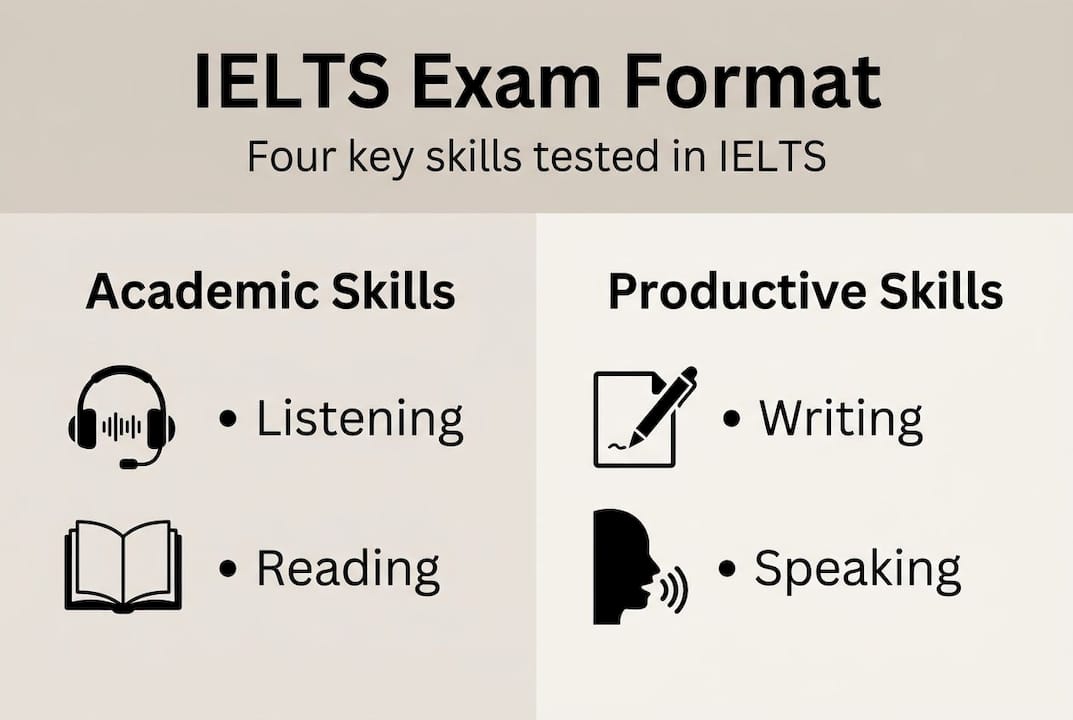
| Section | Duration | Questions/Tasks | Key Features |
|---|---|---|---|
| Listening | 30 minutes | 40 questions | Four recorded conversations or monologues |
| Reading | 60 minutes | 40 questions | Academic: formal texts; General: everyday texts |
| Writing | 60 minutes | 2 tasks | Task 1 differs by version; Task 2 essay is the same |
| Speaking | 11 to 14 minutes | 3 parts | Face-to-face interview with a certified examiner |
Here is a breakdown of each section:
Listening: You hear four recordings and answer 40 questions. Recordings include conversations between two people and monologues in everyday or academic contexts. You hear each recording only once.
Reading: You have 60 minutes to read three passages and answer 40 questions. Academic passages are drawn from books, journals, and newspapers. General Training passages include notices, advertisements, and workplace documents.
Writing: Task 1 in the Academic version requires you to describe or summarize visual data in at least 150 words. In General Training, you write a letter of at least 150 words. Task 2 is an essay of at least 250 words and is identical across both versions.
Speaking: The IELTS exam preparation section is a live, face-to-face interview. It consists of three parts: an introduction and general questions, a one-minute task card response, and a two-way discussion on an abstract topic.
The sections are typically scheduled in this order:
- Listening
- Reading
- Writing
- Speaking (may be on a separate day)
To develop all four IELTS skills effectively, structured practice under realistic test conditions is essential. Once you know the sections, it’s important to grasp how IELTS scores work and what they mean.
Understanding IELTS scores and what they mean
IELTS uses a 9-band scoring scale that runs from 0 to 9, including half-band increments such as 6.5 or 7.5. There is no pass or fail. Each institution or authority sets its own minimum band score requirement.
Your overall band score is the average of your four individual section scores, rounded to the nearest whole or half band. For example, if you score 7.0 in Listening, 6.5 in Reading, 6.0 in Writing, and 7.0 in Speaking, your overall band is 6.5.
Statistic callout: In Academic Reading, a raw score of approximately 30 out of 40 corresponds to Band 7. In General Training Reading, the same Band 7 requires approximately 34 out of 40 correct answers, reflecting the difference in text complexity.
Typical minimum score requirements across contexts include:
- Undergraduate university admission: Band 6.0 to 6.5 overall
- Postgraduate university admission: Band 6.5 to 7.0 overall
- Professional registration (medical, nursing): Band 7.0 to 7.5 overall, sometimes with minimum scores per skill
- Skilled migration visas (e.g., Australia, Canada): Band 6.0 to 7.0 depending on visa category
- UK visa applications: Band scores vary by visa type and applicant category
It is important to note that some institutions require a minimum score in each individual skill, not just the overall band. A candidate may achieve an overall Band 7.0 but be rejected if their Writing score falls below a required minimum. Always verify the specific requirements of your target institution or authority.
Now that you know how scoring works, it’s useful to see how IELTS compares with other English proficiency exams.
IELTS vs. TOEFL: Key differences and choosing the right test
IELTS and TOEFL (Test of English as a Foreign Language) are the two most widely accepted English proficiency exams globally. While both are recognized by most universities and immigration bodies, IELTS emphasizes real-life communication with a face-to-face speaking component, whereas TOEFL is entirely computer-based and uses integrated tasks that combine multiple skills.
| Feature | IELTS | TOEFL iBT |
|---|---|---|
| Test delivery | Paper-based or computer-based | Fully computer-based |
| Speaking format | Face-to-face with an examiner | Recorded responses, no live examiner |
| Listening accents | British, Australian, American, Canadian | Primarily American English |
| Scoring | 0 to 9 band scale | 0 to 120 points |
| Test duration | Approx. 2 hours 45 minutes | Approx. 2 hours |
| Acceptance | 11,000+ organizations worldwide | Widely accepted, especially in the US |
Candidates who prefer real-time human interaction during the speaking section often find IELTS more natural. Those who are more comfortable with technology and typing may prefer TOEFL’s digital format.
Destination also matters. IELTS is generally preferred or required for UK, Australian, and Canadian immigration pathways. TOEFL tends to be more common for university admissions in the United States. For guidance on which exam fits your specific teaching or professional goals, reviewing destination-specific requirements is the most reliable approach.
Pro Tip: Before registering for either exam, confirm with your target institution or immigration authority which tests they accept. Some accept both, but a few specify one over the other.
With a clear understanding of what IELTS is and how it compares, let’s share a deeper perspective on the exam experience and preparation.
What most guides don’t tell you about succeeding in IELTS
Most preparation advice focuses on grammar drills and vocabulary lists. That approach has limits. The IELTS exam rewards candidates who can communicate ideas clearly and adapt their language to context, not just those who have memorized rules.
The biggest gains typically come from targeted practice, not simply studying more hours. Identify your weakest skill, then practice that skill under real test conditions. Timed reading exercises, recorded speaking practice with playback, and essay feedback from a qualified reviewer produce faster improvements than passive review.
Many test-takers underestimate the Writing section. Task 2 essays are not just grammar checks. Examiners assess how well you develop an argument, whether your ideas are logically connected, and how precisely you use vocabulary.
Choosing the right version of the test is also frequently overlooked. If your goals include both academic study and future IELTS preparation guidance, getting early advice from a qualified IELTS instructor can save you from booking the wrong test.
Pro Tip: Focus specifically on paraphrasing in Listening and Reading, idea development in Writing, and clear fluency in Speaking. These four areas produce the most measurable score gains in a short preparation period.
Boost your English skills and unlock new opportunities
If this guide has clarified what IELTS involves and what preparation requires, the next step is structured, focused action.
The TEFL Institute offers targeted resources and courses designed to strengthen English language skills and exam readiness. Whether you are preparing for IELTS or building long-term language proficiency, the TEFL Institute provides practical, structured support. Explore course extensions that let you deepen your language and teaching knowledge at your own pace. If you prefer in-person learning, TEFL courses in Newcastle combine classroom instruction with hands-on practice. Take the next step toward your study or career goals with resources built for real results.
Frequently asked questions
What does IELTS stand for and why is it important?
IELTS stands for International English Language Testing System. It is essential for demonstrating English proficiency to universities, employers, and immigration authorities in English-speaking countries.
Which IELTS test should I take: Academic or General Training?
Choose Academic IELTS for university admission or professional registration. Select General Training for migration, work, or training programs and secondary education placements.
How is IELTS scored and what do the bands mean?
IELTS uses a 9-band scale from 0 to 9 with no pass or fail. Your overall score averages the four skill scores, and each institution or authority sets its own minimum band requirement.
How does IELTS compare with TOEFL?
IELTS uses a face-to-face speaking format and tests a range of English accents, while TOEFL is computer-based with recorded speaking tasks. Both are widely accepted, but destination and institution requirements often determine which is more appropriate.
How should I prepare for the IELTS exam?
Practice all four skills under timed conditions and seek qualified feedback on writing and speaking. Targeted practice on paraphrasing, argument development, and fluent speaking produces the most consistent score improvements.
Recommended
- How to prepare for IELTS tutoring: steps for exam success | TEFL Institute
- What is IELTS? Teaching IELTS Increases Salary & Job Prospects | TEFL Institute
- How to Teach IELTS Preparation: Step-by-Step Guide for Teachers | TEFL Institute
- 7 Essential IELTS Preparation Tips for English Teachers | TEFL Institute