

 United Kingdom (UK)
 United States (US)
 Canada
 South Africa
 India
India Australia
 New Zealand
 China
China Russia
 Germany
 France
 Spain
Spain Netherlands
 Vietnam
 United Arab Emirates
 Italy
Italy Poland
 Thailand
 Türkiye





 Algeria


What Is Business English? Essential Guide for TEFL Teachers
What Is Business English? Essential Guide for TEFL Teachers

TL;DR:
- Business English is a specialized form focused on professional communication and industry-specific vocabulary.
- Effective teaching employs needs analysis, task-based learning, and authentic materials tailored to workplace tasks.
- Challenges include diverse learner backgrounds and evolving language trends like BELF, requiring adaptable and industry-aware instructors.
Business English is widely misunderstood as simply a more formal version of everyday English. In reality, it is a distinct discipline that requires specialized knowledge, targeted teaching strategies, and a deep understanding of professional communication across industries. Business English is a specialized form of English for Specific Purposes (ESP), focused on professional communication skills, vocabulary, and terminology used in contexts like international trade, negotiations, presentations, emails, and meetings. For TEFL teachers aiming to work with multinational corporations or executive learners, understanding this distinction is not optional. It is foundational.
Table of Contents
- Defining Business English: Beyond formal conversation
- Core skills and competencies in Business English teaching
- Methodologies and materials for effective Business English instruction
- Pitfalls, challenges, and evolving trends in Business English
- A fresh perspective: What most TEFL training misses about Business English
- Advance your Business English teaching skills
- Frequently asked questions
Key Takeaways
| Point | Details |
|---|---|
| Business English scope | It’s more than formal language—it’s specialized communication for global workplaces. |
| Teaching essentials | Effective instruction requires skills-based teaching, authentic resources, and adaptability. |
| Challenges and trends | Trends like BELF and AI shape the field, but human flexibility and cultural sensitivity are vital. |
| Next steps for TEFL teachers | Ongoing learning and targeted qualification boost career prospects in business-focused teaching roles. |
Defining Business English: Beyond formal conversation
Business English is not simply polished grammar or a broader vocabulary. It is a purpose-driven form of communication designed to help professionals operate effectively in workplace environments, often across cultural and linguistic boundaries. The Business English definition sits firmly within the English for Specific Purposes (ESP) framework, meaning the language taught is always tied to real professional outcomes rather than general fluency.
What separates Business English from general English is context and intent. General English focuses on broad communicative competence, covering everyday conversation, reading, and writing. Business English, by contrast, zeroes in on specific business English contexts such as:
- Conducting and participating in formal meetings
- Writing professional emails and reports
- Delivering and understanding presentations
- Negotiating contracts and agreements
- Communicating across international trade environments
The following table highlights the core distinctions between general English and Business English:
| Feature | General English | Business English |
|---|---|---|
| Primary goal | Broad communicative fluency | Professional task completion |
| Vocabulary focus | Everyday language | Industry-specific terminology |
| Context | Social and academic | Workplace and corporate |
| Learner profile | General population | Executives, managers, professionals |
| Assessment style | Standardized tests | Performance-based outcomes |
A critical point for TEFL teachers to internalize is that Business English is not just about what learners say. It is about what they achieve through language. A negotiation, a board presentation, or a cross-border email chain each demands precision, cultural sensitivity, and strategic word choice. As one authoritative source puts it:
“Business English is a specialized form of English for Specific Purposes (ESP) focused on professional communication skills, vocabulary, and terminology.”
This framing matters because it shifts the teacher’s role. You are not simply correcting grammar. You are equipping professionals to succeed in high-stakes environments where language directly affects business outcomes.
Core skills and competencies in Business English teaching
Now that you have a working definition, let’s look at what TEFL teachers actually need to teach and why it matters. Business English instruction covers a wide range of communication skills that go well beyond standard language teaching.
The primary skills TEFL teachers must address include:
- Written communication: Drafting professional emails, reports, proposals, and meeting minutes with clarity and appropriate tone.
- Spoken communication: Participating in meetings, delivering presentations, and conducting negotiations with confidence.
- Active listening: Understanding accented or rapid speech in multinational meetings and conference calls.
- Cultural awareness: Adapting communication style to different national and corporate cultures.
- Formal register: Knowing when to use formal, semi-formal, or informal language depending on the audience.
The student profiles you will encounter are equally varied. Executives need concise, high-level language for leadership contexts. Mid-level managers often require meeting and negotiation language. Corporate trainees may need foundational professional vocabulary combined with practical email writing skills.

The table below compares the core competencies in Business English versus general English teaching:
| Competency | General English | Business English |
|---|---|---|
| Vocabulary | Common everyday words | Industry jargon and professional terms |
| Grammar focus | Broad grammatical accuracy | Functional grammar for professional tasks |
| Cultural content | General social norms | Corporate etiquette and cross-cultural communication |
| Lesson materials | Coursebooks and fiction | Reports, emails, case studies |
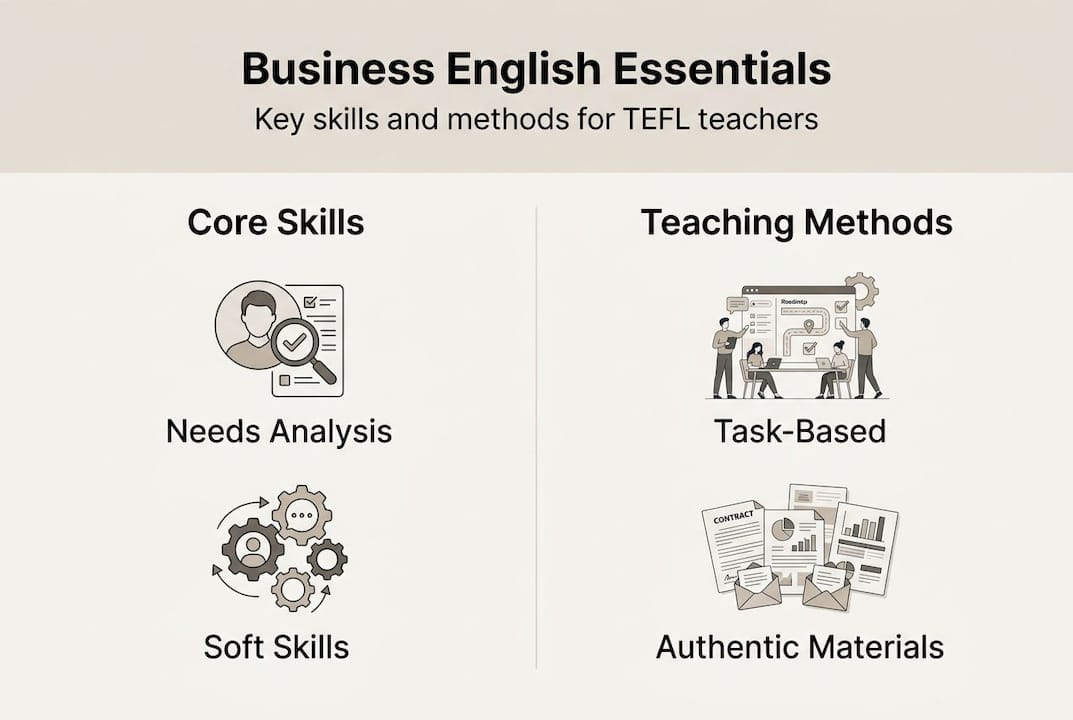
Key Business English teaching steps always begin with a needs analysis, a structured process of identifying exactly what each learner or group needs to accomplish through English. This prevents wasted instructional time and ensures lessons stay relevant to real job demands.
Pro Tip: Before your first session with a corporate client, request a sample of their actual work communications, such as a recent email thread or meeting agenda. This gives you authentic material and demonstrates professional credibility from day one.
Building career success in Business English also depends on soft skills. Adaptability, patience, and genuine curiosity about your students’ industries are just as important as your language teaching expertise. The best Business English teachers are also active learners.
Methodologies and materials for effective Business English instruction
With key skills outlined, the next step is choosing the right teaching approaches and resources. Effective Business English instruction relies on a set of methodologies that prioritize real-world application over abstract language study.
Needs analysis, task-based learning, authentic materials, role-plays, and continuous assessment are the cornerstone methodologies for results-oriented Business English teaching. Each one serves a distinct purpose:
- Needs analysis: Identifies the specific language gaps and professional goals of each learner or cohort before instruction begins.
- Task-based learning (TBL): Structures lessons around completing real professional tasks, such as drafting a proposal or chairing a mock meeting, so learners practice language in context.
- Authentic materials: Uses actual business documents, news articles, company reports, and email samples rather than textbook-only content. These authentic materials in Business English expose learners to the language they will genuinely encounter.
- Role-plays and simulations: Recreates workplace scenarios so learners can practice negotiations, client calls, or presentations in a low-stakes environment before doing them for real.
- Continuous assessment: Tracks progress through regular feedback, performance tasks, and learner self-evaluation rather than relying solely on end-of-course tests.
The value of task-based learning in particular cannot be overstated. When a learner practices chairing a meeting in class, they are not just learning vocabulary. They are building procedural fluency, the ability to use language automatically while managing real cognitive demands.
Pro Tip: Use classroom activities for Business English that mirror your students’ actual job functions. A sales team benefits most from pitch and objection-handling simulations, while a finance team gains more from report-writing and data presentation tasks.
Material selection is equally important. Avoid relying exclusively on published Business English coursebooks, which can feel generic to experienced professionals. Supplement with current industry news, real company case studies, and learner-generated content for maximum relevance and engagement.
Pitfalls, challenges, and evolving trends in Business English
Having explored approaches and resources, it is vital to understand the real-world challenges and evolving landscape for teachers. Business English instruction comes with a unique set of obstacles that general TEFL training rarely prepares you for.
Common challenges include:
- Varied student backgrounds: Learners may come from finance, technology, law, or manufacturing, each with its own specialized vocabulary and communication norms.
- Rapid vocabulary change: Business language evolves quickly. Terms like “agile,” “pivot,” and “scalability” have shifted meaning in corporate contexts, and teachers must stay current.
- Student expertise exceeding teacher knowledge: A senior executive may know their industry far better than you do. This requires confidence, humility, and a focus on language rather than content expertise.
- Short course durations: Many corporate training contracts are brief, demanding efficient lesson planning and clear prioritization of outcomes.
One significant and growing trend is BELF, or Business English as a Lingua Franca. BELF refers to English used between non-native speakers in professional settings, where BELF prioritizes clarity over native accuracy. This means that native-speaker norms are less relevant than mutual intelligibility and professional effectiveness. Teachers who understand BELF can better serve multinational learners who will rarely interact with native English speakers in their actual work.
AI tools are increasingly present in language learning, but TBL in Business English textbooks research highlights that some materials underuse task-based approaches, and hybrid human-AI models work best for addressing nuance and articulation. AI can support vocabulary practice and grammar feedback, but it struggles with the cultural and interpersonal subtleties that define high-level business communication.
“Contrasting views: Some materials underuse TBL; hybrid human-AI approaches best for nuances; research-practice gaps in BELF pedagogy require teacher training.”
Pro Tip: Explore resources on running a business English classroom and invest in teaching tools for Business English that complement your instruction without replacing the human judgment that corporate learners genuinely need.
A fresh perspective: What most TEFL training misses about Business English
Most TEFL programs do an adequate job of covering general pedagogy, but they frequently underemphasize the real demands of business context adaptation. Teaching a corporate executive is fundamentally different from teaching a general English class, and that gap is rarely addressed head-on in standard certification programs.
The classroom comfort zone in TEFL training centers on structured exercises, predictable learner needs, and clear progression. Business English breaks that model. Learners arrive with complex professional identities, time pressure, and very specific goals. The ambiguity of a real multinational business environment cannot be replicated in a training scenario.
What actually works in practice is a mindset shift. Flexibility matters more than a rigid lesson plan. Genuine curiosity about your students’ industries builds trust faster than any textbook. And being willing to learn from your learners, not just teach them, creates the kind of collaborative dynamic that corporate clients value and remember.
As research-practice gaps in BELF pedagogy confirm, teacher training must evolve to close the distance between theoretical methodology and real corporate classroom demands. Pursuing a specialized English teaching qualification that addresses Business English directly is one of the most practical steps you can take to bridge that gap.
Advance your Business English teaching skills
If this guide has clarified what Business English teaching really involves, the next step is building the qualifications and practical skills to do it well. TEFL Institute offers specialized courses and advanced extensions designed specifically for teachers who want to work in corporate and executive language training environments.

Whether you are just starting out or looking to specialize further, TEFL Institute provides structured pathways to help you grow. From foundational certification to advanced TEFL course extensions that cover niche areas like Business English, there are options suited to every stage of your career. Teachers based in the UK can also explore TEFL courses in Newcastle for in-person training opportunities. Investing in the right qualification now positions you for the corporate and multinational teaching roles that demand specialized expertise.
Frequently asked questions
What makes Business English different from general English?
Business English centers on workplace communication, specialized vocabulary, and real-world professional scenarios such as meetings, negotiations, and emails, rather than broad everyday fluency.
Do you need business experience to teach Business English?
No prior business career is required, but teachers must adapt to varied levels and industries, since students may surpass the teacher’s business expertise in their specific field.
What teaching methods are most effective for Business English?
Needs analysis, task-based learning, and authentic materials are considered the most effective methods, as they align instruction directly with learners’ professional goals and real workplace tasks.
How is AI used in teaching Business English?
AI supports vocabulary practice and grammar feedback, but AI fails on nuance and articulation in Business English, making human teacher judgment essential for high-level professional communication training.
