

 United Kingdom (UK)
 United States (US)
 Canada
 South Africa
 India
India Australia
 New Zealand
 China
China Russia
 Germany
 France
 Spain
Spain Netherlands
 Vietnam
 United Arab Emirates
 Italy
Italy Poland
 Thailand
 Türkiye





 Algeria


Teaching Business English Explained: Complete Guide
Teaching Business English Explained: Complete Guide

Over 80 percent of international business relies on clear and effective communication in English. In today’s global market, language is more than just a tool for conversation. It shapes deals, builds relationships, and opens doors to opportunity around the world. Business English gives professionals a crucial edge by teaching the vocabulary and skills needed for success in high-stakes commercial settings.
Table of Contents
- Defining Business English And Its Purpose
- Types Of Business English Courses Offered
- Essential Skills For Business English Teachers
- Qualifications And Course Requirements Explained
- Common Challenges And Classroom Solutions
Key Takeaways
| Point | Details |
|---|---|
| Importance of Business English | Business English equips professionals with essential communication skills needed for success in multinational environments. |
| Diverse Course Offerings | Courses vary from general language skills to industry-specific training, catering to diverse professional needs. |
| Teacher Qualifications | Effective Business English instructors require a combination of linguistic education and industry knowledge along with relevant certifications. |
| Challenges in Teaching | Teachers face challenges such as varied skill levels and rapidly changing business communication trends, requiring adaptable teaching strategies. |
Defining Business English And Its Purpose
Business English is a specialized form of language learning designed to prepare professionals for effective communication in global commercial environments. Business English goes far beyond traditional language instruction, focusing specifically on the linguistic skills and technical vocabulary required to navigate complex professional interactions.
According to ERIC, Business English serves as a critical “bridge for non-native speakers to engage in global commerce” by emphasizing key professional communication skills such as:
- Technical terminology mastery
- Professional presentation techniques
- Precise note-taking strategies
- International business communication protocols
The primary purpose of Business English training is to equip learners with the linguistic tools necessary to communicate confidently and competently in multinational business settings. Wikipedia highlights that this specialized language learning approach concentrates on vocabulary and communication skills specifically used in domains like international trade, finance, and cross-border professional relations.
Professionals seeking to advance their careers internationally will find Business English an indispensable skill set. Whether you’re negotiating contracts, delivering presentations, or participating in global team meetings, mastering Business English provides the linguistic foundation for success. Learn more about teaching Business English techniques in our comprehensive tutorial on how to teach Business English.
Types Of Business English Courses Offered
Business English courses represent a sophisticated educational landscape designed to meet the diverse communication needs of professionals across multiple industries. These specialized programs are strategically crafted to bridge language gaps and enhance professional competency in global business environments.
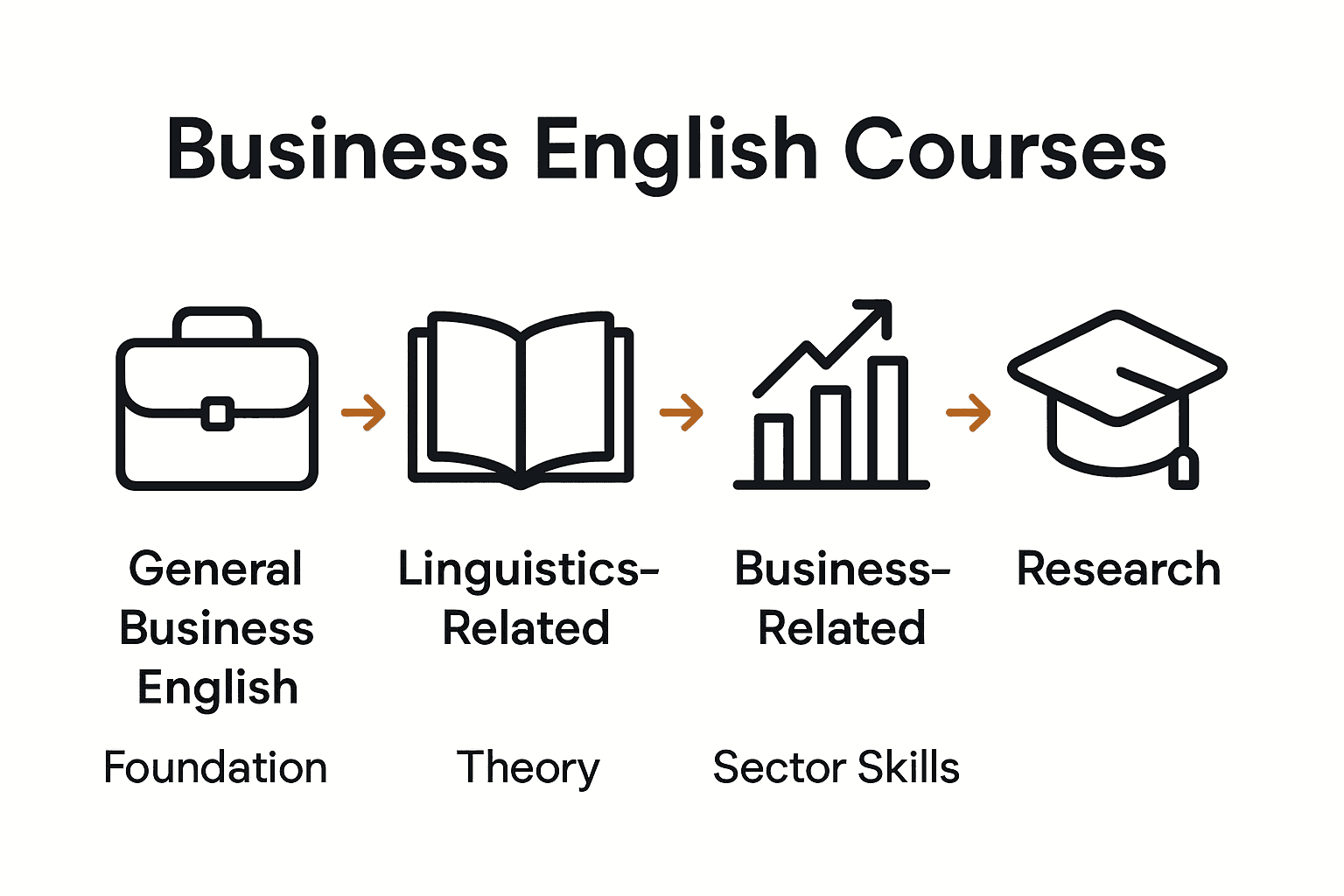
ERIC outlines that Business English courses can be categorized into four primary types:
- General Business English Courses: Foundational language skills for professional contexts
- Linguistics-Related Courses: Advanced language structure and communication theory
- Business-Related Courses: Industry-specific communication strategies
- Business English Research Courses: Academic exploration of language in commercial settings
According to Science Publishing Group, these courses uniquely integrate interdisciplinary elements, combining linguistics, economics, international commercial law, and business correspondence. This comprehensive approach ensures that learners develop a holistic understanding of professional communication.
Professionals and aspiring business communicators can choose from a range of specialized courses tailored to specific career needs. Whether you’re looking to improve presentation skills, master negotiation language, or enhance written communication, there’s a Business English course designed to elevate your professional language capabilities.
 Discover strategies for teaching Business English and advancing your career with targeted, industry-specific training programs.
Here’s a comparison of the four primary types of Business English courses:
| Course Type | Main Focus | Target Learners |
|---|---|---|
| General Business English | Professional language foundations | Entry-level professionals |
| Linguistics-Related | Language structure & theory | Advanced learners Academics |
| Business-Related | Industry-specific communication skills | Professionals in specific sectors |
| Business English Research | Academic language studies in business context | Researchers Graduate students |
Essential Skills For Business English Teachers
Business English teaching is a specialized profession that demands a unique blend of linguistic expertise, professional knowledge, and adaptive teaching strategies. Successful instructors must go beyond traditional language instruction, transforming themselves into communication strategists who can bridge linguistic and professional gaps.
JETIR highlights that effective Business English teachers must possess a deep understanding of both language structure and business communication strategies. This requires a multifaceted skill set that includes:
- Advanced linguistic comprehension
- Industry-specific communication expertise
- Adaptive teaching methodologies
- Cultural and professional context awareness
According to ESP & EAP, Business English instructors must navigate the complex challenges of teaching language within specific professional contexts. This means being knowledgeable about various business sectors and designing courses that address the unique demands of different industries.
Professional development is crucial for Business English teachers. Continuous learning about emerging business trends, technological communication tools, and evolving language practices ensures that instructors remain relevant and effective. Learn more about developing essential teaching skills for TEFL professionals to enhance your career and teaching effectiveness in this dynamic field.
Qualifications And Course Requirements Explained
Business English teaching represents a sophisticated professional pathway that demands comprehensive educational preparation and specialized training. Prospective instructors must navigate a complex landscape of qualifications that blend linguistic expertise with professional communication skills.
ERIC reveals that qualifying for Business English instruction requires a nuanced combination of academic credentials. Educators typically need advanced studies encompassing:
- Theoretical linguistics
- Pragmatic communication strategies
- Economic principles
- Management fundamentals
- International business practices
According to Science Publishing Group, successful Business English programs mandate instructors possess interdisciplinary knowledge. This comprehensive approach ensures teachers can effectively navigate the intricate language skills required in international professional environments.
Most institutions require a minimum of a bachelor’s degree, with many preferring candidates holding advanced certifications like TEFL or TESOL specialized in Business English. Professional experience in business communication can significantly enhance a candidate’s marketability. Learn more about selecting the right TEFL certification for your career goals to kickstart your Business English teaching journey.
Common Challenges And Classroom Solutions
Business English instruction presents a complex landscape of unique pedagogical challenges that require innovative and strategic approaches. Teachers must navigate a sophisticated environment where language learning intersects with professional communication skills and diverse learner expectations.
JETIR highlights that teaching Business English involves addressing significant challenges, particularly the varied linguistic backgrounds of students and the need to align course content with specific business contexts. Key challenges include:
- Diverse student skill levels
- Industry-specific communication requirements
- Varied professional backgrounds
- Complex technical terminology
- Rapidly changing business communication trends
According to ESP & EAP, instructors must develop strategies that balance linguistic instruction with practical business applications. This involves designing curricula that enhance students’ communicative competence through real-world business scenarios and targeted language development techniques.
Successful Business English teachers must remain adaptable, continuously refining their approach to meet the dynamic needs of professional learners. Learn practical classroom management strategies for addressing these challenges to create an engaging and effective learning environment that prepares students for global business communication.
Elevate Your Business English Teaching Skills Today
Struggling with the demands of teaching Business English means facing diverse student needs, mastering industry-specific language, and adapting to fast-changing communication trends. This article highlights how essential in-depth knowledge of both language and business is for effective teaching. With challenges like varied professional backgrounds and complex terminology, your goal is to deliver clear, confident instruction that prepares learners for real-world success.

Take control of your career with specialized training from TEFL Institute. Our courses are designed to give you the advanced linguistic expertise and practical teaching strategies needed to excel in Business English instruction. Whether you want to deepen your understanding of professional communication or gain internationally recognized certification, now is the time to invest in your future. Explore how to develop essential teaching skills and start your path with a comprehensive TEFL certification that will unlock new opportunities in the global teaching market.
Frequently Asked Questions
What is Business English?
Business English is a specialized form of language learning focused on developing the communication skills and technical vocabulary necessary for effective interaction in global commercial environments.
What types of Business English courses are available?
Business English courses can be categorized into general courses, linguistics-related courses, business-related courses, and research courses, each designed to address specific professional communication needs.
What skills should Business English teachers possess?
Effective Business English teachers should have advanced linguistic comprehension, industry-specific communication expertise, adaptive teaching methodologies, and an awareness of cultural and professional contexts.
What qualifications are needed to teach Business English?
To teach Business English, instructors typically require advanced studies in linguistics, communication strategies, and business practices, along with a minimum of a bachelor’s degree and certifications like TEFL or TESOL specialized in Business English.