

 United Kingdom (UK)
 United States (US)
 Canada
 South Africa
 India
India Australia
 New Zealand
 China
China Russia
 Germany
 France
 Spain
Spain Netherlands
 Vietnam
 United Arab Emirates
 Italy
Italy Poland
 Thailand
 Türkiye





 Algeria


How to Teach Business English for Career Success
How to Teach Business English for Career Success

Nearly 80 percent of Business English learners say customized lessons help them communicate more confidently at work. Understanding your students’ professional needs is the key to turning ordinary classes into real career assets. By uncovering specific workplace communication goals, you can shape every lesson to fit the challenges your learners actually face on the job.
Quick Summary
| Key Point | Explanation |
|---|---|
| 1. Identify learner needs first | Conduct a needs analysis to determine specific professional contexts and language goals of your students. |
| 2. Develop a targeted syllabus | Design a curriculum that aligns with real-world workplace skills to address your students’ communication challenges. |
| 3. Create engaging activities | Use role plays and simulations reflecting actual business scenarios to enhance learner engagement and relevance. |
| 4. Integrate authentic materials | Curate real workplace documents to ensure learning aligns with genuine business communication practices. |
| 5. Evaluate learner progress regularly | Implement multi-dimensional assessments and provide feedback to track skill development in practical contexts. |
Table of Contents
- Step 1: Assess Learner Needs And Business Goals
- Step 2: Develop A Targeted Business English Syllabus
- Step 3: Design Engaging, Industry-Relevant Activities
- Step 4: Integrate Real-World Business Materials
- Step 5: Evaluate Learner Progress And Outcomes
Step 1: Assess learner needs and business goals
Learning how to effectively assess your Business English students’ specific needs and professional goals is the cornerstone of creating a targeted and impactful training program. This crucial first step transforms generic language instruction into a personalized learning experience that directly supports your students’ career objectives.
Begin by conducting a comprehensive needs analysis through an initial consultation or detailed questionnaire. According to research from Teaching English, engaging learners early helps build awareness and course autonomy. Your goal is to uncover specific professional contexts where students will apply their English skills.
During this initial assessment, ask strategic questions that reveal their workplace communication challenges:
- What industry do you work in?
- What are your primary communication goals?
- Do you need English for presentations, negotiations, email correspondence, or meetings?
- What technical or sector specific vocabulary do you most require?
This targeted approach allows you to design a curriculum that addresses real world business communication scenarios. Listen carefully to their responses and take detailed notes about their professional background, current language proficiency, and specific skill gaps.
Pro Tip: Always validate your initial assessment by requesting sample workplace documents or communication scenarios from the student to confirm their actual language needs.
Remember that needs analysis is not a one time event. Plan to conduct periodic check ins to ensure your curriculum continues meeting the evolving professional development goals of your Business English learners. Your next step will involve translating these insights into a customized learning roadmap.
Here’s a summary of each step and its core focus:
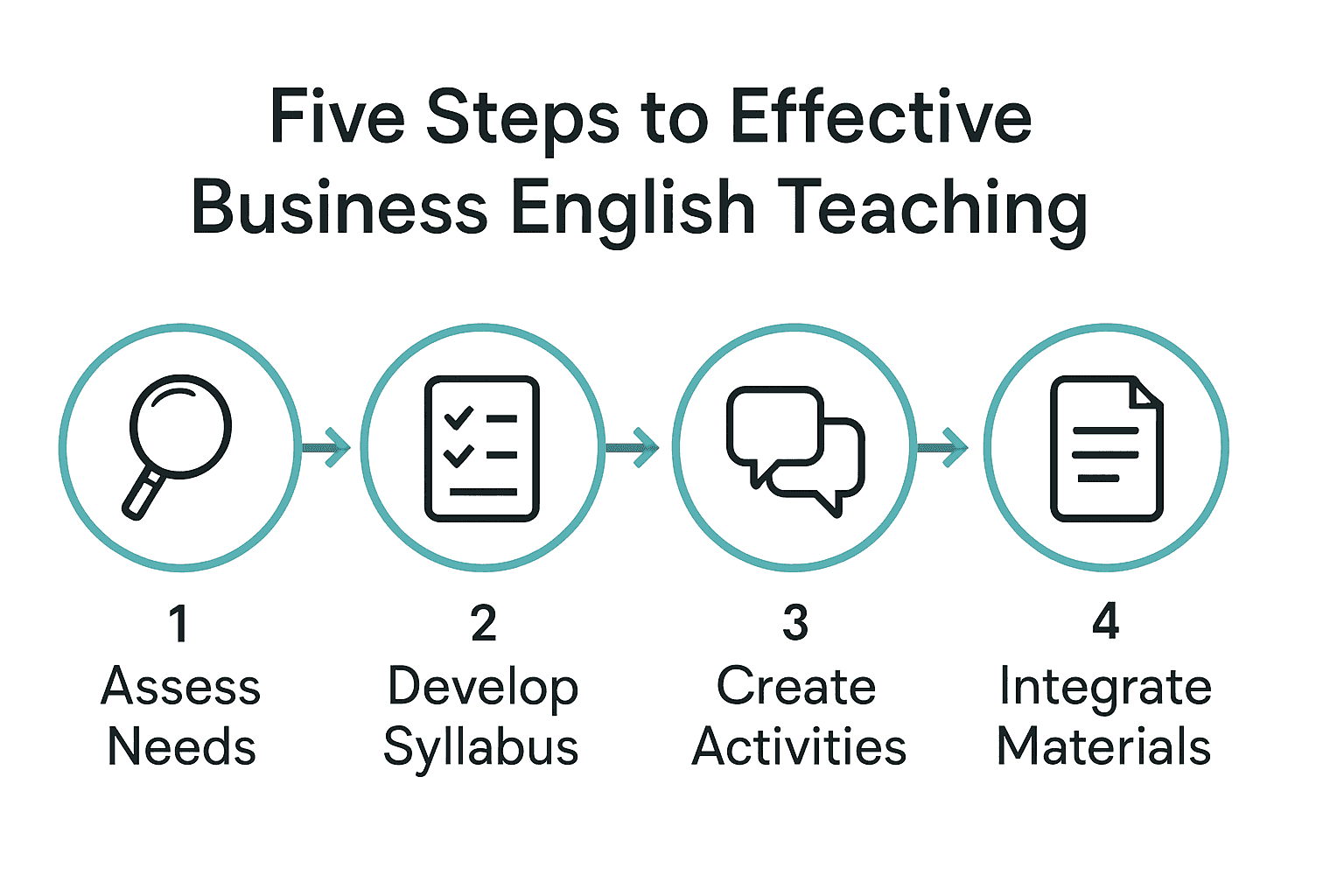
| Step | Main Goal | Key Activities |
|---|---|---|
| Assess Needs | Identify learner goals | Consultation Needs analysis survey Workplace context questions |
| Develop Syllabus | Design targeted curriculum | Align outcomes Modular units Focus on real tasks |
| Create Activities | Foster engagement | Role plays Simulations Group projects |
| Integrate Materials | Use authentic resources | Real emails Company reports Presentation docs |
| Evaluate Outcomes | Track progress | Rubric assessments Role play reviews Feedback sessions |
Learn more in our guide on teaching Business English to adults, which provides additional strategies for effective classroom management.
Step 2: Develop a targeted business English syllabus
Transforming your needs analysis insights into a strategic Business English syllabus is where your curriculum truly comes to life. Your goal is to create a learning roadmap that precisely addresses the professional communication challenges your students face in their specific workplace contexts.
Research highlights the importance of outcome-based syllabus design. According to a post-pandemic study from Thai Journal of Multidisciplinary Research, successful Business English curricula must align closely with real professional life skills and actual workplace requirements.
Structure your syllabus around core communication competencies:
- Professional speaking skills
- Business vocabulary development
- Written communication techniques
- Workplace presentation strategies
- Intercultural communication nuances
Drawing from research published in the Unnes Journal, prioritize speaking, vocabulary, and workplace-relevant reading materials. Each module should connect directly to practical business communication scenarios your students encounter.
Pro Tip: Design assessments that mirror real world business communication challenges to ensure skills transfer directly to professional environments.
Consider creating modular units that can be customized based on industry specifics. A technology sector professional will need different communication skills compared to someone in finance or healthcare. Flexibility allows you to adapt your curriculum to diverse professional needs.
Learn more about teaching English for specific purposes to further refine your approach to Business English instruction.
Step 3: Design engaging, industry-relevant activities
Creating dynamic and authentic learning experiences is crucial for keeping your Business English students motivated and connected to their professional goals. Your activities should bridge the gap between classroom learning and real world communication challenges.
According to research from Teach This, the most effective Business English activities include worksheets, role plays, games, and simulations specifically tailored to workplace communication scenarios like presentations, telephoning, negotiations, and problem solving.
Consider developing activities that simulate authentic business environments:
- Negotiation role plays with realistic business scenarios
- Presentation skills workshops mimicking corporate settings- Email and communication skills practice using industry specific templates
- Telephoning exercises with professional communication protocols
- Case study analysis reflecting current business challenges
Research from ArXiv highlights the value of integrating agile project methods like eduScrum to enhance student engagement and motivation by connecting learning directly to real world industry challenges.
Pro Tip: Use actual business documents, email threads, or communication scenarios from your students professional contexts to make activities hyper relevant.
Make your activities interactive and collaborative. Group projects that require teamwork and problem solving will help students develop both language skills and professional communication strategies. Your goal is to create a learning environment that feels less like a classroom and more like a dynamic professional development workshop.

Explore our tutorial on teaching English for specific purposes to further enhance your activity design skills.
Step 4: Integrate real-world business materials
Transforming your Business English classroom into an authentic professional learning environment requires carefully curated materials that mirror actual workplace communication. The key is selecting resources that make language learning feel less like an academic exercise and more like practical professional development.
According to research from Teaching English, the most effective approach involves selecting or creating materials that directly reflect genuine workplace artifacts. Think real emails, corporate reports, presentation decks, and communication documents from actual business contexts.
Start by building a diverse collection of authentic business materials:
- Genuine corporate email exchanges
- Professional presentation templates
- Industry specific reports and white papers
- Communication protocol documents
- Meeting minute templates
- Professional correspondence samples
Research on business simulation techniques suggests creating sandbox environments where learners can apply language skills through realistic decision making scenarios. This approach transforms learning from passive absorption to active professional skill development.
Pro Tip: Always obtain permission or use anonymized documents to protect confidentiality while maintaining authenticity.
Encourage your students to contribute materials from their own professional experiences. This collaborative approach not only provides relevant content but also increases student engagement and personal investment in the learning process.
Learn more about teaching English for specific purposes to further refine your material integration strategy.
Step 5: Evaluate learner progress and outcomes
Measuring student growth in Business English goes beyond traditional testing. Your evaluation strategy should provide comprehensive insights into each learner’s communication skill development and professional language competence.
Research from ArXiv highlights the effectiveness of rubric-based self-assessment combined with oral feedback. This approach not only improves student performance but also reduces potential grading disputes by making assessment criteria transparent and collaborative.
Develop a multi-dimensional assessment framework that captures various aspects of business communication skills:
- Spoken communication proficiency
- Written communication accuracy
- Professional vocabulary usage
- Intercultural communication competence
- Business presentation skills
- Contextual language application
Implement assessment methods that mirror real world business communication scenarios. Consider using:
- Role play evaluations
- Professional communication portfolios
- Simulated business scenario performances
- Peer and self-assessment exercises
- Video recorded presentation reviews
Pro Tip: Create assessment rubrics that are clear, specific, and aligned with your initial learner needs analysis to ensure meaningful progression tracking.
Regular feedback sessions help students understand their growth trajectory. Schedule periodic one-on-one discussions to review progress, address challenges, and set future learning objectives.
Explore our guide on teaching English for specific purposes to enhance your assessment strategies.
Ready to Teach Business English for Real Career Impact?
Many educators struggle to build effective Business English programs that truly align with student goals and workplace demands. You care about bridging the gap between language learning and professional success, but tailoring lessons and engaging activities for unique business needs can be overwhelming. Our step-by-step approach—needs analysis, targeted syllabus design, and authentic workplace activities—shows you how to turn theory into real-world results. But where do you find the right tools, guidance, and credentials to take that next leap?

At TEFL Institute, we empower you to confidently teach Business English with our accredited online TEFL courses and specialist pathways. Explore resources and advanced certifications built for modern classrooms, whether you are just starting or elevating your ESL career. Don’t wait. Equip yourself with proven strategies, verified qualifications, and practical support to help learners achieve career success through Business English. Visit our main site to get started today.
Frequently Asked Questions
How can I assess my Business English students’ specific needs?
To assess your Business English students’ needs, conduct an initial consultation or distribute a detailed questionnaire. Ask targeted questions about their communication challenges and professional goals to uncover key areas for improvement.
What should I include in a Business English syllabus?
A Business English syllabus should focus on essential communication skills, including professional speaking, written communication techniques, and vocabulary development. Structure your syllabus around practical scenarios that reflect real-world workplace requirements to enhance student learning.
How can I create engaging activities for Business English learners?
Design activities that simulate real business environments, such as negotiation role plays or presentation skills workshops. Make your activities interactive and relevant to industry-specific communication challenges to keep students engaged and motivated.
What types of materials should I integrate into Business English training?
Use authentic business materials, such as real emails, corporate reports, and presentation documents, to create a professional learning environment. Ensure the resources reflect actual workplace communication to help students connect their learning to practical applications.
How can I evaluate the progress of my Business English learners?
Implement a multi-dimensional assessment framework that includes spoken proficiency, written accuracy, and professional vocabulary usage. Use methods like role play evaluations and peer assessments to track student progress effectively and provide regular feedback to guide their development.
