

 United Kingdom (UK)
 United States (US)
 Canada
 South Africa
 India
India Australia
 New Zealand
 China
China Russia
 Germany
 France
 Spain
Spain Netherlands
 Vietnam
 United Arab Emirates
 Italy
Italy Poland
 Thailand
 Türkiye









 Algeria



How to Teach Business English: A Practical Step-by-Step Guide
How to Teach Business English: A Practical Step-by-Step Guide

Did you know that nearly 90 percent of employers say strong business communication skills are critical for career success? Many English learners struggle to meet these demands because every industry and job role brings unique language challenges. Understanding what sets Business English apart means tailoring lessons to real workplace needs, not just textbook phrases. Discover how targeted strategies can unlock learners’ confidence and help them thrive in professional settings.
Quick Summary
| Key Point | Explanation |
|---|---|
| 1. Conduct a comprehensive needs assessment | Understand students’ specific language and communication needs through detailed questionnaires or interviews. |
| 2. Design targeted business-focused lessons | Create lessons that directly address identified professional scenarios, ensuring real-world relevance and applicability. |
| 3. Incorporate authentic business materials | Use real-world resources like news articles and podcasts to enrich lessons and enhance student engagement. |
| 4. Facilitate immersive communication practice | Implement role-play scenarios and simulations to help students apply their language skills in realistic business contexts. |
| 5. Continuously evaluate and adjust instruction | Regularly assess student progress and adapt teaching strategies to meet their evolving language and communication needs. |
Table of Contents
- Step 1: Assess Learners’ Business Language Needs
- Step 2: Design Relevant Business-Focused Lessons
- Step 3: Incorporate Authentic Business Materials
- Step 4: Facilitate Real-World Communication Practice
- Step 5: Evaluate Progress And Adjust Instruction
Step 1: Assess Learners’ Business Language Needs
Successfully teaching Business English starts with understanding exactly what your learners need. This step focuses on uncovering the specific language skills and professional communication requirements unique to each student or group.
Begin by conducting a comprehensive language needs assessment. This means going beyond standard language tests and diving deep into your learners professional contexts. Schedule an initial consultation or send out a detailed questionnaire that explores their specific work environments, job roles, and communication challenges.
Your assessment should cover several key areas:
- Current professional communication challenges
- Industry specific terminology gaps
- Preferred communication channels (email, presentations, meetings)
- Specific language skills needed (negotiation, report writing, networking)
- Confidence levels in different business scenarios
Consider using a mix of methods to gather this information. Interviews work well for understanding nuanced needs. Written surveys can capture structured data. Some teachers even recommend brief recorded video responses from learners explaining their language goals.
Here’s a summary comparing key approaches for gathering Business English learner needs:
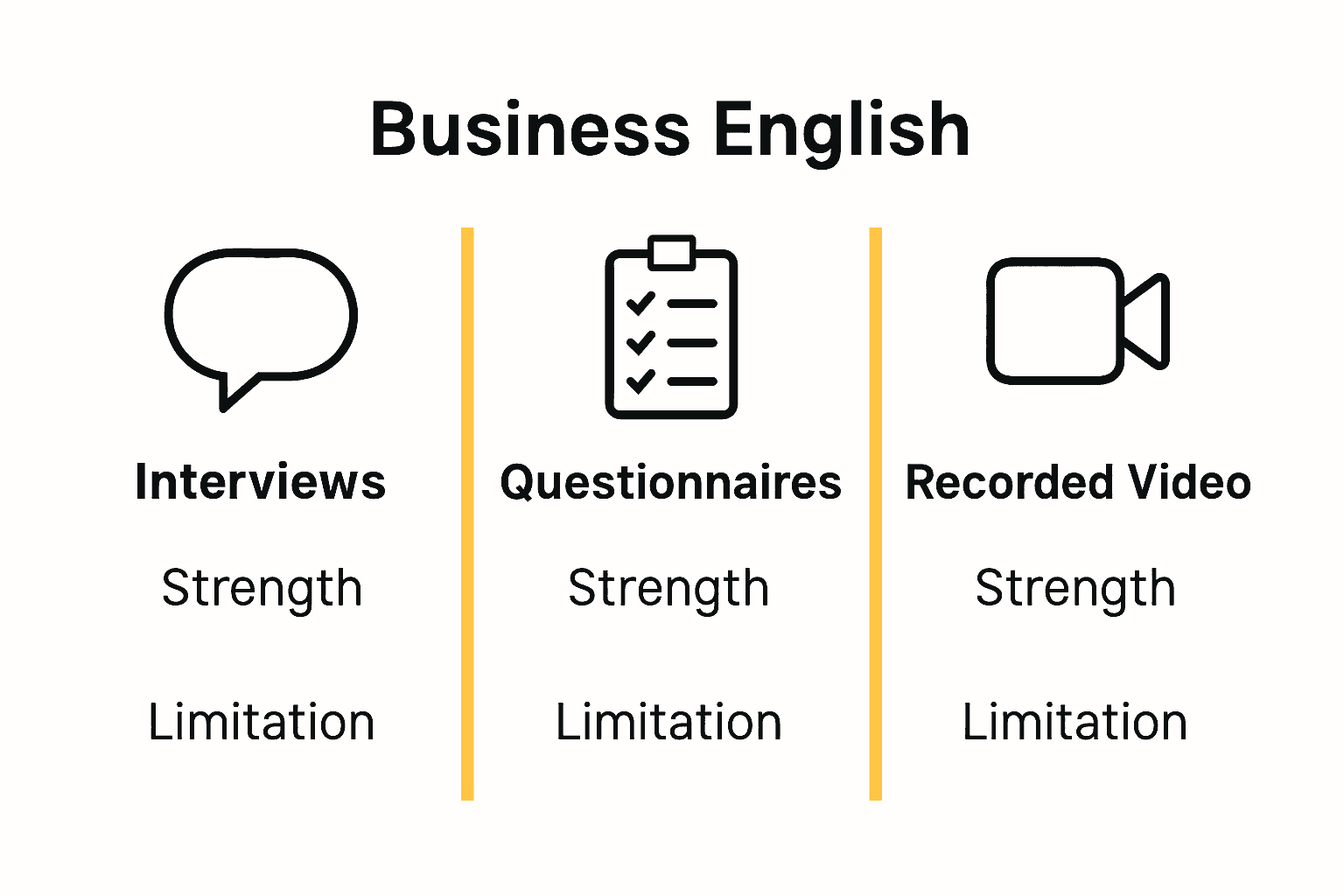
| Assessment Method | Strengths | Limitations |
|---|---|---|
| Interviews | Nuanced insights Personal connections |
Time-consuming Less structured data |
| Questionnaires | Efficient Easy data analysis |
Limited depth Potential misinterpretation |
| Recorded Video Responses | Observes speaking Authentic self-expression |
Tech access required Time to review footage |
Pro Tip: Always connect language learning directly to professional outcomes. Learners are more motivated when they see clear pathways between language skills and career advancement.
In teaching English for specific purposes, the more precisely you can map learner needs, the more targeted and effective your instruction will become. Treat this assessment phase as the critical foundation for your entire Business English teaching strategy.
Once you have gathered comprehensive insights, you will be ready to design a customized learning approach that addresses each learner’s unique professional language development requirements.
Step 2: Design Relevant Business-Focused Lessons
With a clear understanding of your learners needs from the initial assessment, you are now ready to craft targeted Business English lessons that speak directly to professional communication scenarios. This step transforms your insights into practical learning experiences.
According to instructional design principles, lesson development should follow a systematic approach. Research on instructional design suggests creating interventions that precisely align with identified learner goals. This means translating your assessment data into specific learning objectives that mirror real world business communication challenges.
Start by mapping your lessons to actual workplace communication scenarios. For example, if your learners need stronger email writing skills, design modules that cover:
- Professional email structure
- Tone and formality levels
- Effective subject line creation
- Concise and clear messaging techniques
- Cultural communication nuances
Each lesson should simulate authentic business interactions. This might mean creating role play scenarios that replicate negotiation meetings, crafting practice presentations, or developing complex email communication exercises that reflect genuine professional exchanges.
Pro Tip: Build lessons around contextual learning. The more your materials resemble actual workplace communication, the more engaged and motivated your students will be.
In teaching English for specific purposes, your lesson design should prioritize practical application over theoretical knowledge. Focus on developing communicative competence that students can immediately transfer to their professional environments.
Remember that flexibility is key. Your lesson plans should be adaptable, allowing you to pivot based on ongoing student feedback and emerging communication needs in their specific industries.
Step 3: Incorporate Authentic Business Materials
Transforming your Business English lessons from theoretical to truly practical requires bringing real world communication directly into your classroom. Authentic business materials become the bridge between language learning and professional communication skills.
According to recent research, incorporating authentic materials offers profound learning advantages. Experts highlight that these resources expose learners to genuine business discourse, current terminology, and professional communication trends while simultaneously boosting student motivation and critical thinking skills. Ready to go deeper? Our 30-hour Teaching Business English course walks you through needs analysis, frameworks and ready-to-use lesson templates step by step.
Start by curating a diverse collection of authentic resources:
- Business news articles from reputable sources
- Company annual reports
- Professional podcast episodes
- Industry conference recordings
- TED Talks from business leaders
- Professional networking platform content
The US Department of Education notes that while authentic materials provide exceptional real world context, instructors must carefully select resources matching student proficiency levels. Lower level learners might feel overwhelmed by complex materials.
Pro Tip: Always preview materials thoroughly. Select content that challenges students without creating language anxiety.
In teaching English for specific purposes, authentic materials serve as more than learning tools. They represent actual communication environments where your students will eventually operate professionally.
Consider developing structured activities around these materials. This might involve comprehension questions, vocabulary extraction exercises, or collaborative discussions that deconstruct professional communication strategies embedded within the content.
Remember that authentic materials are living resources. Stay current, rotate your selections regularly, and always align them with your learners specific industry and communication needs.
Step 4: Facilitate Real-World Communication Practice
Moving beyond theoretical learning requires creating dynamic environments where students can actively practice professional communication skills. This step transforms classroom knowledge into practical workplace competence through structured interactive experiences.
According to professional ESL resources, effective communication practice involves strategic role play scenarios that mirror authentic business interactions. These simulations should target specific professional communication challenges students are likely to encounter.
Design comprehensive communication practice activities that cover multiple professional scenarios:
- Job interview simulations
- Business negotiation role plays
- Professional presentation workshops
- Networking conversation exercises
- Cross cultural communication scenarios
- Client relationship management interactions
Drawing inspiration from business training methodologies, research on business war games suggests creating structured negotiation simulations. These exercises involve gathering intelligence, strategizing communication approaches, and conducting detailed debriefing sessions that help students understand nuanced communication strategies.
Pro Tip: Record practice sessions when possible. Allowing students to review their own communication performance provides powerful learning opportunities.
In teaching English for specific purposes, communication practice should feel immersive and consequential. Create scenarios with real stakes where students must navigate complex professional interactions using their developing language skills.
Ensure each practice session includes constructive feedback mechanisms. This means providing immediate guidance, highlighting effective communication strategies, and offering targeted suggestions for improvement.
Remember that communication skills develop through consistent practice. Design a progression of increasingly complex scenarios that challenge students while building their professional linguistic confidence.

Step 5: Evaluate Progress and Adjust Instruction
Effective Business English instruction demands continuous assessment and strategic adaptation. This step focuses on developing a robust evaluation system that tracks student progress and allows for responsive instructional modifications.
Cambridge Assessment English offers insights into modern proficiency evaluation techniques, highlighting the importance of modular adaptive testing that can precisely measure learners business language skills. Your evaluation approach should be comprehensive and multifaceted.
Design an assessment strategy that incorporates multiple evaluation methods:
- Periodic skills assessments
- Performance based communication tasks
- Self reflection journals
- Peer evaluation exercises
- Standardized business English proficiency tests
- Portfolio development tracking progress
Create a structured feedback loop where assessment results directly inform your instructional approach. This means carefully analyzing student performance data to identify specific language skill gaps and developing targeted interventions.
Pro Tip: Use digital tools and platforms that allow granular tracking of student progress across different communication competencies.
In teaching English for specific purposes, evaluation should extend beyond traditional testing. Focus on authentic performance metrics that demonstrate real world communication capabilities.
Encourage student participation in the assessment process. This might involve collaborative goal setting, regular progress conferences, and transparent discussions about learning objectives and achievements.
Remember that effective evaluation is not about ranking students but about understanding their unique learning journeys and providing personalized support to help them achieve their professional communication goals.
Take Your Business English Teaching Skills to the Next Level
Feeling overwhelmed trying to tailor your Business English lessons for real workplace needs? Many aspiring and current teachers struggle with issues like identifying learner challenges, designing relevant lesson plans, and building authentic practice opportunities that drive genuine results. Searching for clear guidance on targeted assessments, authentic material integration, or communication-focused evaluation? You deserve a complete training path that helps you confidently make the leap from theory to classroom excellence.

Get practical, proven strategies with the TEFL Institute’s online certification courses and targeted professional resources. Our comprehensive programs empower you to design business-focused lessons, master needs assessments, and create authentic learning experiences for every type of learner. Start your journey today—visit TEFL Institute and unlock step-by-step support as you transform your Business English teaching skills. Don’t wait to advance your expertise and reach your career goals—explore your options now.
Frequently Asked Questions
How can I assess my learners’ Business English needs?
Begin by conducting a comprehensive needs assessment through questionnaires or interviews. Identify their current communication challenges, industry-specific terminology gaps, and language skills required for their job roles.
What are the key components of designing effective Business English lessons?
Focus on mapping your lessons to real workplace scenarios, such as email writing or negotiation tactics. Create specific learning objectives that align with your learners’ professional communication needs to ensure relevance.
How can I incorporate authentic materials into my Business English teaching?
Select real-world business resources like news articles or company reports that match student proficiency levels. This enhances motivation and exposes them to actual communication contexts they will face in their careers.
What role does communication practice play in teaching Business English?
Facilitate immersive communication practice through role play and simulations of business interactions. Implement activities like job interview scenarios or negotiation exercises to build confidence in real-life situations.
How should I evaluate progress in my Business English classes?
Implement a multi-faceted evaluation strategy that includes performance-based tasks and self-reflection journals. Regularly track progress and adjust your teaching methods based on students’ specific language skill gaps.
What is the importance of feedback in teaching Business English?
Provide constructive feedback during practice sessions to help students understand their strengths and areas for improvement. Use immediate guidance to foster a supportive learning environment and encourage ongoing development.