
 United Kingdom (UK)
 United States (US)
 Canada
 South Africa
 India
India Australia
 New Zealand
 China
China Russia
 Germany
 France
 Spain
Spain Netherlands
 Vietnam
 United Arab Emirates
 Italy
Italy Poland
 Thailand
 Türkiye










 Algeria



ESL teaching trends for 2026: methods that work
ESL teaching trends for 2026: methods that work

TL;DR:
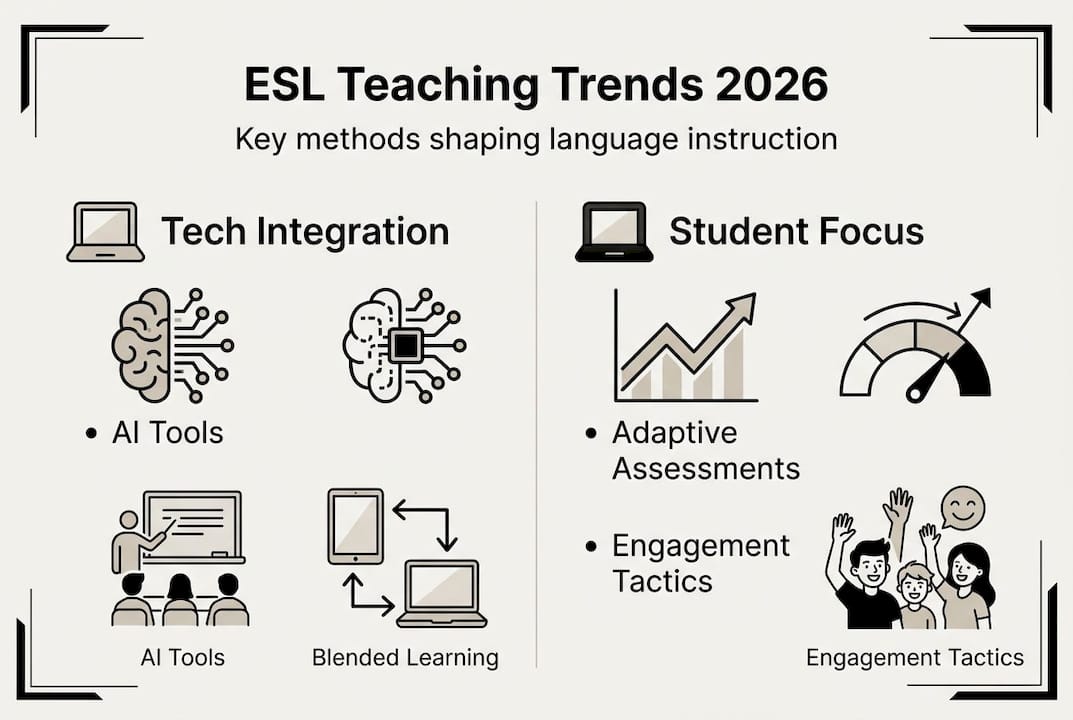
- ESL teaching is rapidly evolving with new methodologies like blended learning and AI-assisted feedback.
- Effective integration of EdTech enhances student engagement and proficiency, especially through intentional platform use.
- Career prospects demand recognized certifications, specialized micro-credentials, and adaptability to global and online markets.
ESL teaching is evolving faster than most educators anticipated. New methodologies are reshaping how teachers plan lessons, assess students, and deliver content across in-person and online settings. For aspiring and current ESL teachers, staying current is not optional. It directly affects classroom outcomes, student retention, and career advancement. Whether you are new to the field or looking to sharpen your practice, understanding the key shifts happening right now gives you a real competitive edge. This guide breaks down the most important ESL teaching trends, practical technology applications, student engagement strategies, and the credentials that matter most in today’s hiring market.
Table of Contents
- The biggest shifts in ESL instruction for 2025
- Integrating technology: EdTech and the digital ESL classroom
- Student-centered learning: Engagement and motivation tactics
- Credentials, career paths, and hiring outlook for ESL teachers
- A fresh perspective: What most ESL teaching guides miss
- Advance your ESL teaching career with TEFL Institute
- Frequently asked questions
Key Takeaways
| Point | Details |
|---|---|
| Blended learning dominates | Combining in-person and digital methods is the backbone of effective ESL teaching in 2025. |
| EdTech drives progress | Digital tools like AI and online platforms improve engagement and measurable student skills. |
| Student motivation is key | ESL teachers are succeeding by focusing lessons around active student participation and real-world applications. |
| Continuous teacher growth | Teachers benefit most from updated credentials and staying current with hiring trends in the ESL market. |
The biggest shifts in ESL instruction for 2025
ESL, or English as a Second Language, refers to teaching English to non-native speakers in environments where English is the dominant language or a key academic requirement. The field has always adapted to social and technological change, but the pace of that change has accelerated significantly.
Several major instructional approaches are now defining effective ESL teaching strategies in modern classrooms:
- Blended learning: Combines face-to-face instruction with online activities, allowing students to progress at their own pace while still benefiting from teacher-led sessions.
- Microlearning: Breaks content into short, focused modules of five to fifteen minutes, improving retention and reducing cognitive overload.
- Task-based language teaching (TBLT): Structures lessons around real-world tasks, such as writing an email or navigating a job interview, rather than grammar drills alone.
- Differentiated instruction: Tailors content, pacing, and assessment to individual student needs, which is especially valuable in mixed-ability classrooms.
- AI-assisted feedback: Uses artificial intelligence tools to provide instant, personalized feedback on writing, pronunciation, and grammar.
Adaptive assessments are also gaining ground. These are evaluations that adjust in difficulty based on a student’s responses in real time, producing a more accurate picture of proficiency than static tests.
| Approach | Primary benefit | Best suited for |
|---|---|---|
| Blended learning | Flexibility and pacing | Mixed in-person and online groups |
| Microlearning | Retention and focus | Busy adult learners |
| TBLT | Real-world application | Intermediate to advanced students |
| Differentiated instruction | Personalized outcomes | Mixed-ability classes |
| AI feedback tools | Immediate correction | Large class sizes |
AI tools in particular are shifting how teachers spend their time. Instead of manually marking every written exercise, teachers can now review AI-generated feedback summaries and focus their energy on higher-order instruction. This is not about replacing teachers. It is about freeing them to do what technology cannot: build relationships, model authentic communication, and respond to the emotional needs of learners. Effective lesson planning tips now routinely incorporate these tools as standard practice rather than optional extras.
Integrating technology: EdTech and the digital ESL classroom
EdTech, short for educational technology, covers any digital tool, platform, or software used to support teaching and learning. In ESL contexts, this includes learning management systems (LMS) like Google Classroom or Canvas, video conferencing platforms, interactive apps, and AI-powered language tools.
Research shows that digital platforms boost oral proficiency by up to 40%, making a strong case for intentional technology integration rather than ad hoc adoption. The key word is intentional. Not every tool improves outcomes. The ones that do share a few common features: they are interactive, they provide feedback, and they support communication rather than passive consumption.
Here is a comparison of digital and traditional classroom setups:
| Feature | Traditional classroom | Digital or hybrid classroom |
|---|---|---|
| Feedback speed | Delayed (next class) | Immediate (automated or live) |
| Student pacing | Uniform | Individualized |
| Resource access | Limited to physical materials | Unlimited digital libraries |
| Teacher monitoring | Observation-based | Data-driven dashboards |
| Engagement tools | Whiteboard, handouts | Apps, polls, video, gamification |
For teachers new to setting up digital classrooms, the most effective approach is to start with one or two tools and build from there. Overloading a lesson with technology creates confusion rather than clarity.
Popular tools currently used in ESL settings include:
- Kahoot and Quizlet: For vocabulary review and formative assessment
- Flipgrid: For asynchronous speaking practice
- Nearpod: For interactive, teacher-led digital lessons
- ChatGPT and similar AI tools: For writing feedback and conversation practice
Understanding the types of online ESL teaching available, from one-to-one tutoring to large group instruction, also shapes which tools are most appropriate.
Pro Tip: Blend synchronous sessions (live video calls) with asynchronous tasks (recorded responses or written forums) to accommodate different time zones and learning styles. This combination consistently produces stronger engagement than either format alone.
Student-centered learning: Engagement and motivation tactics
Student-centered learning shifts the focus from teacher delivery to student participation. In ESL contexts, this means designing lessons where students are actively producing language rather than passively receiving it. The goal is to create conditions where learners feel ownership over their progress.
Best practices for ESL lesson planning in 2025 consistently point to the same core tactics for boosting engagement:
- Gamification: Introduce point systems, badges, or team challenges around language tasks. Students respond to competition and reward structures, especially in younger age groups.
- Peer projects: Assign collaborative tasks that require negotiation and communication in English. This mirrors real-world language use and builds confidence.
- Real-world tasks: Use authentic materials, such as news articles, job listings, or social media posts, as the basis for language activities. Students engage more when content feels relevant.
- Clear routines: Predictable lesson structures reduce anxiety and allow students to focus on language rather than logistics.
- Flexible pacing: Allow students to revisit content or move ahead based on demonstrated proficiency rather than a fixed calendar.
“The most effective ESL classrooms are those where students feel safe to make mistakes, try new structures, and take risks with language. That psychological safety is the foundation of progress.”
For teachers looking at enhancing classroom skills, the shift toward student-centered models requires a change in mindset as much as a change in method. Teachers move from being the primary source of knowledge to being facilitators of language use.

Pro Tip: At the start of each unit, give students a simple choice, such as selecting a discussion topic or choosing between two task formats. This small act of agency significantly increases motivation and class ownership over the following lessons.
Credentials, career paths, and hiring outlook for ESL teachers
The ESL job market in 2025 is competitive but expanding. Certification and career trends show that employers are increasingly looking beyond a basic TEFL certificate. Micro-credentials, specialized training in areas like IELTS preparation or young learner instruction, and evidence of ongoing professional development are now strong differentiators.
The standard entry-level qualification remains a 120-hour TEFL or TESOL certificate. However, advanced diplomas and hybrid programs that include observed teaching practice are gaining preference among top employers, particularly in East Asia and the Middle East.
| Region | Demand level | Preferred qualification | Average monthly salary (USD) |
|---|---|---|---|
| China | Very high | TEFL + degree | $1,800 to $3,000 |
| Vietnam | High | TEFL certificate | $1,200 to $2,200 |
| Middle East | High | Advanced diploma | $2,500 to $4,500 |
| Online platforms | Very high | TEFL + tech skills | $15 to $40 per hour |
| Europe | Moderate | TEFL + local language | $1,000 to $2,500 |
ESL teacher hiring trends indicate that online teaching positions now account for a growing share of available roles, particularly for teachers who combine strong digital skills with recognized qualifications.
For those planning a career path, the options extend well beyond the classroom:
- Classroom teacher: The most common entry point, available in public schools, language academies, and universities worldwide
- Online ESL tutor: Flexible, location-independent roles through platforms or private clients
- Curriculum developer: Creating materials and lesson frameworks for publishers or schools
- Teacher trainer: Mentoring new teachers, often requiring several years of classroom experience
- Academic coordinator: Administrative and instructional leadership roles within institutions
For practical guidance on global career options, it helps to research specific country requirements early, as visa regulations and employer expectations vary significantly.
Key tips for job seekers in a competitive ESL market:
- Obtain an accredited, internationally recognized TEFL qualification
- Build a portfolio of lesson plans and recorded teaching samples
- Pursue at least one specialist credential, such as business English or exam preparation
- Network through ESL forums, LinkedIn groups, and professional associations
- Keep digital skills current, particularly with LMS platforms and video conferencing tools
A fresh perspective: What most ESL teaching guides miss
Most guides on ESL trends focus heavily on tools and methods. That is useful, but it risks creating a false impression: that the right app or the right framework is what separates effective teachers from ineffective ones.
The reality is more straightforward. Teacher adaptability and genuine student empathy consistently outperform the adoption of any single method. A teacher who reads the room, adjusts the pace when students look lost, and takes time to understand individual motivations will produce better outcomes than one who follows a trending methodology rigidly.
There is also a strong case for revisiting older, sometimes overlooked strategies. Structured oral repetition, for example, fell out of favor as communicative approaches took over. Yet for many learners, particularly those from educational backgrounds that emphasize memorization, structured repetition builds the confidence needed to attempt spontaneous communication. Dismissing it entirely is a mistake.
The expert guide to online teaching makes a similar point: sustainable teaching practice comes from blending innovation with what has been proven to work over time. The best teachers in 2025 are not the ones using the most technology. They are the ones who know when to use it and when to put it aside.
Advance your ESL teaching career with TEFL Institute
If you want to make these trends work for your classroom and career, having the right qualifications and support structure matters. TEFL Institute offers accredited courses designed around current best practices, from foundational TEFL certificates to advanced diplomas and specialist micro-credentials.
Whether you are just starting out or looking to move into specialized roles, TEFL certification courses at TEFL Institute are structured to fit around your schedule and career goals. Programs include practicum components, digital teaching modules, and globally recognized credentials that open doors in competitive markets. Explore the full course catalog to find the path that fits your ambitions in 2025 and beyond.
Frequently asked questions
Which ESL teaching trend is most important for 2025?
Blended learning, which combines digital platforms with in-person instruction, is the most widely adopted and impactful trend in ESL education for 2025. It offers flexibility for both teachers and students while maintaining the structure of direct instruction.
How are digital tools changing student results in ESL classes?
Studies show that digital platforms improve oral proficiency by up to 40%, particularly when tools are used consistently and tied to clear learning objectives rather than used as standalone activities.
What qualifications do I need to teach ESL in 2025?
Most employers require a recognized TEFL or TESOL certificate, and many now favor candidates with advanced certification paths such as diplomas or specialist micro-credentials in areas like business English or young learner instruction.
Where are the best ESL teaching opportunities in 2025?
China, Vietnam, and the Middle East remain top destinations for in-person roles, while global ESL opportunities on online platforms continue to expand, offering competitive pay and location flexibility for qualified teachers.
Recommended
- Top ESL teaching methodologies: proven strategies for 2026 | TEFL Institute
- ESL Teaching Tips 2025: Boost Oral Proficiency by 40% | TEFL Institute
- Boost ESL teaching success with lesson planning in 2026 | TEFL Institute
- Online ESL class setup guide for effective teaching in 2026 | TEFL Institute
- How To Encourage Language Learning