

 United Kingdom (UK)
 United States (US)
 Canada
 South Africa
 India
India Australia
 New Zealand
 China
China Russia
 Germany
 France
 Spain
Spain Netherlands
 Vietnam
 United Arab Emirates
 Italy
Italy Poland
 Thailand
 Türkiye










 Algeria



ESL Teacher Hiring: What Future Teachers Need to Know
ESL Teacher Hiring: What Future Teachers Need to Know

Finding your first international ESL teaching job can feel confusing when recruiters stress native speaker status over real classroom skills. Many aspiring teachers worry that their qualifications and training might be overlooked in favor of outdated hiring preferences. Native speakerism in ESL recruitment continues to influence hiring decisions, especially in countries like Spain and the UK, but more employers are starting to recognize the value of robust teaching credentials and recognized TEFL certification. This guide helps clarify what you need for success, whether you hope to teach in Asia or Europe.
Table of Contents
- ESL Teacher Hiring Defined And Debunked
- Global Hiring Pathways And Job Types
- Qualifications, Certifications, And Experience Needed
- Step-By-Step Process For Landing A Position
- Legal, Contractual, And Visa Essentials
- Risks, Costs, And Common Pitfalls
Key Takeaways
| Point | Details |
|---|---|
| ESL Hiring Practices Evolve | ESL teacher recruitment prioritizes teaching credentials and certifications over native speaker status, reflecting systemic biases in hiring. |
| Diverse Job Opportunities | The global ESL job market offers various positions, including public schools and online platforms, each requiring tailored qualifications. |
| Legal and Contractual Awareness | Understanding visa processes and contractual obligations is crucial for ESL teachers aiming to work internationally. |
| Financial Planning Is Essential | Aspiring teachers should prepare for potential costs and risks associated with international relocation and should establish an emergency fund. |
ESL Teacher Hiring Defined and Debunked
ESL teacher hiring is far more complex than simply recruiting native English speakers with good language skills. The global landscape of English Language Teaching (ELT) has transformed dramatically, challenging traditional recruitment paradigms that once prioritized native speaker status over actual teaching competence.
Traditionally, ESL hiring practices were heavily influenced by native speakerism – a discriminatory ideology that automatically privileges native English speakers regardless of their pedagogical training. Recent academic research reveals significant systemic biases in international hiring. Systemic discrimination against non-native teachers remains a persistent challenge in the global ELT marketplace.
Key factors now driving ESL teacher hiring include:
- Demonstrated teaching credentials
- TEFL/TESOL certification
- Pedagogical skills
- Cultural adaptability
- Advanced language teaching methodologies
- Professional development experience
Many employers are moving beyond simplistic native speaker requirements and recognizing that effective language instruction depends on structured training, classroom management skills, and sophisticated teaching approaches. Hiring practices challenging native speaker ideologies now emphasize professional qualifications over linguistic origin.
Pro tip: Focus on obtaining recognized certifications and developing robust teaching skills rather than relying solely on your native speaker status when pursuing international ESL opportunities.
Global Hiring Pathways and Job Types
The global ESL job market offers a diverse range of employment opportunities for qualified teachers, spanning multiple educational settings and international contexts. Teaching job categories worldwide encompass a broad spectrum of professional environments, each with unique requirements and potential career trajectories.
ESL teaching positions typically fall into several primary categories:
- Public school language instruction
- Private language academies
- Corporate language training
- Online teaching platforms
- International university programs
- Adult education centers
- International school systems
Full-time and part-time positions vary significantly across different global regions. Private institution hiring methods reveal complex recruitment strategies that go beyond traditional hiring approaches. Some employers prioritize practical teaching demonstrations, while others focus on comprehensive credential evaluations.
Regional job markets demonstrate distinct characteristics in ESL teacher recruitment. Asian countries like South Korea and China often seek young, energetic teachers for public and private language programs, whereas European markets tend to emphasize advanced academic qualifications and specialized language training expertise. Middle Eastern countries frequently offer competitive salary packages for experienced educators with advanced certifications.
Pro tip: Research specific regional job market requirements and tailor your application materials to highlight credentials most valued in your target geographic area.
Compare major ESL teaching settings worldwide:
| Job Setting | Student Age Group | Work Environment | Advancement Potential |
|---|---|---|---|
| Public Schools | Children, teens | Structured, formal | Limited, government dependent |
| Private Academies | Children to adults | Varied, flexible hours | High with performance |
| Corporate Training | Adults, professionals | Office/classroom hybrid | Promotion, specialization |
| Online Platforms | All ages | Remote, technology-focused | Rapid, skill-based |
| Universities | Young adults, adults | Academic, research-oriented | High, academic rank |
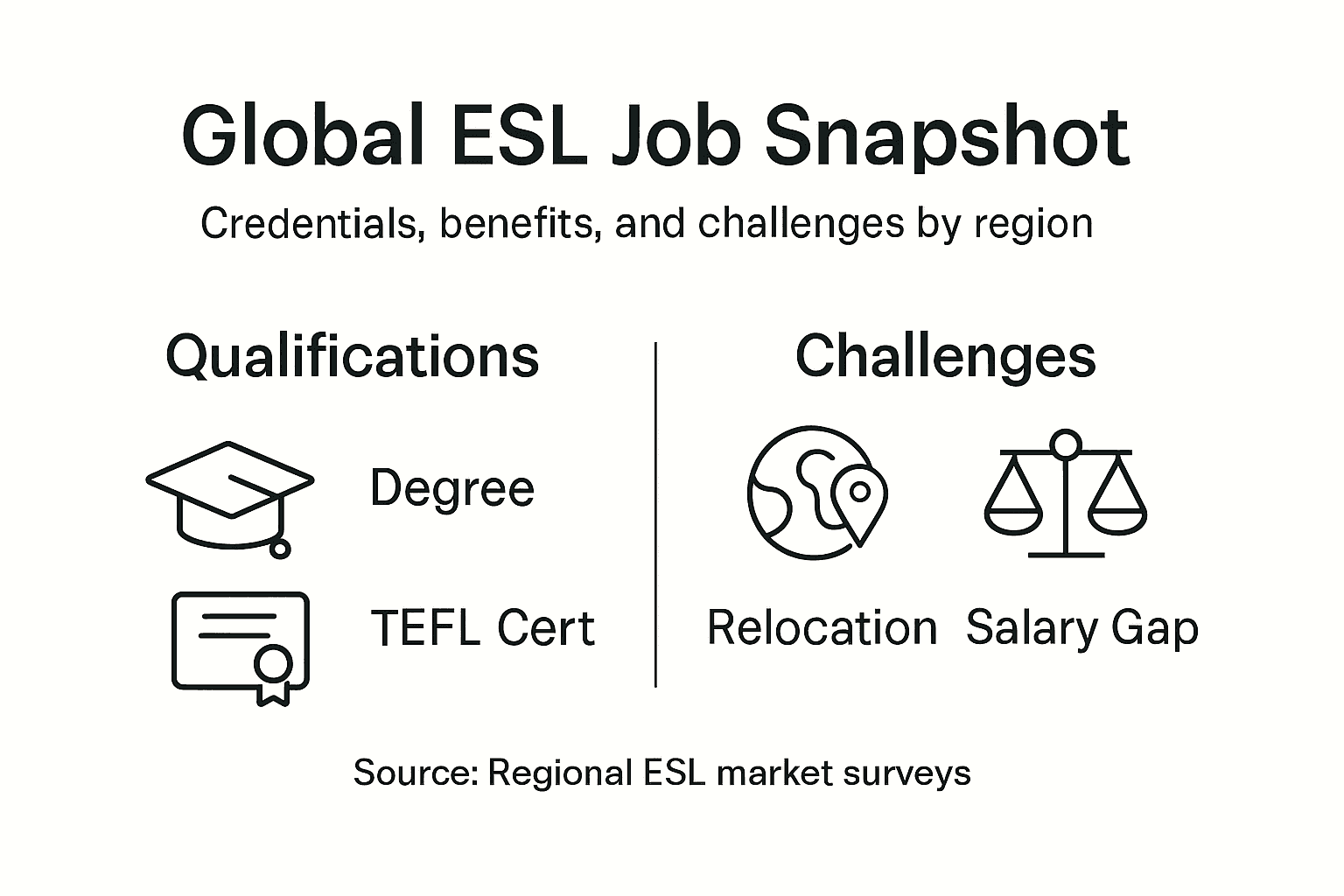
Here’s how regional ESL job markets differ in expectations and benefits:
| Region | Preferred Qualifications | Typical Benefits | Common Challenges |
|---|---|---|---|
| Asia | Bachelor’s, TEFL/TESOL, youth | Housing, airfare, bonuses | Upfront relocation costs |
| Europe | Advanced degrees, CELTA/Delta | Fewer benefits, higher pay | Stringent credential requirements |
| Middle East | Experience, advanced certs | High salaries, allowances | Rigorous visa/medical checks |
| Latin America | Basic certification, fluency | Modest pay, cultural exposure | Fewer full-time openings |
Qualifications, Certifications, and Experience Needed
Successful ESL teaching careers demand a strategic combination of academic credentials, professional certifications, and practical experience. Teaching qualification requirements worldwide emphasize the importance of a comprehensive professional profile that goes beyond basic language skills.
Essential qualifications for aspiring ESL teachers typically include:
- Bachelor’s degree (preferably in Education, Linguistics, or English)
- TEFL/TESOL certification
- Native or near-native English proficiency
- Teaching practicum or internship experience
- Additional language skills
- Demonstrated cultural adaptability
Certification pathways vary significantly across different regions and institutions. Private education recruitment standards reveal that employers look beyond basic credentials, seeking candidates who demonstrate robust pedagogical skills and potential for professional growth. Many international schools and language programs now require advanced certifications like CELTA, Delta, or specialized teaching diplomas that prove advanced methodological training.

Experience plays a crucial role in distinguishing competitive candidates. While entry-level positions might accept minimal teaching background, advanced roles in university settings, corporate training, and specialized language programs demand substantial professional experience. Candidates who can demonstrate successful classroom management, curriculum development, and student engagement will have a significant advantage in the competitive global ESL job market.
Pro tip: Continuously update your professional credentials and seek opportunities for additional certification to remain competitive in the dynamic ESL teaching landscape.
Step-by-Step Process for Landing a Position
Navigating the ESL job market requires a strategic and methodical approach. Global teacher recruitment processes reveal a complex landscape that demands careful preparation and targeted execution of your job search strategy.
Hiring windows close while you scroll.
Deadlines, salaries and visa notes for teaching jobs worldwide, checked against official sources and sent free every two weeks.
Get on the WireA comprehensive job search strategy typically involves the following critical steps:
- Research potential job markets and geographic opportunities
- Update and customize professional documentation
- Create a comprehensive teaching portfolio
- Develop targeted application materials
- Network with international teaching professionals
- Prepare for virtual and in-person interviews
- Complete necessary visa and legal documentation
The application process requires meticulous attention to detail. Teacher hiring methodologies demonstrate that institutions are increasingly sophisticated in their recruitment strategies. Many employers now utilize multi-stage screening processes that evaluate not just academic credentials, but also teaching demonstrations, personality fit, and potential for professional growth.
Successful candidates understand that landing an ESL position is more than submitting a generic application. Regional variations in hiring practices mean that approaches must be tailored to specific geographic markets. Asian institutions might prioritize youth and energy, while European programs often emphasize advanced academic credentials. Middle Eastern schools frequently seek experienced professionals with specialized certifications and demonstrable classroom expertise.
Pro tip: Develop a flexible, adaptable application strategy that can be quickly customized for different international job markets and institutional requirements.
Legal, Contractual, and Visa Essentials
Navigating the international ESL job market requires a comprehensive understanding of complex legal and contractual requirements. International teaching employment regulations demand meticulous attention to visa processes, work permits, and contractual obligations that vary significantly across different countries.
Critical legal considerations for ESL teachers include:
- Obtaining appropriate work visas
- Understanding contract termination clauses
- Verifying employer sponsorship requirements
- Comprehending local labor laws
- Securing health insurance and professional liability coverage
- Documenting tax obligations in host and home countries
The contractual landscape for international ESL teachers is intricate and multifaceted. Global teaching contract complexities reveal that employment agreements often include nuanced provisions beyond standard salary and teaching hours. Teachers must carefully scrutinize contracts for details about housing allowances, travel reimbursements, professional development opportunities, and potential legal protections.
Regional variations in legal requirements demand specialized knowledge. Asian countries like South Korea and China have structured visa processes that require specific documentation, while European Union nations have more fluid work permit systems. Middle Eastern countries often mandate additional health screenings and professional credential verifications. Successful international ESL teachers invest time in understanding these complex regulatory environments before committing to employment contracts.
Pro tip: Consult with experienced ESL teachers and legal professionals familiar with your target country’s specific work visa and employment regulations before signing any international teaching contract.
Risks, Costs, and Common Pitfalls
The international ESL teaching landscape presents numerous potential challenges that aspiring teachers must carefully navigate. Global teacher recruitment risks reveal complex financial and professional vulnerabilities that can significantly impact career trajectories and personal well-being.
Common risks and potential financial burdens include:
- Unexpected relocation expenses
- Visa processing costs
- Potential salary discrepancies
- Health insurance gaps
- Legal contract inconsistencies
- Professional credential verification expenses
- Emergency return travel funds
The economic landscape of international ESL teaching demands strategic financial planning. Systemic recruitment challenges highlight institutional practices that may create financial uncertainty. Some employers leverage complex contractual language to minimize their financial obligations, potentially leaving teachers vulnerable to unexpected expenses or reduced compensation.
Geographic variations significantly impact risk profiles. Asian markets often require substantial upfront investments in documentation and relocation, while Middle Eastern positions might offer more comprehensive support packages. European institutions typically demand extensive professional credentials, increasing initial preparation costs. Successful international ESL teachers must develop comprehensive risk management strategies that include financial reserves, comprehensive insurance coverage, and flexible career contingency plans.
Pro tip: Establish an emergency fund covering at least six months of living expenses before committing to an international ESL teaching position.
Take Control of Your ESL Teaching Career Today
Navigating the complex global ESL job market demands more than just good intentions. This article highlights critical challenges such as overcoming native speaker biases, meeting rigorous qualifications, and understanding regional legal requirements. If you want to build your teaching credentials, gain recognized certifications, and prepare for real-world classroom success, starting with the right training can make all the difference.

TEFL Institute offers comprehensive online TEFL courses designed to equip you with practical skills and globally recognized certifications that employers value. Whether you seek entry-level options or advanced diplomas, our flexible programs support your goals to teach abroad or online. Visit TEFL Institute now to explore course listings and take the first step toward becoming a confident and qualified ESL teacher ready to meet today’s market demands.
Frequently Asked Questions
What qualifications are necessary to teach ESL?
To become an ESL teacher, individuals typically need a bachelor’s degree (preferably in Education, Linguistics, or English), TEFL/TESOL certification, native or near-native English proficiency, and teaching practicum or internship experience. Additional language skills and cultural adaptability are also beneficial.
How can I improve my chances of getting hired as an ESL teacher?
Focus on obtaining recognized certifications, developing robust teaching skills, and gaining practical experience. Tailor your application materials to highlight the credentials most valued in your target market and prepare for teaching demonstrations during the hiring process.
What are common challenges faced by ESL teachers in international markets?
Common challenges include unexpected relocation expenses, visa processing costs, potential salary discrepancies, and navigating legal contract complexities. Additionally, some teachers may face gaps in health insurance or issues with professional credential verification.
What should I consider before accepting an ESL teaching contract?
Before accepting an ESL teaching contract, carefully review the terms, including salary, housing allowances, health insurance, and job responsibilities. Understanding the local labor laws, contract termination clauses, and any legal requirements for visas and work permits is essential to avoid future complications.
Recommended
- Best Platforms To Teach English Online in 2026: Complete TEFL Guide | TEFL Institute
- The Expert Guide to Teaching English Online in 2026 | Complete TEFL Roadmap | TEFL Institute
- Role of ESL Teacher: What It Means and Why It Matters | TEFL Institute
- How to Pass a TEFL Job Interview (7 Questions + Demo Lesson)