
 United Kingdom (UK)
 United States (US)
 Canada
 South Africa
 India
India Australia
 New Zealand
 China
China Russia
 Germany
 France
 Spain
Spain Netherlands
 Vietnam
 United Arab Emirates
 Italy
Italy Poland
 Thailand
 Türkiye










 Algeria



CELTA Exam: Unlocking Global ESL Opportunities
CELTA Exam: Unlocking Global ESL Opportunities

Pursuing the Cambridge CELTA qualification can feel both exciting and overwhelming for those eager to advance in English language teaching. With its strong focus on both theory and hands-on practice, CELTA is an internationally recognized teaching qualification trusted by schools and employers around the world. Whether you have limited classroom experience or wish to formalize your skills, understanding the exam’s scope can open doors to professional opportunities in nearly any country.
Table of Contents
- Defining The CELTA Exam And Its Scope
- CELTA Course Formats And Variations
- Exam Structure, Assessment, And Grading
- Entry Requirements And Preparation Process
- Costs, Global Recognition, And Career Impact
- CELTA Vs. TEFL: Key Differences And Pitfalls
Key Takeaways
| Point | Details |
|---|---|
| CELTA Certification Significance | The CELTA is a globally recognized credential for teaching English, emphasizing both theoretical knowledge and practical skills. |
| Course Formats | CELTA offers various course formats, including full-time, part-time, online, and blended, catering to diverse schedules and learning preferences. |
| Rigorous Assessment | The CELTA exam includes practical teaching, written assignments, and lesson planning, focusing on candidates’ adaptability and teaching potential. |
| Investment Value | Although it requires a financial commitment, CELTA certification enhances employability and salary potential in the global market. |
Defining the CELTA Exam and Its Scope
The Cambridge Certificate in English Language Teaching to Adults (CELTA) represents a pivotal professional credential for aspiring English language instructors worldwide. This internationally recognized teaching qualification prepares educators to teach English as a second or foreign language across diverse global contexts.
The CELTA is specifically designed to provide comprehensive training for individuals interested in teaching English, with a unique emphasis on both theoretical knowledge and practical application. Initial teacher training qualification requirements are stringent, ensuring that candidates develop robust pedagogical skills.
Key characteristics of the CELTA exam include:
- Suitable for candidates with little to no teaching experience
- Internationally recognized certification
- Balanced approach between theoretical understanding and hands-on teaching practice
- Applicable for teaching English to diverse age groups
- Provides foundational skills for global English language instruction
The program has evolved significantly from its original adult-focused framework to now encompass a broader range of learner demographics. Participants can expect an intensive training experience that prepares them for real-world teaching challenges across different educational environments.
The CELTA represents more than just a certification – it’s a gateway to global teaching opportunities.
Pro tip: Research authorized Cambridge Assessment English centers in your region to ensure you select a high-quality CELTA training program that meets international standards.
CELTA Course Formats and Variations
The Cambridge CELTA program offers remarkable flexibility for aspiring English language teachers, with multiple course delivery formats designed to accommodate diverse learning needs and professional schedules. These varied formats ensure that candidates can pursue their teaching certification regardless of their current work or life commitments.
Candidates can choose from several comprehensive CELTA course structures:
- Full-time intensive courses: Typically lasting 4-5 weeks, ideal for individuals who can dedicate concentrated time to training
- Part-time courses: Spread over several months, perfect for working professionals or those with existing responsibilities
- Online courses: Providing digital learning flexibility with virtual instruction
- Blended learning formats: Combining online self-study with practical teaching components
- Face-to-face training: Traditional in-person instruction with direct interaction
Each course format maintains rigorous standards, including a minimum of 120 guided learning hours and six hours of assessed teaching practice with adult learners at different proficiency levels. The training encompasses both theoretical instruction and practical teaching methodology, ensuring comprehensive skill development for potential educators.
The diversity of CELTA course formats demonstrates the program’s commitment to accessibility and professional development in English language teaching.
Students can select a course format that best matches their learning style, time availability, and career objectives. Experienced instructors provide personalized support, helping candidates develop robust pedagogical skills through structured curriculum and supervised teaching experiences.
Here’s a concise summary of CELTA course delivery options and the learners they best suit:
| Format Type | Ideal Candidate | Key Benefit |
|---|---|---|
| Full-time (4-5 wks) | Dedicated learners | Fast-track certification |
| Part-time (months) | Working professionals | Fits around commitments |
| Online | Remote learners | Flexible location |
| Blended | Self-motivated | Combines online & practical |
| Face-to-face | Classroom-focused | In-person interaction |
Pro tip: Research multiple training centers and compare their specific CELTA course formats to find the most suitable option for your individual learning preferences and schedule.
Exam Structure, Assessment, and Grading
The CELTA exam is renowned for its comprehensive and rigorous assessment approach, designed to evaluate candidates’ teaching potential through a multifaceted evaluation process. Teaching practice forms the cornerstone of the assessment, with candidates required to demonstrate practical instructional skills across various teaching scenarios.
The CELTA assessment encompasses several critical components:
- Teaching Practice: Six hours of assessed teaching with real adult learners
- Written Assignments: Four mandatory assignments testing theoretical knowledge
- Lesson Planning: Detailed preparation and documentation of teaching strategies
- Language Skills Evaluation: Assessment of English language proficiency
- Pedagogical Understanding: Demonstration of teaching methodology comprehension
Candidates are evaluated using a nuanced grading system that goes beyond simple pass/fail criteria. The assessment focuses on candidates’ potential for growth, professional development, and ability to apply teaching principles effectively in real-world classroom environments.
Success in the CELTA exam is not about perfection, but about demonstrating adaptability, learning potential, and core teaching competencies.
The four written assignments are designed to challenge candidates’ understanding of language teaching principles. These assignments cover critical areas such as language analysis, teaching background, and specialized teaching approaches. Experienced tutors provide detailed feedback, helping candidates understand their strengths and areas for improvement.

Pro tip: Maintain a reflective teaching journal throughout your CELTA course to track your progress and document your learning journey.
Entry Requirements and Preparation Process
Preparing for the CELTA certification requires careful planning and meeting specific entry requirements designed to ensure candidates have the foundational skills necessary for successful English language teaching. CELTA preparation modules offer aspiring teachers a strategic pathway to understanding the program’s expectations and requirements.
Key entry requirements for the CELTA program include:
- Minimum Age: Candidates must be at least 18 years old
- Language Proficiency: Advanced English language skills
- Educational Background: High school diploma or equivalent
- English Competency: Native or near-native English speaking ability
- Interview Requirement: Formal interview to assess teaching potential
- Pre-course Task: Completion of preparatory assignment demonstrating language awareness
The application process is comprehensive and designed to evaluate not just academic qualifications, but also personal aptitude for teaching. Prospective candidates will undergo a detailed assessment that examines their communication skills, adaptability, and potential for professional growth in language education.
Success in the CELTA program begins long before the first class – it starts with thorough preparation and self-assessment.
Candidates are strongly encouraged to develop their language awareness, familiarize themselves with basic teaching methodologies, and reflect on their motivations for pursuing English language teaching. The pre-course preparation typically involves completing online modules, studying recommended texts, and engaging in self-directed learning to build a strong foundation.
Pro tip: Practice reflective teaching techniques and develop a growth mindset before starting your CELTA course to maximize your learning potential.
Costs, Global Recognition, and Career Impact
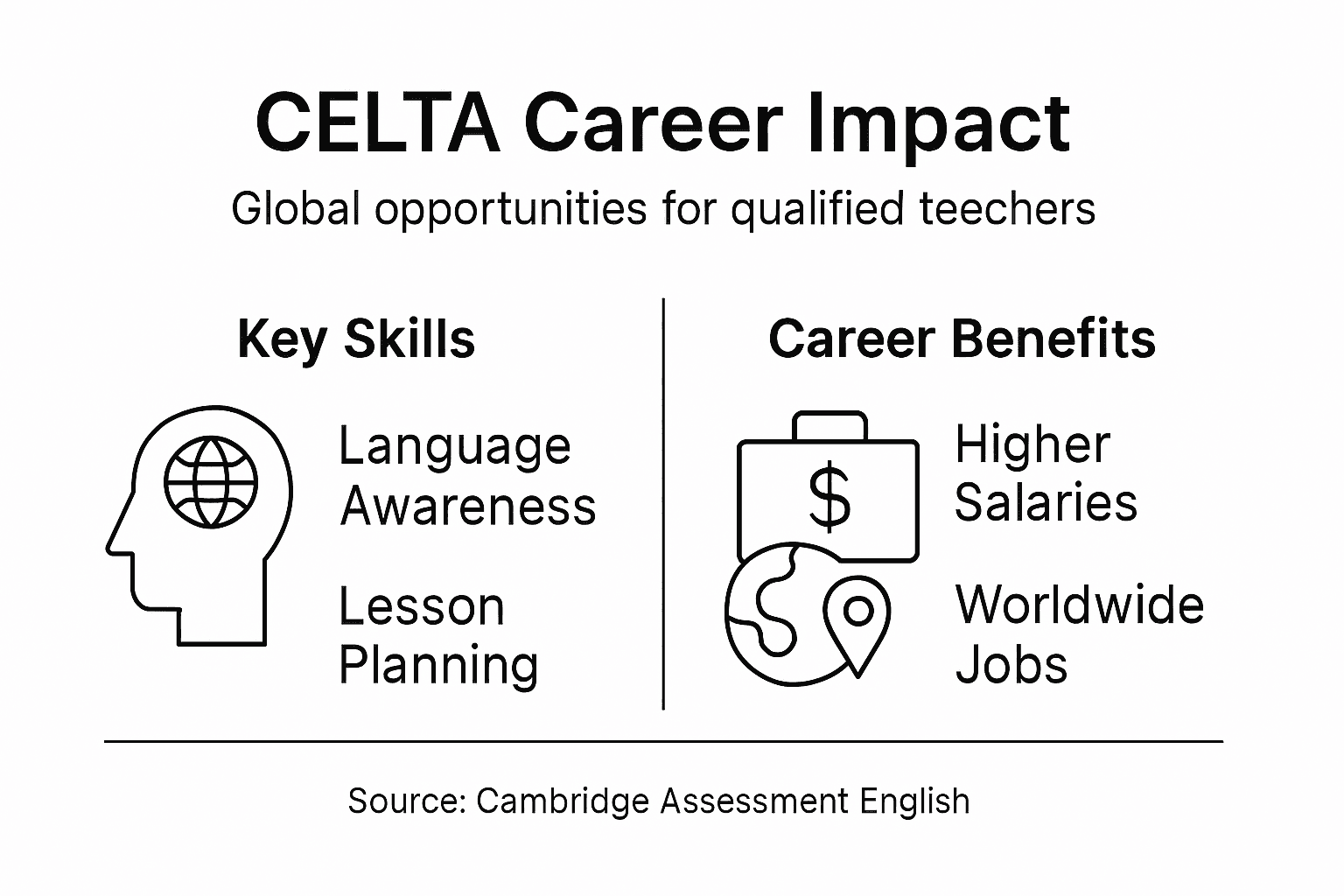
The CELTA certification represents a strategic investment in professional development for aspiring English language teachers, offering substantial returns through enhanced global employability and career opportunities. While the initial financial investment can vary, the long-term career potential makes it a compelling credential for educators seeking international teaching positions.
Key financial and professional aspects of the CELTA include:
- Average Course Cost: $1,500 – $3,000 USD depending on location and provider
- Global Recognition: Accepted in over 120 countries worldwide
- Career Opportunities: Opens doors to teaching positions in international schools, language centers, and online platforms
- Salary Potential: Can increase earning potential by 20-40% compared to uncertified positions
- Professional Credibility: Demonstrates advanced pedagogical training to potential employers
- Validity: Lifetime certification with no expiration date
Employers across the globe recognize the CELTA as a gold-standard qualification for English language instruction. The certification provides a competitive edge in both traditional classroom settings and emerging online teaching markets, making it an invaluable credential for educators seeking international career mobility.
The CELTA is more than a certification – it’s a passport to global teaching opportunities.
Beyond immediate employment prospects, the CELTA equips teachers with transferable skills applicable across diverse educational contexts. The comprehensive training prepares educators to adapt to different teaching environments, cultural settings, and learner needs, making it an investment that continues to pay dividends throughout one’s professional journey.
Pro tip: Research international job markets and salary ranges before investing in your CELTA to strategically align your certification with your career goals.
CELTA vs. TEFL: Key Differences and Pitfalls
Navigating the landscape of English language teaching certifications can be challenging, especially when comparing the CELTA and TEFL qualifications. While both certifications aim to prepare educators for international teaching roles, they differ significantly in structure, recognition, and depth of training. Comparing certification options reveals nuanced distinctions that can impact a teacher’s career trajectory.
Key differences between CELTA and standard TEFL certifications include:
- Accreditation: CELTA is Cambridge-validated, while TEFL varies widely in quality
- Practical Teaching Hours: CELTA requires mandatory observed teaching practice
- Global Recognition: CELTA is more universally accepted by international employers
- Course Depth: CELTA offers more comprehensive, standardized training
- Interview Process: CELTA involves a rigorous pre-course screening
- Specialization: CELTA focuses specifically on adult language learners
Standard TEFL courses often provide a more generalized approach to language teaching, with significant variation in curriculum and rigor. In contrast, the CELTA represents a more structured, professionally recognized pathway with stringent quality control and consistent training standards.
Not all teaching certifications are created equal – the CELTA stands out as a gold standard in English language education.
Potential pitfalls for candidates include underestimating the intensity of the CELTA program, assuming all TEFL certifications are equivalent, or failing to research specific employer requirements in their target job markets. Understanding these nuanced differences can help educators make more informed decisions about their professional development.
This table contrasts CELTA and TEFL certifications to highlight strategic choices for teachers:
| Aspect | CELTA Advantage | TEFL Limitation |
|---|---|---|
| Employer Preference | Preferred for top roles | May lack universal recognition |
| Quality Assurance | Stringent Cambridge standards | Varies greatly between providers |
| Career Progression | Easier for senior positions | Often entry-level only |
Pro tip: Carefully research employer requirements in your desired teaching markets to determine whether a CELTA or standard TEFL certification best meets your career goals.
Unlock Your Global Teaching Career with Expert TEFL Training
The journey through the CELTA exam highlights the challenges of balancing rigorous teaching practice with comprehensive theoretical knowledge. Many aspiring educators face the pressure of developing strong pedagogical skills, passing detailed assessments, and choosing the right course format to fit their busy lives. If you are looking to expand your ESL teaching options beyond CELTA or complement your certification with specialized skills like IELTS preparation or advanced diplomas, personalized and flexible training solutions are essential to meet your goals.
Explore TEFL Institute’s courses designed to empower both new and experienced teachers with practical tools and recognized certifications. Benefit from a wide range of online and hybrid programs that mirror the high standards of the CELTA while allowing you to learn at your own pace. Take the next step now to unlock global ESL opportunities tailored to your unique career path by visiting TEFL Institute and discovering courses that fit your ambitions and lifestyle.
Frequently Asked Questions
What is the CELTA exam and who is it for?
The CELTA (Certificate in English Language Teaching to Adults) is a professional teaching qualification designed for individuals interested in teaching English as a second or foreign language. It caters to those with little to no teaching experience, providing comprehensive training in both theory and practical application.
What types of course formats are available for CELTA certification?
CELTA offers various course formats, including full-time intensive courses, part-time courses, online options, blended learning formats, and traditional face-to-face training. This flexibility accommodates different learning needs and schedules.
How is the CELTA exam assessed, and what components does it include?
The assessment for the CELTA exam includes six hours of assessed teaching practice, four written assignments, lesson planning, language skills evaluation, and demonstration of pedagogical understanding. The grading system focuses on candidates’ teaching potential and adaptability.
What are the entry requirements to enroll in a CELTA program?
To enroll in a CELTA program, candidates must be at least 18 years old, possess advanced English language skills, have a high school diploma or equivalent, undergo a formal interview, and complete a pre-course task demonstrating language awareness.