

 United Kingdom (UK)
 United States (US)
 Canada
 South Africa
 India
India Australia
 New Zealand
 China
China Russia
 Germany
 France
 Spain
Spain Netherlands
 Vietnam
 United Arab Emirates
 Italy
Italy Poland
 Thailand
 Türkiye









 Algeria


TEFL Classroom Management Tips for Confident Teaching
TEFL Classroom Management Tips for Confident Teaching

TL;DR:
- Effective TEFL classroom management requires deliberate strategies, routines, and strong student relationships.
- Blending clear rules with relationship-building fosters motivation and reduces disruptive behaviors.
- Proactive preparation, engaging activities, and calm, consistent responses prevent and address issues effectively.
Picture this: you walk into your TEFL classroom, lesson plan ready, and within minutes students are talking over each other, ignoring instructions, and checking their phones. It’s a situation many TEFL teachers face, regardless of experience level. Effective classroom management is consistently ranked as one of the most pressing challenges in English language teaching. The good news is that calm, productive classrooms are not a matter of luck. They are built through deliberate strategies, consistent routines, and strong student relationships. This guide delivers research-backed, practical strategies you can apply immediately to create a focused, engaging learning environment.
Table of Contents
- Understanding classroom management in TEFL
- Setting classroom expectations: Rules versus relationships
- Proactive preparation: Preventing problems before they start
- Handling disruptions with calm, consistency, and care
- Keeping engagement high: Activities and routines that work
- What experienced TEFL teachers wish they knew sooner
- Advance your TEFL teaching with expert support
- Frequently asked questions
Key Takeaways
| Point | Details |
|---|---|
| Balance rules and relationships | A mix of clear expectations and strong teacher-student rapport leads to lasting classroom management success. |
| Prepare proactively | Well-planned lessons, routines, and welcoming environments prevent most discipline issues. |
| Handle disruptions fairly | Stay calm and consistent, and always address behavioral issues with fairness and privacy. |
| Engagement reduces problems | Vary classroom activities and give students ownership to keep energy high and behaviors positive. |
Understanding classroom management in TEFL
Classroom management refers to the actions and decisions a teacher makes to create an orderly, productive environment where learning can take place. In the TEFL context, as explained in this classroom management explained resource, it involves an additional layer of complexity: students are learning in a language that is not their mother tongue, which affects how they respond to instructions, interact with peers, and process feedback.
TEFL classrooms often differ significantly from traditional K-12 settings. Students may come from diverse cultural backgrounds, each with different expectations about classroom behavior, authority, and participation. Some cultures treat the teacher as an unquestioned authority figure, while others encourage debate and open questioning. These cultural dynamics directly affect how management strategies land with your students.
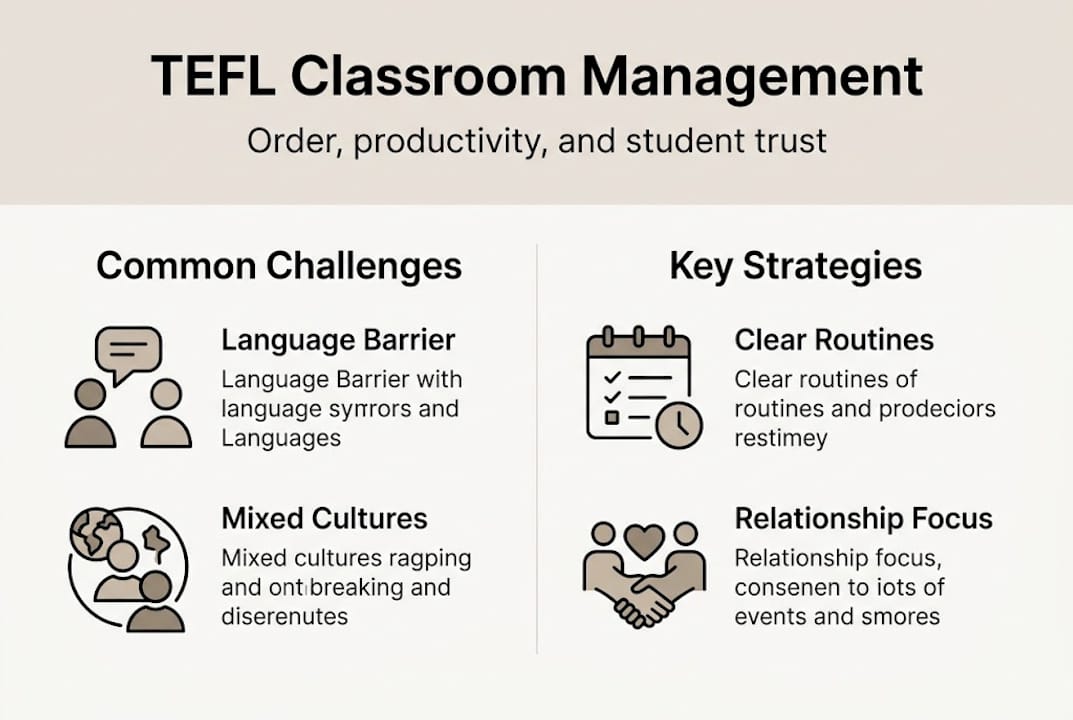
Language barriers add another dimension. A student who seems defiant may simply not understand the instruction. A quiet student might be struggling to formulate a response, not disengaged. TEFL teachers must develop the ability to read these situations accurately before responding. The TEFL classroom management guide outlines many of these context-specific considerations in detail.
Research confirms that experienced teachers tend to be more interventionist and controlling in both behavior and instructional management. This can be effective, but it also highlights a real gap: newer teachers often lack the toolkit to assert this kind of structured authority confidently without becoming overly rigid.
Common challenges faced at different experience levels:
- New TEFL teachers: Unclear boundaries, inconsistent rule enforcement, difficulty reading cultural cues
- Mid-level teachers: Complacency, outdated routines, difficulty managing mixed-proficiency classes
- Experienced teachers: Over-reliance on control-based methods, reduced flexibility, potential to suppress student motivation
| Experience level | Primary challenge | Recommended focus |
|---|---|---|
| New teacher | Establishing authority | Clear routines and boundaries |
| Mid-level teacher | Sustaining engagement | Variety and student choice |
| Experienced teacher | Balancing control and trust | Relationship-based strategies |
Understanding where you currently sit in this spectrum helps you choose the right strategies and build on your existing strengths rather than starting from scratch.
Setting classroom expectations: Rules versus relationships
Once you understand TEFL classroom management fundamentals, the next step is forming a solid foundation for behavior and engagement. Traditionally, classroom management relied heavily on a rules-based approach: post the rules clearly, explain the consequences, enforce them consistently. This model has clear benefits. Students know exactly what is expected, and boundaries are explicit. For TEFL classrooms where students are already navigating language uncertainty, predictable rules can reduce anxiety and provide reassurance.
However, research supports a significant shift in thinking. Moving from rules-based to relationship-based management produces stronger student engagement and motivation. When students feel respected and valued by their teacher, they are far more likely to comply with expectations, participate actively, and persist through language challenges. Rules without relationships are often perceived as arbitrary, especially across cultural contexts.
The most effective TEFL teachers blend both approaches. They set clear, non-negotiable boundaries while investing daily in knowing their students as individuals. This is not about being a friend to your students. It is about being a trusted, consistent presence in the room.
Practical numbered steps for building a strong classroom foundation:
- Co-create classroom norms with students on day one to build ownership and buy-in
- Learn and use students’ preferred names correctly and consistently
- Open each class with a brief personal check-in or warm-up question
- Acknowledge effort publicly and correct privately to preserve dignity
- Follow through on every expectation you set, every single time
The essential classroom management strategies you use daily should reflect a mix of structure and warmth. Neither alone is sufficient for a motivated TEFL classroom.
| Approach | Strengths | Limitations |
|---|---|---|
| Rules-based | Clear expectations, easy to enforce | Can feel punitive, may reduce motivation |
| Relationship-based | Increases trust, improves engagement | Requires time investment, harder to scale |
| Blended approach | Balances clarity with connection | Requires consistent effort and self-awareness |
Pro Tip: During the first week, spend at least five minutes per class simply talking with students about non-language topics. Ask about their weekend, their favorite food, or their hometown. This investment pays dividends in student compliance and engagement throughout the term. You can find additional techniques in these TEFL teaching success tips.
Proactive preparation: Preventing problems before they start
With expectations set, let’s prevent disruptions by preparing the physical and emotional environment for success. The most powerful classroom management happens before students arrive. A well-designed, proactive approach dramatically reduces the frequency and severity of behavioral issues.
Edutopia’s framework for proactive classroom management outlines six key steps: prevent problems through preparation, persist through challenges, design engaging lessons, greet students at the door, practice self-care, and build strong routines. These are not abstract ideas. Each one has a direct, practical application in the TEFL context.
“Proactive classroom management begins with lesson design. When students are genuinely engaged with content that is pitched at the right level, many behavioral problems simply do not occur.”
Step-by-step proactive preparation framework for TEFL teachers:
- Arrange the room intentionally. Desk layout affects interaction and focus. Horseshoe or group arrangements encourage speaking practice; rows encourage focused individual work. Match the layout to the lesson goal.
- Design lessons with variety baked in. Alternate between teacher-led instruction, pair work, group tasks, and individual reflection. A 60-minute class should have at least three distinct activity types.
- Prepare compelling lesson openers. Start with a short video clip, an unusual image, a poll question, or a brief game. The first five minutes set the tone for the entire lesson.
- Greet students at the door. This simple act signals to each student that you see them, you are prepared, and the class begins with connection, not chaos.
- Anticipate language-related frustrations. Pre-teach key vocabulary and provide clear visual instructions for complex tasks. Confusion fuels disengagement, so reduce it wherever possible.
- Prioritize your own well-being. A teacher who arrives overwhelmed and underprepared communicates stress to students. Plan lessons in advance, sleep adequately, and build a sustainable schedule.
These confident teaching steps form a repeatable system rather than a collection of one-off fixes. The more consistently you apply them, the more automatic good classroom culture becomes.
Pro Tip: Create a “sponge activity,” a short, self-directed task students begin the moment they sit down. This fills transition time, signals that class has started, and eliminates the dead time that often triggers off-task behavior. Review examples of engaging class activities to build a library of these openers.
The step-by-step classroom management approach ensures you are building routines systematically rather than reacting to problems as they arise.
Handling disruptions with calm, consistency, and care
Even with the best preparation, issues can arise. Here is how to handle them confidently. Disruptions in TEFL classrooms range from students speaking in their native language to persistent side conversations, phone use, or refusal to participate. The way you respond in these moments shapes both the individual situation and the classroom culture as a whole.
The most important principle: stay calm, consistent, and fair when handling disruptions, and address issues privately wherever possible. A calm teacher communicates control. A flustered or emotional response often escalates the situation and undermines your authority in front of the group.

Consistency matters because students notice when rules apply selectively. If you correct one student for speaking their native language but ignore the same behavior from another, trust erodes quickly. Fairness is non-negotiable in a multicultural TEFL classroom where students are already acutely sensitive to differential treatment.
Practical strategies for handling common disruptions:
- The quiet signal: Establish a non-verbal cue, a raised hand, a clap pattern, or a countdown timer, that signals students should stop and listen. Practice it until it becomes automatic.
- Proximity over punishment: Move toward a disruptive student without interrupting the lesson. Physical proximity often resolves minor issues without any words.
- Private correction: If a student needs a stronger correction, wait for an appropriate moment, then speak quietly and directly to them. Avoid public confrontations that create power struggles.
- Redirect, don’t reprimand: Instead of saying “Stop talking,” say “Let’s focus on the question on the board.” This moves attention forward rather than dwelling on the problem.
- Use scripted language: Prepare neutral, calm phrases in advance. “I need you to focus now, please” is more effective than an improvised response when you are stressed.
When managing behavior management ideas for diverse learner groups, remember that age also matters. Strategies for adults differ from those for teaching young learners, who may need more structured routines and more frequent positive reinforcement.
Pro Tip: Keep a brief written record of recurring behavioral patterns. After two or three weeks, you will often spot triggers, specific activity types, times of day, or seating arrangements, that consistently precede disruptions. Adjusting these variables removes the problem at its root.
Keeping engagement high: Activities and routines that work
To minimize disruptions, let’s maximize engagement with routines and activities that energize your classroom. Research is clear that when students are genuinely invested in what they are doing, behavioral issues decrease sharply. Relationship-based management improves engagement and reduces the frequency of classroom problems, because students who feel connected to the teacher and the material are far less likely to disengage.
Variety is essential in a TEFL classroom. Repetitive lesson structures cause even motivated students to drift. Alternating activity types, interaction modes, and skill focuses keeps the brain active and the energy in the room positive.
High-engagement activities and routines for TEFL classrooms:
- Speed networking: Students rotate through brief one-minute conversations with classmates, practicing a target structure. This builds community and language fluency simultaneously.
- Think-pair-share: Students reflect individually, discuss with a partner, then share with the class. This structure gives quieter learners time to prepare before speaking publicly.
- Vocabulary storms: Display a central concept word and give students 60 seconds to write every related word they know. Pairs then compare, and the class builds a shared word map.
- Student choice tasks: Offer two or three ways to complete the same objective. Students might write a dialog, record a short voice memo, or draw a comic strip. Choice increases ownership and effort.
- Movement breaks: Short physical transitions, such as standing to find a partner, moving to a different group, or using gestures to respond, reduce fatigue and re-energize focus.
- Exit tickets: End each class with a one-sentence written response to a prompt. This reinforces language use and gives you valuable data on comprehension and engagement levels.
Use language skill activities that integrate community-building with language practice. When students feel comfortable with each other, they take more linguistic risks, and that is when real language acquisition happens. For additional ideas organized by learning context, explore these boost engagement ideas to expand your activity library.
Clear routines reduce cognitive load for both teacher and students. When transitions are practiced and predictable, time-on-task increases noticeably across the course of a term.
What experienced TEFL teachers wish they knew sooner
Here is an uncomfortable truth about classroom management advice: most of it is written as if one approach fits every teacher in every context. It does not. Research confirms that while strict interventionist methods work for experienced teachers, applying the same level of control prematurely can actually reduce student motivation rather than improve it. A new teacher who tries to project authoritative control before building genuine rapport often comes across as rigid or disconnected, which backfires.
The real skill in classroom management is not mastering a fixed set of rules. It is developing the self-awareness to assess what your specific students, in your specific context, actually need from you on any given day. That takes honest reflection, not just more techniques. Many experienced teachers admit they spent years applying strategies they admired in colleagues without first asking whether those strategies suited their own teaching personality and their students’ learning culture.
The experienced teachers’ strategies worth adopting are the ones you can sustain authentically. Flexibility, self-reflection, and the willingness to adjust your approach mid-course are what actually accelerate long-term classroom success.
Advance your TEFL teaching with expert support
If you’re ready to put these strategies into action and take your classroom management skills further, dedicated support is just a click away.

The TEFL Institute offers structured courses and specialized training programs that build classroom confidence at every stage of your teaching career. Whether you are just starting out or looking to strengthen specific skills, options including TEFL courses in Newcastle provide hands-on learning in a supervised environment. If you are already certified and want to go deeper, course extensions allow you to specialize further. For those ready to gain real classroom experience in an international setting, TEFL internships offer structured placements with professional mentoring built in.
Frequently asked questions
What is classroom management in a TEFL context?
Classroom management in TEFL means organizing the classroom, activities, and student interactions to maintain a positive, productive learning environment for language learners, factoring in cultural diversity and language barriers.
How do you handle disruptive behavior in a TEFL class?
Stay calm, act consistently, address issues privately, and use redirection and proximity before escalating to formal consequences to keep the classroom respectful and orderly.
Why is relationship-based management effective for TEFL?
Building strong relationships increases student engagement and trust, which reduces behavioral problems significantly more than rule enforcement alone, particularly in culturally diverse TEFL settings.
What proactive steps prevent problems in TEFL classes?
Preparing engaging lessons, greeting students at the door, using sponge activities, and establishing clear routines help prevent most common classroom disruptions before they begin.
Recommended
TEFL Institute guides

Taiwan
Buxibans, pay and visas
Italy
Jobs, pay and visa routes
Dubai
Pay, requirements and visas
Japan
JET, ALT and eikaiwa pay
China
Z visa, pay and cities
